
A fire that starts while you are asleep gives you minutes, not hours. Smoke and carbon monoxide alarms are the only thing standing between a smouldering cushion and a fatal night, and the bedroom is where that margin is thinnest. Sleepers are slower to react, deeper under the blanket, and further from the nearest exit than anyone in the house.
That makes choosing the best smoke and carbon monoxide detectors for bedrooms a different job than picking alarms for a hallway. A bedroom unit has to do three things well: stay quiet when there is nothing wrong, sound loudly enough to wake a heavy sleeper, and tell you whether you are dealing with fire or carbon monoxide. Most cheap units handle the first job and then fail on one of the other two.
Our top pick is the X-Sense SC07. It pairs a photoelectric smoke sensor with an electrochemical CO sensor, runs on a sealed ten-year lithium battery, carries UL 217 and UL 2034 certification, and shows the live CO reading on an LCD. For anyone who wants a hardwired system with spoken location alerts, the First Alert BRK SC7010BV is the stronger long-term answer.
If your interest is wider than bedrooms, our smart smoke detector guide covers app-connected units and voice assistants in more depth.
We spent six weeks reading spec sheets, install manuals and thousands of owner reviews, then sorted every unit against the same four bedroom-specific criteria: nuisance-alarm behaviour, power reliability, fire-versus-CO identification, and whether it links to the rest of the house. Ten detectors made the list. Here is how they landed.
Table of Contents
Top 3 Smoke and Carbon Monoxide Detectors for Bedrooms for October 2026

X-Sense SC07 Combo Alarm
- Photoelectric and electrochemical sensors
- 10-year sealed lithium battery
- LCD shows live CO level
- UL 217 and UL 2034 certified

X-Sense SC01 Combo Alarm
- Large real-time CO LCD readout
- 10-year sealed lithium battery
- ETL Listed to UL 217 and UL 2034
- Mounts on wall or ceiling

First Alert BRK SC7010BV
- Spoken fire or carbon monoxide alerts
- Names one of up to 11 locations
- Hardwired with end-of-life chirp
- Photoelectric plus CO sensing
The three cards above are the units we would actually fit in a sleeping room today. Everything further down is a valid choice for a specific household situation, but these three cover the widest range of bedrooms, tenants and budgets.
Quick Overview: Every Detector We Compared in October 2026
| Product | Specs | Action |
|---|---|---|
| X-Sense SC07 Combo Alarm |
|
Check Latest Price |
| X-Sense SC01 Combo Alarm |
|
Check Latest Price |
| First Alert BRK SC7010BV |
|
Check Latest Price |
 First Alert SMICO100-AC First Alert SMICO100-AC |
|
Check Latest Price |
 Kidde 30CUDR Kidde 30CUDR |
|
Check Latest Price |
 Kidde 30CUA10-V Kidde 30CUA10-V |
|
Check Latest Price |
 BRK SC9120B BRK SC9120B |
|
Check Latest Price |
 X-Sense XP0H-SN X-Sense XP0H-SN |
|
Check Latest Price |
 Heiman HM-636THS Heiman HM-636THS |
|
Check Latest Price |
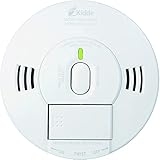 Kidde KN-COPE-IC Kidde KN-COPE-IC |
|
Check Latest Price |
1. X-Sense SC07 Combo Smoke and CO Detector, 1-Pack
X-Sense Smoke Detector Carbon Monoxide Detector Combo, SC07, 1-Pack
Photoelectric and electrochemical sensors
10-year sealed lithium battery
85 dB alarm
LCD CO readout
UL 217 and UL 2034
Pros
- Ten-year sealed lithium battery ends battery swaps and low-battery chirps
- Photoelectric sensor responds faster to slow smouldering fires
- LCD displays live CO level and battery status
- Includes mounting bracket screws and anchor plugs
- UL 217 and UL 2034 certified
Cons
- Standalone design with no wireless interconnection
- No Wi-Fi app or voice assistant support
- Wall and ceiling mounting only
- no hardwired option
The SC07 is the alarm I keep coming back to for bedrooms because it removes the three failure modes that make owners disable their alarms. There is no battery to forget, no wiring to run, and no night-time chirp to train you to ignore the sound of a warning.
Owner reviews describe the same pattern repeatedly: install it on a bracket with three screws, twist it on, and leave it alone for a decade. The 85 dB alarm is genuinely loud, and because the smoke sensor is photoelectric rather than ionization, it leans toward slow-smouldering fires and stays quiet around cooking vapour that trips cheaper units.
Two details matter more in a bedroom than anywhere else. The LCD keeps the screen dark in normal conditions and shows a live carbon monoxide reading, so a small rise from a leaking flue is visible long before it becomes an emergency. And the sealed lithium battery means the unit never goes quiet because a battery was never fitted during a renovation.
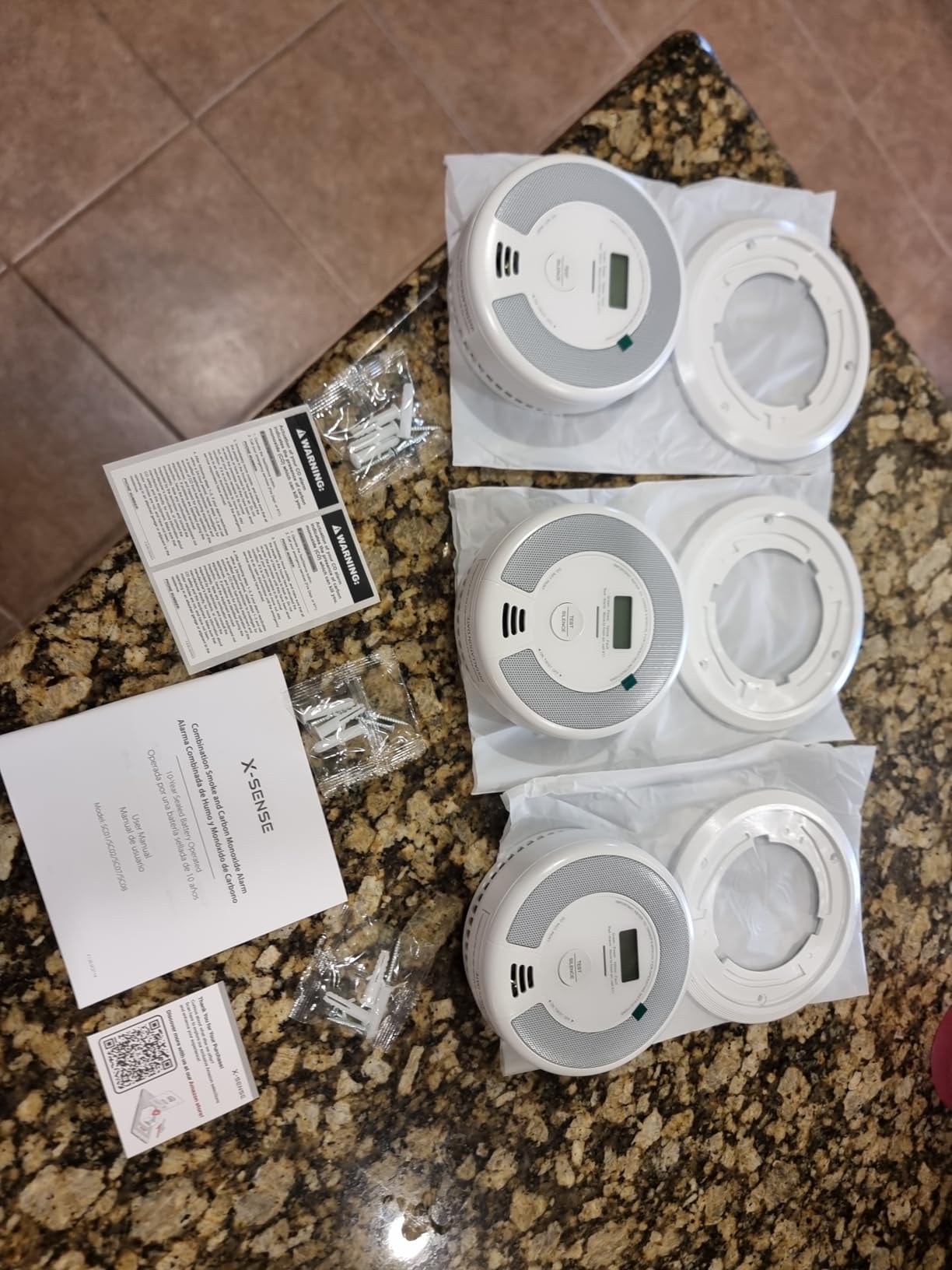
What you give up is network capability. The SC07 is a standalone alarm: it will not link to other detectors, a base station, or a smart home hub. Owners looking at wireless interconnection should look at the SC07-W version instead, which is a different listing entirely.
Its dimensions are 5.7 inches across the bracket and 2 inches deep, which is bulkier than the slim hardwired units but far easier to mount on an existing screw pattern. The weight is 16 ounces, and the box includes the alarm, a manual, and three screws with anchor plugs.
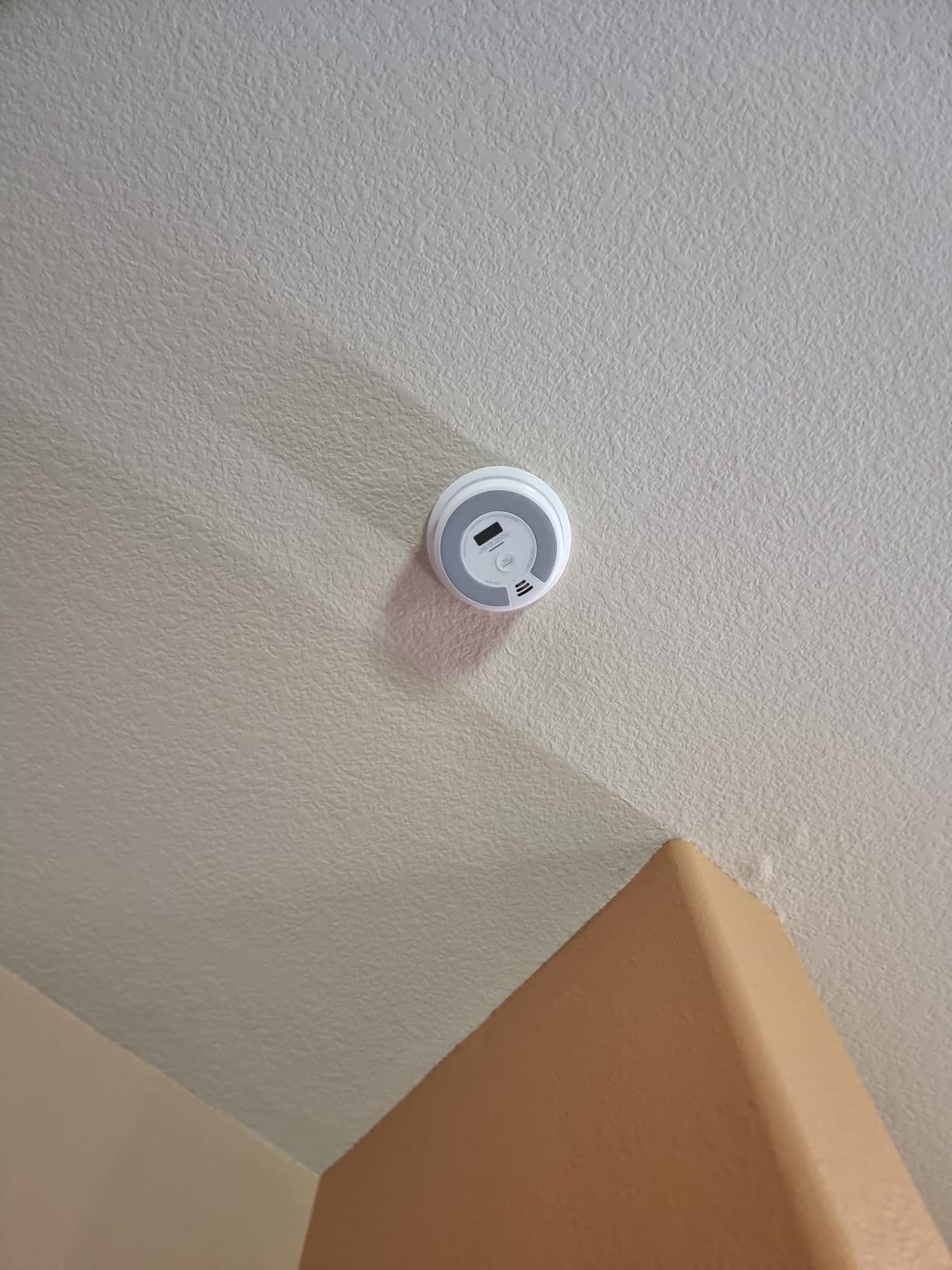
Why it works in a bedroom
Photoelectric sensing is the right bias for a sleeping room. It reacts to the larger particles a smouldering fire produces, which is the failure mode that actually kills people at night, and it is markedly less twitchy around dust, steam and aerosol sprays than an ionization chamber.
The sealed battery plus the certification markings make it a defensible choice for renters and landlords too. X-Sense backs the unit with a 60-day money-back guarantee, a 5-year quality warranty, and lifetime technical support.
Where it falls short
If you live in a multi-bedroom house and want the whole floor to sound together, this is the wrong box. Wireless interconnection and app alerts are the two features people most often wish they had added at install time, because retrofitting later means redoing every bedroom bracket.
It also has no spoken alerts. A sleeper who does not wake to an 85 dB siren has no second chance from a voice announcement naming the danger and the room.
2. X-Sense SC01 Combo with Large CO Display
X-Sense Smoke Detector and Carbon Monoxide Detector, SC01, 1-Pack
Photoelectric and electrochemical sensors
Large LCD for CO level
10-year sealed lithium battery
ETL Listed to UL 217 and UL 2034
Pros
- Large LCD shows real-time CO level battery and working status
- Highest-rated unit in our group with a 4.6 average
- ETL Listed to UL 217 and UL 2034
- Ten-year sealed lithium battery
- Mounts on any wall or ceiling with included hardware
Cons
- Standalone with no interconnection
- No app or Wi-Fi connectivity
- Same 5.7 inch footprint as the larger X-Sense units
The SC01 is the same sealed-battery architecture as our top pick with a bigger, easier-to-read screen. If you want a CO reading you can check without getting out of bed, this is the one to shortlist.
At 4.6 average across more than 2,000 reviews, it holds the highest owner rating of the ten units we compared. Reviewers consistently single out three things: the display legibility, the fact that they have never touched a battery, and how painless the wall or ceiling mount was.
The operating humidity range is listed at 90 percent, which gives it a little more headroom in humid climates than units rated closer to 85 percent. The sensor pairing is photoelectric for smoke and electrochemical for CO, matching the SC07 exactly.
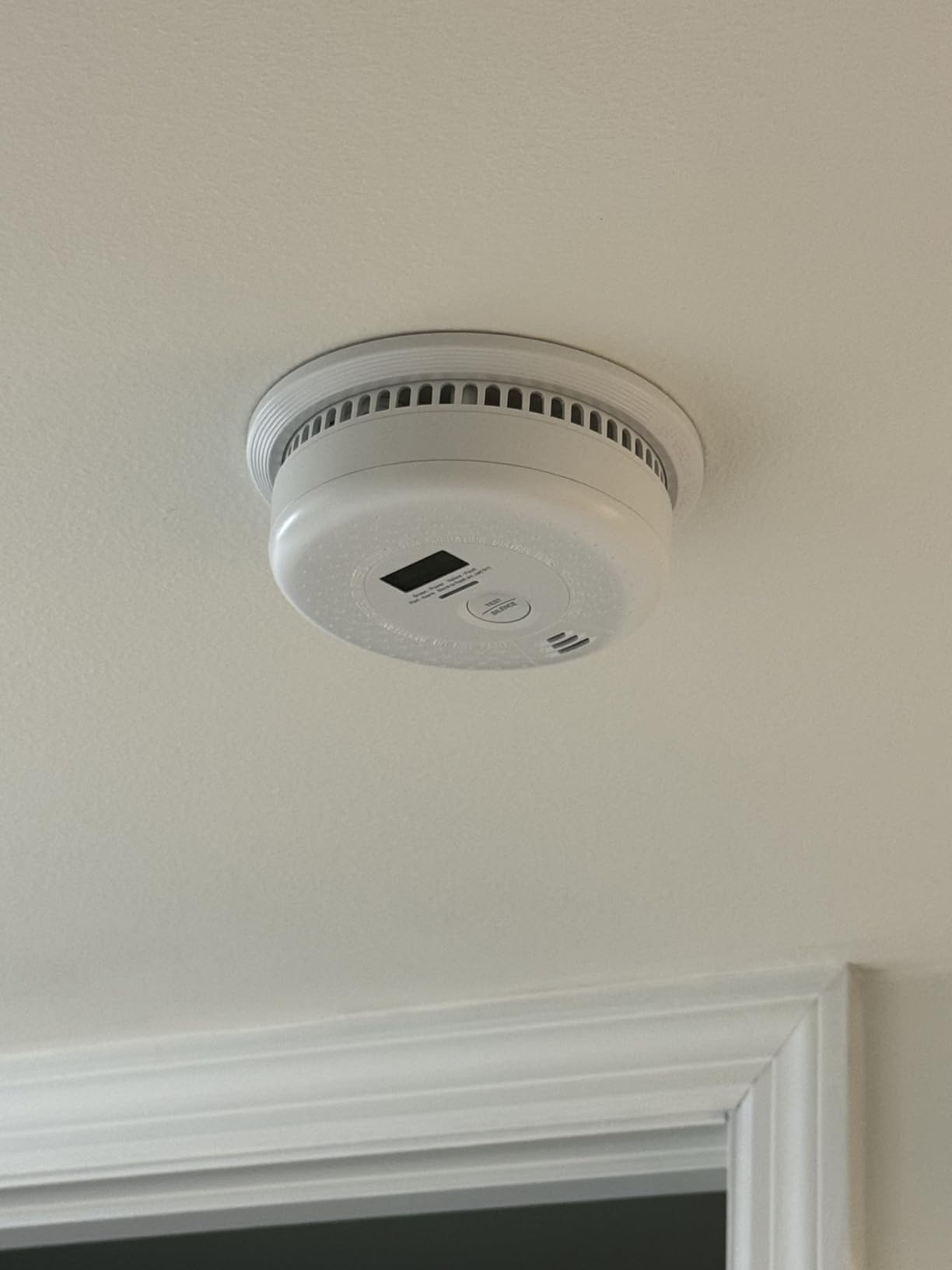
Like the SC07, the trade-off is that it stands alone. Neither alarm can be grouped with a second detector, so in a three-bedroom house you are running three independent devices rather than one network. That is acceptable if every bedroom is covered, and less acceptable if you want an alarm in the hallway to trip the bedroom units as well.
Both X-Sense models in this list carry third-party listing marks. The SC01 is described as ETL Listed to UL 217 and UL 2034, which matters because an unlisted alarm fails code inspection in most jurisdictions regardless of how well it performs in a lab.
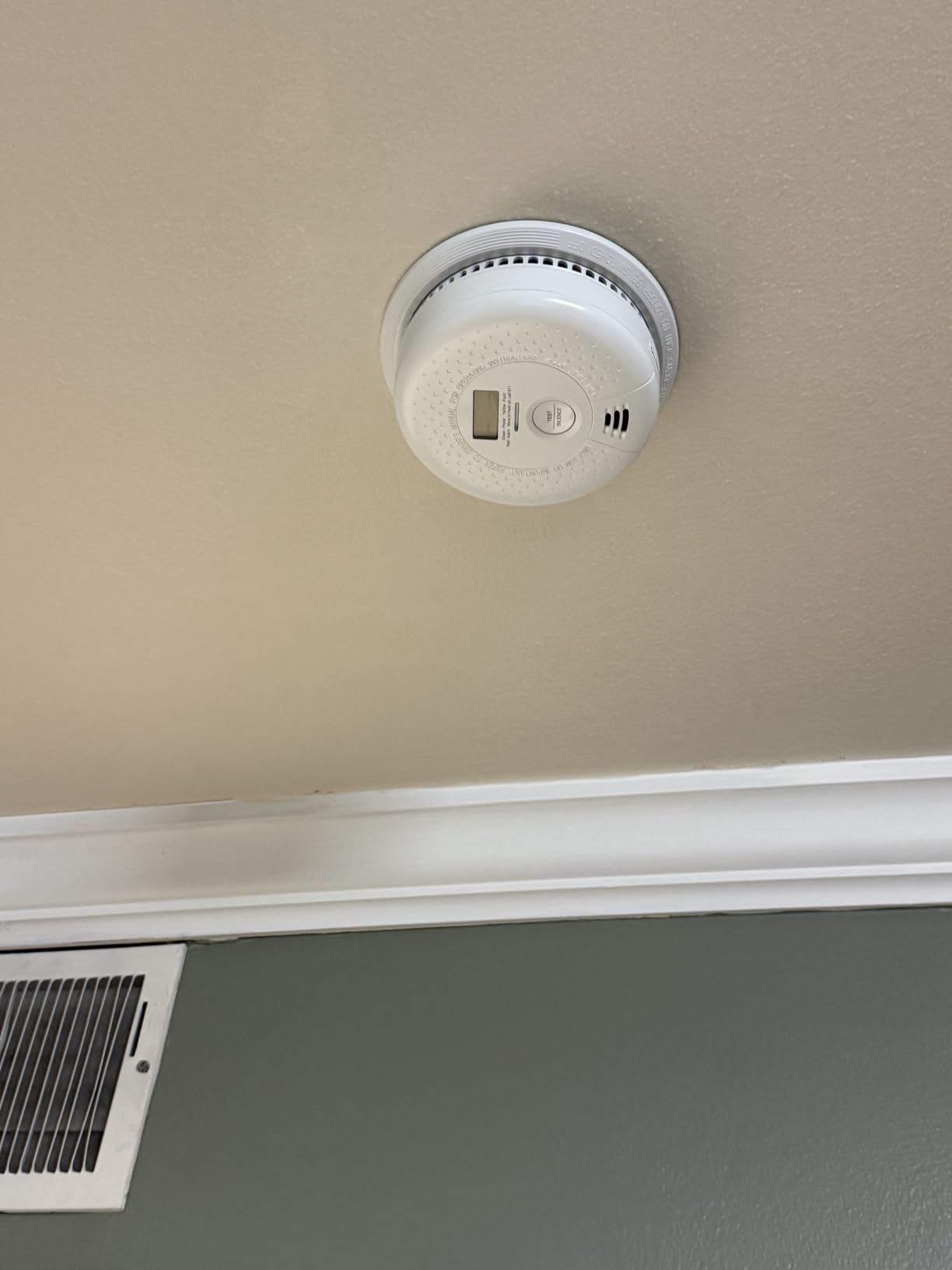
Where the display earns its place
Carbon monoxide is colourless, odourless and tasteless, so a bedroom has no natural warning sign. A live numeric readout changes the response: a small non-zero reading at bedtime lets you check the flue or the attached garage door before you go to sleep rather than after a headache starts.
Reviewers also note that showing battery level on the same screen removes the guesswork around a ten-year sealed pack, since you can see the state of the cell rather than guessing from a chirp you might sleep through.
Where it falls short
Owners who moved from a networked alarm sometimes miss the phone notification that tells them the alarm went off in an empty house. There is no way to add that capability to this unit later.
It is also a single pack, which is awkward for a landlord outfitting several identical bedrooms at once. Plan on buying one per room rather than a multi-unit job.
3. First Alert BRK SC7010BV Hardwired Talking Smoke and CO Detector
FIRST ALERT Battery Powered BRK SC7010BV Hardwired Talking Photoelectric Smoke and Carbon Monoxide (CO) Detector , White
Hardwired 120V with talking alerts
Photoelectric and electrochemical sensors
Announces one of up to 11 locations
10-year limited warranty
Pros
- Voice alerts name both the danger and the room
- Photoelectric sensor tuned to larger smouldering particles
- Interconnects with compatible BRK and First Alert alarms
- End-of-life chirp signals when replacement is due
- 10-year limited warranty
Cons
- Highest cost in this group
- Requires hardwiring and a compatible interconnected system
- Not a battery option for renters
The SC7010BV is the most complete answer for a house that can be wired. It is the only unit in this group that tells a sleeping household both what the danger is and which room it started in, which is exactly the information people are too groggy to work out on their own at 3 a.m.
The talking alarm announces the type of danger and the location, drawn from up to 11 preprogrammed positions across the house. When one alarm detects smoke or CO, every compatible BRK or First Alert detector sounds and speaks, so a fire in the kitchen is announced in the master bedroom by name.
Sensing is a photoelectric smoke sensor paired with electrochemical CO detection, with the smoke chamber optimised for the larger particles a smouldering fire produces. The result is fewer nuisance events in a room where an unwanted alarm is expensive.
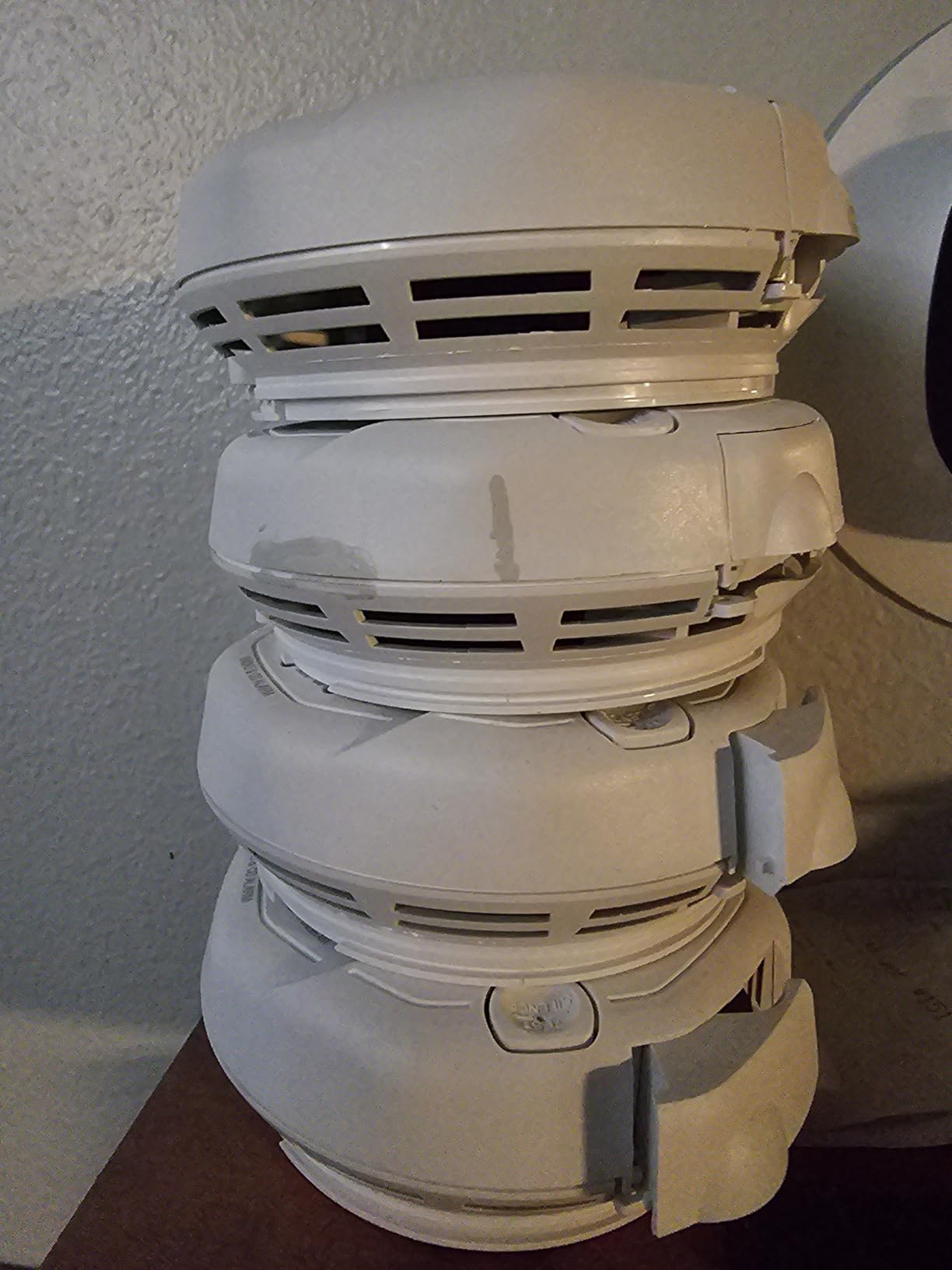
Hardwired units are the more dependable choice over a decade. They do not depend on a battery that can be removed, corroded or drained during a power cut, and the 10-year limited warranty outlasts most of the alternatives here. Owners describe the alarm itself as clear and loud, and several mention that the location announcement replaced a lot of panicked searching.
The catch is the installation. It needs a 120V circuit and compatible interconnected alarms elsewhere for the voice feature to do anything useful. A single SC7010BV in one bedroom of an otherwise unwired apartment gives you a loud siren and a voice, but no homewide announcement.
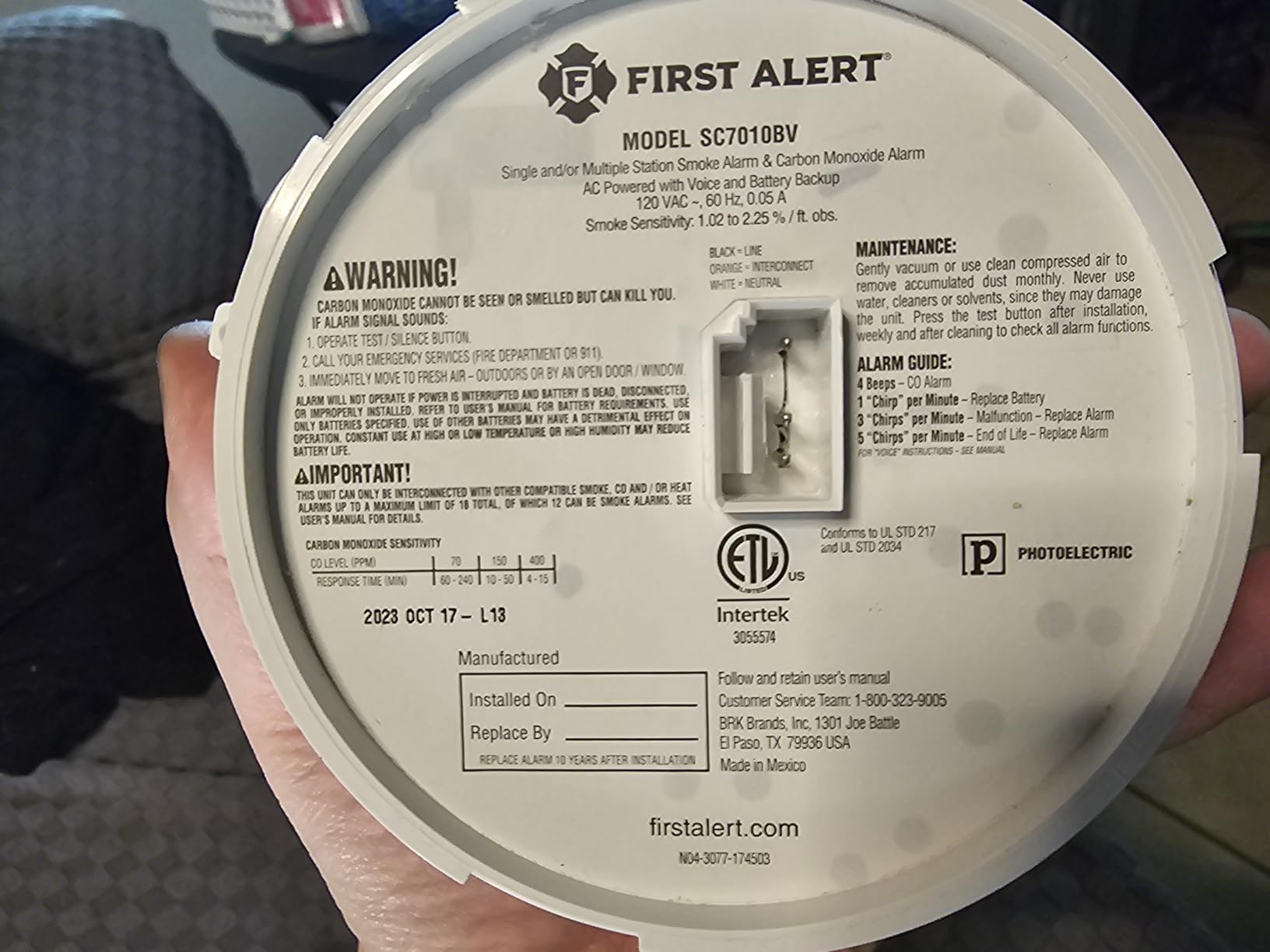
Why voice alerts matter after midnight
A siren tells you there is a problem. It does not tell you whether to open a window and leave or whether to get everyone out and call emergency services, and that distinction matters most when a CO alarm is what woke you.
The end-of-life signal chirp is the other feature owners appreciate. Rather than a unit quietly failing somewhere in the house after a decade, this one announces that it needs replacing.
Where it falls short
Cost is the first barrier. It sits well above every battery unit in this roundup, and the price applies per room rather than once for the house.
If your ceilings are plaster or lath and you cannot run cable without opening up the structure, a hardwired talking alarm is the wrong specification, however good it is. Our wireless and sealed-battery picks cover that situation better.
4. First Alert SMICO100-AC Hardwired Combination Smoke and CO Alarm
First Alert Hardwire Combination Smoke & Carbon Monoxide Alarm
Hardwired 120V with 9V battery backup
Precision Detection sensing
Quick Connect Plug for no-rewire installs
Interconnectable with compatible alarms
Pros
- Precision Detection cuts cooking-related nuisance alarms
- Quick Connect Plug installs without touching existing wiring
- Pre-installed 9V Duracell backup battery included
- Dust cover protects the unit during installation
- Interconnect confirmed working across compatible alarms
Cons
- Will not fit the older SC9120B mounting bracket so the bracket must be swapped
- Slightly larger than the units it replaces
- No Wi-Fi voice alerts or app integration
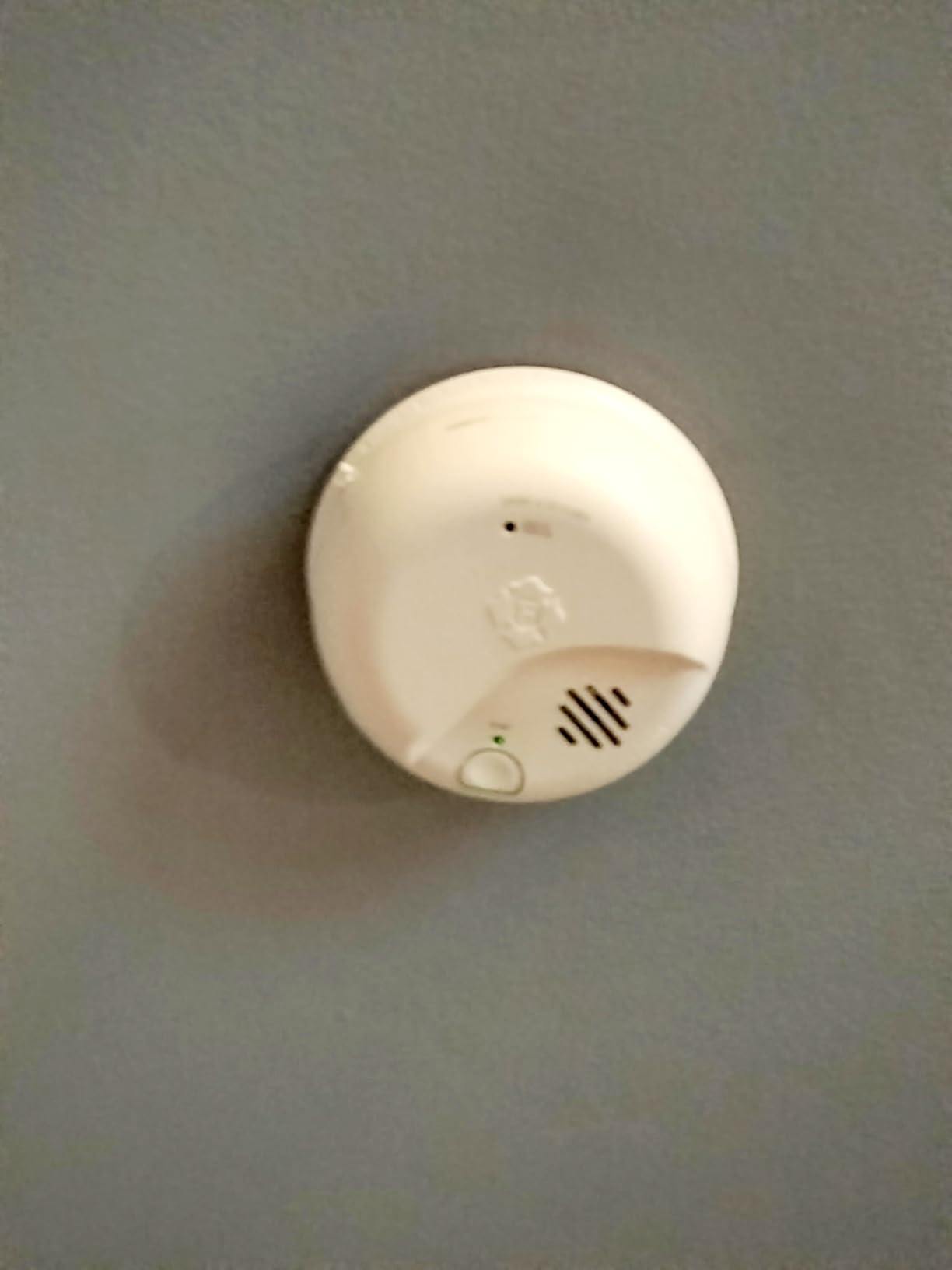
The SMICO100-AC solves the problem owners complain about most with hardwired First Alert units: alarms that go off for no reason until people start taking them out of the ceiling. Its Precision Detection sensing is built around the current industry standard for reducing cooking nuisance events.
Electricians and homeowners report a noticeably cleaner installation, working interconnection across the house, and a real drop in false alarms after swapping older units. The Quick Connect Plug means most replacements do not require touching the wiring in the box at all.
Power comes from a 120V line with a 9V battery backup that is already fitted in the box, so there is protection during an outage without a separate trip to the hardware store. Operating humidity is rated 10 to 95 percent non-condensing.
The unit measures 5.5 inches across and 2 inches deep, slightly larger than the older devices it replaces, and weighs just under 9 ounces. A dust cover is included so the sensing chamber stays clean while you work above it with the power off.
What this alarm does not do is tell you anything. There are no voice alerts, no smartphone notifications and no display. It sounds, and you investigate. For a household that has already had a silenced alarm in the past, that restraint is arguably a feature rather than a gap.
Why nuisance control matters more than features
Statistically, the fastest way to end up with no working alarm in a bedroom is for a person to remove it after a false alarm at 2 a.m. Alarm technology that cuts those events is doing more for household safety than a voice prompt, because it keeps the device in place for a decade.
Reviewers comparing it against older hardwired units describe the sensing as noticeably less reactive to cooking vapour and everyday aerosol use, which is the correct bias for a house where a bedroom shares a wall with a kitchen.
Where it falls short
The single most common complaint is mechanical. This model does not fit the legacy SC9120B mounting bracket, so anyone doing a like-for-like upgrade needs to swap the bracket as well, which turns a five-minute job into a longer one.
Owners who came from a smart alarm miss the app and the voice prompts. Nothing on this unit can be added later.
5. Kidde 30CUDR AA Battery Smoke and Carbon Monoxide Detector
Kidde Smoke & Carbon Monoxide Detector, AA Battery-Powered, 30CUDR, 1 Pack
Two AA batteries included
Photoelectric and electrochemical sensors
85 dB alarm with red LED
UL 217 10th and UL 2034 5th edition
Pros
- Two AA batteries included so no wiring or tools at all
- Advanced sensing over 25 percent faster smoke detection
- Helps separate real smoke from cooking and steam
- Tested to UL 217 10th and UL 2034 5th edition
- 10-year limited warranty from the date of purchase
Cons
- AA batteries need periodic replacement
- Standalone with no interconnection capability
- No digital CO level readout
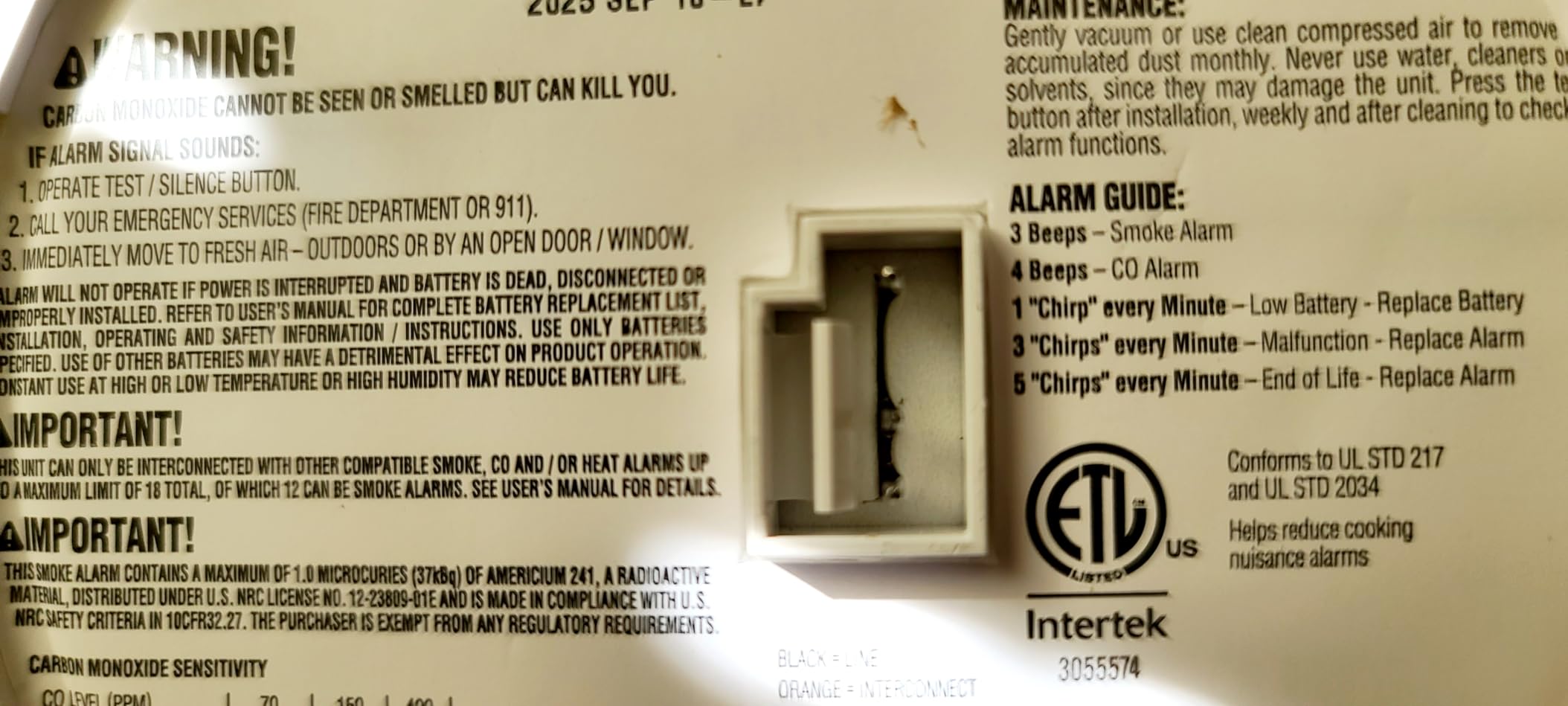
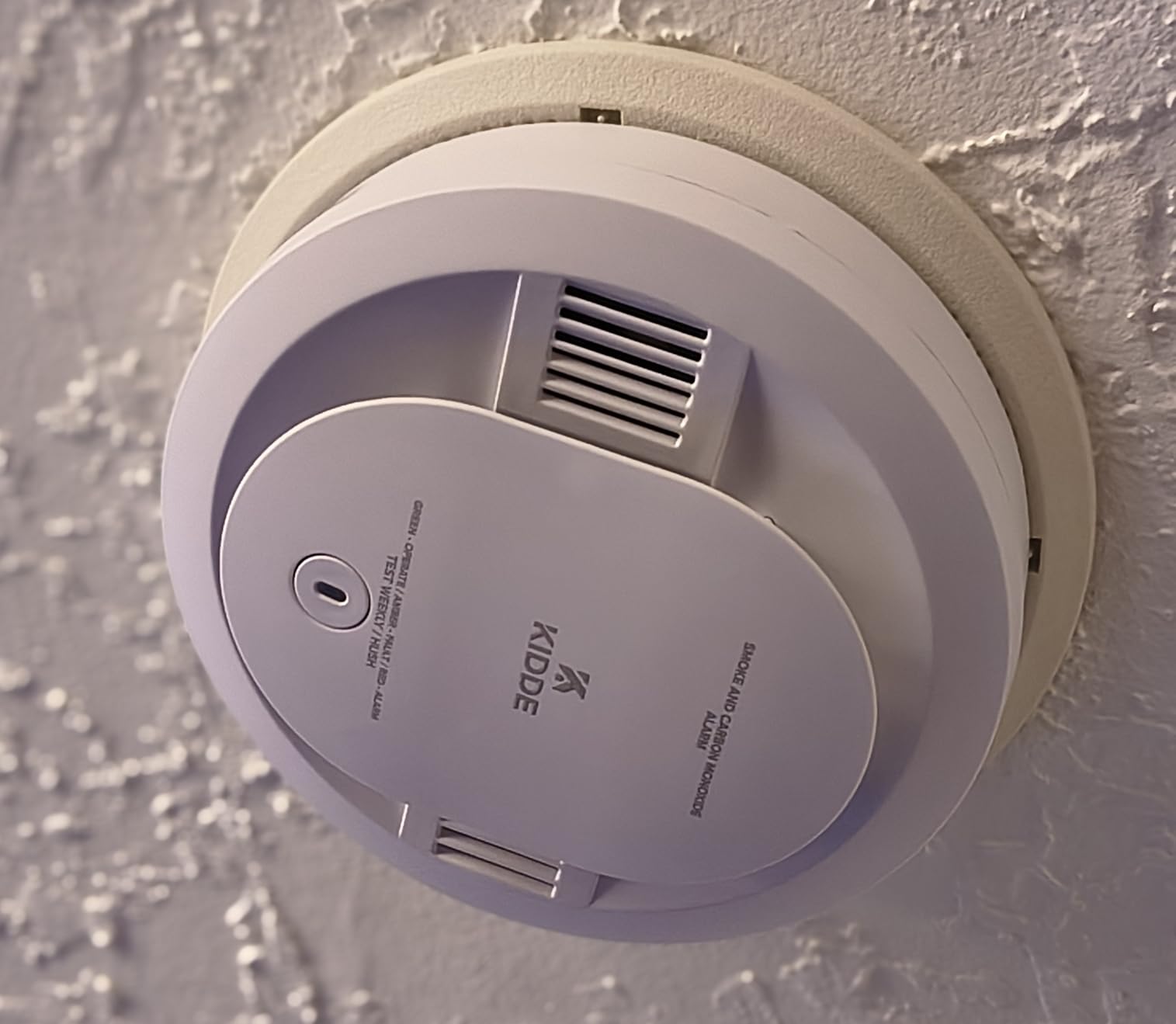
The 30CUDR is the most current-standard battery alarm in this roundup and the simplest thing to install. Two AA batteries come in the box, the bracket goes on the wall or ceiling, and there is no wiring, no electrician and no landlord conversation.
Kidde rates the sensing as more than 25 percent faster at smoke detection than earlier generations, and the tuning is aimed at telling real smoke apart from cooking vapour and steam. That is the single most valuable trait for a bedroom, because the room is where a nuisance alarm at night is most likely to be silenced permanently.
Certification is the other strength. It is tested to UL 217 10th edition, UL 2034 5th edition and FCC standards, which places it alongside the newest units in this list rather than the older designs still sold as replacements.
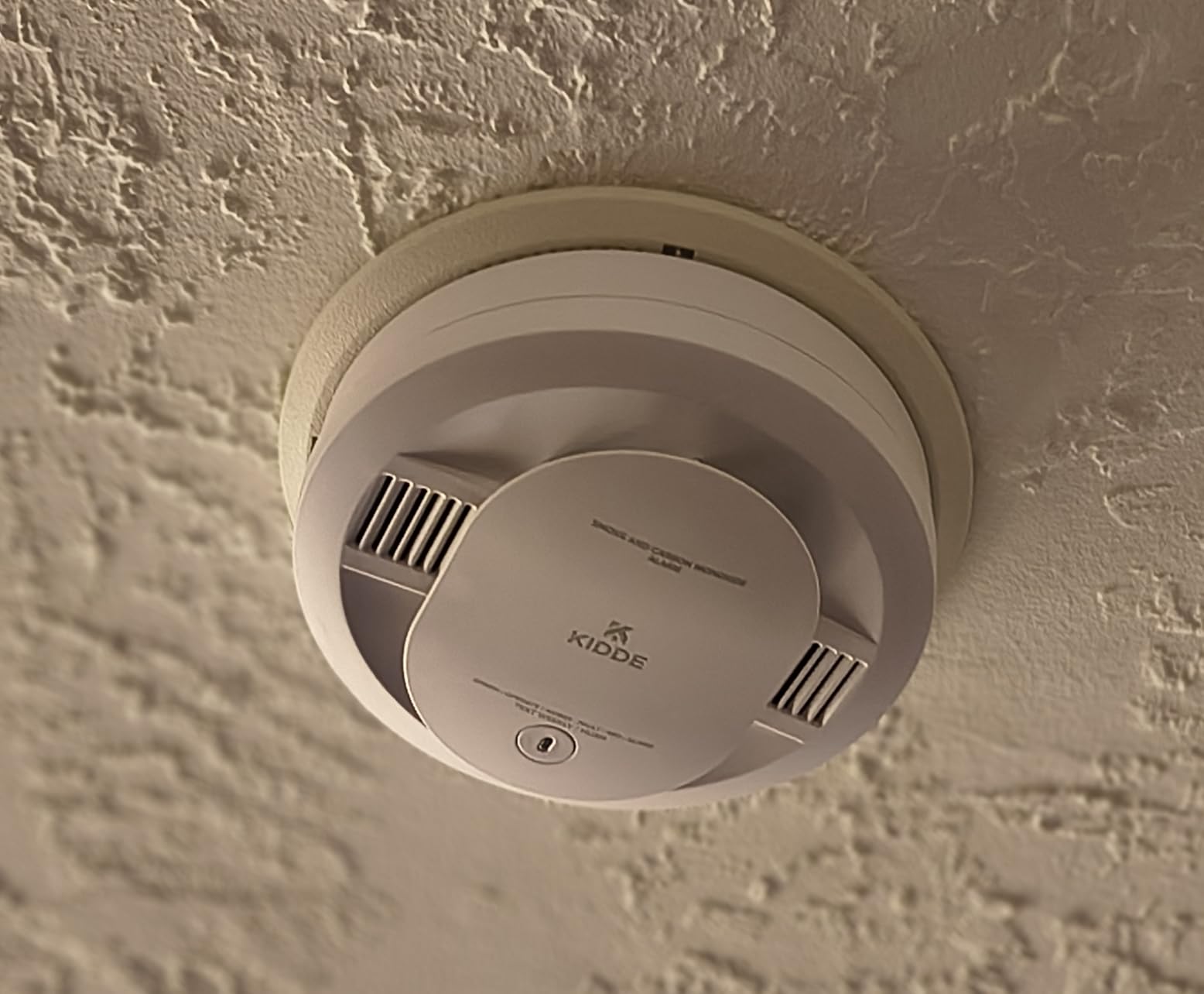
At 5 inches across and 1.88 inches deep, it is among the slimmest hardwired-style housings here, so it sits flat against a ceiling without looking like a dated retrofit. Upper temperature rating is 100 degrees Fahrenheit, and humidity tolerance runs 10 to 95 percent non-condensing.
What you give up is the sealed battery. AA cells need replacing, and while the alarm is rated for 10 years under its warranty, the cells inside it have a much shorter life. A rental where nobody checks the battery is the weak point in this setup.
Where this alarm fits best
Renters, student flats and any room where drilling for a hardwired line is not an option. The included hardware covers both wall and ceiling mounting, and the install takes minutes with no tools beyond a screwdriver and a drill for the anchors.
It is also a good secondary alarm for a home that already has a hardwired network, since a battery unit in an un-wired bedroom adds coverage without touching the wiring.
Where it falls short
There is no interconnection, so nothing else in the house knows it has gone off. If you want the whole floor to sound when the bedroom detects smoke, this is not the unit.
It also has no carbon monoxide readout, which means a slow CO build-up gives you no early numeric warning before the alarm threshold is reached.
6. Kidde 30CUA10-V Hardwired Alarm with 10-Year Battery Backup
Kidde Smoke and Carbon Monoxide Detector, Hardwired with 10-Year Battery Backup, Voice Alerts, LED, 85 dB, 30CUA10-V, 1 Pack
Hardwired 120V with 10-year battery backup
Spoken fire or carbon monoxide alerts
Photoelectric and electrochemical sensing
UL 217 10th and UL 2034 5th edition
Pros
- Ten-year battery backup removes annual 9V changes
- Voice alert says Fire or Warning Carbon Monoxide clearly
- Often fits existing Kidde mounting brackets
- Interconnects with other Kidde alarms
- Advanced sensing reduces cooking nuisance alarms
Cons
- Three-wire connection means two-wire homes must be rewired
- Installation instructions omit the tools list
- Existing pigtail connectors often will not plug in
- A few reports of early failure or whole-home false alarms
The 30CUA10-V is the best hardwired Kidde in this group on paper. It runs on 120V with a ten-year sealed battery backup, speaks the type of danger out loud, and carries a 10-year limited warranty. It also saves roughly the cost of nine 9V batteries over the life of the alarm.
The voice alerts are specific rather than generic. The unit announces Fire when smoke is detected and Warning, Carbon Monoxide when CO is present, so a sleeping household knows immediately which emergency plan to run.
Sensing combines a photoelectric smoke chamber with electrochemical CO detection, using the same advanced platform Kidde rates at more than 25 percent faster detection, tuned to separate real smoke from cooking and steam. It interconnects with other Kidde alarms so the whole home sounds together.
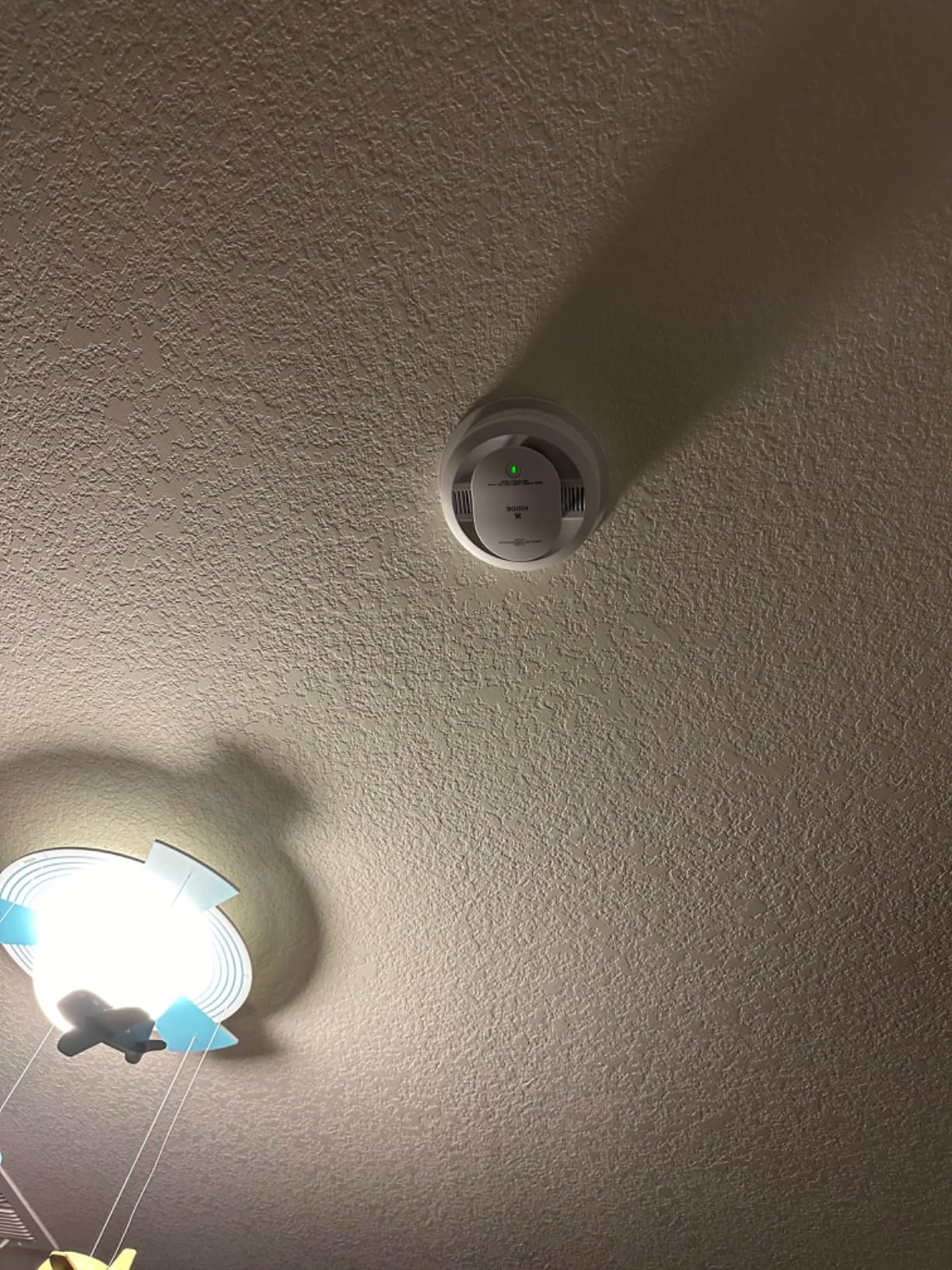
The rating sits lower than the rest of this field, and the reviews explain why. A recurring theme is the three-wire interconnect requirement: homes wired with only two wires cannot use the interconnection feature and need a rewire first. Several owners also report that the existing pigtail or connector will not plug in, so a new pigtail or adapter is part of the job.
There is also a small cluster of early-life reports, including a whole-home false alarm with no fire present, and a 13 percent one-star share. That is worth weighing against the 10-year battery backup, which is a genuine improvement over annual battery changes.
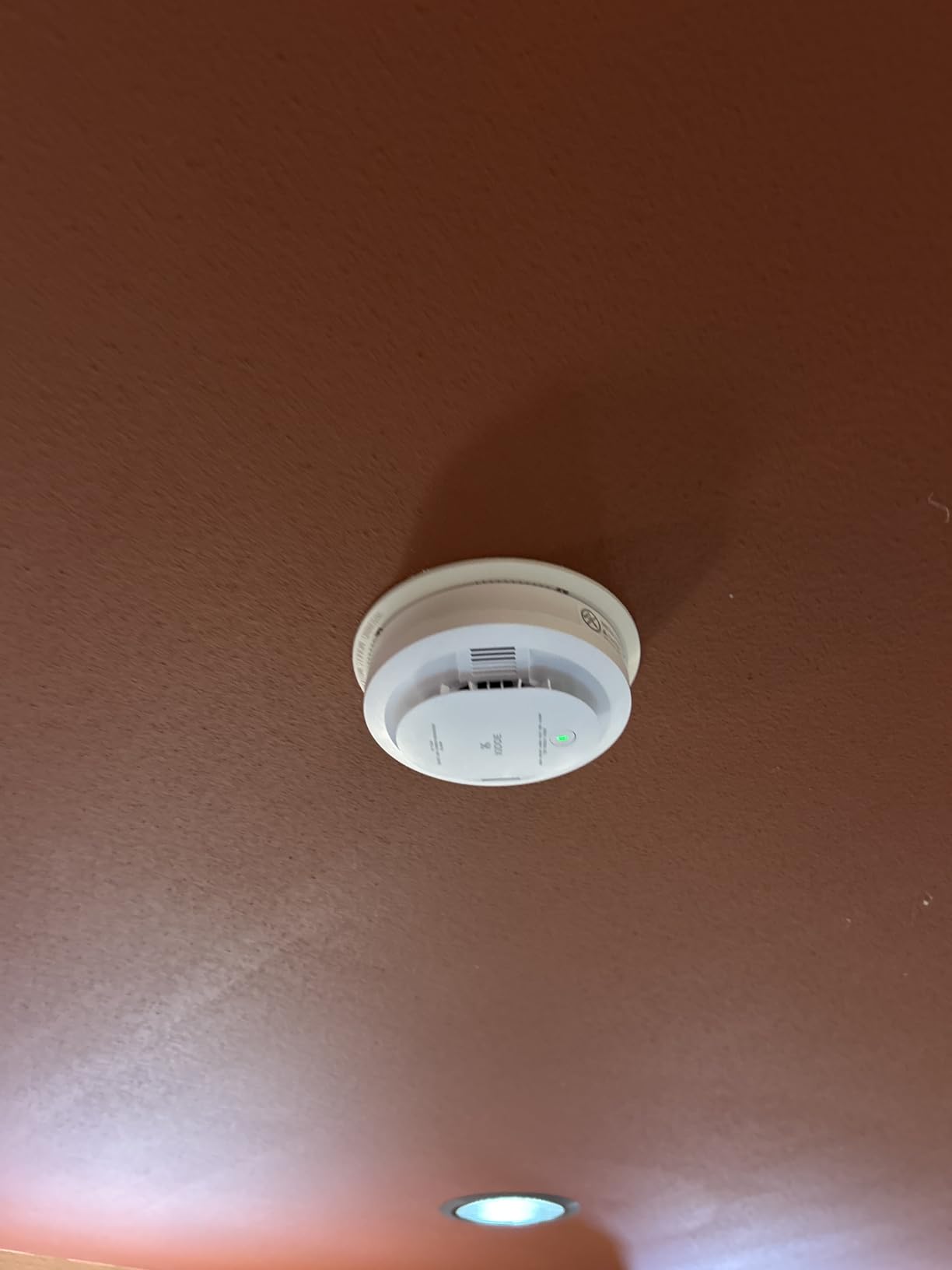
Why the ten-year backup is the point
Hardwired alarms traditionally carried a 9V backup that owners had to remember. Miss it, and the alarm goes silent the moment the power fails, which is precisely when a working device matters. A ten-year sealed backup removes the single most common reason a hardwired alarm stops working.
Owners also report that the unit often fits the existing Kidde mounting bracket, which speeds up a bedroom-by-bedroom replacement considerably compared with brands that changed their mount.
Where it falls short
The wiring requirement is the dealbreaker for a lot of older homes. Check whether your interconnection wiring is two-wire or three-wire before committing, and budget for a rewire if it is two-wire.
The documentation is thin. Owners report that the instructions do not list the tools needed or confirm whether the old bracket is reusable, so a first-time hardwired install will need some independent guidance.
7. BRK SC9120B Smoke and Carbon Monoxide Alarm
BRK SC9120B Smoke and Carbon Monoxide Alarm
Dual ionization smoke alarm and CO sensor
9V battery included
Silence and test button with latching indicators
Interconnectable with BRK and First Alert
Pros
- Drops into existing BRK and First Alert wiring and mounts
- Interconnects with other BRK and First Alert alarms
- 9V battery included so it works out of the box
- Separate smoke and CO latching indicators show the trigger
- 4.6 average rating across owner reviews
Cons
- One owner reports failure after roughly 3 years
- Replaceable 9V battery needs changing over its life
- 7-year limited warranty rather than 10
- No digital CO level readout
The SC9120B is not a purchase decision so much as a replacement decision. If your home already runs BRK or First Alert hardwired alarms and you are replacing expired units, this is the like-for-like part. It drops onto the existing wiring and the universal mount bracket.
At a 4.6 average across 500 reviews, it holds one of the highest owner ratings in this roundup, and 85 percent of the review set is five star. Reviewers describe the swap as nearly plug-and-play, and the 9V battery is included so the unit works the moment it is mounted.
Silence and test share one button, and the unit carries separate latching indicators for smoke and CO, which tells you which sensor triggered after the fact. Interconnection with other BRK and First Alert alarms is confirmed working across owner reports.
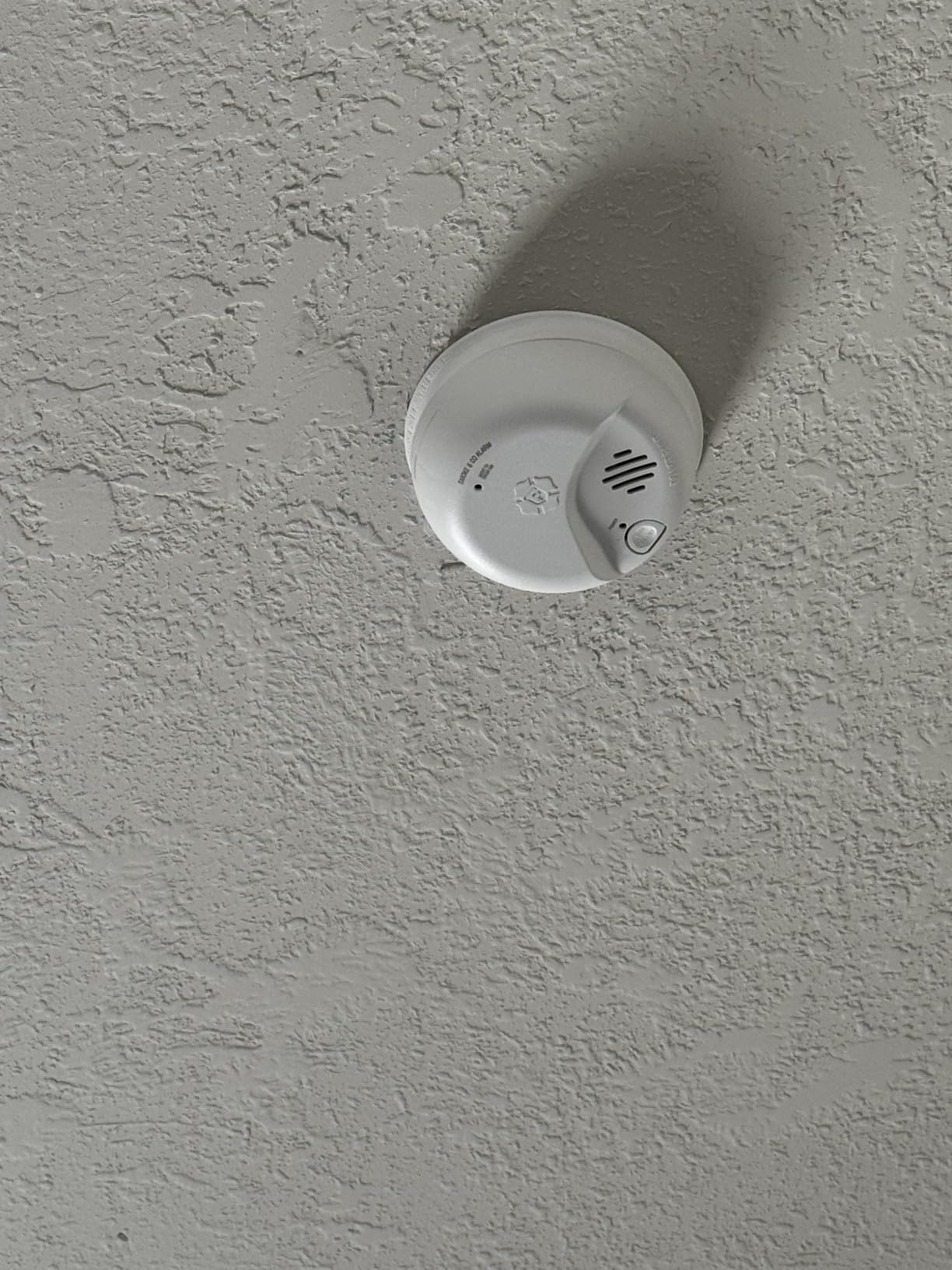
Two things to be clear about. The smoke sensing here is dual ionization, not photoelectric, which makes it more reactive to the small particles of a fast-flaming fire and more prone to nuisance events around dust and steam. There is also no CO display, so a slow build-up gives you no early numeric signal.
The warranty is 7 years rather than 10, and the 9V battery is replaceable rather than sealed. One owner reports the unit stopped working after roughly three years, which is well short of that warranty window. Treat that as an isolated report rather than a pattern, but check the unit during annual testing.
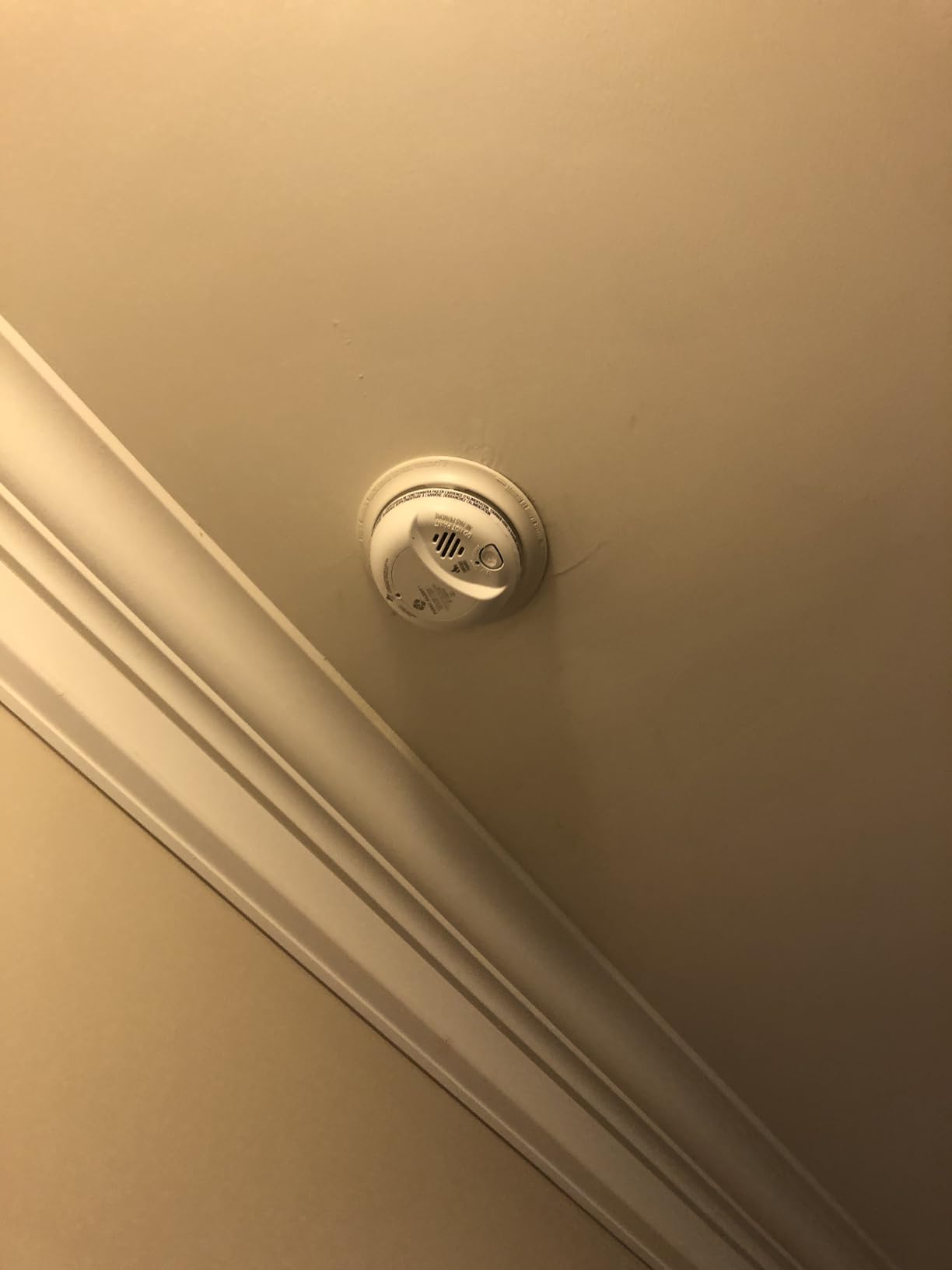
Why owners rate it so highly
Fit is everything for this model. It is the correct answer when the alternative is a ceiling full of exposed wiring, a brand-new colour in an old hallway, and an afternoon with an electrician for something that should take ten minutes.
Because it is a battery unit with interconnection capability, it also works in a mixed system, which matters in older homes where you may be replacing alarms one at a time rather than all on the same day.
Where it falls short
It is a 2011-era design being sold into a 2026 market where photoelectric and dual-sensor standards are the norm. If you are fitting a new bedroom rather than repairing an old one, a photoelectric unit is the better default.
Do not plan to keep one of these for a decade. The seven-year warranty and the reported early failure are both signals to schedule a replacement rather than forget it in the ceiling.
8. X-Sense XP0H-SN Combo with Oversized Mounting Bracket
X-Sense Smoke Detector Carbon Monoxide Alarm Combo, XP0H-SN, 1-Pack
10-year sealed lithium battery
Large 5.7 inch mounting bracket
Built-in self-test every 60 seconds
LCD for CO level and battery
Pros
- Oversized bracket covers old screw holes and ceiling stains
- Owners report no false alarms after switching from other brands
- Solid housing that feels heavier than competing units
- Installation is two screws and a twist onto the base
- Self-test checks sensors electronics and battery continuously
Cons
- Standalone design with no interconnection or Wi-Fi
- Took about 5 to 7 minutes to return to normal after a real smoke test
- Single pack rather than a multi-pack
The XP0H-SN solves a problem the other X-Sense units do not: what the wall looks like afterwards. Its bracket measures 5.7 inches across, which is wide enough to cover the screw holes and ceiling stains left by a previous detector.
Several buyers describe switching to this unit from a larger brand they said false-alarmed, and report no nuisance events since. The 2-in-1 detection uses a photoelectric smoke sensor and an electrochemical CO sensor on a ten-year sealed lithium battery.
The built-in self-test checks the sensors, electronics and battery every 60 seconds, which is a stronger answer to the silent-failure problem than pressing a test button once a year and hoping. The LCD stays dark in standby and lights only during an alarm or test.
Owners comment on the housing feeling heavier and more solid than competing units at this size, and the install is genuinely simple: two screws, then a twist onto the base plate. That broad bracket is the reason this model suits a bedroom where the old alarm is being removed rather than added alongside.
One behavioural note that catches people out: after a genuine smoke test, the unit took about five to seven minutes post-silencing to return to its normal green blink. That is a lockout period, not a fault, but it is worth knowing before you test it at night.
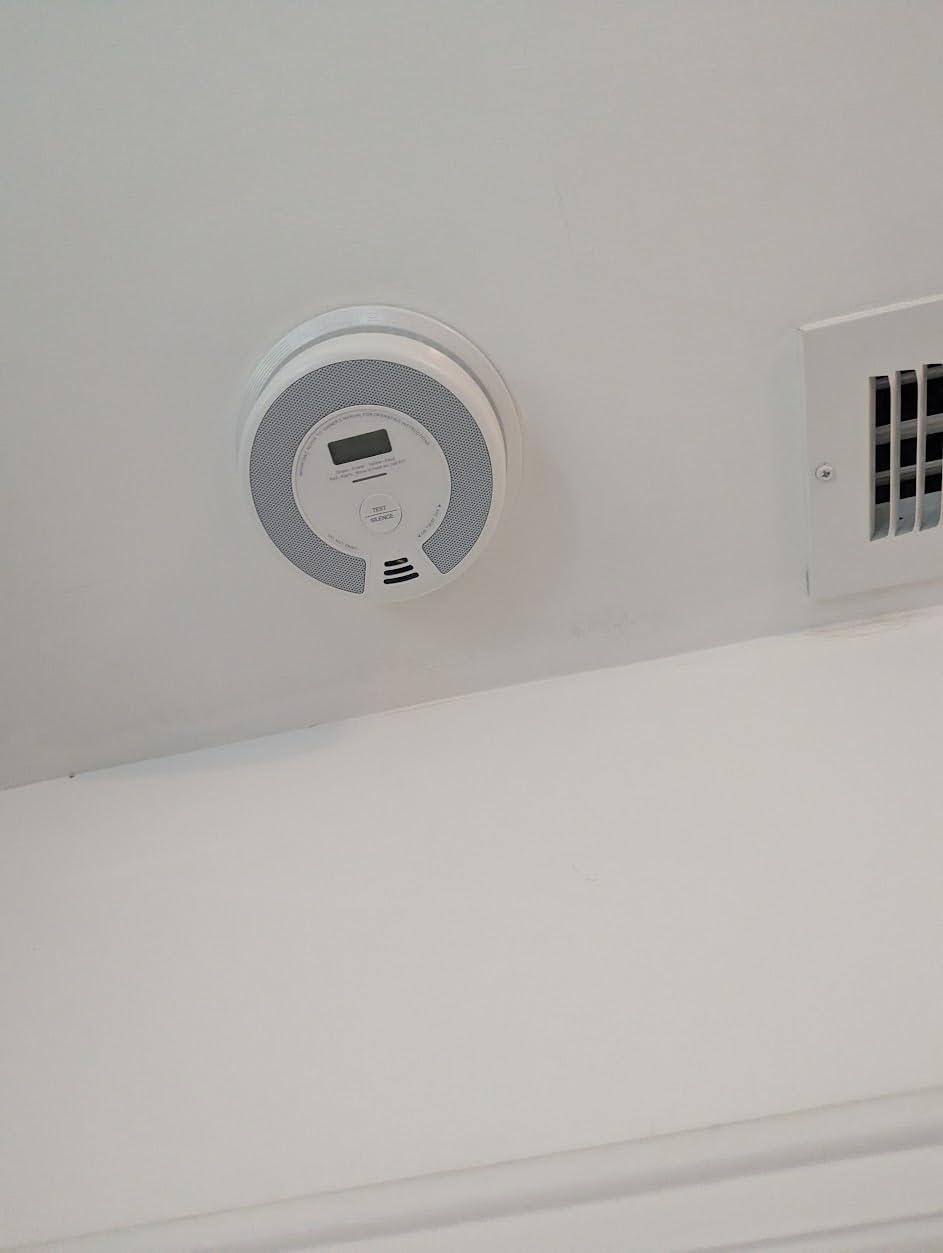
Where the oversized bracket earns its place
Bedrooms are where detectors get replaced most often, because they are the rooms people renovate. A wide bracket turns a patch-and-match job into an invisible one, particularly on a textured or stained ceiling where old holes are obvious under a lamp.
The continuous self-test also removes the annual reminder problem. There is no battery to check and no test to forget, so the alarm is more likely to still be working in year eight than anything relying on a 9V cell and a calendar.
Where it falls short
It is standalone, with no wireless interconnection, Wi-Fi or base station support. For a large home that is a meaningful limitation, and the interconnected XP0H-WN version is a different listing.
At this point the X-Sense range is well established, but this specific model has a much thinner pool of owner feedback than the SC01 or SC07, so you are relying on a smaller body of long-term experience.
9. Heiman HM-636THS 10-Year Sealed Battery Combo
Heiman Smoke Detector Carbon Monoxide Detector Combo 10-Year Sealed Battery
Dual-beam photoelectric and electrochemical sensors
10-year sealed battery
UL 217 10th and UL 2034 5th certified
85 dB alarm with 20-second memory flash
Pros
- Slim contemporary housing with no outlet or hardwiring needed
- Dual-beam sensing ignored cooking smoke in owner testing
- Current UL 217 10th and UL 2034 5th certification with CSFM approval
- 20-second alarm memory flash helps identify the trigger
- 10-year limited warranty with 24/7 support
Cons
- One owner reports the indicator LED pulsing brightly every 54 seconds
- One owner reports end-of-life chirp at 11 months
- Instructions described as somewhat ambiguous
- No digital CO level readout and no on/off switch
The Heiman HM-636THS is the thinnest unit here, at 4.91 inches across and 1.46 inches deep, which makes it a good fit on a low ceiling or a sloped wall where a bulkier alarm hangs awkwardly. It weighs 6.4 ounces and uses a ten-year sealed battery with no wiring or outlet required.
Sensing is dual-beam photoelectric for smoke alongside electrochemical CO detection, and the unit is certified to UL 217 10th edition and ETL UL 2034 5th edition, with CSFM approval. The alarm is 85 dB with a flashing LED and a 20-second memory flash so you can see what triggered it after the noise stops.
Owners like the price, the quick install and the absence of false alarms even with cooking smoke, and the housing uses a UL94 V-0 rated ABS and PC compound rated for heat and corrosion.
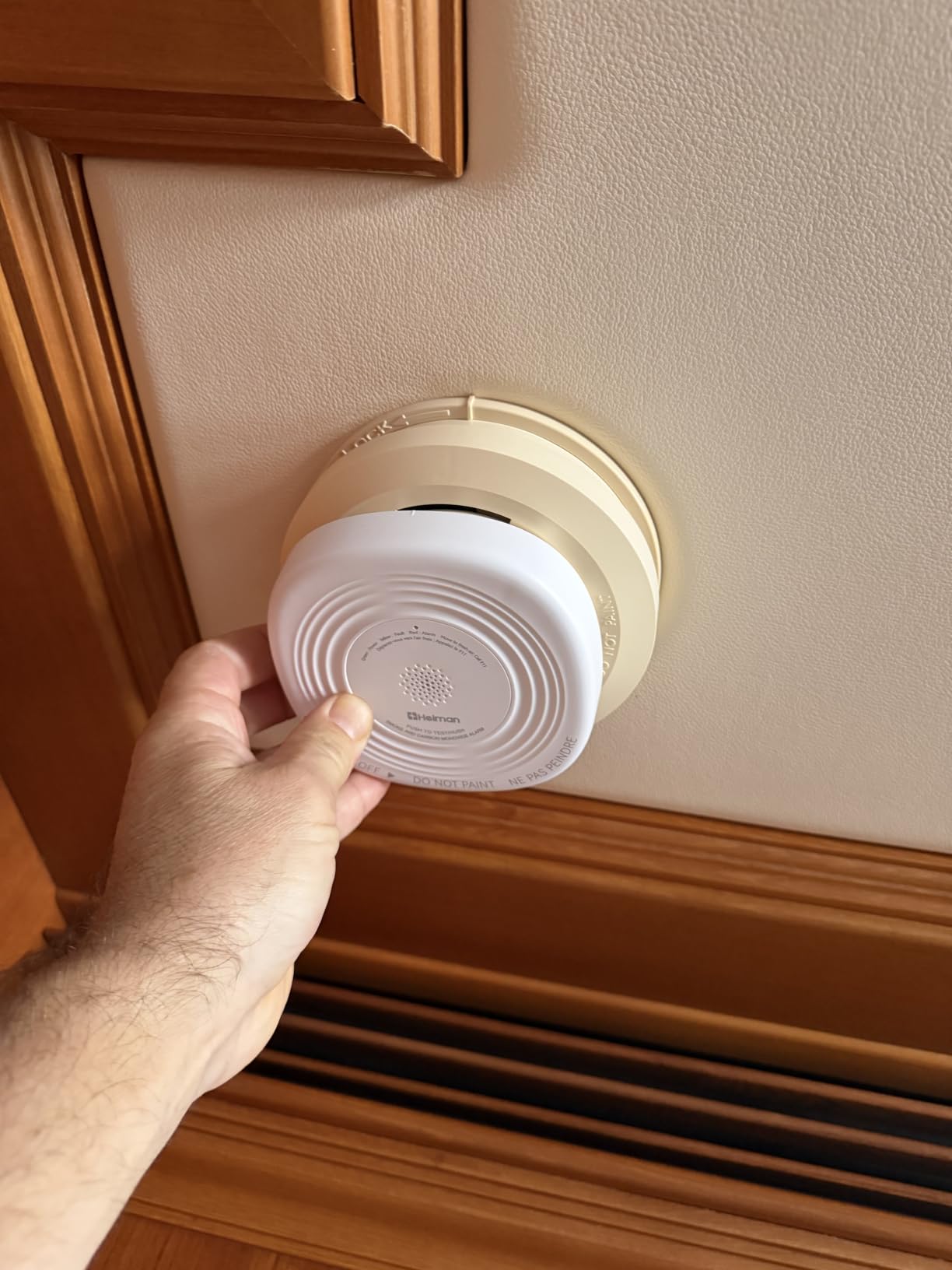
Two design details are worth knowing before you commit. There is no on and off switch: the alarm activates by twisting it onto its bracket, which is also how you deactivate it, so an installer who leaves the unit off the bracket leaves you with no protection. The instructions are also described as somewhat ambiguous about that step.
There is no digital CO readout, so early detection depends entirely on the alarm threshold. And this is the unit in the group with the thinnest feedback, at 90 reviews and a 4.2 average, so long-term reliability data is thin compared with the rest.
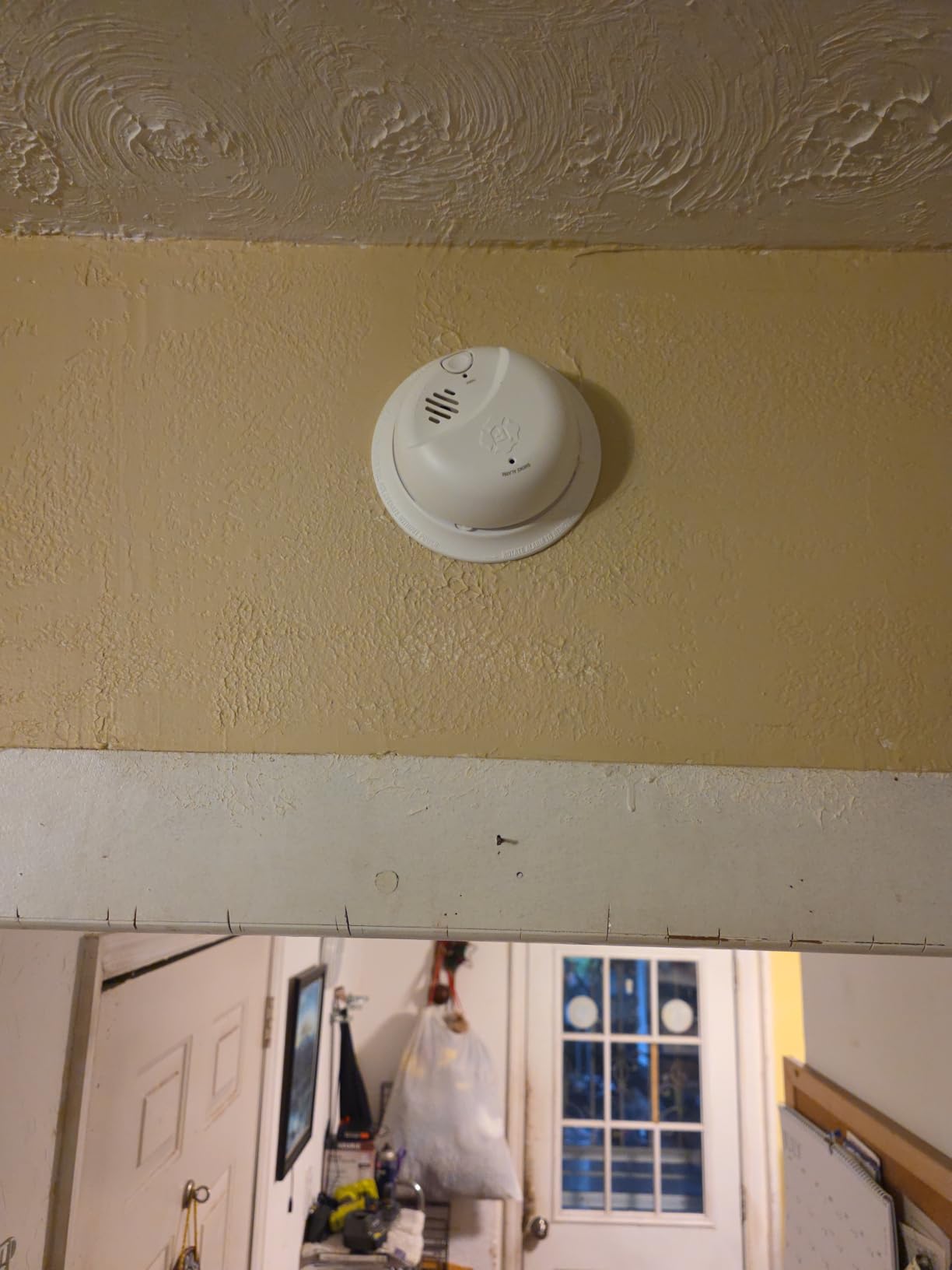
Where the slim profile helps
Crown moulding, vaulted ceilings and low attic conversions are the cases where a 2-inch-deep alarm looks and feels wrong. At 1.46 inches this one sits almost flush, and the small bracket can be positioned over old screw holes from a previous detector.
The 20-second alarm memory is a genuinely useful feature in a bedroom, because it records whether smoke or CO caused the alarm once the sound has stopped and you are standing in the dark trying to work out whether to evacuate.
Where it falls short
The two most-raised issues are cosmetic but real in a sleeping room. One owner reports the indicator LED pulsing brightly every 54 seconds, which is exactly the sort of repeated light you do not want beside a bed. Another reports the end-of-life chirp starting at 11 months, which on a sealed battery leaves you no option but to replace the whole alarm.
For a ten-year commitment, we would want a longer record of owner feedback before recommending it over the X-Sense units.
10. Kidde KN-COPE-IC Hardwired Interconnect Voice Alert Alarm
Kidde Smoke & Carbon Monoxide Detector, Hardwired Interconnect, Combination Smoke & CO Alarm with Battery Backup, Voice Alerts
Hardwired 120V with 9V battery backup
Spoken Fire or Carbon Monoxide alerts
Photoelectric plus electrochemical sensing
Interconnects with up to 24 Kidde devices
Pros
- Voice alerts clearly state fire or carbon monoxide
- Front-mounted battery door for quick 9V swaps
- Direct same-brand swap since base and harness fit
- Interconnection confirmed working with other alarms
- 4.6 average rating with 82 percent five star
Cons
- Model is discontinued and the connector has changed on newer units
- Replaceable 9V battery rather than a sealed 10-year pack
- 7-year limited warranty
- Costs more than battery combination units
The KN-COPE-IC is the highest-rated hardwired unit in this roundup, at 4.6 across more than 2,400 reviews with 82 percent of that set at five stars. It is also the unit most existing owners should recognise, because it is the standard like-for-like replacement for an expired hardwired Kidde alarm.
It sounds an 85 decibel alarm with voice alerts that announce Fire, Fire or Warning, Carbon Monoxide, and it is hardwired into a 120V source with a 9V battery backup. The battery door is on the front, so a swap does not mean taking the alarm off the ceiling.
Smoke detection is photoelectric with an electrochemical CO detector alongside it, and it interconnects with up to 24 other Kidde smoke, CO and heat alarms. Operating humidity is 5 to 85 percent non-condensing, with a 38 degree Celsius upper temperature rating.
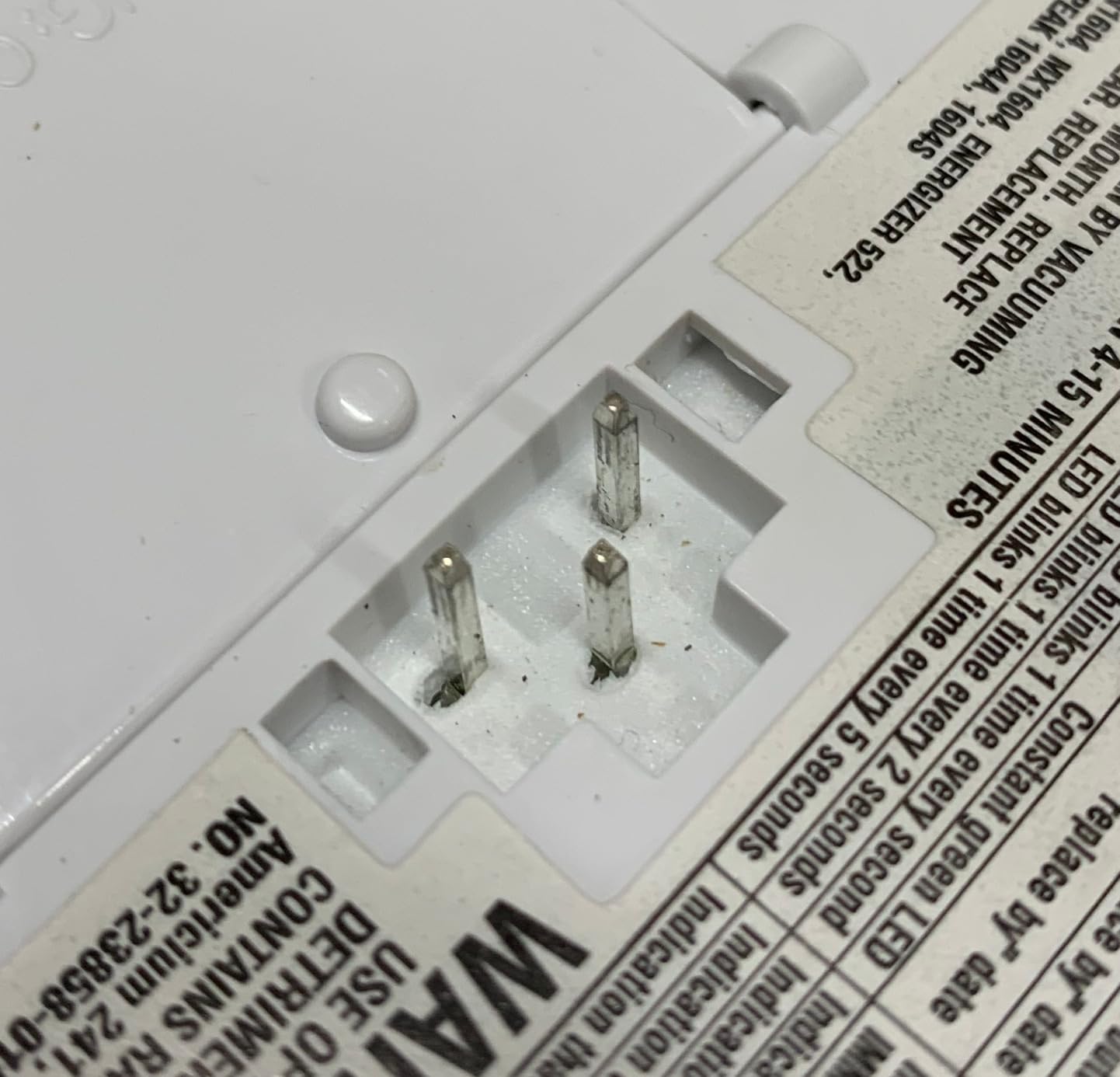
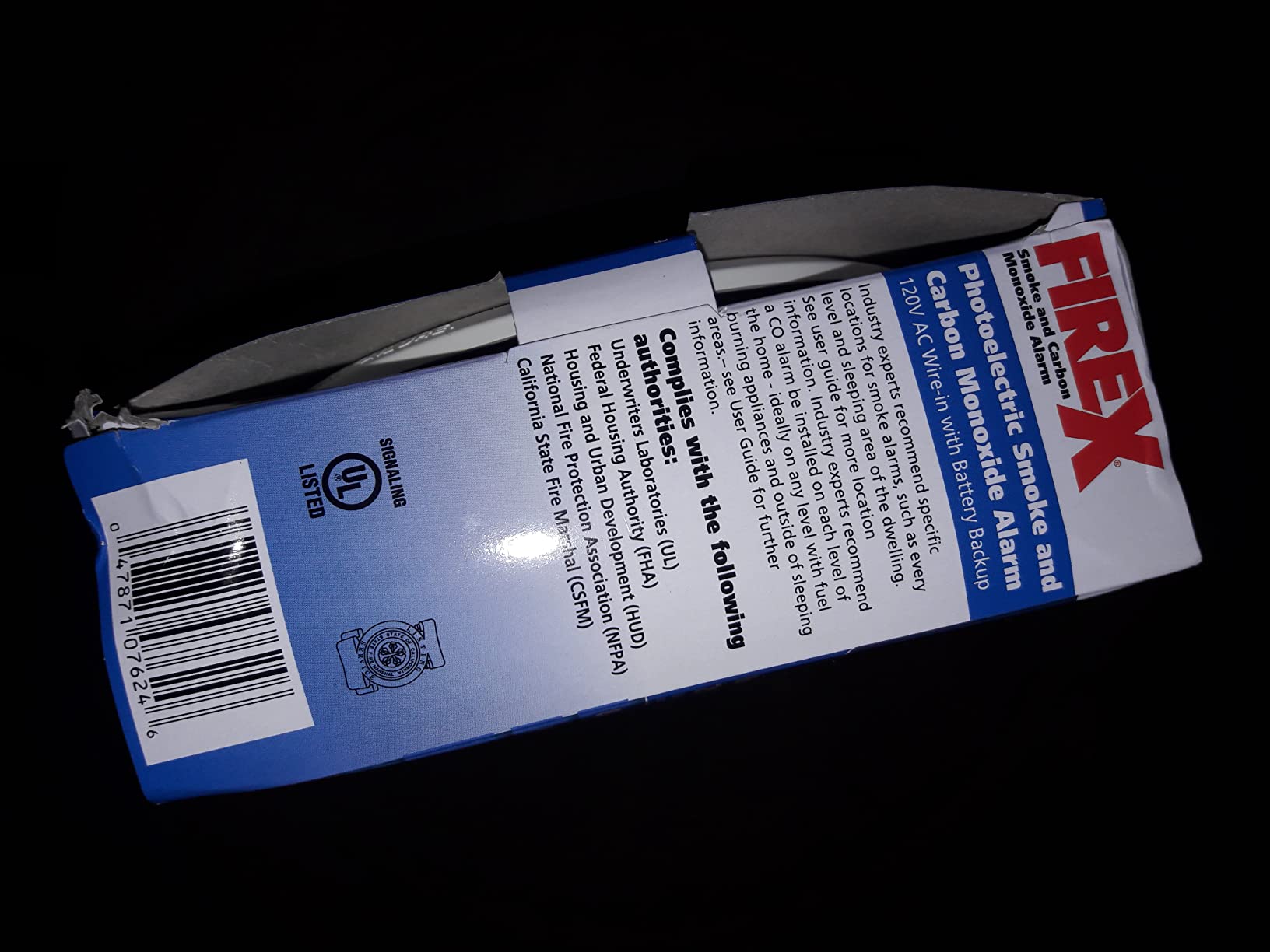
The honest caveat is on the packaging. Kidde has discontinued this model and changed the electrical connector on newer units, so anything you buy now will not accept the older style bracket that this one uses. It is a bridge purchase, an excellent way to replace expired alarms on an existing installation, but not a specification to build a new house around.
It also uses a replaceable 9V rather than a sealed ten-year pack, and carries a 7-year limited warranty. For a long installation, the newer 30CUA10-V addresses both of those points but adds a three-wire interconnect requirement.
Why it stays in the roundup
For a house that already has Kidde hardwired alarms on the same base, this is close to a no-brainer: the existing base and wiring harness fit, so the bedroom swap takes minutes rather than a morning. Several owners report confirmed working interconnection across the rest of the home, and one reports a smoke-damaged unit replaced free of charge by support.
The voice alert wording is the other draw. Reviewers consistently value being told whether the danger is fire or carbon monoxide rather than waking to an undifferentiated siren.
Where it falls short
Buying a discontinued model does not make sense if you are wiring new bedrooms, because the connector standard has moved on and you would be fitting hardware that is already at the end of its run.
It also costs more than the battery combination units while still needing annual battery attention on the 9V, which is an awkward middle ground in 2026.
How to Choose a Smoke and CO Detector for a Bedroom
Most buying guides organise alarms by sensor type or power source. That is useful, but it misses the question a bedroom actually raises, which is how the alarm behaves for ten years in a room where nobody wants to hear from it. The four things below carry the most weight.
Photoelectric vs ionization vs dual sensor
Photoelectric sensors detect smoke by measuring light scatter, and they respond quickly to the larger particles produced by a slow-smouldering fire. Ionization sensors detect the disruption of a current by smoke particles, and they lean toward fast-flaming fires but are more easily triggered by dust, steam and aerosol sprays.
For a bedroom, photoelectric is the better default. Fires that develop slowly overnight are the ones that matter, and the sensor that catches them is also the one least likely to cry wolf at 2 a.m. Dual-sensor units give you both response profiles at the cost of more ways to nuisance-alarm, which only pays off in a professionally monitored system.
The current generation standard is UL 217 10th edition. Units tested to it are built around nuisance-alarm reduction targets that earlier standards did not include, which is why the newer First Alert and Kidde models above are worth the small premium over legacy stock.
Hardwired vs 10-year sealed battery vs AA
Hardwired units run on your mains supply and are the more dependable over a decade, because there is no battery that can be removed or drained. Their weakness is installation, particularly in older homes with plaster or lath ceilings where running cable is a genuine project.
Ten-year sealed lithium units are the sweet spot for most bedrooms. There is no battery change, no low-battery chirp waking a household at 3 a.m., and no electrician. The catch is that the whole alarm is discarded at end of life, and the 10-year clock starts at the manufacture date printed on the label rather than the day you bought it.
AA-powered units are the cheapest and the most portable. They suit rentals and single-room additions, but they need annual attention, and an alarm in a room nobody enters is an alarm nobody checks.
Combination unit vs separate smoke and CO detectors
A combo unit gives you both sensors in one housing, one mounting point and one alarm to test. Separate units let you put the smoke alarm on the ceiling where smoke collects and the CO detector lower down where the gas actually sits, which is a real technical advantage.
The trade-off is failure modes. A combo unit is a single point of failure, and a fault or an end-of-life chirp takes out both protections at once. Two separate detectors cost more, need two locations, and give you two chances to sound. In a bedroom, a single combo on the ceiling is the common-sense compromise, provided it also carries a CO readout so you can see a slow rise before the threshold.
Interconnection for multi-bedroom homes
Interconnected alarms sound together across the house, so a fire in the kitchen wakes the bedrooms. For smoke alarms, interconnection is where local codes tend to require it in existing homes; for CO alarms it is almost always optional, because CO is a local hazard and a CO alarm in the room with the source is doing the work.
The practical constraint is brand and wiring. Wired interconnection generally works within a single manufacturer’s family, and a three-wire signal line is required for some newer Kidde models where older two-wire homes cannot interconnect at all. Wireless interconnection avoids the wiring entirely and is the only realistic route in a plaster-ceiling house.
Count what you need rather than what you can afford to buy. Each bedroom needs its own alarm, plus a hallway alarm outside the sleeping area, and the same wiring or wireless pairing has to cover all of them or the network is not doing its job.
Smart features worth paying for in a bedroom
The features that genuinely earn their place in a sleeping room are the ones that help you act, not the ones that add a screen. Voice alerts naming fire versus carbon monoxide let you run the right emergency plan immediately. A live CO reading gives you early warning of a slow leak. A pathlight or night-light gives you a lit escape route without fumbling for a switch.
App notifications are worth it when someone is away for long periods, an elderly relative is home alone, or you want to know an alarm went off in an empty house. They are much less useful when the people who need to hear the alarm are already in the room.
What to discount is anything that adds a subscription without adding coverage, and any lock-in to a single assistant that you may want to change. Our smart smoke detector roundup goes into the ecosystem comparison in more detail.
Kidde vs First Alert vs X-Sense
Kidde and First Alert are the two names fire alarm trade professionals have leaned on for decades, and the practical difference between them is the bracket. First Alert units mount on BRK hardware, and BRK and First Alert alarms interconnect with each other. Kidde units interconnect with other Kidde devices, up to 24 on some models. Mixing families generally means the interconnection feature does nothing.
For a hardwired existing home, the deciding question is simply which family is already in your ceilings. Replacing like with like takes minutes; crossing brands means new brackets and possibly lost interconnection.
X-Sense occupies a different position entirely. These are 10-year sealed battery units, ETL Listed to the same UL 217 and UL 2034 standards, with CO readouts that the legacy hardwired designs rarely offered. They are standalone, which rules them out for interconnection, and the oldest buyer feedback is younger than the 50-year track record of the major brands.
UL certification and end-of-life warnings
Every unit in this roundup carries third-party certification, listed under UL 217 for smoke alarms and UL 2034 for CO alarms, with ETL or CSFM approval on several. An unlisted alarm fails inspection in most jurisdictions, so this is a hard filter rather than a preference.
Look for an end-of-life signal as well. Units built to UL 217 10th edition emit a distinctive end-of-life chirp that differs from the low-battery sound, so a replacement alarm does not get mistaken for a flat battery and ignored for another two years.
Bedroom Placement, Installation and Nuisance Alarms
Where an alarm goes matters as much as which one you buy. Bedroom placement follows different rules from the rest of the house in one important respect: carbon monoxide and smoke do not want the same height.
Where the smoke alarm goes
Smoke rises. Install the smoke alarm on the ceiling, or on the wall no more than a foot below it, at least four inches from both walls and corners. In a bedroom, place it on the ceiling if you can, and keep it away from the bathroom door, because shower steam carries aerosol particles straight to a ceiling vent.
Do not put a bedroom alarm directly above a bed if you can avoid it. A nuisance alarm with an 85 dB siren two feet from a sleeping head is the fastest route to someone pulling the battery out.
Where the CO detector goes, and why height matters
Carbon monoxide mixes with air and settles, so a CO sensor mounted on the ceiling reads lower than the air you breathe. This is the detail most guides skip: the CO sensing element performs best at roughly chest to knee height, or on a bedside table, rather than at ceiling level alongside the smoke sensor.
That is the argument for two separate units in a bedroom. A ceiling combo is the simple answer, and acceptable in most cases, but a combo that gives you a live CO readout on the wall at chest height is closer to where the gas actually accumulates. Whichever route you take, keep CO detection inside the bedroom rather than relying on a unit in the hallway.
Why bedroom alarms get silenced, and how to stop it
Unwanted alarms are the leading reason working alarms are removed, and a 3 a.m. false alarm trains a household to ignore the sound permanently. The triggers in a bedroom are predictable: dust on the sensing chamber, humidity, aerosol hairspray and air freshener, cooking vapour drifting from an adjoining room, and steam from an ensuite.
Counter them in the order of impact. Vacuum the vents gently every few months. Keep aerosol products away from the alarm and out of the direct line of the sensor. Choose photoelectric sensing, which is markedly less twitchy than ionization. If you cook a lot and the bedroom shares a wall with the kitchen, a unit with current-generation nuisance control such as the First Alert SMICO100-AC or the Kidde 30CUDR is a better fit than a bare legacy design.
Test every alarm monthly with the test button, and test the CO function as well as the siren. Where a unit supports a self-test, that covers both sensing paths without a canister.
Renters, apartments and homes with plaster ceilings
If you cannot rewire, you are not excluded from good protection. A ten-year sealed battery unit or a two-AA model covers the room completely, and in most jurisdictions the renter’s landlord is responsible for code-required alarms anyway, so raise it with them in writing rather than drilling into a wall you do not own.
Older homes with plaster or lath ceilings fall into the same group. Running new cable means cutting into a structure that is expensive to repair, so a wireless interconnected system is the sensible answer there, with the understanding that wireless units cost more per room. Ceiling detectors on a plaster surface should be fixed with appropriate anchors rather than the lightweight plugs supplied for drywall.
One more note on timing, and it catches almost everyone: a 10-year lifespan is measured from the manufacture date printed on the base, not the day you bought it. Check that label before installing, and set a reminder for the full ten years from manufacture rather than from the receipt.
Frequently Asked Questions
What type of smoke detector is most effective for bedrooms?
A photoelectric sensor is the best default for bedrooms because it responds fastest to the larger particles produced by a slow-smouldering fire, the type that develops while people sleep, and it triggers far less often on dust and steam than an ionization chamber. A dual-sensor unit adds fast-flaming response but also adds more nuisance-alarm potential. Look for UL 217 10th edition certification, which sets nuisance-reduction targets.
What is the best combination smoke and carbon monoxide detector for a bedroom?
Our top pick is the X-Sense SC07, which pairs a photoelectric smoke sensor with an electrochemical CO sensor, runs on a ten-year sealed lithium battery and displays the live CO reading on an LCD. For a hardwired home that can be wired, the First Alert BRK SC7010BV adds spoken location alerts across up to 11 rooms. Both carry UL 217 and UL 2034 third-party certification.
Are combination smoke and CO detectors a good idea for bedrooms?
A combination unit is the sensible choice for most bedrooms because it gives both protections from one mounting point and one alarm to test. The trade-off is that it becomes a single point of failure, and a fault or end-of-life chirp removes both protections at once. Note also that smoke and CO prefer different heights, so a ceiling combo is less accurate for CO than a unit mounted at chest height.
Should each bedroom have its own carbon monoxide detector?
Yes, in practice. CO is a local hazard, so interconnection is optional for CO alarms rather than code-required in the way it often is for smoke. The reason to put one in each bedroom is that CO sources such as a gas water heater, furnace or attached garage are not always on the same level as the sleeping area, and CO settles low, so a hallway unit misses what collects beside a bed.
Do carbon monoxide detectors need to be interconnected?
Usually not. Interconnection is generally required or strongly recommended for smoke alarms so the whole house sounds, but CO is treated as a local hazard, so a detector placed in the room with the source does the work on its own. Local rules vary, and some states require CO alarms in specific rooms, so check your state and municipal code before relying on a single hallway unit.
Are interconnected smoke alarms worth it in a bedroom?
They are worth it in a multi-room home because an alarm in the hallway or kitchen that does not sound in the bedrooms may not wake anyone who needs to escape. The limits are practical: wired interconnection usually works only within one manufacturer’s family, some newer Kidde models need a third wire that older two-wire homes do not have, and wireless options are the practical answer in homes that cannot be rewired.
Which brand is better for bedrooms, Kidde or First Alert?
For a hardwired existing home, choose the family already installed. First Alert units mount on BRK hardware and interconnect with other BRK and First Alert alarms, while Kidde units interconnect with other Kidde devices, up to 24 on some models. Mixing brands usually voids the interconnection feature. For sealed battery alarms, X-Sense units are ETL Listed to the same UL 217 and UL 2034 standards with a CO readout.
How often should bedroom smoke and CO detectors be replaced?
Replace the whole unit ten years after the manufacture date printed on its label, not ten years after purchase, which is the most common mistake owners make with sealed battery models. Test every alarm monthly using the test button, and replace any replaceable AA or 9V batteries as required. Many current-generation units emit a distinct end-of-life chirp that differs from the low-battery sound.
Conclusion: Our Bedroom Picks by Scenario
For most households, the X-Sense SC07 is the best smoke and carbon monoxide detector for bedrooms in 2026. It covers smoke and CO, never needs a battery change, shows you the live CO reading, and carries the UL 217 and UL 2034 certification that keeps it legal to install. The SC01 is the near-identical alternative if you want a larger, more readable display.
If your home is hardwired and can stay that way, the First Alert BRK SC7010BV is the stronger long-term choice, because spoken location alerts remove the guesswork at 3 a.m. and the end-of-life chirp keeps it from failing silently. For replacement-only work on an existing installation, match the brand already in your ceilings rather than crossing families.
For renters and anyone who cannot rewire, a ten-year sealed battery unit covers the room completely, and the Kidde 30CUDR is the AA-powered option when the sealed pack is not what you want to commit to. Whatever you choose, mount the smoke sensor on the ceiling away from the bathroom door, keep CO sensing low, and test it every month so the alarm is still working when you need it.