
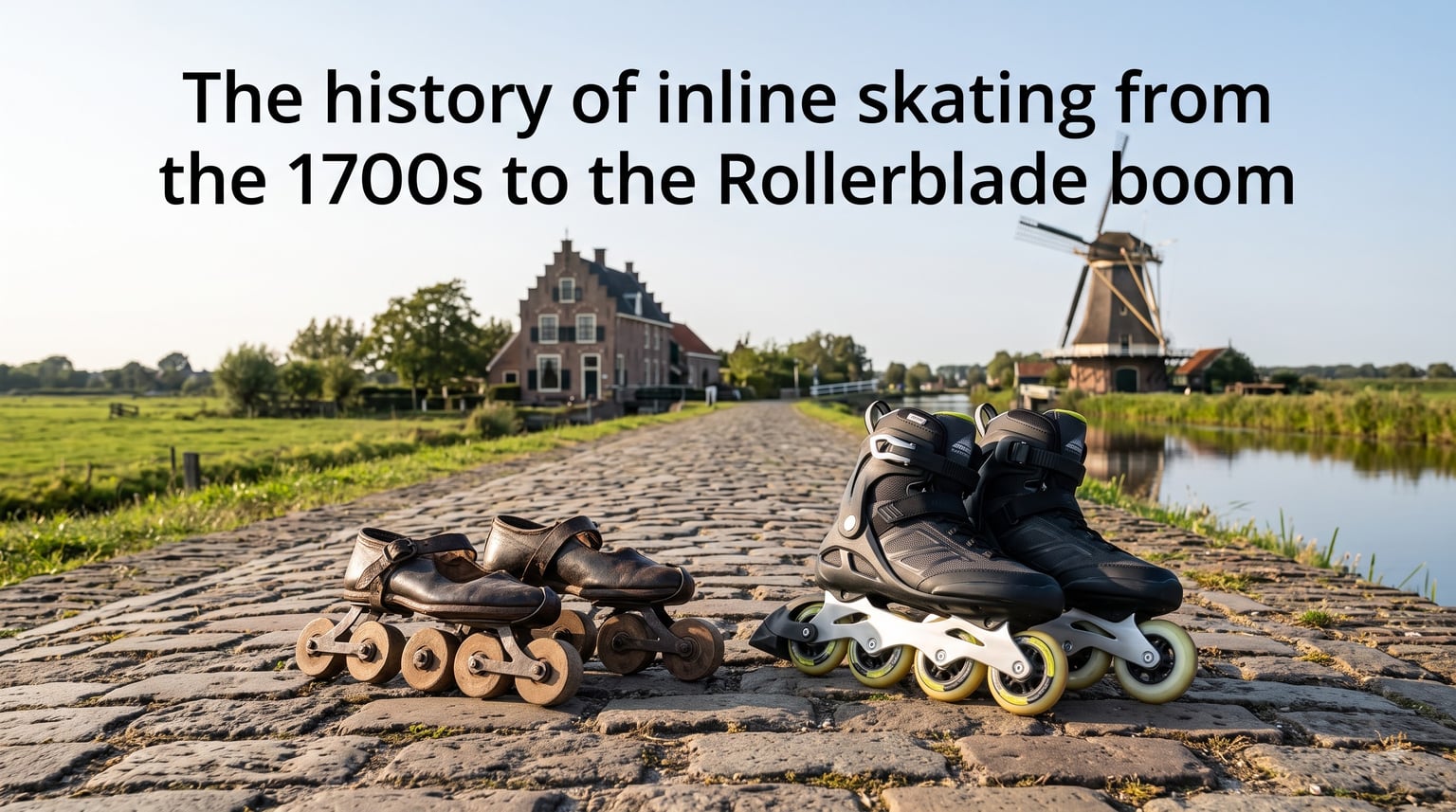
Inline skating feels like a modern sport, but the history of inline skating stretches back nearly 300 years to a Dutch inventor who just wanted to keep skating after the canals thawed. From wooden spools nailed to boots in the 1700s to the polyurethane-wheeled Rollerblade craze that defined the 1990s, this is a story of obsession, marketing genius, and one very determined Minnesota hockey player.
What started as an off-season ice skating substitute became a multi-billion-dollar industry, a fitness phenomenon, and a defining piece of youth culture. Inline skating even outpaced skateboarding in participation at its peak in the mid-1990s, with an estimated 26 million Americans strapping on wheels.
Our team traced the full timeline from the earliest Dutch prototypes through John Joseph Merlin’s disastrous 1760 party entrance, James Plimpton’s quad-skate detour, and Scott Olson’s 1980 rediscovery that sparked the Rollerblade revolution. We pulled from patent records, company histories, forum discussions from long-time skaters, and academic sources to build the most complete picture possible.
Whether you are a current skater curious about how your sport began, a former 1990s rollerblader feeling nostalgic, or someone researching the history of inline skating for a project, this guide walks you through every milestone. The keyword “history of inline skating” covers a much richer story than most people realize, full of false starts, forgotten patents, and one iconic brand that changed everything.
Here is how inline skating evolved from a curious novelty into a global cultural movement.
Table of Contents
Dutch Origins: The First Inline Skates (1700s)
The history of inline skating begins in the Netherlands in the early 1700s. An unknown Dutch skater wanted a way to glide during the summer months when the canals were not frozen, so he nailed wooden spools to strips of wood and attached them to his shoes. This crude creation is widely recognized as the first roller skate, and it was an inline design, with wheels arranged in a single line to mimic ice skating.
Ice skating was deeply woven into Dutch culture and transportation, so the motivation to replicate that feeling year-round made perfect sense. These early wooden spool skates were far from practical. They had no brakes, no ankle support, and no way to turn smoothly. Skaters could only glide in relatively straight lines, and stopping meant dragging a foot or running into something.
Despite their limitations, these early prototypes proved one critical concept: wheels arranged in a single line could approximate the glide of an ice skate. That foundational idea would persist for centuries, even as it was repeatedly overshadowed by more maneuverable designs. The Dutch origins of inline skating established the principle that every later inventor would build upon.
Records from the era are sparse, and the identity of the original Dutch inventor remains unknown. What historians do know comes from secondhand accounts and later references to “shoes with wheels” used in the Netherlands during this period. The fact that the concept survived at all, passed down through descriptions and sketches, speaks to how compelling the idea of summer skating was.
These earliest inline skates were novelty items rather than serious sporting equipment. They were curiosities, conversation pieces, and occasionally tools for performers. But they planted the seed for every innovation that followed, and they established the Netherlands as the birthplace of roller skating history.
John Joseph Merlin and the 1760 Spectacle
The next major figure in the history of inline skating was John Joseph Merlin, a Belgian-born inventor and instrument maker working in London during the mid-1700s. Merlin was a prolific tinkerer who invented everything from musical instruments to clocks, and he had a flair for dramatic demonstrations.
Around 1760, Merlin created a pair of metal-wheeled inline skates and decided to debut them at a fashionable London masquerade party. He planned to glide into the hall playing a violin, dazzling the assembled guests with his wheeled boots. The reality did not match the vision.
Merlin had no way to stop or steer his invention. He crashed headlong into a large mirror, shattering it and seriously injuring himself. The violin may or may not have survived. The incident became one of the most famous, and most painful, moments in early skating history.
While Merlin’s entrance was a disaster, his skates were genuinely innovative for their time. Unlike the Dutch wooden spool designs, Merlin used metal wheels mounted on a single line beneath a boot. This was a significant engineering step forward, even if the lack of steering and braking made them nearly unusable.
Merlin’s failed performance actually served an important purpose: it documented inline skating for a broader audience. His story was recorded in print and passed down through generations of skating historians. Without Merlin’s spectacular crash, the early history of roller skate development might have been lost entirely.
The First Patents: Petitbled and the Inline Concept (1819)
The first registered patent for a roller skate was filed in 1819 by Monsieur M. Petitbled in Paris, France. Petitbled’s design featured three wheels aligned in a single row, attached to the bottom of a boot sole. This was a true inline skate, and it represented the first time someone formally documented and protected an inline skate design.
Petitbled’s skates were made with wooden wheels and a metal frame. Like Merlin’s earlier attempt, they could only travel in a straight line with very limited turning ability. Skaters had to lift and reposition the skate to change direction, which made them impractical for anything beyond basic forward gliding.
Despite these shortcomings, the 1819 patent was a watershed moment in the history of inline skating. It established roller skating as a recognizable concept in the patent record and inspired other inventors across Europe and America to attempt improvements. Throughout the 1820s and 1830s, several other patents were filed for skate designs, most trying to solve the fundamental problems of turning and stopping.
None of these early inline designs caught on commercially. The single-line wheel arrangement that mimicked ice skating was simply too difficult to control without modern materials and bearing technology. This persistent usability problem would eventually lead inventors away from the inline concept entirely, and toward a very different wheel configuration.
For nearly 40 years after Petitbled’s patent, inline skating remained a niche curiosity. Inventors kept trying to improve the single-line design, but every attempt ran into the same wall: inline skates were fast in straight lines but nearly impossible to turn. The breakthrough that would dominate skating for the next century came from a completely different direction.
James Plimpton and the Quad Skate Era (1863)
In 1863, an American inventor named James Leonard Plimpton from Medford, Massachusetts, changed the course of roller skating history. Plimpton designed a skate with four wheels arranged in pairs, two in front and two in back. This was the quad skate, and it solved the turning problem that had plagued inline designs for over a century.
Plimpton’s key innovation was a pivoting action that allowed skaters to lean and turn by shifting their weight. For the first time, skaters could carve turns, stop with some control, and even skate backward. Quad skates were dramatically easier to balance on than inline designs because of their wider wheelbase, which made skating accessible to ordinary people rather than just adventurous tinkerers.
Plimpton did not just invent a better skate; he built an entire business model around it. He opened the first commercial roller skating rink in Newport, Rhode Island, and leased his patented skates to rink operators across the country. Skaters paid for rink admission and skate rental, creating the first profitable roller skating industry.
From the 1860s through the mid-1900s, quad skates completely dominated roller skating. The inline concept that began in the Netherlands was essentially forgotten for mainstream use. Roller rinks, roller derby, artistic skating, and recreational roller skating all developed around the four-wheel quad design.
Plimpton’s quad skate was so successful that it pushed inline skating into obscurity for nearly 120 years. The inline design, despite being the original concept, became a historical footnote. It would take a completely different motivation to bring single-line skating back: the training needs of ice hockey and figure skaters who wanted to practice off the ice.
The quad era was not wasted time for inline history, though. Innovations in wheel materials, bearing systems, and boot construction during the quad-skating boom would later prove essential when inline skates finally returned. Polyurethane wheels, developed for quad skates, would become one of the most important components of modern inline skating.
The Roller Disco Years (1970s)
The 1970s brought roller skating back into the cultural spotlight with the roller disco movement. While this revival was built on quad skates, not inline skates, it created conditions that would make the inline boom possible a decade later. Millions of Americans were skating, listening to disco music at rinks, and viewing roller skating as a legitimate recreational activity.
Roller disco culture made skating visible, social, and cool. Skating rinks proliferated across the United States, and the equipment industry matured. Companies learned how to mass-produce skating gear, market to consumers, and build retail distribution networks. All of that infrastructure would be waiting when inline skates reemerged.
At the same time, ice hockey was growing rapidly in popularity in the United States, particularly in cold-weather states like Minnesota and Michigan. Hockey players needed off-season training options, and some were experimenting with modified skates to simulate ice skating on pavement. This niche need would prove to be the spark that reignited the inline skating industry.
By the late 1970s, the stage was set. The culture was ready for new forms of skating, the manufacturing capability existed, and a specific training need was going unmet. All that was missing was someone to connect the dots between an old Dutch concept and modern materials.
Scott Olson and the Birth of Rollerblade (1980)
The modern history of inline skating pivots on one person: Scott Olson, a young hockey player from Bloomington, Minnesota. In 1979, Olson found an old pair of inline skates in a sporting goods store in Minneapolis. They were manufactured by the Chicago Roller Skate Company and featured a basic inline design with four wheels in a row.
Olson immediately saw potential that the original manufacturer had missed. As a hockey player, he recognized that an improved inline skate could be the perfect off-season training tool for ice hockey players. He could practice his stride, build leg strength, and maintain his skating mechanics on pavement during the summer months when ice rinks were closed.
Olson purchased the design rights from the Chicago Roller Skate Company and began modifying the skates. He used better materials, including polyurethane wheels borrowed from quad skate technology, and attached them to hockey-style boots. The result was a dramatically better inline skate that actually performed well and felt similar to ice skating.
In 1980, with his brother Brennan Olson, Scott founded Ole’s Innovative Sports in Minnesota to manufacture the improved inline skates. The company would later be renamed Rollerblade, Inc., and that brand name would become so dominant that “rollerblading” became the generic term for inline skating, a phenomenon known as a proprietary eponym.
The early years were difficult. The skates were expensive to produce, the market was tiny, and most people had never seen inline skates. The Olsons sold primarily to hockey players and competitive skaters in the Minneapolis area. In what US state were rollerblades invented? Minnesota, and that Minnesota origin story would become central to the brand’s identity and connection to ice sports culture.
Scott Olson eventually sold his interest in the company, and Rollerblade, Inc. changed hands several times. But his insight, that inline skates could be both a serious training tool and a fun recreational product, was the foundation of everything that followed. Without his discovery in that Minneapolis sporting goods store, inline skating might have remained a forgotten footnote.
The Rollerblade Boom: How Inline Skating Took Over the 1980s and 1990s
Rollerblade, Inc. spent the early 1980s refining its product and slowly building awareness. The turning point came when the company began marketing beyond the hockey community. They positioned inline skating not just as training but as a standalone fitness and recreational activity, comparable to jogging or cycling.
The fitness angle was a marketing masterstroke. In the 1980s, the aerobics and fitness boom was in full swing, and Americans were hungry for new ways to exercise. Inline skating burned serious calories, provided low-impact cardiovascular training, and felt more fun than running on a treadmill. Rollerblade advertised in fitness magazines, partnered with sporting goods retailers, and demoed skates at events.
By the late 1980s, inline skating was growing rapidly. When did rollerblading become a thing? Most historians point to the period between 1987 and 1989, when sales exploded nationally. Rollerblade, Inc. was acquired by North American Training Corporation and then eventually by the Italian company Nordica, part of the Benetton Sportsystem empire, which poured resources into marketing and distribution.
Competitors entered the market quickly. Bauer, Roces, K2, and other brands launched their own inline skates, creating competition that drove innovation and lowered prices. The industry grew from near zero in the early 1980s to over a billion dollars in annual sales by the mid-1990s. At its peak, an estimated 26 million Americans participated in inline skating, more than skateboarding at the time.
Safety was a major concern throughout the boom. Early inline skates lacked effective braking systems, and injuries spiked as millions of beginners hit the streets. Rollerblade addressed this by introducing Active Brake Technology, or ABT, which allowed skaters to stop by bending their knee into a padded bracket rather than tilting a heel brake. ABT and similar innovations made inline skating significantly safer and helped maintain the sport’s growth.
The cultural impact was enormous. Inline skating became associated with the sunny, active lifestyle of California, with Venice Beach and Santa Monica becoming iconic skating destinations. At the same time, the sport retained its Minnesota and hockey roots. Regional skating cultures developed differently: beach communities favored recreational and fitness skating, while heartland rinks and hockey towns used inline skates for training and competitive roller hockey.
Inline skating also spawned new competitive disciplines. Speed skating, aggressive inline skating with rails and ramps, and inline hockey all developed passionate followings. Aggressive skaters like Dustin Latimer and Franky Morales pushed the limits of what was possible on inline skates, and many in the community argue that inline skating never got its defining cultural moment the way skateboarding did with Tony Hawk.
By the mid-1990s, Rollerblade had become a household name, and inline skating was everywhere. Parks built dedicated paths. Schools offered skating programs. Major retailers stocked dozens of models. The sport had gone from a Minnesota hockey player’s side project to a genuine cultural phenomenon in just 15 years.
Decline and Diversification: Why Rollerblading Lost Its Mainstream Grip
The inline skating boom could not last forever. By the late 1990s, sales began to decline sharply, and participation rates dropped year after year. Several factors converged to end the rollerblading craze, and understanding why rollerblading became unpopular reveals a lot about how sports trends rise and fall.
Market saturation was the first problem. Nearly everyone who wanted inline skates had already bought a pair, and the skates lasted for years. There was little repeat purchasing, and manufacturers struggled to convince people to upgrade. The market shrank as the pool of first-time buyers dried up.
Cultural shifts also worked against inline skating. Skateboarding was resurging, fueled by the X Games and the Tony Hawk video game franchise. Skateboarding had a rebellious, youth-driven image that inline skating, now associated with suburban fitness enthusiasts, could not match. Many young people viewed rollerblading as uncool by comparison.
Safety concerns persisted as well. Despite improvements like ABT, inline skating still carried significant injury risks, and the perception of danger kept many potential new participants away. Some cities restricted skating in public spaces, and insurance issues plagued rinks and skate parks.
Perception as a fad was perhaps the most damaging factor. Inline skating had grown so fast that many people dismissed it as a passing trend rather than a legitimate sport. Once the mainstream media started treating rollerblading as yesterday’s news, the cultural momentum evaporated quickly.
Despite the decline, inline skating did not disappear. It diversified. Aggressive inline skating developed a dedicated underground scene that continues today. Speed skating remains a competitive discipline. Inline hockey thrives in certain regions. And recreational fitness skating maintains a loyal, if smaller, base of participants. The sport’s heritage, dating back to those Dutch wooden spool skates, gives it a depth that pure fads never achieve.
Frequently Asked Questions
When did rollerblading become a thing?
Rollerblading became a mainstream phenomenon between 1987 and 1989, when Rollerblade, Inc. expanded its marketing beyond hockey training and positioned inline skating as a fitness and recreational activity. Sales exploded nationally during this period and peaked in the mid-1990s with an estimated 26 million American participants.
Why did rollerblading become unpopular?
Rollerblading declined in the late 1990s due to market saturation, since most buyers already owned skates that lasted years. Skateboarding’s resurgence with the X Games and Tony Hawk franchise made inline skating seem less cool to younger participants. Persistent safety concerns and a perception of being a passing fad also contributed to the drop in popularity.
Where did inline skating originate?
Inline skating originated in the Netherlands in the early 1700s, when an unknown Dutch inventor nailed wooden spools to strips of wood and attached them to shoes to simulate ice skating during the summer months. This was the first documented inline skate design, with wheels arranged in a single line.
In what US state were rollerblades invented?
Rollerblades were invented in Minnesota. In 1979, hockey player Scott Olson discovered an old pair of inline skates in a Minneapolis sporting goods store, redesigned them with polyurethane wheels and hockey boots, and founded the company that became Rollerblade, Inc. in Bloomington, Minnesota in 1980.
Conclusion
The history of inline skating is a remarkable journey from a Dutch inventor’s wooden spools to a billion-dollar industry that defined a decade. Along the way, we met John Joseph Merlin crashing through a mirror, James Plimpton inadvertently sidelining inline skating for over a century with his quad design, and Scott Olson rediscovering the concept in a Minneapolis store.
Inline skating may no longer dominate mainstream culture the way it did in the 1990s, but its story is far from over. Aggressive inline, speed skating, inline hockey, and recreational fitness skating all keep the spirit alive. If you want to experience that history firsthand, the best thing you can do is lace up a pair and start rolling.