
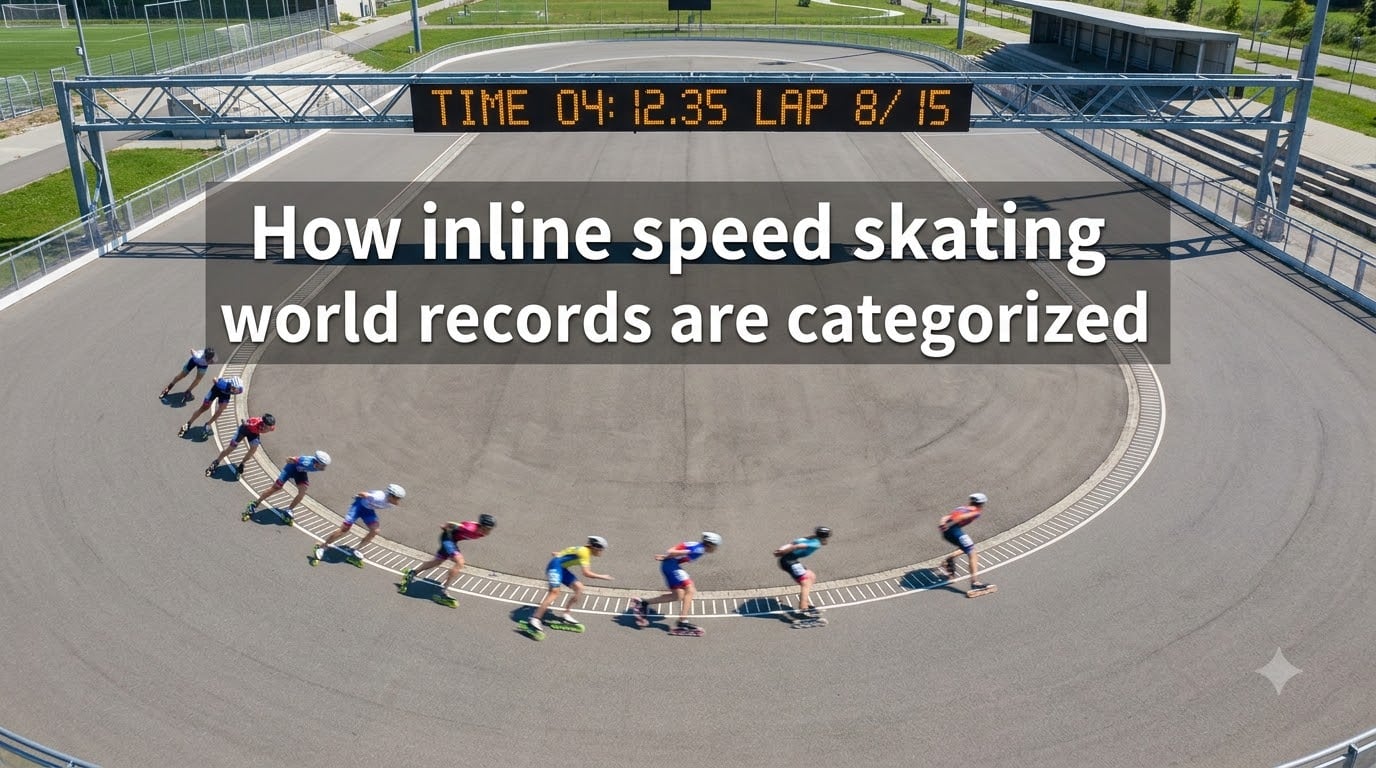
If you have spent any time around the inline speed skating community, you have probably heard someone refer to “the track record” or “the road record” as if these were completely different sports. In many ways, they are. Inline speed skating world records are categorized into a structured system that separates track events from road events, splits records by gender, and further subdivides them by distance and age class.
I have been following competitive inline skating for years, and one of the most common questions I get from newer skaters is: why are there so many different record categories? The answer is simpler than you might think. Each category exists because of equipment differences, racing surfaces, and the way the sport’s governing body wants to keep fair comparisons. In this guide, I will walk you through how inline speed skating world records are categorized, who ratifies them, and where to find the most current numbers.
Table of Contents
What Are Inline Speed Skating World Records and Who Governs Them?
Inline speed skating world records are the fastest officially ratified times across specific distances, surfaces, and athlete categories. They are not just informal bests from a training session or a local race. For a time to count as a world record, it has to be set at a sanctioned competition under strict conditions, with verified timing and the proper equipment specifications.
The official governing body is World Skate, which was formerly known as FIRS (Fédération Internationale de Roller Sports). World Skate ratifies records across both track and road disciplines and publishes them in official lists updated after each major championship season. National federations like US Speedskating work under the World Skate umbrella, but only World Skate itself has the authority to certify a new world record.
Records are also tracked separately for ice speed skating under the International Skating Union (ISU), which is a completely different organization. Inline records are not interchangeable with ice records, even though the events often share distance names. If you see a “500m world record” in a top search result, you need to check whether it refers to the ice or inline version because they live in separate record books.
How Inline Speed Skating World Records Are Categorized by Discipline
The first and most important split in the inline speed skating world records categorized system is discipline: track or road. These are not just two ways of racing the same thing. They are treated as separate sports for record purposes.
Track records are set on a closed oval circuit with a specific banking and surface. The standard is a 200-meter indoor or outdoor track, similar in shape to an ice speed skating oval, though often smaller. Sprints, middle distances, and relay events all happen on track. Times are typically very fast because skaters have constant cornering support and a consistent surface.
Road records are set on open public roads that are temporarily closed for competition. Races like marathons, half-marathons, and 100km events take place on road. The terrain can vary from flat city circuits to hillier point-to-point courses. Elevation, wind, and road surface quality all play a role in road times, which is why road records tend to look slower on paper compared to track records at the same nominal distance.
This track vs road split exists because comparing a track 500m time against a road 500m would not be fair to either discipline. Different equipment is allowed, different tactics apply, and the surface itself produces different results. World Skate maintains eight track record categories (four distances for men, four for women) and eleven road record categories across distances and team events.
Gender Categories in Speed Skating Record Keeping
The next layer of categorization is gender. Inline speed skating world records are kept entirely separately for men and women, just like in ice speed skating, track and field, and swimming. You will never find a men’s and women’s record listed together in the same row, and the two are not directly comparable for ranking purposes.
Historically, this separation grew out of the same reasons it exists in most sports: physiological differences, separate competitive divisions, and the structure of race entries. Today, World Skate sanctions men’s and women’s events at every official distance on both track and road. Each gender then has its own world record at each distance.
In practice, the men’s records tend to be faster by roughly 8-12% over middle distances like 1000m and 3000m. For sprints like 300m on track, the gap is narrower, around 6-7%. These numbers are not part of any official categorization rule, but they help explain why the records are kept in completely separate lists rather than combined rankings.
Distance Event Classifications From Sprints to Marathons
Within each discipline and gender, records are subdivided by distance. World Skate recognizes a clear hierarchy of events that ranges from short bursts of speed to endurance tests lasting hours.
The track distances commonly recognized for world records include 300m, 500m, 1000m, 1500m, 3000m, 5000m, 10000m, and 15000m. Team pursuit events also have their own record categories. Road events typically include distances like 100m sprint road, one-lap road race, marathon (42.195km), and ultramarathon (100km or more).
These distances are often grouped into three informal categories that help readers understand the difference between events:
Sprint distances (300m to 1000m): Explosive speed, anaerobic effort, often decided in under 90 seconds.
Middle distances (1500m to 5000m): Mix of speed and endurance, require both power and pacing.
Long distances (10000m, marathon, ultra): Aerobic endurance tests, with tactics and drafting playing a much larger role.
The distance you choose to compete in dramatically changes the training, equipment setup, and even your choice of skates. This is why each distance has its own record slot rather than being combined into a single “best performance” metric.
How Wheel Size Regulations Shape Record Categories?
One thing that often confuses people new to the sport is that equipment rules vary by event, and these rules directly affect which records count. Inline speed skating world records can only be set on equipment that meets the regulations for the specific distance.
For most track events, World Skate regulations cap wheel diameter at 110mm. For road events, smaller wheel diameters like 100mm or 110mm are typical, and some ultra-endurance events allow different specifications. Frames are also restricted to a maximum length depending on the event.
This is why record categories are not purely about distance. Two skaters running the same 1000m on different wheel setups can produce very different times, even if their physical ability is identical. By tying records to specific equipment classes, World Skate keeps the comparisons fair across generations of equipment improvements. A 1998 record set on 80mm wheels cannot directly compete with a modern record set on 110mm wheels, so each configuration has its own line in the record book.
The Skating subreddit and other community forums regularly surface confusion about these rules. The simplest way to remember it: every record category has both a distance label and an equipment spec, even if the latter is not always shown in casual references.
Indoor vs Outdoor Record Distinctions
A subtler layer of categorization is venue type: indoor versus outdoor. Inline skating events are held both ways, and the conditions produce measurably different results.
Indoor tracks typically offer controlled conditions: no wind, consistent temperature, and a measured surface. This is where the fastest sprint records tend to be set because variables are minimized. Outdoor tracks can also host records but are subject to weather, with wind and humidity both playing small roles in elite-level timing.
Road events are always outdoor by definition, but even there, comparisons between a flat city marathon and a hilly point-to-point ultra event are not equal. World Skate’s road record lists do combine these into general categories like “marathon” and “100km,” but records at hilly courses tend to be slower than flat-course records at the same distance. If you are benchmarking your own time, knowing the course profile is just as important as the distance.
Age Categories in Inline Speed Skating Records
Beyond discipline, gender, and distance, inline speed skating world records are also split by age category. The main categories are Senior and Junior, with Junior typically covering athletes up to age 19 or 20 depending on the federation’s rules.
Senior records represent the absolute peak of the sport. Junior records are kept separately so that younger athletes have meaningful benchmarks even before they are physically developed enough to compete with senior elites. There are also sub-categories at the national federation level, such as U17, U15, and U13, but only Senior and Junior world records are ratified by World Skate at the international level.
If you are a younger skater looking at the world record list and feeling discouraged, look at the Junior column first. The Junior men’s 300m track record, for example, is meaningfully slower than the Senior men’s record, and that gap is the entire development arc you are training through. The age category system exists precisely to give that growth path measurable waypoints.
Current World Record Examples by Distance
Specific numbers help make these categories feel real. Here are examples of current Senior world records across the main event types, based on the official World Skate records list.
On track, the Senior men’s 300m sprint record sits around 17.231 seconds, set in 2026. The Senior women’s 300m record stands near 18.531 seconds. These sprint records show how close the gender gap is at the shortest distances.
Over longer track distances, the Senior men’s 1000m record is held below 1 minute 18 seconds, while the Senior men’s 10000m record is in the 14 minute 30 second range. On the road side, the marathon world record sits around 1 hour 8 minutes for senior men, with women’s records running roughly 8-10 minutes slower.
These numbers change whenever a major championship or sanctioned competition delivers a faster time. World Skate updates the official list after each ratification cycle, so always cross-check against the current World Skate publication rather than relying on cached screenshots from past seasons.
How to Verify Official Inline Speed Skating World Records?
If you want to confirm whether a record you saw mentioned is actually current, here is the verification process I use.
First, go directly to the World Skate website at worldskate.org and look for the Speed discipline section. The official world records PDF is published there and updated after each season. That PDF is the primary source for any record claim involving World Skate events.
Second, cross-reference with your national federation. US Speedskating, the Korean federation, and the Colombian federation all maintain their own record lists. These are useful for confirming that a record set in a particular country has been properly submitted through the national body to World Skate.
Third, check the event sanctioning documentation. A record only counts if the race was sanctioned by World Skate or a recognized national federation under World Skate rules. Unverified times, even from large marathons, are not records unless the sanctioning chain is confirmed. This is the step most casual sources skip.
Frequently Asked Questions About Inline Speed Skating Records
What are the world records in speed skating?
The world records in speed skating are the fastest officially ratified times across a structured set of categories. For inline speed skating, those categories are split by discipline (track or road), gender (men or women), and distance (from 300m sprints to 100km ultras). Each combination has its own record kept by World Skate, the international governing body. Ice speed skating records are tracked separately by the International Skating Union and are not interchangeable with inline records.
Who is the fastest inline speed skater in the world?
There is no single fastest skater across all categories because records are split by distance, gender, and discipline. In the Senior men’s 300m track sprint, the current world record holder posted a time near 17.231 seconds in 2021. In longer events, different skaters hold the records. The fastest skater in any given event depends on which category you are asking about.
Why are speed skating records separated by track and road?
Track and road records are separated because the racing conditions, equipment allowances, and tactics differ significantly between the two. Track events are held on a closed banked oval that allows for fast, repeatable sprint times. Road events are held on open roads where elevation, weather, and drafting play a much larger role. Comparing times across the two would not be fair, so each gets its own record list.
How do wheel size rules affect inline speed skating world records?
Wheel size regulations cap the maximum wheel diameter allowed for each event type, typically 110mm for most track and road races. Because faster equipment can produce faster times, world records are tied to specific equipment specifications as well as the distance. A record set on 80mm wheels cannot be directly compared to one set on 110mm wheels, which is why categories include both the distance label and the equipment standard.
Are inline speed skating world records recognized by the Olympics?
Inline speed skating is not currently an Olympic event, so its world records are not Olympic records. However, World Skate continues to ratify records through its own international competitions and works toward broader recognition. Inline records are fully recognized at the world championship level and form the official benchmarks for the sport outside the Olympic framework.
Final Thoughts on Inline Speed Skating Record Categories
Understanding how inline speed skating world records are categorized comes down to four intersecting axes: discipline (track or road), gender (men or women), distance (sprint, middle, long), and age class (Senior or Junior). Layered on top of that are equipment specs like wheel size and frame length, plus venue distinctions like indoor versus outdoor conditions.
Each layer exists to make sure that when you read a record number, it means something specific. The next time you see a record quoted on a forum or in an article, check which combination of these categories it sits in. That single step turns a number into context, which is exactly what the categorization system was designed to provide.
For the most current numbers, head to the World Skate speed discipline page and download the latest official PDF. That source is updated after each season and represents the canonical list of how inline speed skating world records are categorized today.