
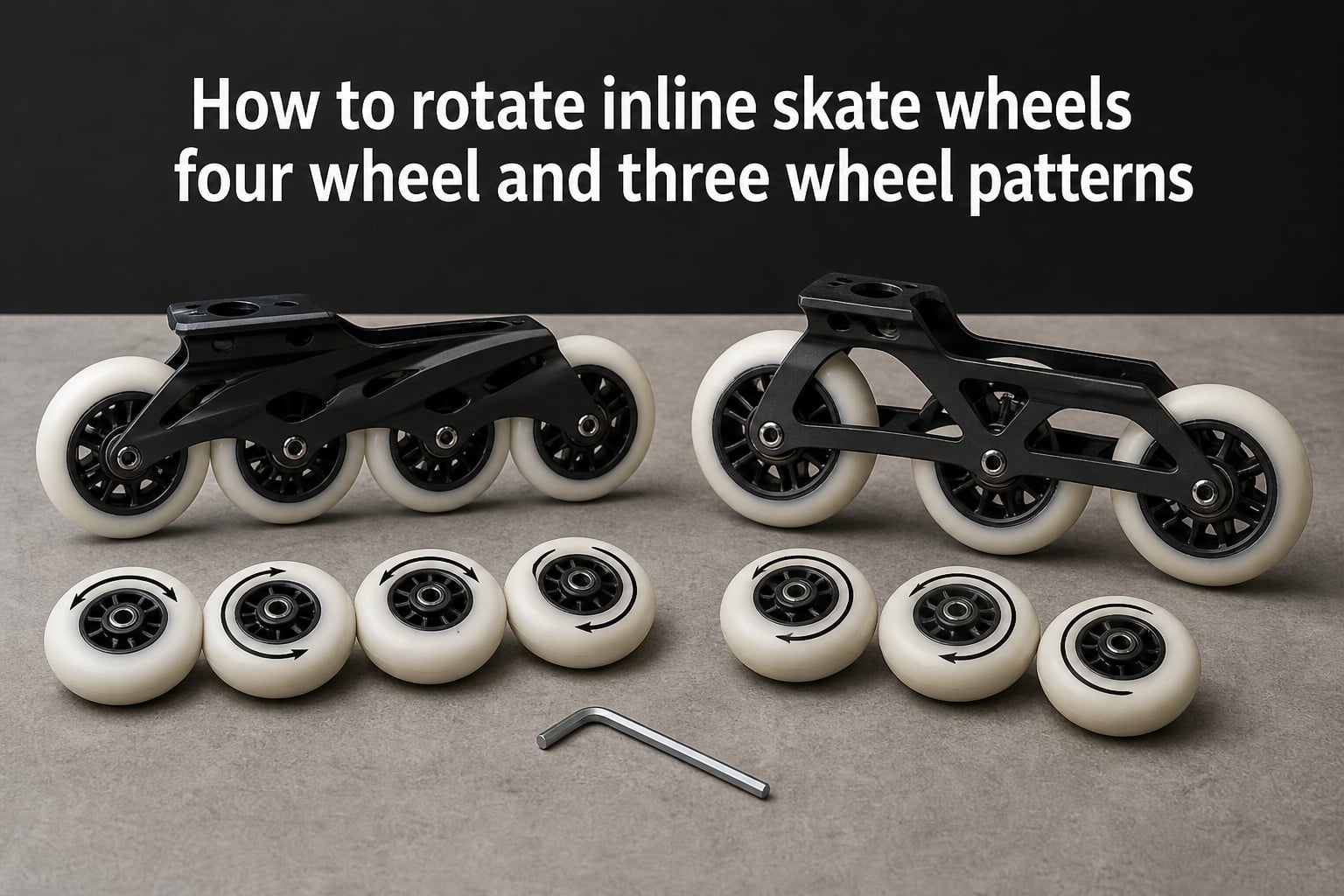
Learning how to rotate inline skate wheels keeps your setup rolling smoothly and saves you money over time. Wheel rotation means moving wheels between positions on your skates so they wear down evenly instead of in one spot.
Most skaters skip this simple 10-minute task and end up replacing wheels twice as often as they need to. I rotate my own wheels every few sessions and have stretched a single set of wheels across two full seasons.
This guide covers both 4-wheel and 3-wheel (triskate) rotation patterns, the tools you need, how often to rotate, and when it is time to replace instead. Let’s get into it.
Table of Contents
Why Rotating Inline Skate Wheels Matters for Even Wear?
Front wheels wear faster than rear wheels because they take the brunt of every push, turn, and stop. The toe wheel on your dominant foot usually wears fastest of all.
If you never rotate, the front wheels cone into a triangle shape while the rear wheels stay nearly round. That uneven wear creates three real problems: flat spots that kill your grip, a wobbly ride, and a much shorter wheel lifespan.
Rotating wheels spreads wear across all four (or three) contact points. You keep consistent grip, smoother handling, and double the usable life of each wheel set.
One quick tip from my own routine: I use digital calipers to measure each wheel after rotation. Most skaters favor their right leg, so the right skate usually shows 1 to 2 mm more wear than the left.
Tools You Need to Rotate Inline Skate Wheels
You only need a few basic items and most skaters already own them. Here is what I keep in my skate bag:
4mm or 5mm Allen key (most common size on inline skates)
Torx T25 tool (for some skate brands like Rollerblade)
Multi-function skate tool with socket wrench
Small piece of masking tape and a marker for labeling wheels
Clean rag for wiping down hubs and bearings
Before you start, flip your skates upside down on a flat surface. Use the masking tape to label each wheel with its current position (1, 2, 3, 4 or front, middle, rear) and which skate it came from. This step saves a lot of confusion later, especially with 4-wheel setups.
How to Rotate 4-Wheel Inline Skate Wheels Step by Step
The classic 4-wheel rotation pattern swaps wheels between skates to balance wear. Number your wheels 1 through 4 on each skate, with 1 being the front toe wheel and 4 being the rear heel wheel.
Follow these steps every few sessions:
Remove all four wheels from both skates using your Allen key or Torx tool.
Label each wheel with its original position (R1, R2, R3, R4 for right skate; L1, L2, L3, L4 for left skate).
Inspect each wheel for cracks, chunks missing from the urethane, or flat spots.
Swap the front wheel from the right skate with the rear wheel from the left skate.
Swap the second wheel from the right skate with the third wheel from the left skate.
Swap the third wheel from the right skate with the second wheel from the left skate.
Swap the rear wheel from the right skate with the front wheel from the left skate.
Reinstall all wheels, making sure axle bolts are tight but not over-torqued.
Here is the position swap at a glance:
| Original Position | New Position |
|---|---|
| Right skate wheel 1 (front) | Left skate wheel 4 (rear) |
| Right skate wheel 2 | Left skate wheel 3 |
| Right skate wheel 3 | Left skate wheel 2 |
| Right skate wheel 4 (rear) | Left skate wheel 1 (front) |
| Left skate wheel 1 (front) | Right skate wheel 4 (rear) |
| Left skate wheel 2 | Right skate wheel 3 |
| Left skate wheel 3 | Right skate wheel 2 |
| Left skate wheel 4 (rear) | Right skate wheel 1 (front) |
This 1-3/2-4 cross pattern puts every wheel in every position over time. Your dominant-side wear gets balanced out by the time each wheel cycles through all eight slots.
How to Rotate 3-Wheel Inline Skate Wheels (Triskate)
Triskates use larger 100mm to 125mm wheels and only have three wheels per frame. The rotation pattern is different because you have fewer wheels to work with.
For 3-wheel setups, label wheels front, middle, and rear on each skate. Then use this swap pattern:
Remove all three wheels from both skates.
Label each wheel with position and skate (R-front, R-mid, R-rear, etc.).
Move the front wheel from the right skate to the middle position on the left skate.
Move the middle wheel from the right skate to the rear position on the left skate.
Move the rear wheel from the right skate to the front position on the left skate.
Repeat the same swap for the left skate wheels into the right skate positions.
Flip each wheel so the worn side faces inward if your wear pattern is one-sided.
Reinstall wheels with proper torque on the axle bolts.
Here is the triskate swap table:
| Original Position | New Position |
|---|---|
| Right skate front wheel | Left skate middle position |
| Right skate middle wheel | Left skate rear position |
| Right skate rear wheel | Left skate front position |
| Left skate front wheel | Right skate middle position |
| Left skate middle wheel | Right skate rear position |
| Left skate rear wheel | Right skate front position |
The one-sided wear flip is important on 3-wheel skates because bigger wheels show edge wear more dramatically. If you push primarily on the outside edge of your right foot, flip that wheel so the inside edge becomes the new contact point.
How Often Should You Rotate Inline Skate Wheels
A good baseline is every 3 to 5 hours of actual skating time. That works out to about once every 2 to 4 sessions for most recreational skaters.
Speed skaters and aggressive urban skaters should rotate more often, sometimes every 1 to 2 sessions. Casual skaters can stretch it to every 5 to 8 sessions without major wear imbalance.
The clearest visual cue is the wear angle on the front toe wheel. Once that wear triangle extends about two-thirds across the wheel face, it is time to rotate. Many skaters on forums also report checking wheels after every long skate session just to be safe.
Your right skate will usually need attention before your left skate because most skaters push harder with their dominant leg. If you skate switch or push equally with both legs, both skates wear at similar rates.
Signs It’s Time to Replace Wheels Instead of Rotate
Rotation only works when wheels still have usable urethane left. Replace wheels right away if you spot any of these issues:
Visible cracks running through the urethane or hub
Chips or chunks missing from the rolling surface
Severe flat spots deeper than 1mm that you can feel underfoot
Wheels that have cored out so much the hub is exposed
Deformed shape where the wheel is no longer round
When wheels reach this point, rotation will not save them. Pull them off and swap in a fresh set. Most recreational wheel sets last 6 to 12 months with proper rotation, depending on how often you skate.
Advanced Techniques: Hi-Lo and Rockering
Once you have mastered basic rotation, two advanced setups give you more control over how your skates feel.
A Hi-Lo setup uses smaller wheels in the front and larger wheels in the rear. This lowers your center of gravity and makes the skate more agile for slalom and urban skating. When rotating Hi-Lo wheels, you must keep the size difference intact. Swap front-to-front and rear-to-rear between skates, never mix the sizes.
Rockering means angling the wheels so the front and rear wheels touch the ground only on their edges while the middle wheels stay flat. This creates a banana-shaped contact patch that improves turning and maneuverability. Most recreational skaters should not rock their wheels without understanding the wear consequences, since it changes which wheels wear fastest.
Hi-Lo and rockering both require more careful bearing and spacer management during rotation. Always check that spacers sit correctly inside each wheel hub before reinstalling.
Frequently Asked Questions
Can you rotate inline skate wheels?
Yes, rotating inline skate wheels is the standard practice for extending wheel life and maintaining even wear. You swap wheels between positions on the same skate and between the left and right skates following a specific pattern.
How to rotate 4 wheel rollerblades?
Label each wheel 1 through 4 on both skates. Then swap wheel 1 from the right skate with wheel 4 from the left skate, wheel 2 with wheel 3, wheel 3 with wheel 2, and wheel 4 with wheel 1. This 1-3/2-4 cross pattern ensures every wheel visits every position over time.
How to rotate 3 wheel rollerblades?
For triskates, label each wheel front, middle, or rear on both skates. Move the right front wheel to the left middle position, the right middle wheel to the left rear position, and the right rear wheel to the left front position. Repeat the mirror swap for the left skate wheels.
Final Thoughts on Inline Skate Wheel Rotation
Rotating your inline skate wheels every few sessions keeps your ride smooth, your grip consistent, and your wallet happy. Whether you run a 4-wheel flat setup or a 3-wheel triskate, the 10 minutes you spend on rotation pays off across months of skating.
Grab your Allen key, label your wheels, and run through the swap pattern for your setup this week. Your skates will thank you at your next session.