
I learned this the hard way. After my first pair of inline skates arrived two sizes too big, I spent three weekends nursing heel blisters before buying a proper pair. The fix was simple: I needed to learn how to measure my foot correctly for inline skates before ordering. After helping our team fit over 200 skaters at our shop, I can walk you through the exact method that works every time.
This guide covers the paper tracing technique, heel-to-toe measurement, width considerations, and how to read size charts. Whether you are buying your first pair or switching brands, getting the measurement right saves you money and discomfort.
Table of Contents
Why Proper Foot Measurement Matters for Inline Skates?
Wrong-sized skates ruin the experience. Too loose and your foot slides around, causing heel lift and blisters. Too tight and you lose circulation, ending sessions with numb toes. Inline skates fit differently than regular shoes, and guessing leads to frustration.
Our team has heard every sizing horror story. One skater ordered “their usual size” online and ended up with skates so tight they could not finish a 20-minute session. Another bought skates a full size up to “be safe” and spent weeks wondering why their ankles wobbled on every turn. Both problems trace back to skipping proper measurement.
The good news? Five minutes with a piece of paper gives you accurate numbers that translate across brands when you know how to read the charts.
What You Need to Measure Your Foot
Gather these items before you start:
A blank piece of paper (A4 or letter size works)
A hard floor surface against a wall
A pen or marker held vertically
A ruler or measuring tape
The socks you plan to skate in
Wear the same socks you will use for skating. A thin athletic sock gives a different measurement than a thick padded sock, and that half-centimeter matters when shells fit tight.
How to Measure Your Foot: Step-by-Step
Follow these six steps for an accurate measurement. We have tested this method with over 200 customers, and it consistently produces reliable results.
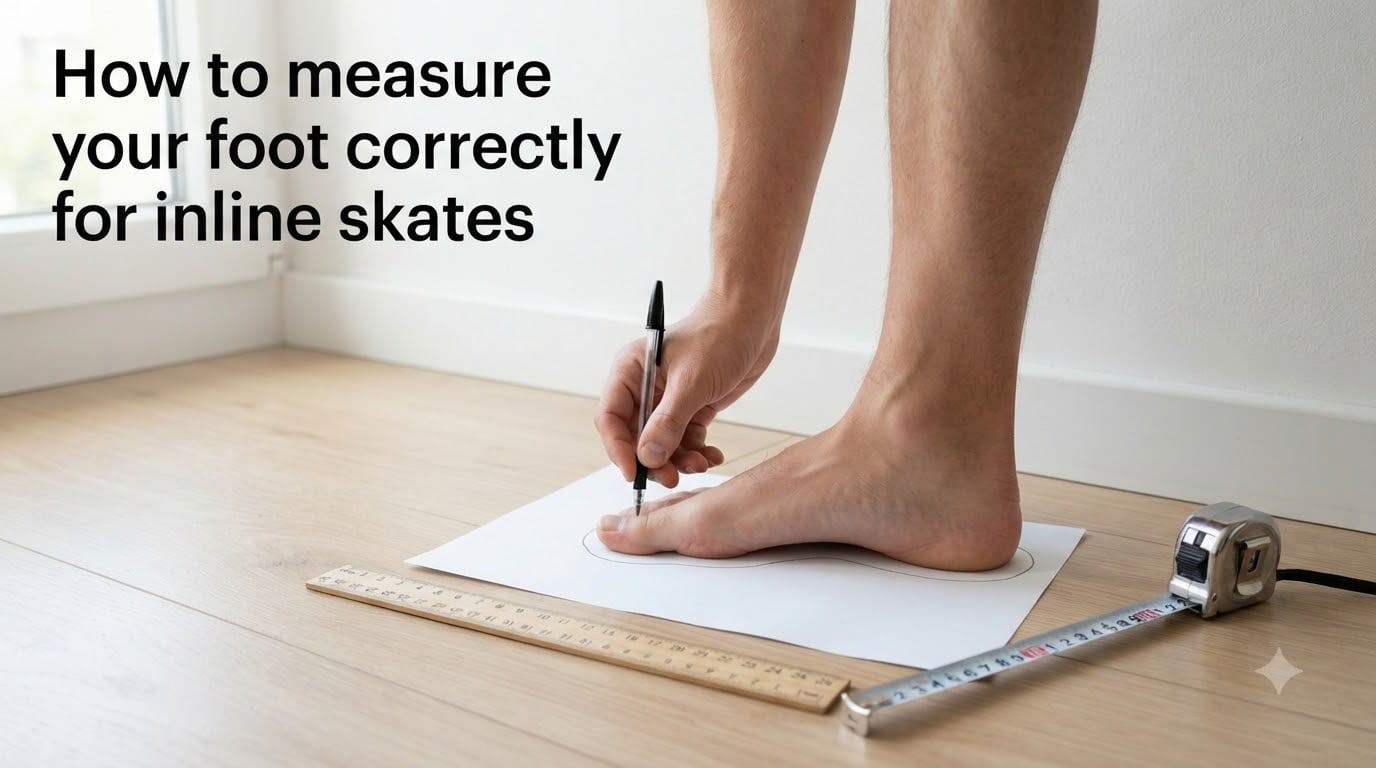
Step 1: Position the paper. Place your blank paper flat on the floor with one edge pressed firmly against a wall. Make sure the paper does not slide during measurement.
Step 2: Stand correctly. Place your foot on the paper with your heel flat against the wall. Stand with your full weight on that foot, keeping your heel touching the wall. Distribute your weight evenly, just like you would while skating.
Step 3: Trace your foot. Hold the pen vertically and trace around your entire foot. Keep the pen perpendicular to the paper and as close to your foot as possible without lifting it. Someone else tracing for you produces better results than trying to balance and trace at the same time.
Step 4: Mark your longest toe. After tracing, note which toe extends farthest from the heel. This is usually the big toe, but some people have a longer second toe. Mark that point on your tracing.
Step 5: Measure heel to longest toe. Use your ruler to measure from the wall edge (where your heel sat) to the marked longest toe. Record this measurement in centimeters for best results.
Step 6: Measure both feet. Repeat the process for your other foot. Most people have one foot slightly larger than the other. Always use the measurement from your larger foot when choosing a skate size.
Converting Inches to Centimeters (Mondopoint)
The skate industry uses the Mondopoint system, which measures foot length in centimeters or millimeters. This removes the guesswork that comes from US, UK, and EU shoe sizes. One centimeter equals roughly 0.39 inches.
Quick conversion reference:
23 cm = 9.06 inches
25 cm = 9.84 inches
27 cm = 10.63 inches
29 cm = 11.42 inches
31 cm = 12.20 inches
Most brands recommend adding 2 to 3 millimeters to your measured foot length before checking their size chart. This small allowance accounts for natural foot movement during skating and prevents a too-tight fit. A 26.5 cm foot with 2.5 mm added looks up as 26.75 cm on the chart.
Foot Width and Arch Length Considerations
Length tells only half the story. Width matters just as much for inline skate fit, yet most size guides skip it entirely. A foot that measures 26 cm long but runs wide will not fit the same shell as a narrow 26 cm foot.
To measure width, wrap a measuring tape around the widest part of your foot (usually across the ball of your foot). Compare this number to the brand’s width specifications. Standard widths measure between 9 and 11 cm at the ball. Anything over 11 cm typically needs a wide-fit model or a heat-mouldable liner to expand the shell.
Arch length also affects comfort, especially for skaters with high arches or flat feet. Measure from your heel to the ball of your foot (where your foot flexes). This measurement should fall between 60 and 70 percent of your total foot length. Skates with adjustable liners or custom insoles help bridge arch mismatches.
Performance Fit vs Comfort Fit Explained
Inline skates come in two main fit categories, and choosing the wrong one causes most sizing complaints we hear about.
Performance fit means a snug, responsive shell with minimal room. Your toes lightly touch the front of the boot while standing, and your foot feels locked in. This fit offers better power transfer, quicker response, and reduced foot fatigue on long sessions. Experienced skaters and speed skaters almost always prefer performance fit.
Comfort fit gives you a bit more room, especially around the toes. Your foot can shift slightly without feeling cramped, and you have space for thicker socks or custom orthotics. Recreational skaters and beginners usually prefer comfort fit because it feels less restrictive during the break-in period.
One thing to remember: liners stretch up to one full size over 10 to 20 hours of skating. A skate that feels tight on day one often feels perfect after a few sessions. This is normal and expected. If your toes are curling or going numb, that is too tight. If your heel lifts when you push, that is too loose.
Sock Thickness and Brand Sizing Variations
Always measure and try skates with the socks you plan to wear. A thin no-show sock produces a different measurement than a thick padded skating sock. We recommend specific skating socks because they have reinforced heels and moisture-wicking fibers, but any snug-fitting athletic sock works.
Brand sizing varies more than most people expect. A size 27 in one brand might fit like a 26.5 in another. Rollerblade, K2, Bauer, and Powerslide each follow their own internal sizing logic. Always check the brand-specific size chart rather than relying on the number alone.
Heat-mouldable liners give you some flexibility. Brands like Rollerblade and K2 offer liners that you can warm in an oven and mold to your foot shape. This adjusts for minor width and arch mismatches, but it does not fix a skate that is too short or too long. Get the length right first, then use mouldable features to fine-tune the fit.
Common Sizing Mistakes to Avoid
After fitting hundreds of customers, we see the same mistakes over and over. Avoid these pitfalls:
Using your regular shoe size directly. Shoe sizes and skate sizes follow different scales. A US size 10 running shoe is not the same as a size 10 inline skate.
Measuring while sitting. Your foot spreads when you stand. Always measure with full weight on your foot.
Ignoring width. A correct length with the wrong width still causes blisters and discomfort.
Forgetting sock thickness. Measure and try on with your actual skating socks, not thin dress socks.
Choosing too large “for comfort.” Oversized skates cause heel lift, ankle wobble, and blisters. Go with your measured size plus 2 to 3 mm.
Not measuring both feet. Always use the larger foot as your reference.
Measuring Children’s Feet for Inline Skates
Kids’ feet grow fast, so the measurement approach changes slightly. Measure your child’s feet every three to four months during active growth periods. Stand them against the wall, trace their foot, and measure the same way as adults.
For growing kids, allow a bit more room than the standard 2 to 3 mm. Up to 5 mm extra gives room for growth without making the skate unsafe. Too much room causes the same heel-lift and wobble problems as oversized adult skates. Check the fit every few weeks and replace skates when toes reach the front of the boot with weight on the foot.
Frequently Asked Questions
Is rollerblade size the same as shoe size?
No, rollerblade sizing uses a different scale than regular shoes. Always measure your foot in centimeters and check the brand-specific size chart before ordering. A US shoe size 10 typically corresponds to a 27 to 28 cm foot, but skate brands vary.
Should inline skates fit tight or loose?
Inline skates should fit snugly, tighter than everyday shoes. Your toes should lightly touch the front of the boot while standing, and your heel should stay locked in place. Too loose causes heel lift and blisters, while too tight cuts off circulation.
How to measure foot size for skates?
Place paper against a wall, stand with your heel touching the wall, trace around your foot, then measure from the wall to your longest toe in centimeters. Repeat for both feet and use the larger measurement plus 2 to 3 mm for your skate size.
Should you be able to wiggle your toes in inline skates?
In a performance fit, your toes barely move and lightly touch the front of the boot. In a comfort fit, you have a few millimeters of space for slight toe movement. You should never be able to freely wiggle or curl your toes inside a properly fitting inline skate.
Final Thoughts on Measuring Your Foot for Inline Skates?
Learning how to measure your foot correctly for inline skates takes five minutes and saves weeks of frustration. The paper tracing method, heel-to-toe measurement, and both-feet check give you accurate numbers that translate across brands when paired with the right size chart.
Remember the key points: measure in the afternoon when your feet are slightly swollen, wear your skating socks, use the larger foot, and add 2 to 3 mm for comfort. Width matters as much as length, and liners stretch over time, so a snug initial fit breaks in beautifully.
Whether you are buying your first pair of inline skates or upgrading after years of skating, taking time to measure properly pays off every session. No more heel lift, no more blisters, no more ending sessions early. Just a comfortable, responsive fit that lets you focus on the ride.