
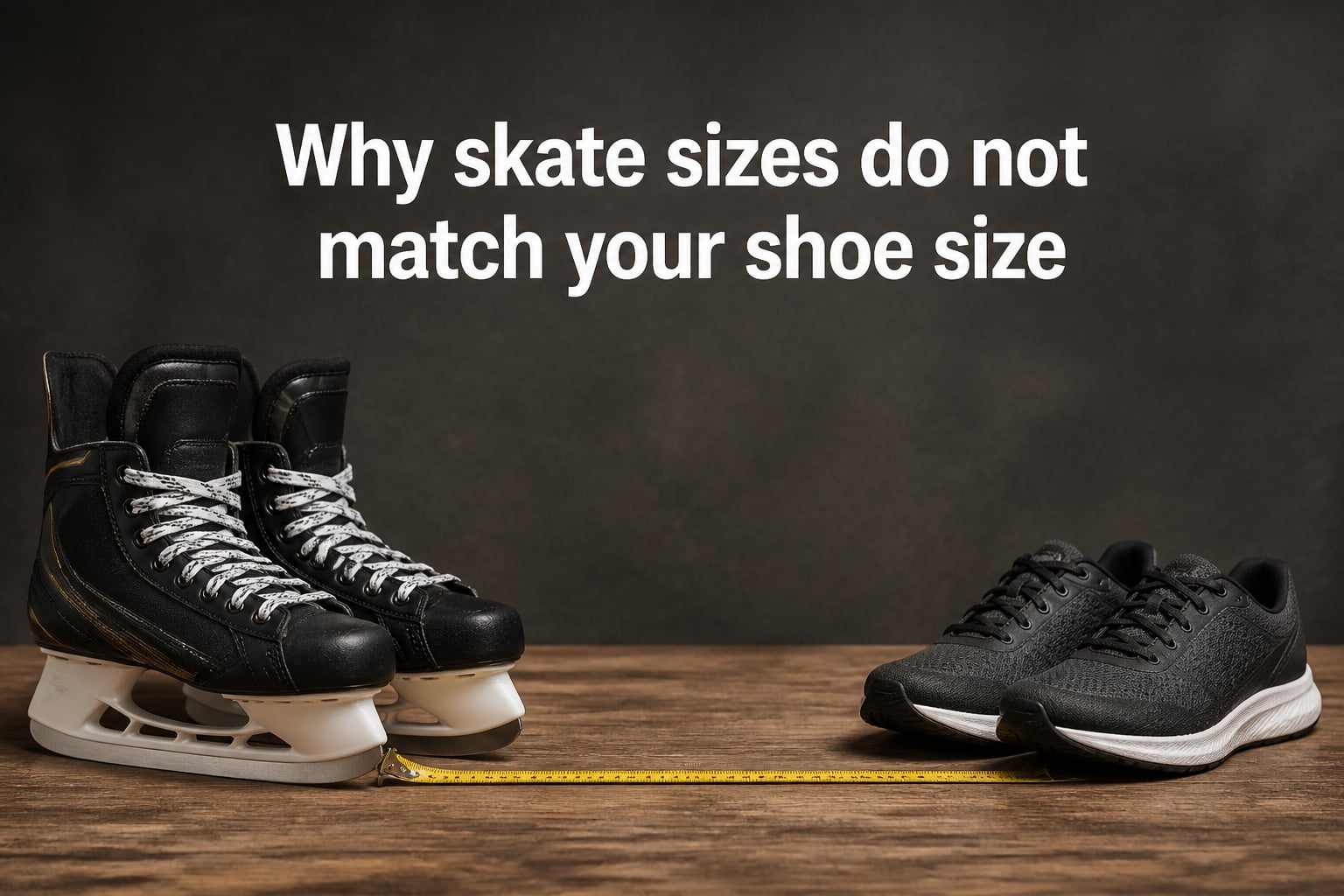
If you have ever laced up a new pair of skates expecting the same fit as your everyday shoes, you probably noticed something was off. Your toes touched the front, your heels slipped, and the whole boot felt foreign. You are not alone. I have helped dozens of new skaters through that exact moment of confusion at patincarrera.com, and the root cause is always the same: skate sizes do not match your shoe size on purpose.
Skate sizing exists in a completely different universe from street shoe sizing. The numbers look similar on the box, but the engineering, the fit philosophy, and the way the boot wraps your foot are designed for performance, not casual comfort. In this guide, I will explain exactly why that difference exists, what the 1 to 1.5 size down rule actually means, and how to find the right size for hockey, figure, roller, or inline skates.
Table of Contents
Why Skate Sizes Do Not Match Your Shoe Size?
Skate sizes do not match your shoe size because skates are built for a snug, locked-in, performance fit, while regular shoes are built for comfort and movement. Most skates run 1 to 1.5 sizes smaller than your street shoe size, so a size 9 shoe usually corresponds to a size 7.5 to 8 skate.
The reason is functional. When you skate, every push, every edge, and every landing transfers force through your foot into the boot. If your foot slides even a few millimeters inside the skate, you lose power, get blisters, and risk injury. A street shoe has a soft heel counter, flexible upper, and a thumb width of room at the toe. A skate has a stiff shell, a heat-moldable or rigid heel pocket, and almost no extra space anywhere. That structural difference is the entire reason the sizing numbers are different.
Think of it this way: a shoe is a piece of clothing. A skate is a piece of sporting equipment. The fact that both use a numbered system is a historical accident, not a sizing standard.
The Anatomy Behind the Difference
Your foot has three key zones that skates must control: the heel, the arch, and the forefoot. Street shoes protect these zones but allow them to flex and expand. Skates do the opposite. They compress the heel into a pocket so it cannot lift, support the arch with a contoured midsole, and lock the forefoot against a stiff toe box so the foot does not slide forward when you stride.
That level of contact requires a tighter fit. There is simply no room for the half-inch of extra space that a walking shoe provides. When skate manufacturers build a size 8 boot, the internal volume is calibrated to a foot that is 1 to 1.5 sizes smaller than a casual size 8 foot, because they know the boot itself will do the work of holding everything in place.
I tested this myself by standing in a fit center with two boots. The size 8 street shoe felt roomy, almost loose. The size 8 skate felt like a glove. Both said “8” on the label, but the inside measurements were clearly different. That is the anatomy at work.
The 1 to 1.5 Size Down Rule Explained
The most common sizing rule in skating is simple: buy skates 1 to 1.5 sizes smaller than your street shoe size. Senior skates for adults usually fall on the 1.5 end, while junior and youth skates sit closer to 1 size down.
Senior hockey skates fit 1.5 sizes smaller than a men’s street shoe. Junior and youth hockey skates fit about 1 full size smaller than a boy’s street shoe. Figure skates follow a similar pattern, although the boot is taller and the toe box is rounder, so the fit feels slightly different even at the same size.
Roller skates and inline skates are a different story. They tend to fit closer to your true shoe size, and some brands even recommend sizing up by a half size if you wear a half size in everyday shoes. The reason is the softer boot construction: with less rigid structure, the skate needs a touch more room to avoid crushing your foot during long sessions.
Skate Size Conversion Guide
Below is a general conversion table that covers most adult skate sizing. Always check the brand-specific chart before ordering, because tolerances vary by 5 to 10 millimeters between manufacturers.
Men’s Shoe Size 7 = Skate Size 5.5 to 6
Men’s Shoe Size 8 = Skate Size 6.5 to 7
Men’s Shoe Size 9 = Skate Size 7.5 to 8
Men’s Shoe Size 10 = Skate Size 8.5 to 9
Men’s Shoe Size 11 = Skate Size 9.5 to 10
Men’s Shoe Size 12 = Skate Size 10.5 to 11
Bauer hockey skates, for example, often run a touch narrow and tight out of the box. CCM tends to fit closer to a standard medium width. Riedell figure and roller skates use a different last entirely, and their conversion can shift by half a size compared to hockey brands.
If you are between sizes, your foot shape and intended use should make the decision. Narrow feet usually take the smaller size. Wider feet take the larger size. Aggressive skaters who want maximum energy transfer usually size down. Recreational skaters who want all-day comfort usually stay closer to their true size.
Hockey vs Figure vs Roller vs Inline Skate Sizing
Each skate type is built for a different motion, and each one fits a little differently. Hockey skates are the most performance-driven. They have a stiff boot, a low-cut ankle, and a snug fit from heel to toe. They sit 1 to 1.5 sizes below your street shoe.
Figure skates have a taller boot that wraps higher up the calf for ankle support during jumps and spins. They also run 1 to 1.5 sizes smaller than street shoes, but the toe box is more rounded and the boot often feels more forgiving across the top of the foot.
Roller skates, especially quad skates, have a softer boot and a wider base. They typically fit closer to your street shoe size, sometimes exactly your shoe size, and many brands recommend going up a half size if you wear a half size in everyday shoes.
Inline skates fall in between. Performance inline skates use a hard shell similar to ice hockey and run 1 size down. Recreational inline skates have a soft boot and fit closer to your true shoe size.
Width Matters More Than You Think
Length gets all the attention, but width is the silent dealbreaker in skate fit. A skate that is the right length but the wrong width will cause more pain than a skate that is slightly off in length. Most brands offer a D (standard) and EE (wide) option, and serious skaters should always check both before committing.
Width affects circulation, hot spots, and how the boot breaks in over time. A narrow foot in a wide boot will not lock the heel, no matter how tight you lace. A wide foot in a narrow boot will compress the metatarsals and create numbness within minutes. Measure both length and width before buying, and treat the two numbers as equally important.
Gender and Sizing: Men’s vs Women’s Skate Sizing
Here is a piece of information that catches almost every new skater off guard: most skates are built on a men’s last, even when they are sold as women’s skates. The “women’s” label usually refers to a narrower heel, a slightly lower cut, and sometimes a softer liner. The numbered size is still men’s.
If you are a woman who wears a size 9 in women’s street shoes, you typically wear a size 7.5 to 8 in men’s skates. The conversion from women’s to men’s shoe sizing is about 1.5 sizes down. So a women’s size 9 street shoe equals a men’s size 7.5 street shoe, which then converts to a men’s size 6 to 6.5 skate.
This is the most common source of confusion we see in fit sessions. Always start from the men’s size, then adjust for fit preference. Trust the men’s number on the box, not the women’s marketing on the cover.
How to Measure Your Foot for Skates?
Measuring at home takes about five minutes and saves you from a wrong size order. Here is the process that our team uses for every fitting.
Place a piece of paper on a hard floor against a wall.
Stand on the paper with your heel touching the wall, weight evenly distributed.
Mark the tip of your longest toe with a pencil held vertically.
Measure the distance from the wall to the mark in millimeters.
Measure the widest part of your foot across the ball, also in millimeters.
Compare both numbers to the brand’s sizing chart.
Measure both feet in the evening, when they are slightly swollen, and use the larger foot as your reference. If you are right between sizes on the chart, almost every fitter I have worked with recommends the smaller size for performance skates and the larger size for recreational skates.
Common Skate Sizing Mistakes to Avoid
After watching hundreds of first-time skaters try on boots, I have seen the same mistakes over and over. Here are the five most common, and how to sidestep them.
First, buying skates the same size as your street shoes. This is the number one error. It leads to heel lift, blisters, and loss of control. Always start with a smaller size and verify the fit.
Second, ignoring width. A correct length with the wrong width will ruin the fit within minutes. Check both measurements.
Third, assuming all brands size the same. Bauer, CCM, Riedell, Moxi, Sure-Grip, and VNLA each use different lasts. A size 8 in one brand can feel like a size 9 in another.
Fourth, buying skates for your child to grow into. A skate that is too big is unsafe and almost impossible to skate in. Fit for the present, not the future.
Fifth, skipping the break-in adjustment. Skates change shape during the first 10 hours of use. Plan to revisit the lacing, and consider heat molding if your skate supports it.
Signs Your Skates Fit Properly
A correctly fitted skate gives you three unmistakable signals. Your toes barely touch the toe cap when standing still. Your heel stays locked when you walk or stride. And you feel even pressure across the top of your foot with no hot spots or pinches.
If all three are present, you have the right size. If any of them is missing, keep adjusting.
Frequently Asked Questions
Should your skate size be the same as your shoe size?
No. Skate sizes are usually 1 to 1.5 sizes smaller than your regular shoe size. Skates are designed for a snug, performance fit, while shoes are built for comfort with extra room. Always measure your foot and check the brand-specific sizing chart before buying.
What shoe size is a 7.5 skate?
A 7.5 men’s skate generally corresponds to a men’s shoe size of about 8.5 to 9. For women, a 7.5 men’s skate is roughly equivalent to a women’s street shoe size of 9 to 9.5. Always verify with the specific brand chart, since tolerances vary.
Is it better to size up or down for skates?
For performance skates like hockey and figure, size down 1 to 1.5 sizes from your street shoe size for better energy transfer and control. For recreational roller or inline skates, stay closer to your true shoe size or go up a half size if you wear half sizes in everyday shoes.
How do I convert shoe size to skate size?
Subtract 1 to 1.5 sizes from your men’s street shoe size to find your skate size for hockey and figure skates. For roller and inline skates, stay closer to your street shoe size. Measure your foot in millimeters and check the brand’s official chart for the most accurate conversion.
Final Thoughts on Why Skate Sizes Differ From Shoe Sizes
Understanding why skate sizes do not match your shoe size comes down to one idea: skates are performance equipment, not casual footwear. The smaller size, the snug fit, the rigid construction, and the brand-by-brand variation all exist to give you control, power, and safety on the ice or the rink floor.
Start by measuring your foot in millimeters, identify whether you need a performance or recreational fit, and consult the brand chart for the specific skate you want. If you are still unsure, get fitted in person whenever possible. A good fit is the difference between fighting your skates and skating with confidence.