
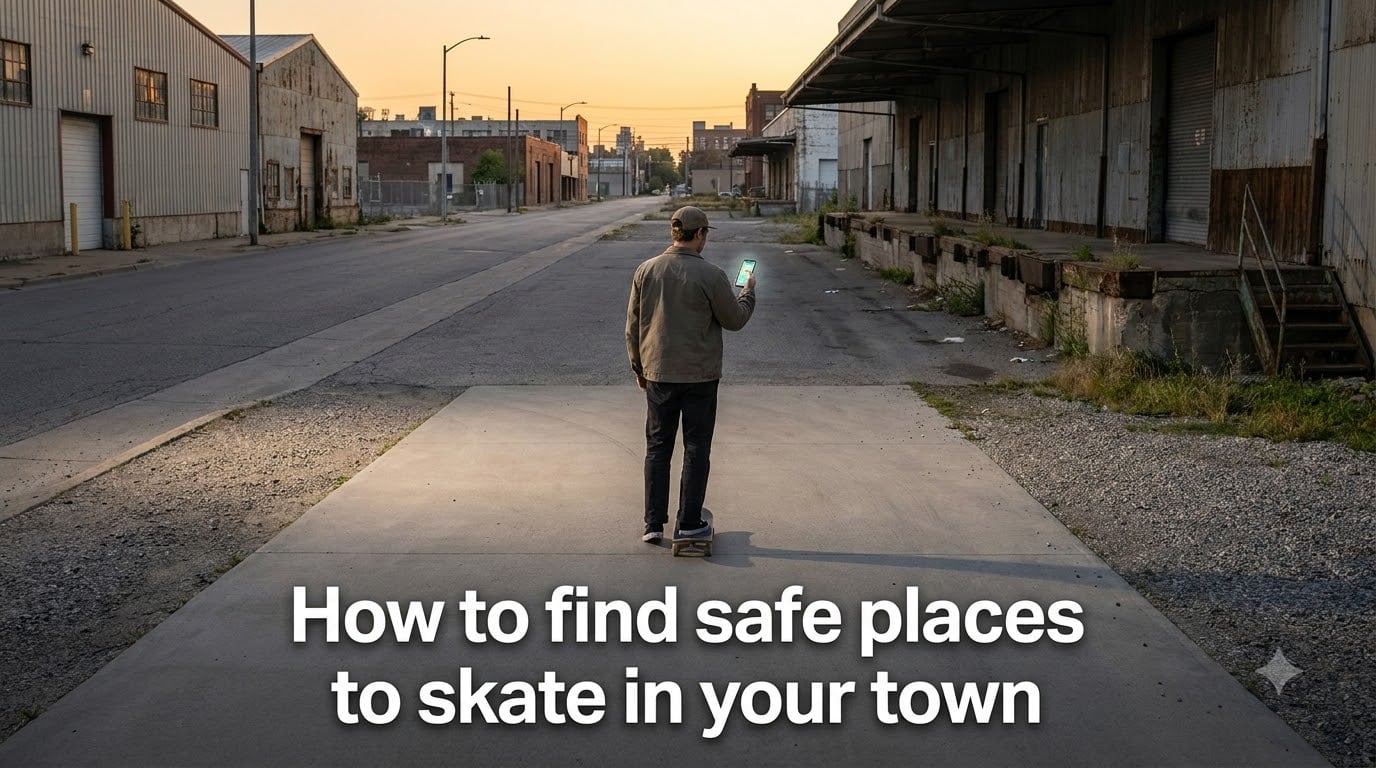
When I first started skating, I lived in a town with zero skateparks and roads that felt like gravel speed bumps. Finding safe places to skate in your town felt impossible until I learned how to look beyond the obvious spots. If you are staring at cracked sidewalks and wondering where everyone actually skates, this guide will walk you through the exact methods I use now.
By the end, you will know how to scout your town using free digital tools, where to look for legal and beginner-friendly surfaces, and how to connect with a community that can point you toward hidden gems. Let us turn that frustration into a real local session plan.
Table of Contents
Why Finding Safe Places to Skate Matters?
Skating on the wrong surface is how most new skaters get injured. Cracked asphalt catches wheels, oily parking lots send you sliding, and busy roads turn a casual push into a survival challenge.
I learned this the hard way when I tried to ollie over a curb next to a delivery truck. The concrete won, my ankle lost, and I spent two weeks questioning my life choices. Safe spots are not just nice to have, they are the difference between consistent progress and a trip to urgent care.
There is also the legal side. Skating on private property or in posted no-skate zones can lead to fines, confiscated boards, or awkward confrontations with security. Knowing where you stand legally keeps your gear in your hands and your stress levels low.
What Makes a Skating Spot Safe?
A safe skate spot has three things working together: a smooth surface, low traffic, and a way out if things go wrong. I run every new location through this mental checklist before I drop in.
Good surface is non-negotiable. Smooth concrete beats asphalt every time because asphalt softens in heat and crumbles over time. Basketball courts, tennis courts, warehouse floors, and freshly poured driveways all qualify. Avoid anything with loose gravel, deep cracks, or visible patches.
Low traffic means fewer people, fewer cars, and fewer eyeballs on you while you learn. Empty lots at off-peak hours beat shopping centers at noon. Look for spots with predictable quiet times, like weekday mornings, late nights in well-lit areas, or weekends when businesses are closed.
Always know your exit. The best spots have multiple ways in and out so you can bail from trouble without skating through a busy zone. I have used this trick more times than I can count when a security guard shows up unexpectedly.
How to Find Safe Places to Skate in Your Town Using Google Maps?
Google Maps is the single best tool for finding skate spots without leaving your couch. I have mapped over 200 pins in my current city using nothing but the satellite and street view features. Here is the workflow our team at patincarrera.com recommends.
Step 1: Pin Every Spot You Already Know
Before you search for new spots, drop a pin on every existing location you have ever skated. Include your house, your friend’s driveway, that basketball court from middle school, and any plaza you have rolled through. This builds your baseline map.
Once you have 10 to 20 pins, you start seeing patterns. Notice which neighborhood types keep showing up. In my case, every pin clustered around industrial zones and older commercial strips. That pattern became my search template.
Step 2: Switch to Satellite View
Satellite view is where the real scouting happens. Zoom out to your whole town, then slowly pan across areas you have never visited. Look for large flat rooftops, empty parking lots, warehouse clusters, and plazas with smooth concrete surroundings.
Industrial areas are goldmines because they usually have wide concrete driveways, drainage ditches with smooth slopes, and abandoned corners nobody visits. I once found a perfect spot behind a self-storage facility just by spotting its empty parking lot from 2,000 feet up.
Step 3: Check Street View Before You Visit
Once you spot a promising area, drop into street view to check surface quality and surroundings. Look for smooth concrete, low fences, and signage indicating whether the property is private or public. This single habit has saved me dozens of wasted trips and a few awkward run-ins with property owners.
Step 4: Save and Categorize Your Discoveries
Create a custom map and color-code your pins. I use green for legal and safe, yellow for use with caution, and red for spots to avoid. This system makes trip planning fast and helps friends find good spots when they visit.
Best Types of Locations for Skating
Different locations serve different purposes. Beginners need smooth and forgiving terrain, while advanced skaters seek out ledges, rails, and transitions. Here are the categories I cycle through in any town I move to.
Public Skateparks
Skateparks are the obvious first stop and for good reason. They are designed for skating, free to use, and full of people who want to share tips. Check your city’s parks and recreation website for a list, or search “skatepark near me” on Google.
If your town does not have one, drive to the nearest city within 30 miles. I have made weekend trips to skateparks an hour away that turned into some of my best sessions. The community at a real skatepark beats almost any street spot for learning.
Empty Parking Lots
Empty parking lots are the beginner’s best friend. They are flat, smooth, and usually wide enough for practicing without hitting anything. Look for lots attached to closed businesses, churches after service, or schools on weekends.
Avoid lots with security cameras pointing at the main area. Find lots where the camera angles miss the back corners, or go during off-hours when the cameras are unwatched. I have never had an issue at a well-lit lot where I was clearly just practicing.
Industrial and Warehouse Areas
Industrial parks hide some of the best spots in any town. Wide concrete driveways, drainage slopes, loading docks, and smooth asphalt work zones give you options that a regular street never will. The catch is that they are often active during business hours.
Weekend mornings before shifts start are prime time. Drive through industrial areas on Saturday morning and you will see why so many skaters consider these their home turf. Just be ready to leave quickly if a foreman shows up.
Plazas and Business Parks
Plazas with smooth tile work, low ledges, and wide stair sets are classic street skating terrain. Many local skaters have mapped the best plazas in their cities and shared them on forums. The legal line here is thin, so always check for posted rules.
Business parks with marble ledges and long benches work similarly. I treat these like bonus spots, fun when accessible, but never worth a confrontation.
Indoor Skate Facilities
Indoor skateparks and roller rinks are lifesavers during bad weather. Some are year-round, some pop up seasonally in warehouses. Search online for “indoor skatepark” in your region or check community boards for pop-up events.
Many charge a small entry fee, often under $10, which goes toward maintenance and staff. That fee is worth it when rain would otherwise shut you down for a week.
Where to Skate in a Small Town?
Small towns have a different problem. There is often no dedicated skatepark, and the population density means every spot is familiar to someone. I have lived in three small towns and found a working strategy each time.
Start with the school. Most schools have a basketball court, tennis court, or empty blacktop that goes unused in summer and on weekends. These are technically school property, so check local rules, but they are usually tolerated when no one else is around.
Next, scout the community parks. Small towns often have a recreation center with a basketball court or pavilion. The pavement is usually smooth because it gets repaved regularly. Go early in the morning when nobody is there.
Look for car dealerships, which often have huge display lots that sit empty in off-hours. Same for tractor supply stores, garden centers, and feed stores. These businesses usually have low security and friendly owners who will let you skate if you ask politely.
Industrial parks on the edge of town are your best long-term bet. I once found a smooth loading dock behind a small feed mill that nobody checked for months. Drive the back roads of any small town and you will find similar unloved corners.
Apps and Online Tools for Finding Skate Spots
Beyond Google Maps, a few specialized tools can save hours of scouting. These are the ones our team has tested and found useful.
FindSkateSpots.com
FindSkateSpots is a free database with user-submitted spots around the world. You can browse by location, see photos, and read notes from other skaters about surfaces and rules. Coverage is best in larger cities but growing in smaller towns too.
Loke
Loke bills itself as the largest skate spot and skatepark finder with over 26,000 spots worldwide. The app lets you filter by spot type, difficulty, and distance from your location. I use it when I travel to find spots I would never discover on my own.
Skate Spots Apps and Maps
Several region-specific apps exist, including SkateSpots for iOS and Skate Map for Android in certain countries. Search your app store with terms like “skate spot” or “skatepark map” to find local options. Many include community reviews and current conditions.
Reddit communities like r/NewSkaters, r/skateboarding, and r/Rollerskating often have city-specific threads where locals share their favorite spots. Search “[your city] skate spots” and you will usually find at least one discussion worth reading.
Legal Considerations and Skate Spot Etiquette
Knowing whether you can legally skate somewhere is just as important as knowing it is safe. Three categories cover almost every spot: public property with no restrictions, public property with posted rules, and private property.
Public sidewalks are usually legal unless posted otherwise. Many cities have ordinances against skating in certain business districts or near government buildings. Check your city website for municipal codes if you are unsure.
Private property requires permission. Even if a lot looks abandoned, it has an owner. Skating without permission can be trespassing, which carries real fines. If a spot is great, walk in during business hours and ask politely. Most owners say yes when you explain you will keep it clean and stay out of the way.
Etiquette matters. Do not skate where it is clearly forbidden, do not damage property, do not leave trash, and do not block entrances. I have kept access to countless spots for years simply by being respectful and leaving when asked.
Safety Gear and Personal Precautions
Even at the safest spots, gear protects you from the unexpected. A helmet is the bare minimum, and wrist guards and knee pads are cheap insurance against the most common falls.
Match your wheels to the surface. Harder wheels (99A and up) work best on smooth skatepark surfaces. Softer wheels (78A to 92A) handle rough asphalt, sidewalks, and parking lots with cracks. Our team at patincarrera.com has tested dozens of wheel hardnesses over the years, and matching the right wheel to the right spot dramatically reduces falls.
Skate with a friend whenever possible. There is safety in numbers, literally. A buddy can call for help, spot you on a trick, or watch your board while you take a break.
Bring water and a phone. Heat exhaustion and phone-less emergencies are real problems at isolated spots. I keep both in my bag every single session.
How to Verify a Spot in Person?
Once you have scouted a promising location on Google Maps, the real test is showing up in person. I run through this quick checklist every time before I roll out.
Walk the surface first. Check for cracks, gravel, oil spots, drainage grates, and uneven seams. Bring a tennis ball and roll it across the surface from different directions. If it rolls smoothly, you are good. If it veers or stops, find a different section.
Look at the surroundings. Identify the nearest exit, the nearest restroom, and the nearest place to grab water. Notice who is around. Families with kids and elderly residents usually mean a friendly spot. Groups of teens with nowhere to be might mean trouble.
Check the signage. Read every posted sign in the area. Some say “no skateboarding” in plain language. Others are vague, which usually means you are fine as long as you behave reasonably.
Test the lighting and noise. If you plan to skate at night, go during the day first. Verify the lights work and the area is not unexpectedly loud or busy after dark. Some spots look great at noon and become sketchy by 10 pm.
Connecting With Your Local Skate Community
The fastest way to find spots is to ask people who already skate them. Local skate communities are usually welcoming to newcomers, especially when you show genuine interest and respect.
Visit your local skate shop. Owners and staff know every good spot within driving distance, plus which ones are currently open and which ones to avoid. They often run events, swap meets, and group sessions that are perfect for meeting other skaters.
Join local Facebook groups, Discord servers, or Reddit communities. Search “[your city] skateboarding” and you will likely find at least one active group. Post asking for beginner-friendly spots and you will usually get a flood of recommendations within hours.
Show up to skatepark sessions regularly. Even if you do not skate the park, watching and chatting builds relationships that lead to spot invites. I have discovered some of my favorite spots purely by being friendly to strangers who later became friends.
Frequently Asked Questions
Where can I legally skateboard?
You can legally skateboard at public skateparks, public sidewalks (unless posted otherwise), designated bike paths, and on private property with the owner’s permission. Some cities prohibit skateboarding in business districts, near government buildings, or on certain public property like stairs and handrails. Check your local municipal code or call your city’s parks department for the exact rules in your area.
Where are some hidden skate spots?
Hidden skate spots are usually in industrial areas, behind warehouses, under bridges, in abandoned parking lots, and around drainage systems. Use Google Maps satellite view to spot smooth concrete in these areas, then verify with street view before visiting. Community databases like FindSkateSpots.com and Loke also list hidden gems contributed by local skaters. Always check whether a spot is on private property before skating to avoid trespassing.
Where to skateboard in a small town?
In a small town, start with local schools (basketball courts, tennis courts, empty blacktops on weekends), community parks, car dealerships with display lots, garden centers, feed stores, and industrial parks on the town edge. Drive the back roads to find smooth loading docks, drainage slopes, and concrete work zones that nobody checks regularly. Join local Facebook groups or ask at the nearest skate shop for spots other town skaters use.
Is there an app to find skate spots?
Yes, several apps and websites help you find skate spots. FindSkateSpots.com is a free global database with user-submitted locations. Loke is the largest skate spot and skatepark finder with over 26,000 spots worldwide. SkateSpots (iOS) and Skate Map (Android) offer region-specific options. Skatepark apps like SkateSpots also include filters for spot type, difficulty, and distance from your location.
Final Thoughts on Finding Your Local Skate Scene
Learning how to find safe places to skate in your town is really about combining three skills: digital scouting with Google Maps, on-the-ground verification, and community networking. Each technique reinforces the others, and the more you use them, the faster new spots reveal themselves.
Start by pinning every spot you already know, then expand outward using satellite view and forum research. Verify each new location in person with the surface checklist, and connect with local skaters who can shortcut the learning curve. Within a few weeks, you will have a personal map of safe, legal, beginner-friendly spots tailored to your town in 2026 and beyond.
Your first session might still feel like guessing, but by your fifth you will know exactly where to go, when to go, and what to expect. That is how every good skater I know built their local scene, and it works in every town I have tried it.