
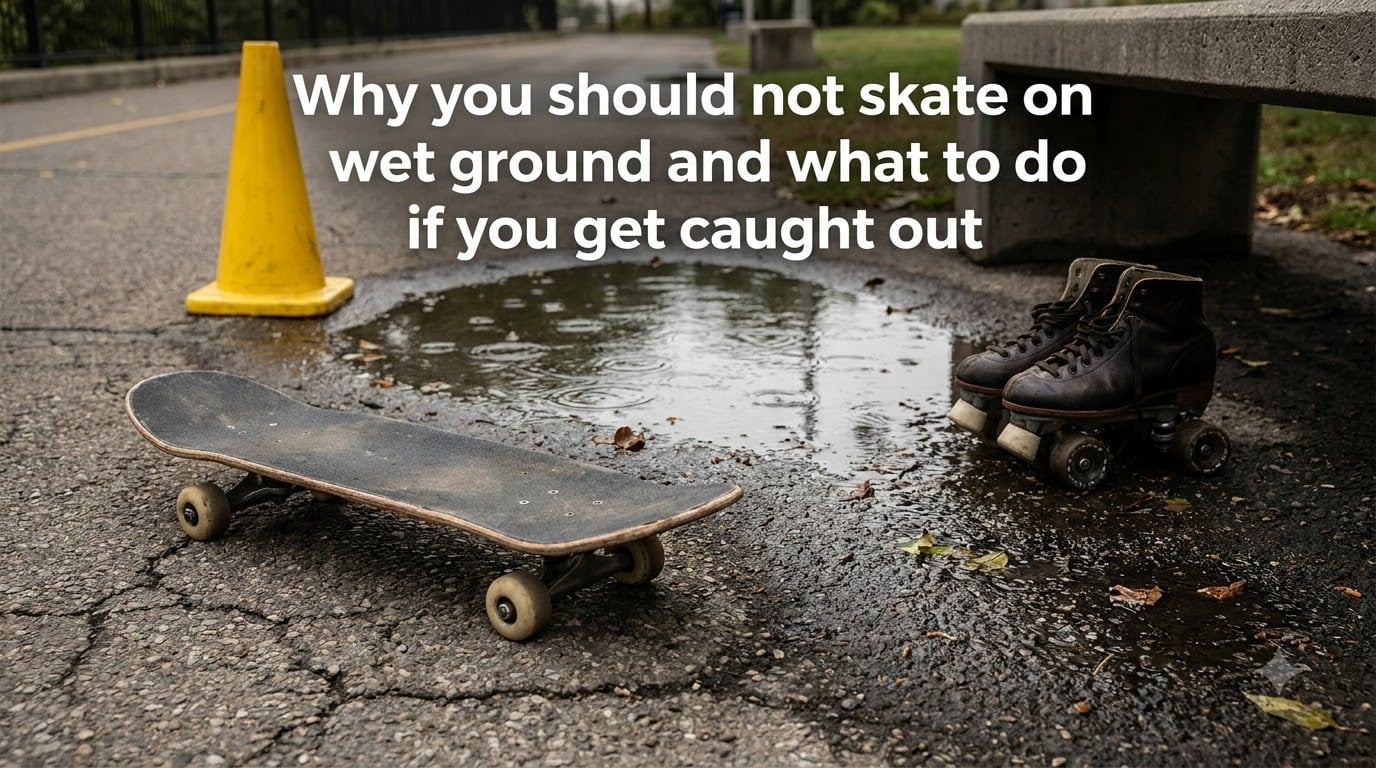
I learned the hard way that wet ground and skates do not mix. One damp patch, one tiny puddle, and a regular cruise home becomes a hospital trip or a ruined set of bearings. If you have ever wondered why you should not skate on wet ground, this guide breaks down the physics, the gear damage, and the exact steps to take when the sky opens up mid-session.
Wet ground is the single biggest variable that separates a smooth session from a wipeout. Whether you ride a skateboard, quad skates, or inline skates, water changes every interaction between your wheels and the floor. In this guide I will explain the core dangers, the equipment damage that sneaks up on you, and a step-by-step plan for getting home safely if the rain catches you out.
Table of Contents
Why You Should Not Skate on Wet Ground: The Core Risks
Wet ground is dangerous because water sits between your wheels and the riding surface, breaking the friction your skates depend on. Without that friction, every push, every turn, and every stop becomes unpredictable.
The simplest answer to the question “why you should not skate on wet ground” comes down to three things: traction drops to almost nothing, your stopping distance can triple, and your gear starts corroding the moment water gets inside. Each of those problems on its own is bad enough. Together, they turn a routine ride into a real safety risk.
Traction Loss and Unpredictable Slides
Skate wheels are designed to grip dry pavement. Even a thin film of water is enough to create a hydroplane effect, where the wheels lift off the microtexture of the ground and skate across the top of the water. Once that happens, your steering inputs have almost no effect.
I have seen skaters describe the feeling as “rolling like a bowling ball.” That is exactly what happens. You stop being in control of direction. Any small wobble or bump sends you sliding, and you cannot recover until traction randomly returns.
Stopping Distances Can Triple
On dry ground, a moderate heel brake or powerslide brings you to a controlled stop in a few metres. On wet ground, the same technique can take three times the distance, and many brakes simply stop working because the rubber slips instead of gripping.
This is the danger that surprises newer skaters most. You push your brake or dig in for a T-stop and nothing happens. By the time friction returns, you have already rolled into traffic, a kerb, or another person.
Reduced Control for Beginners
Experienced skaters can sometimes recover from a wet slide using muscle memory and edge control. Beginners cannot. If you have not yet learned how to fall safely or how to control a slide on purpose, wet ground removes the safety margin you rely on every time you ride.
If you are still building confidence on your skates, treat any damp surface the same way you would treat ice. Walk it first, then decide.
How Wet Surfaces Affect Skateboarders, Quad Skaters, and Inline Skaters Differently
Wet ground does not affect every style of skating the same way. The geometry of your setup changes what fails first and how badly.
Skateboards: Wheels Lock and Slide Sideways
A skateboard has four small contact patches and a tight truck geometry. When the wheels hit water, they tend to lock up and slide out from under you sideways. Kicktails become unpredictable, and even a small crack or stone becomes a launch ramp because the wheels skip instead of roll over.
Quad Skates: Trucks Behave Unpredictably
Quad roller skates have wider platforms and a single front and rear contact per skate. On wet ground, the front wheels tend to wash out first, which is the classic forward-fall scenario. Heel brakes become almost useless because the rubber pad slides instead of gripping.
Inline Skates: Longer Wheelbase Changes Braking
Inline skates have a longer wheelbase, which makes them more stable in a straight line but harder to control when a slide starts. Once the front wheel loses grip, the whole skate rotates, and the rest of the wheels follow. Stopping techniques like the T-stop and powerslide both rely on friction you no longer have.
No matter which setup you ride, the rule is the same. If the ground is wet, your normal technique will not work the way it does on dry pavement.
The Equipment Damage You Cannot See Coming
The injury risk is the headline danger, but the equipment damage is what costs you money. Water gets into places you cannot easily dry, and corrosion starts within hours.
Bearings: Rust, Squealing, and Lifespan Loss
Bearings are the most vulnerable part of any skate. They are precision steel balls coated in grease, and water strips that grease the moment it gets in. Once the protective layer is gone, rust forms quickly.
Forum users routinely describe bearings that start “hissing” or “squealing” after a wet session. That noise is metal grinding against metal where the lubrication used to be. Within a few days, the bearings spin roughly, lose speed, and eventually seize.
Even one wet session can shorten bearing life by months. Repeated exposure destroys them within a single season.
Wheels and Grip Loss
Wheel urethane is slightly porous. Water seeps in, and when it dries it can leave the wheels feeling gritty or “off-round.” You will notice it as a wobble at speed or a loss of grip even on dry ground afterward. Bearings inside the wheels also trap moisture against the metal hub, accelerating rust from the inside out.
Trucks, Kingpins, and Metal Corrosion
Skateboards and quad skates have metal trucks, kingpins, and baseplates that are not fully sealed. Water sits in the pivot cup and around the kingpin nut. Rust forms, the bushings soften and swell, and your trucks start to feel sloppy even after the rain stops.
For electric skateboards, water damage is even worse. Battery enclosures, ESC units, and hub motors are not designed for submerged or soaked riding, and water ingress can be a permanent write-off.
Surface-Specific Dangers: Puddles, Smooth Concrete, and Marked Pavement
Not all wet surfaces behave the same. Some are merely slippery, and some are nearly unrideable.
Painted Lines and Metal Grates
Painted road markings and metal drainage grates become almost frictionless when wet. They are the top cause of unexpected slides even when the rest of the path looks dry. A single painted crosswalk line can send you down before you register what happened.
Smooth Polished Surfaces
Polished concrete, marble tiles, and wooden skatepark floors are already low-traction surfaces. Add water and they behave like ice. Indoor skateparks that have just been mopped are just as dangerous as a rainy street outside.
Shaded Patches That Hide Moisture
One of the sneakiest wet hazards is the shaded patch on an otherwise dry path. The ground can look fine, but the shaded section holds moisture for hours after the sun has dried everything else. Always scan for darker, duller patches of ground before you commit to a line.
A Real Accident: Why Wet Ground Is Not Worth the Risk
A few winters ago, I set out on a familiar path that I had ridden hundreds of times. It had rained lightly an hour before, and I thought the surface was dry enough. I was wrong. I hit one shaded patch, my wheels slid out, and I went down hard on my hip and elbow.
I was lucky. The fall ended in fractures, not surgery, and I learned a lesson that has stuck with me ever since. The five minutes I saved by not waiting for the path to dry properly cost me weeks off my skates and a real fear of going over for the first time. Most skating injuries I have heard about from other riders started the same way: “I thought it was dry enough.”
What to Do If You Get Caught Out in the Rain?
If the sky opens up while you are mid-session, do not try to outrun the weather. Follow these steps to get home safely.
Step 1: Slow Down and Assess
The moment you realise you are riding into water, drop your speed immediately. Stand up straight, knees soft, and stop pushing. Do not try to brake hard on a wet surface because your brake will likely slip. Coast to a slow, controlled roll.
Step 2: Find Sheltered Ground or a Dry Line
Look for the driest path you can. Sheltered tarmac under trees, covered car parks, or a strip of well-drained pavement gives you better grip than the open road. Avoid painted lines, manhole covers, and metal grates even if they look dry.
Step 3: Adapt Your Stride and Stance
Short, shallow pushes are safer than long strides. The harder you push, the more likely your wheels are to slip out from under you. Keep your weight centred, knees bent, and feet shoulder-width apart for stability.
Step 4: Plan Stopping Points Ahead
Identify dry grass, kerbs, or gravel strips in advance so you have somewhere safe to slow down if you need to. Gravel will give you traction where tarmac will not. Use it deliberately, not as a last resort.
Step 5: Get Home and Dry Your Gear
Once you are off the wet surface, dry your bearings, wheels, and trucks as soon as you can. The longer water sits inside your setup, the more damage it does. Move on to the next section for the full drying routine.
How to Care for Your Skates After Wet Skating?
If you have ridden through water, treat it as gear maintenance time. A quick cleaning routine within the first 24 hours will save you from rusted bearings and sloppy trucks later.
Dry Bearings Thoroughly
Remove the wheels and pull out the bearings. Wipe off surface water with a clean cloth. You can spin them dry by flicking them with a finger, but do not apply heat. Heat damages the grease and can warp the bearing cage.
Re-Lubricate Within 24 Hours
Once the bearings are dry, add a drop of skate-specific bearing oil or a thin layer of speed cream. Work the lube in by spinning the bearing between your fingers. This restores the protective layer that the water washed away.
Inspect Wheels and Hardware
Check your wheels for flat spots or wobble. Tighten any truck hardware that feels loose, and wipe down the baseplates, kingpins, and bushings. A light spray of silicone or a dry cloth goes a long way toward preventing flash rust.
If your skates still feel rough or noisy after a day of drying, it is a sign the bearings have started to corrode internally. Replace them rather than riding on damaged hardware.
Frequently Asked Questions
How bad is it to skate on wet ground?
Skating on wet ground is genuinely dangerous. Water removes the friction between your wheels and the surface, which means traction drops sharply, stopping distances can triple, and your ability to turn or push becomes unpredictable. Even experienced skaters can be caught out by a single wet patch.
What happens if I skate in the rain?
Rain strips the lubrication from your bearings almost immediately. Within hours, rust starts to form on the steel balls inside. Your wheels can also absorb moisture and lose their round shape, and your trucks can corrode around the kingpin and bushings. Most skaters notice a hissing or squealing sound from the bearings after just one wet session.
Is it safe to skateboard on wet pavement?
No. Wet pavement is one of the most common causes of skateboarding injuries. Even a slightly damp surface reduces grip enough to send your wheels sliding sideways. If the pavement looks dark or shiny, treat it as unsafe and walk until you find a dry line.
Should I use a skate park whilst wet?
No. Skateparks have smooth concrete, painted lines, metal coping, and often wooden features that all become very slippery when wet. You also risk damaging the surface for other riders. Wait for the park to dry completely before you drop in.
Why shouldn’t you skateboard in the rain?
Skateboarding in the rain combines the worst of both worlds. You lose traction on the ground, your bearings start to rust the moment water gets in, and visibility is lower for both you and any drivers nearby. The risk of injury and the cost of replacing rusted bearings make it a poor trade-off.
Is a skateboard ruined if it gets wet?
Not necessarily, but it can be damaged. A single brief splash is usually fine if you dry the bearings and hardware quickly. Soaking, riding through puddles, or leaving the board wet for hours can rust the bearings, corrode the trucks, and leave the wheels feeling gritty. Dry and re-lubricate within 24 hours to minimise the damage.
The Bottom Line on Skating on Wet Ground
Wet ground is one of the few things that can undo even the most experienced skater. Loss of traction, longer stopping distances, and rapid equipment damage all stack up fast. The five minutes you save by riding through damp ground are rarely worth the weeks off skates or the cost of new bearings.
If you do get caught out, slow down, find a dry line, and plan your stops in advance. Once you are home, dry your bearings and re-lubricate within 24 hours. Treat the wet ground rule the way you treat traffic rules: a hard boundary that protects both you and your gear. Your next session will be safer, your bearings will last longer, and you will not be adding another “I thought it was dry enough” story to the long list of skating lessons learned the hard way.