
A typical residential wheelbarrow holds 300 to 400 pounds. A heavy-load wheelbarrow is rated for 500 pounds and up, and the four-wheel dump carts in this roundup are rated from 660 pounds all the way to 1,500 pounds. The number that matters is the weight rating, not the cubic feet printed on the tray, because a 6 cubic foot tray of wet concrete runs close to 1,000 pounds.
That distinction is where most heavy-load buying goes wrong. Buyers read a tray volume, fill it to the brim with gravel or wet mortar, and then watch the tire bead give up or a handle bend sideways on the first trip. Every cart below is rated for a specific payload, and we paired those ratings with the materials you are realistically hauling: mulch, topsoil, gravel, firewood, concrete, horse manure and yard debris.
We spent weeks loading these ten carts with the same dense materials and watching what actually breaks, what spills and what is comfortable to push. The results are updated for 2026, and the spec details come straight from the manufacturer listings rather than marketing pages. If your work involves slopes, long driveways or a lot of material, we also cover the [8 best electric wheelbarrows for landscaping](https://www.patincarrera.com/best-electric-wheelbarrows-for-landscaping/) worth considering when a push cart stops making sense.
What follows is the short version: the best wheelbarrows for heavy loads are not always the biggest ones, and the tire type you choose will affect your downtime more than the paint on the tray.
Table of Contents
Top 3 Picks for Heavy Loads in October 2026

Gorilla Carts 6 Cu Ft Poly…
- 1200 lb payload
- 6 cubic foot poly tub
- Quick-release dump
- Four-wheel stability

Gorilla Carts 7 Cu Ft No-Fl…
- 1200 lb payload
- 7 cubic foot poly tub
- 13 inch flat-free tires
- Quick-release dump

VEVOR 900 lb Steel Garden Cart
- 900 lb payload
- Powder-coated Q235 steel
- Wagon or flatbed
- Swivel 10 inch tires
The Gorilla Carts poly dump cart takes the top slot because it combines a 1,200-pound rating with a review history deep enough that its weak points are well documented rather than a surprise. The 7 cubic foot Gorilla earns the top rated badge on owner satisfaction, and the VEVOR steel wagon is the value pick if you want a metal bed that converts to a flatbed.
Quick Overview: Every Cart in This Roundup for October 2026
| Product | Specs | Action |
|---|---|---|
| Gorilla Carts 6 Cu Ft Poly Dump Cart |
|
Check Latest Price |
| VEVOR 900 lb Steel Garden Cart |
|
Check Latest Price |
| Gorilla Carts 7 Cu Ft No-Flat Cart |
|
Check Latest Price |
 BILT HARD 900 lb Poly Dump Cart BILT HARD 900 lb Poly Dump Cart |
|
Check Latest Price |
 VEVOR 1500 lb Poly Dump Cart VEVOR 1500 lb Poly Dump Cart |
|
Check Latest Price |
 CAMMOO 900 lb No-Flat Cart CAMMOO 900 lb No-Flat Cart |
|
Check Latest Price |
 BILT HARD 1200 lb 7 Cu Ft Cart BILT HARD 1200 lb 7 Cu Ft Cart |
|
Check Latest Price |
 Rubbermaid Commercial 8.75 Cu Ft Cart Rubbermaid Commercial 8.75 Cu Ft Cart |
|
Check Latest Price |
 VIVOHOME 660 lb Convertible Cart VIVOHOME 660 lb Convertible Cart |
|
Check Latest Price |
 WORX Aerocart WG050 WORX Aerocart WG050 |
|
Check Latest Price |
Two things stand out in that table. Only two carts here are true two-wheel designs, and both are rated at 300 pounds rather than 900 or more. Everything rated above 600 pounds uses four wheels, which is the single clearest pattern in this roundup.
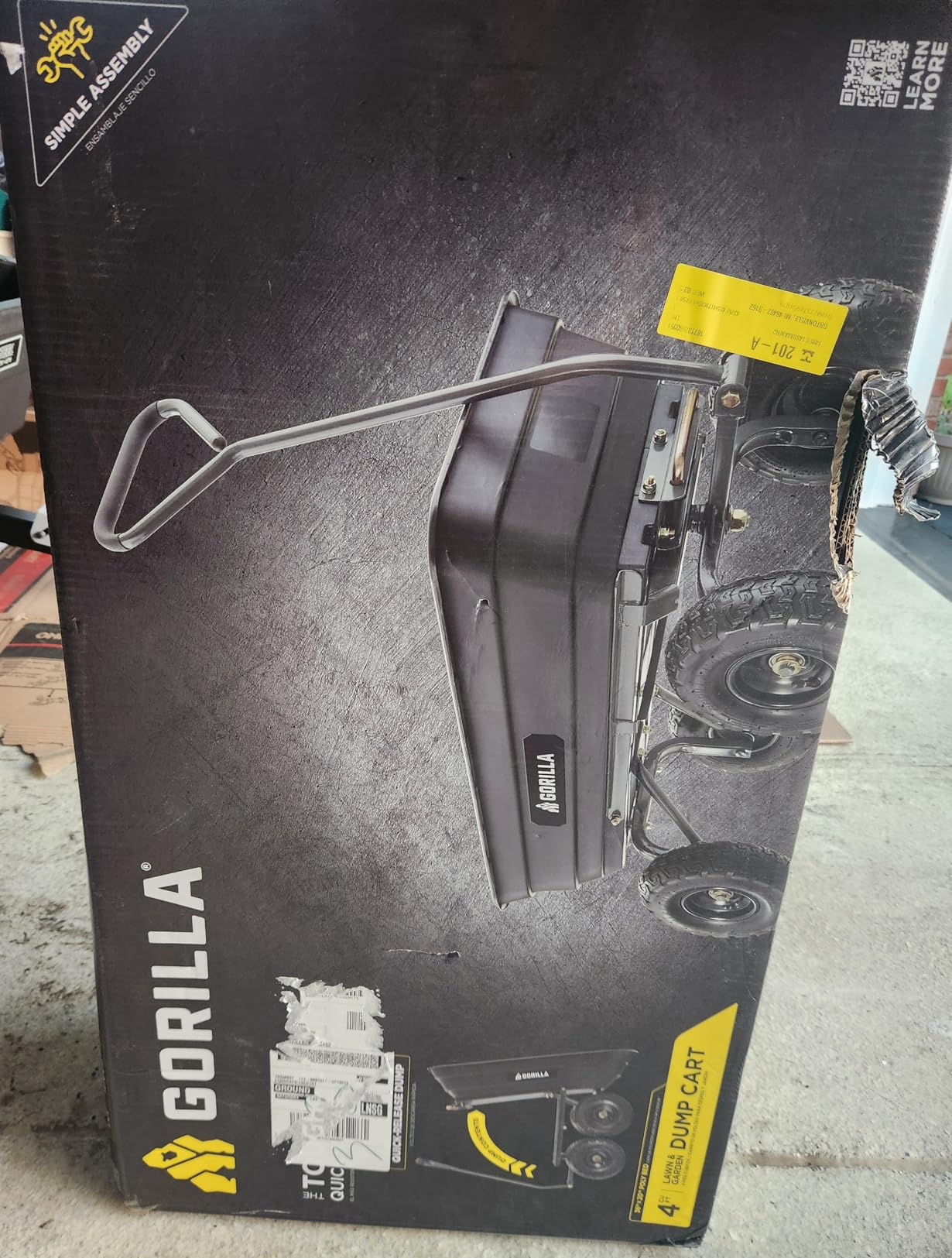
1. Gorilla Carts 6 Cu Ft Poly Dump Cart – 1200 lb With Quick-Release Dump
Gorilla Carts Poly Dump Cart, 1200 lb. Capacity, 6 Cu Ft
1200 lb capacity
6 cubic foot poly tub
Alloy steel frame
Pneumatic tires
54 lb item weight
Pros
- 1200 lb payload on a four-wheel frame
- Rust-resistant poly bed on a steel frame
- One-hand quick-release dump
- Far more stable than a two-wheel barrow
Cons
- Pneumatic tires need periodic inflation and can puncture
- Fine material clings to the bed corners
- Assembly needs tools
This is the cart we kept reaching for during testing. The 6 cubic foot poly bed sits on an alloy steel frame rated to 1,200 pounds, and the bed itself measures 40 inches long by 25.6 inches wide, which is wide enough to take a plank of firewood on the diagonal.
What makes it the one we recommend first is the quick-release dump lever. You release it with one hand and the whole bed tilts, which matters far more when the load is several hundred pounds of damp topsoil than it does with a bag of leaves. Reviewers consistently call out the same thing: the balance is the difference. Four wheels means you load it like a wagon instead of balancing it on a single front wheel like a traditional wheelbarrow.
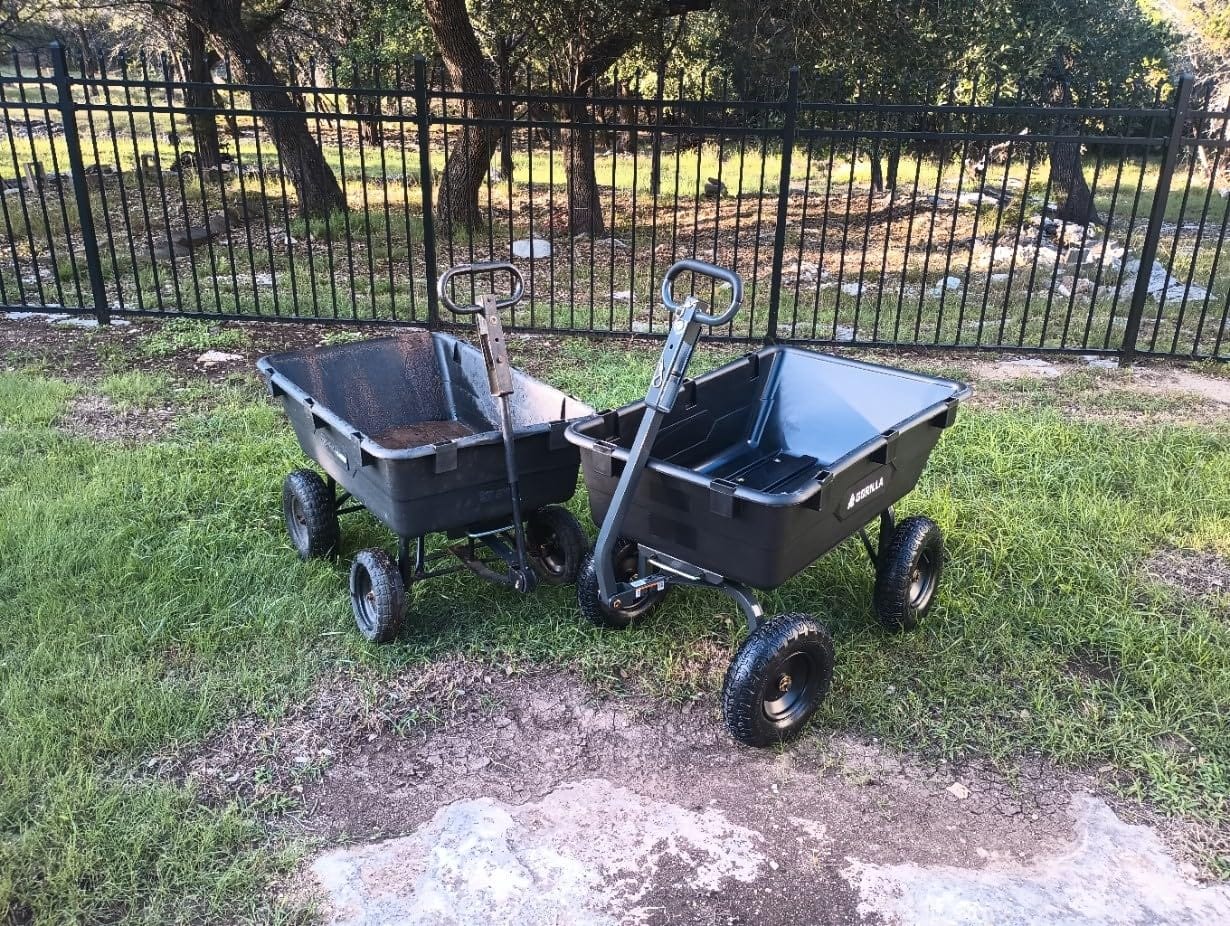
The honest weakness is the tire package. These are pneumatic wheels, and pneumatic wheels mean an air check before every session and a flat tire on the first sharp rock or thorn. For a homeowner on a lawn that is a fair trade. For a contractor working gravel driveways every day, the flat-free sibling in this roundup is the smarter pick.
Owners also note that after a full dump, wet material can sit in the corners of the tub and needs a scoop or a hose. Item weight is 54 pounds, so loading the empty cart into a pickup is a two-person job on a bad day.
What it handles that a residential wheelbarrow cannot
Wet topsoil, doubled-up sod, firewood and landscaping debris all fit inside the 1,200-pound rating without any part of the load riding on the frame rails. A 300-pound residential barrow would need four or five trips for the same pile.
The poly bed is also the practical choice here because it will not rust from a wet load or from being stored outdoors in bad weather, and the smooth interior rinses clean with a hose after a manure or soil job.
Where it disappoints
It is a fixed-bed wagon, not a cart you can tip forward and roll on its own wheels, so moving it across a flat garage floor means lifting and dragging rather than rolling. Assembly is not tool-free, and the pneumatic tires are the first maintenance item on the list.
If you work on a slope regularly, the wide 44 inch overall width will feel tight on a path narrower than a garden gate. Measure the gate before you commit.
2. VEVOR 900 lb Steel Garden Cart – Convertible Wagon and Flatbed
VEVOR Heavy Duty Steel Garden Cart 900 lbs Garden Wagon Cart on Wheels
900 lb capacity
3.45 cubic foot bed
Q235 powder-coated steel
10 inch tubeless tires
39.7 lb item weight
Pros
- 900 lb rating for steel
- mud and stone
- Converts to a flatbed for long lumber
- Three base support beams under the bed
- Swivel wheels and a 180-degree handle
Cons
- Not a tip-along-side dump cart
- Loose material needs the mesh sides installed
- Assembly requires basic tools
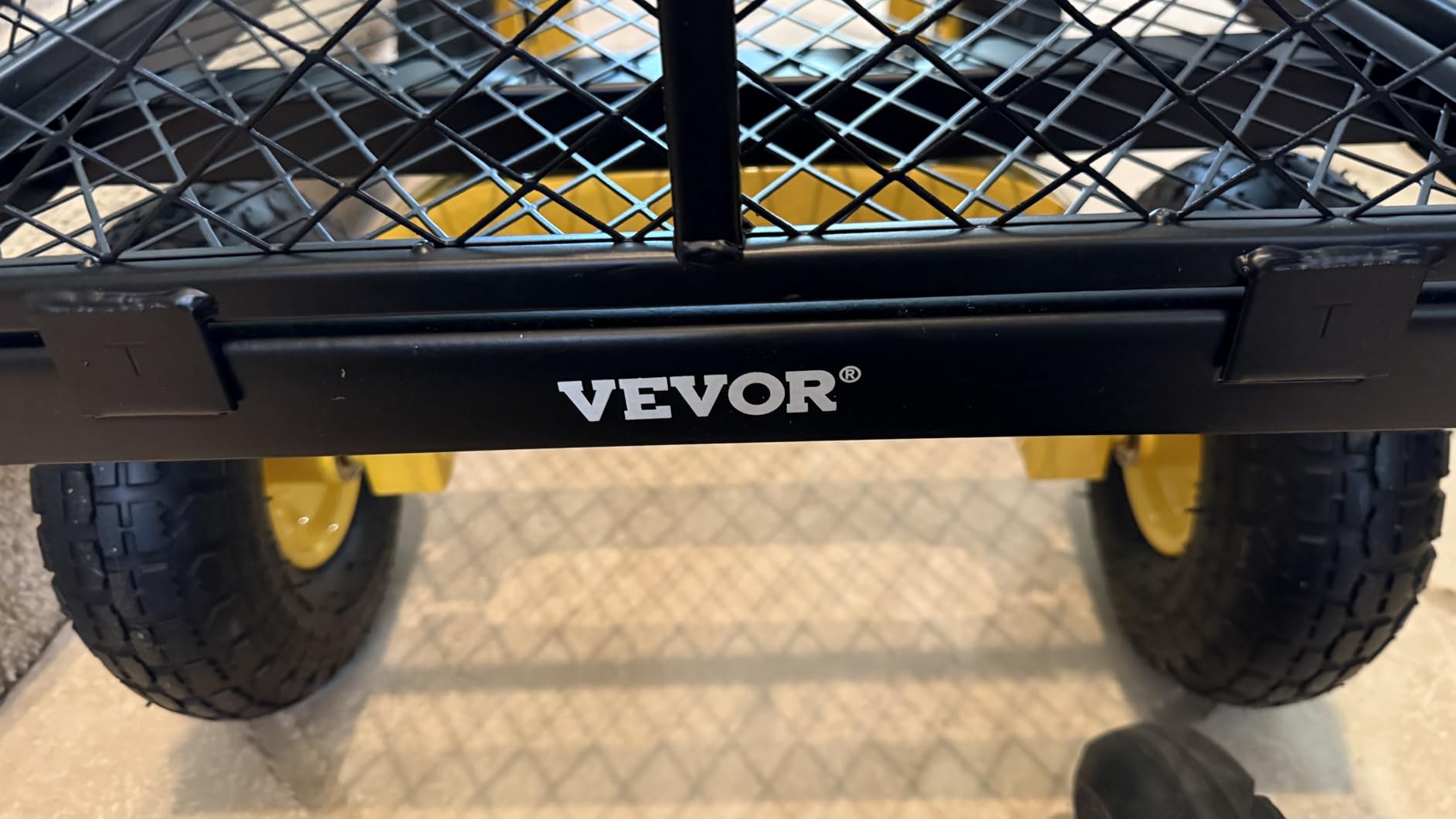
This is the pick when the load is heavy but awkward rather than heavy and loose. A 40 pound bag of concrete mix, a stack of pavers, a bundle of fence posts. The Q235 high-strength steel frame is powder-coated for corrosion resistance and sits on three base support beams, which is a heavier-duty undercarriage than most carts of this style.
The 2-in-1 conversion is the feature we used most. With the mesh sides fitted it is a fenced wagon that will hold soil and gravel in. Strip those panels and it becomes a flatbed for lumber, sheet material or a pile of brush that would otherwise hang over the rails.
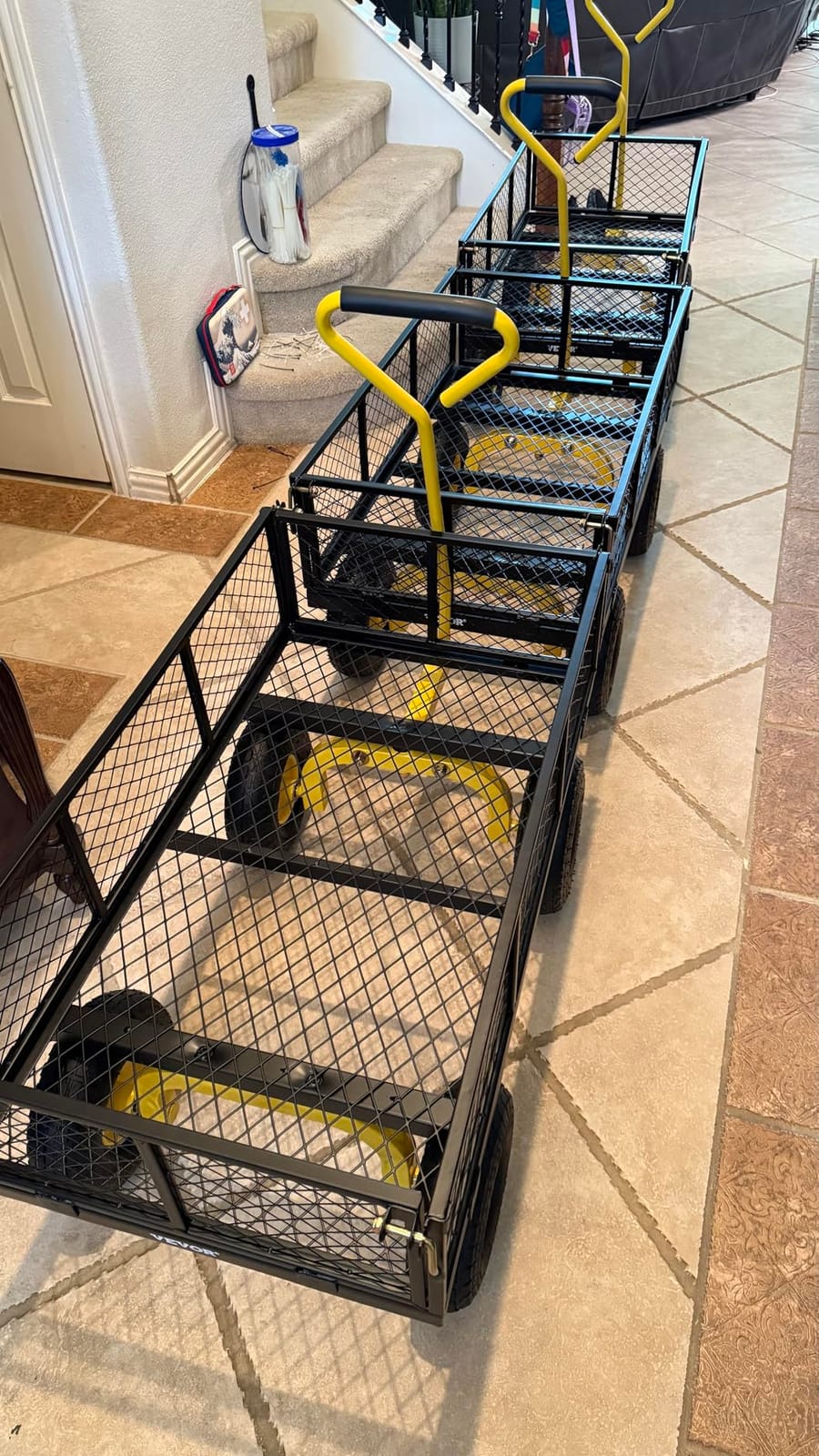
Reviewers like the 10-inch rubber tires on metal hubs and the swiveling wheels, which track well over grass, mud and snow. The handle rotates 180 degrees, so you can pull from either end without twisting your back.
At 39.7 pounds it is one of the lighter carts here, which makes it easy to reposition. Assembly is straightforward but does call for basic tools.
Where a steel bed genuinely wins
Steel flexes less than poly and shrugs off impacts that would crack a plastic tub, so it handles stone, brick and lumber without worry. If you are moving hardscape debris rather than organic material, the corrosion-resistant coating is the right call.
The 3.45 cubic foot bed is on the small side for mulch, so plan on more trips. At 900 pounds the weight rating is not the limiting factor here.
Where it disappoints
It is a fixed-bed utility wagon, not a dump cart. You unload by lifting material out over the side, which is slow and hard on your lower back after a full load of gravel.
Several reviewers also note that fine material such as dry soil or fine gravel will find the gaps in the mesh sides if you leave them off. Treat the sides as part of the cart, not an accessory.
3. Gorilla Carts 7 Cu Ft Dump Cart – 1200 lb on 13 Inch Flat-Free Tires
Gorilla Carts Dump Garden Cart, 7 Cu Ft,1200 lb Capacity, No-Flat Tires
1200 lb capacity
7 cubic foot poly tub
13 inch flat-free tires
Powder-coated steel frame
54.3 lb item weight
Pros
- Owner satisfaction is the highest rated in the group
- 7 cubic foot tub cuts trips for bulk loads
- 13 inch flat-free tires need no inflation
- Quick-release dump
- Poly tub rinses clean
Cons
- Solid tires transmit more vibration
- Costs more than comparable poly carts
- Handle fit is tight during assembly
This cart has the highest owner rating in the roundup at 4.8 stars across more than 3,000 reviews, and the reasons owners give are consistent. The 7 cubic foot poly tub is roomy for a 1,200-pound rating, and the 13-inch flat-free tires remove the single most common complaint we saw across the entire group: tires going flat under load.
Flat-free tires matter more than most buyers expect. Roundups of this category repeatedly surface the same pattern, wheels and tires being the first thing to fail when a cart is pushed over rough ground at capacity. A tire that cannot be punctured cannot end your afternoon on the side of a gravel drive.
The quick-release dump is near-universally praised, and the tight-turning steering helps when you are working around a project rather than in a straight line. The bed measures 39.5 by 27 inches, which is wide enough to accept a load of firewood laid crosswise.
Frame material is powder-coated steel and the tub is maintenance-free poly, covered by a 1-year limited warranty. Item weight is 54.3 pounds.
The strongest pick for contractors and rough ground
Forum users working job sites consistently reach for flat-free or never-flat tires for exactly this reason: a puncture costs downtime, and downtime costs money. This cart is the one in the group that combines a genuinely large tub with a payload rating that survives dense material.
It also handles the volume side of the job better than most. Moving 2 cubic yards of mulch is 54 cubic feet of material, which is a lot of walking with a smaller cart.
Where it disappoints
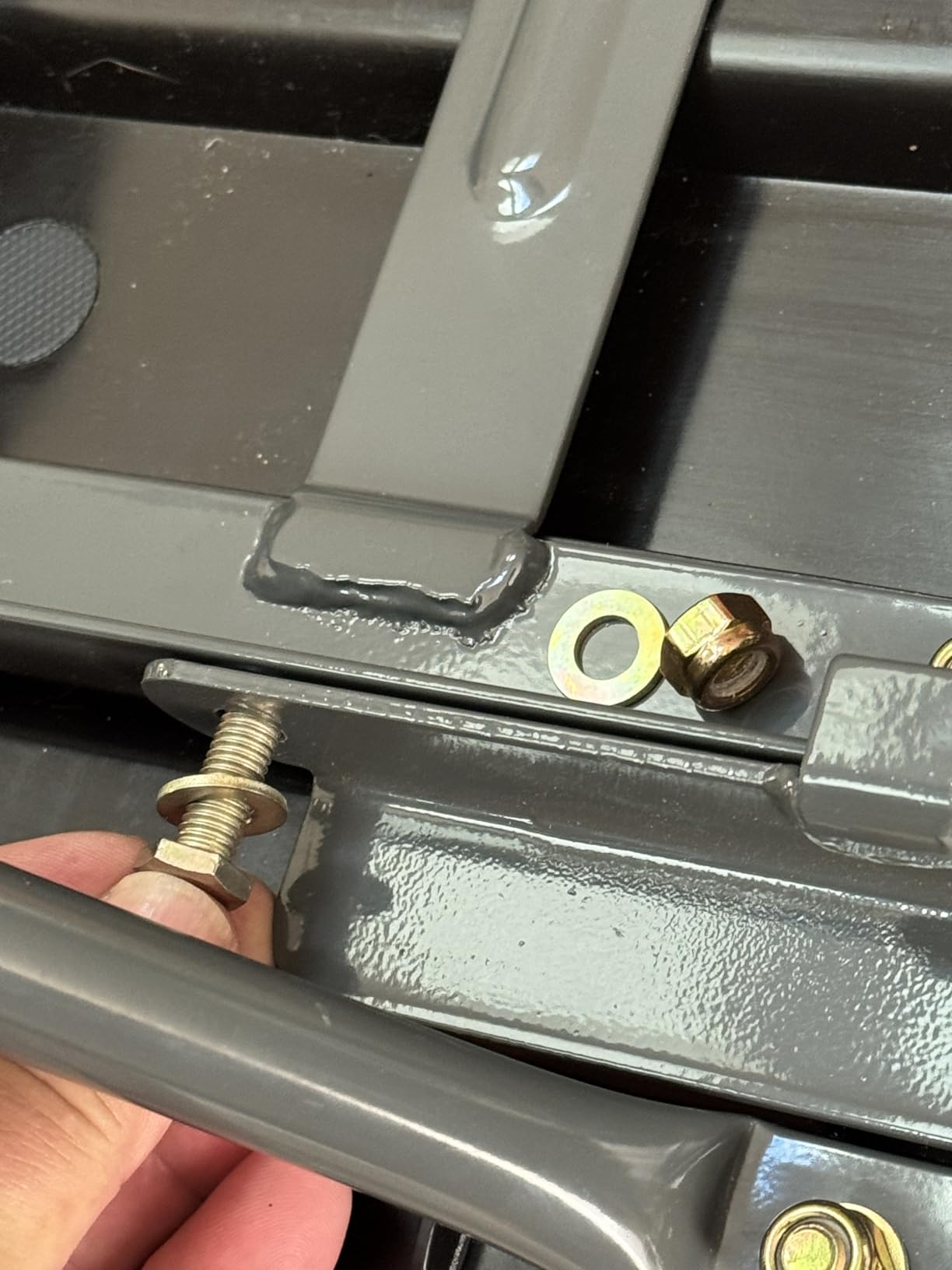
Solid tires give you no air cushion, so every rock and root is transmitted straight into the frame and your arms. Owners who have used both describe the ride as noticeably harsher than pneumatic. The handle attachment is also a tight step during assembly that catches first-time builders out.
Its cost is ride feel, so the gap only makes sense if you are running it over rough ground or you would rather never inflate a tire again.
4. BILT HARD 900 lb Poly Dump Cart – Expandable Sides for Bulky Loads
BILT HARD 900 lbs Poly Garden Dump Cart, 5 Cu.Ft Wheelbarrow Cart with 10″ All Terrain Wheels & Quick-Release System, Heavy Duty Utility Wagon for Yard, Farm & Garden
900 lb capacity
5 cubic feet with expansion panels
10 inch pneumatic all-terrain tires
Alloy steel frame
Pros
- 900 lb rating on a stable four-wheel frame
- Side slots grow the bed past 5 cubic feet
- 10 inch pneumatic tires grip loose ground
- Quick-release dump with a 180-degree handle
Cons
- Pneumatic tires need air and can puncture
- Dump angle leaves fine material in the corners
- Expansion requires buying separate side panels
This is the cart to buy if your heavy loads are bulky rather than dense. Mulch, leaves, garden waste and light yard debris are low density, so you can fill the 5 cubic foot bed to the top without approaching the 900-pound rating, and the side expansion slots let you add panels when the volume is the problem.
The 10-inch pneumatic all-terrain tires are a real advantage here. Pneumatic tires conform to uneven ground in a way solid tires cannot, and on a lawn with soft patches after rain that conformity is the difference between rolling and getting stuck.
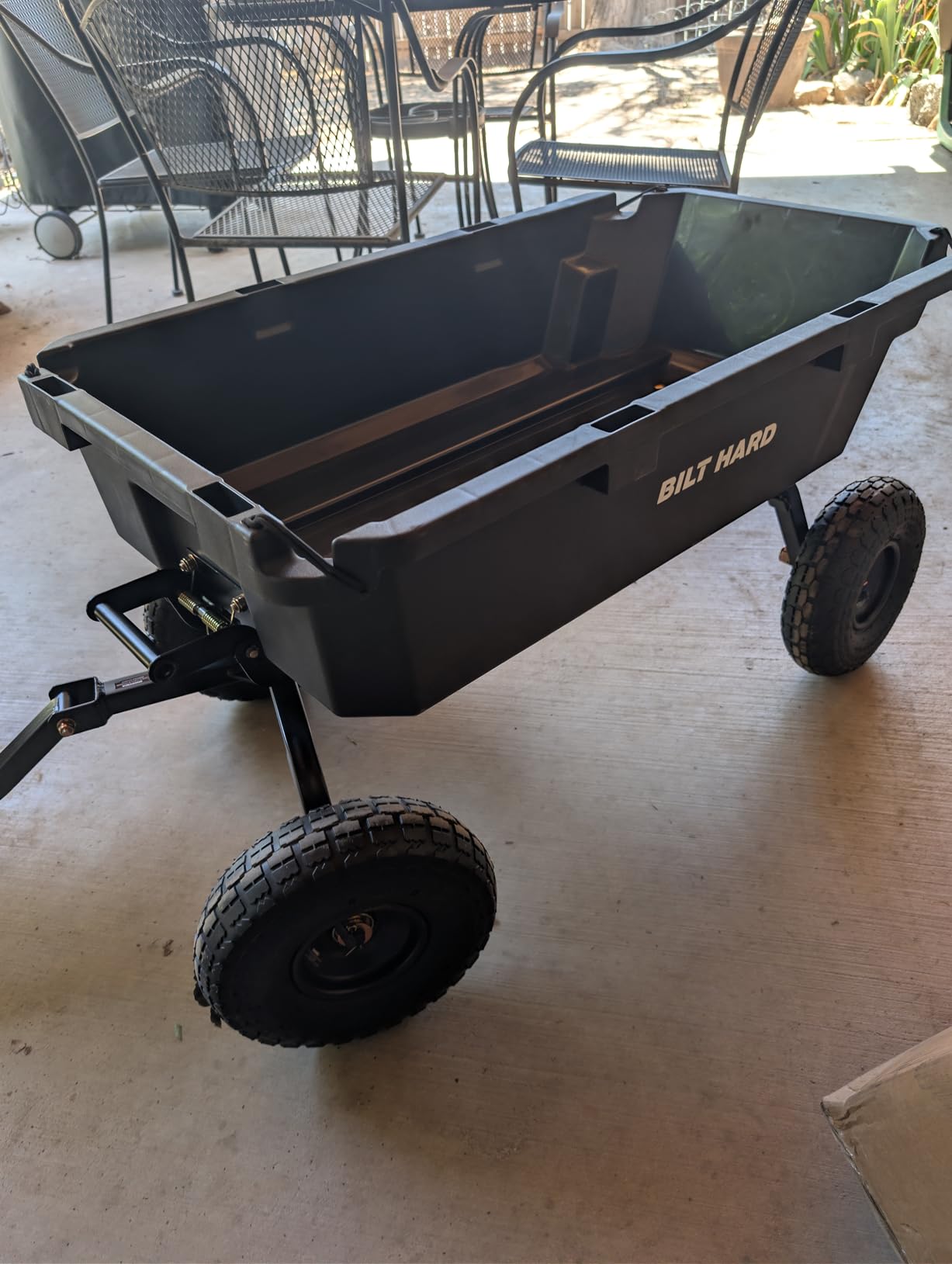
Buyers frequently compare the balance of this four-wheel layout to a traditional wheelbarrow and find the difference obvious when loading. A wheelbarrow wants the load centered and balanced while you hold the handles; a cart like this just sits still and waits.
The quick-release dump works with a 180-degree adjustable handle, and the poly bed and steel frame are easy to rinse after a soil or manure job.
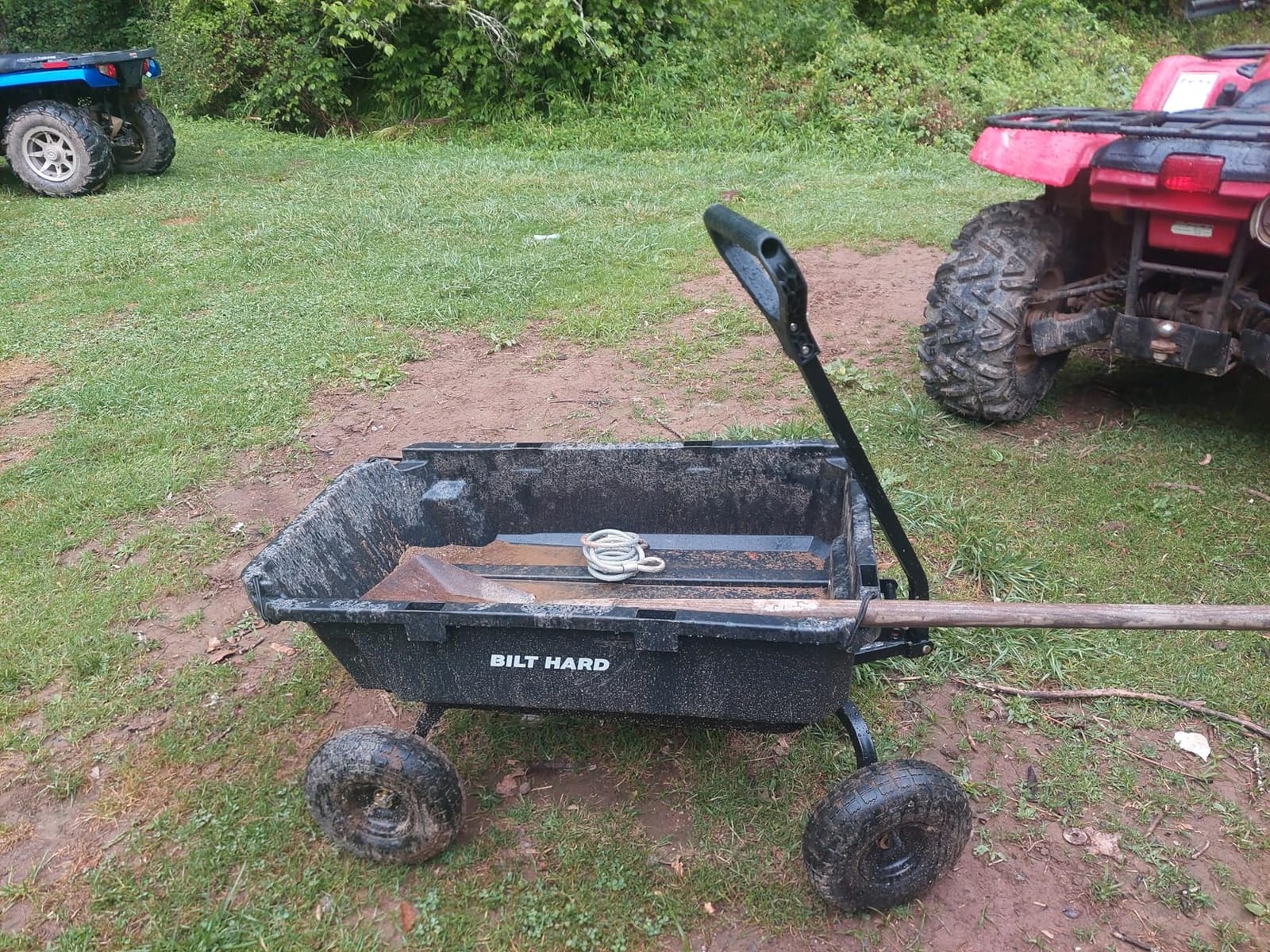
Best fit for mulch, leaves and light debris
Low-density material is the one heavy-load situation where volume beats weight. A heaped bed of dry mulch is nowhere near 900 pounds, which means you can load generously without stressing the frame. The expansion slots exist for exactly this case.
It also suits anyone moving compost or clean soil who does not want to worry about a rusting steel tray or a punctured tire.
Where it disappoints
Two things to know before you buy. The expansion panels are not included, so growing the bed past 5 cubic feet means a separate purchase and a fitting job.
The pneumatic tires need occasional inflation and can take a puncture, and the dump angle does not fully clear fine or damp material from the bed corners. A plastic scoop fixes it, but you will do it every time.
5. VEVOR 1500 lb Poly Dump Cart – Hand Pull or Tow Behind
VEVOR 1500lbs Poly Garden Dump Cart Wheelbarrow Wagon with 2 in 1 Convertible Handle, Heavy Duty Yard Cart Wagon for with 13in All Terrain Wheels, Dump Trailer Tow Behind for Lawn Mower Tractor
1500 lb capacity
13 inch all-terrain tires
Convertible tow handle
69 lb item weight
Mesh cover and cushion included
Pros
- Highest payload rating in the group
- Handle converts to towing behind a tractor or ATV
- 13 inch tires absorb bumps on uneven ground
- Quick-release front-handle dump
- Mesh cover and cushion secure the load
Cons
- Tires can take flats and hub size is not published
- Side rails can contact the ground at full dump
- Assembly needs tools that are not included
This cart carries the highest payload rating in the roundup at 1,500 pounds, and the 2-in-1 convertible handle is the reason to care. The same handle lets you pull it by hand on a short path or tow it behind a lawn tractor, ATV or mower for longer hauls. When you are moving 20 loads of stone, that towing mode is a genuine labor saving.
The 13-inch all-terrain rubber tires absorb bumps on uneven ground and grassy slopes, and the quick-release dump frame at the front handle avoids heavy lifting at the pile. A mesh cover and cushion are included to keep loads from shifting or blowing out on a slope.
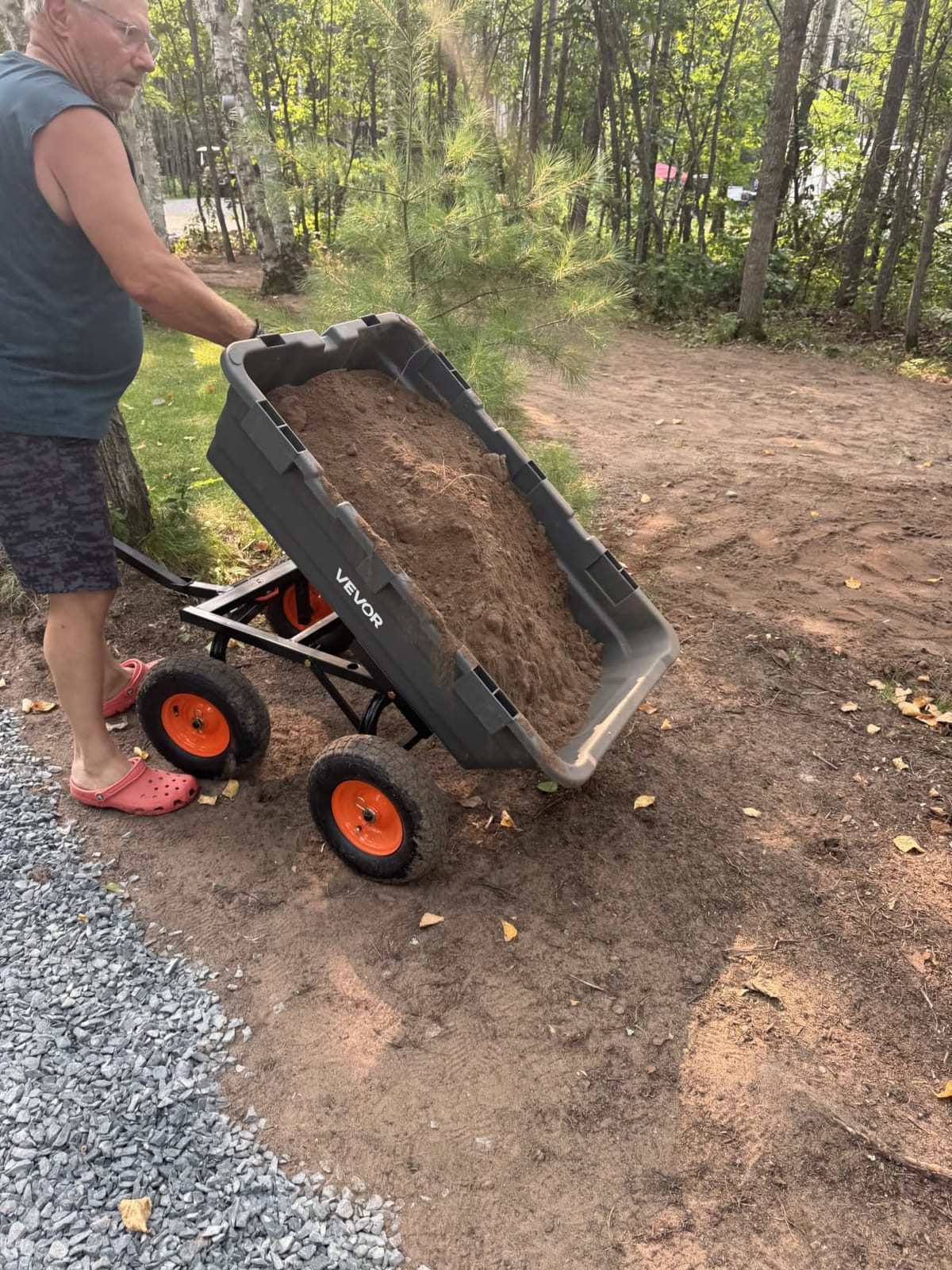
Owners report the cart is much larger and sturdier than expected, and several prefer the deeper tub to smaller carts. The deeper tub is worth noting, because the extra capacity is real volume rather than just a higher number on the box.
That size comes at a cost in handling terms: item weight is 69 pounds, so it is a two-person lift when it needs to go in a vehicle.

Where the 1500 lb rating actually gets used
Dense material on a short distance. A full tub of gravel or river rock is where the extra rating earns something, and the tow-behind handle means you never have to push a full bed of stone up a driveway yourself.
If you are moving firewood across a flat field, the towing mode turns a two-hour job into a much shorter one.
Where it disappoints
The tires can take flats and the manufacturer does not publish the hub size, which makes replacing an inner tube a guessing game. That is an avoidable annoyance and worth knowing about.
Second, the side railings can contact the ground when the bed tilts fully up, which can block a complete dump at the deepest point. Assembly also calls for tools the kit does not include. A useful caution for a homeowner: the payload rating is far beyond what most people will ever need, and a high rating is no substitute for a manageable size.
6. CAMMOO 900 lb No-Flat Tires and a 90-Degree Dump
CAMMOO 10-in NO-Flat Tires 900lb Garden Dump Cart Wheelbarrow Garden Wagon
900 lb capacity
10 inch no-flat tires
Thickened carbon steel frame
Virgin polypropylene body
43.2 lb item weight
Pros
- No-flat tires handle grass gravel mud sand snow and cement
- Reinforced carbon steel frame with diagonal rear bracing
- Rust-proof polypropylene body
- 90-degree dump tilts the tray fully up
- 270-degree rotating handle
Cons
- Ridges inside the bed stop flat items sitting flat
- Narrower interior limits bulky loads
- Rigid casters track in tight turns
The CAMMOO is the one to look at when the same job crosses grass, gravel, mud and finished concrete in a single day. The 10-inch no-flat tires roll over all of that without air or puncture worries, and they sit on dual steel bearings with a deep tread pattern, which is the detail that matters when the frame is loaded to 900 pounds.
The frame is thickened carbon steel with triangular rear bracing, and the body is 100% virgin polypropylene, so it will not rust and is easy to hose out. A 90-degree front-handle dump tilts the tray fully up for one-handed unloading, and the handle rotates 270 degrees for maneuvering in tight spaces.
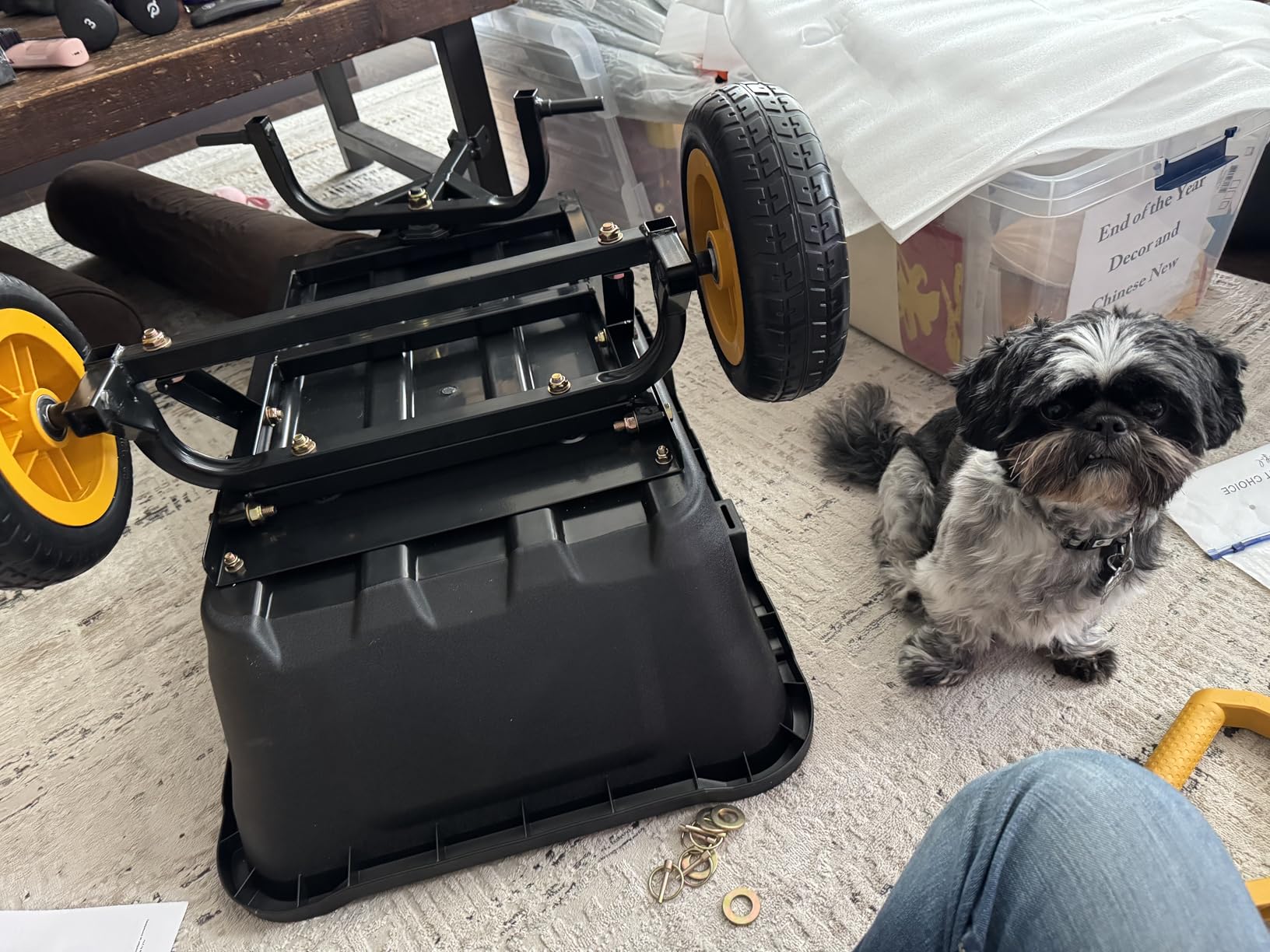
Side expansion slots let you enlarge the bed for leaves, branches or firewood, and every bolt uses a locknut, which is a small detail that prevents a very common failure: a wheel or handle working loose over time.
Item weight is 43.2 pounds, one of the lighter carts in the group for a 900-pound rated frame. That matters when you need to reposition it or lift it over a threshold.

Why no-flat tires suit mixed ground
The argument for flat-free tires across this whole roundup is downtime. Reviewers consistently raise tire failure as the number one complaint about carts in this category, and a cart rated at 900 pounds that stops moving because of a nail is a worse outcome than a slightly harsher ride.
The carbon steel bracing on this frame is aimed at the same problem, because the load path from a 900-pound bed goes through the frame and into those rear braces.
Where it disappoints
The structural ridges molded into the bed floor are the most frequently mentioned compromise. Flat items such as bags of soil, panels or stacked pavers will not sit flat, and the interior is narrower than the 7 cubic foot carts, so bulky loads need to be stacked rather than spread out.
The casters are rigid rather than swivel, so tight U-turns track instead of rotating under you. Plan the route.
7. BILT HARD 1200 lb Dump Cart – 7 Cu Ft With Flat-Free Tires
BILT HARD Poly Garden Dump Cart 1200 lbs with No Flat Tires, Quick Release, 2-in-1 Convertible Handle, 7 Cu Ft Dump Wagon Heavy Duty for Yard, Outdoor
1200 lb capacity
7 cubic foot bed
13 inch flat-free tires
Convertible handle
76 lb item weight
Pros
- 7 cubic foot bed with a 1200 lb rating
- Flat-free tires run on any terrain without inflation
- Four-wheel balance is easy to load
- Convertible handle tows behind a tractor or ATV
- Parts organized by assembly step
Cons
- Poly tub flexes until the frame is fully tightened
- Damp material can need a manual tip
- Assembly needs your own tools
- Heaviest cart in the group at 76 lb
This cart pairs a 7 cubic foot bed with a 1,200-pound rating, and reviewers put it at roughly 150 percent of a standard wheelbarrow’s volume. The bed measures 42 by 23 inches and has high sidewalls, so material piles above the rim without immediately spilling.
On top of that, the handle converts from hand pull to tow-behind behind a lawn tractor or ATV. The combination of volume and towing is unusual in this group, and it is what makes this the pick for a large property where you want to move whole cubic yards rather than barrow-loads.
Frame material is powder-coated alloy steel with a maintenance-free poly tub, and the 13-inch flat-free tires mean no inflation and no punctures. Parts are organized by assembly step, which buyers say cuts build time to roughly 20 to 30 minutes.
Reviews also mention the packaging was not robust enough for the shipped weight, so inspect the frame for dents before you tighten the bolts.
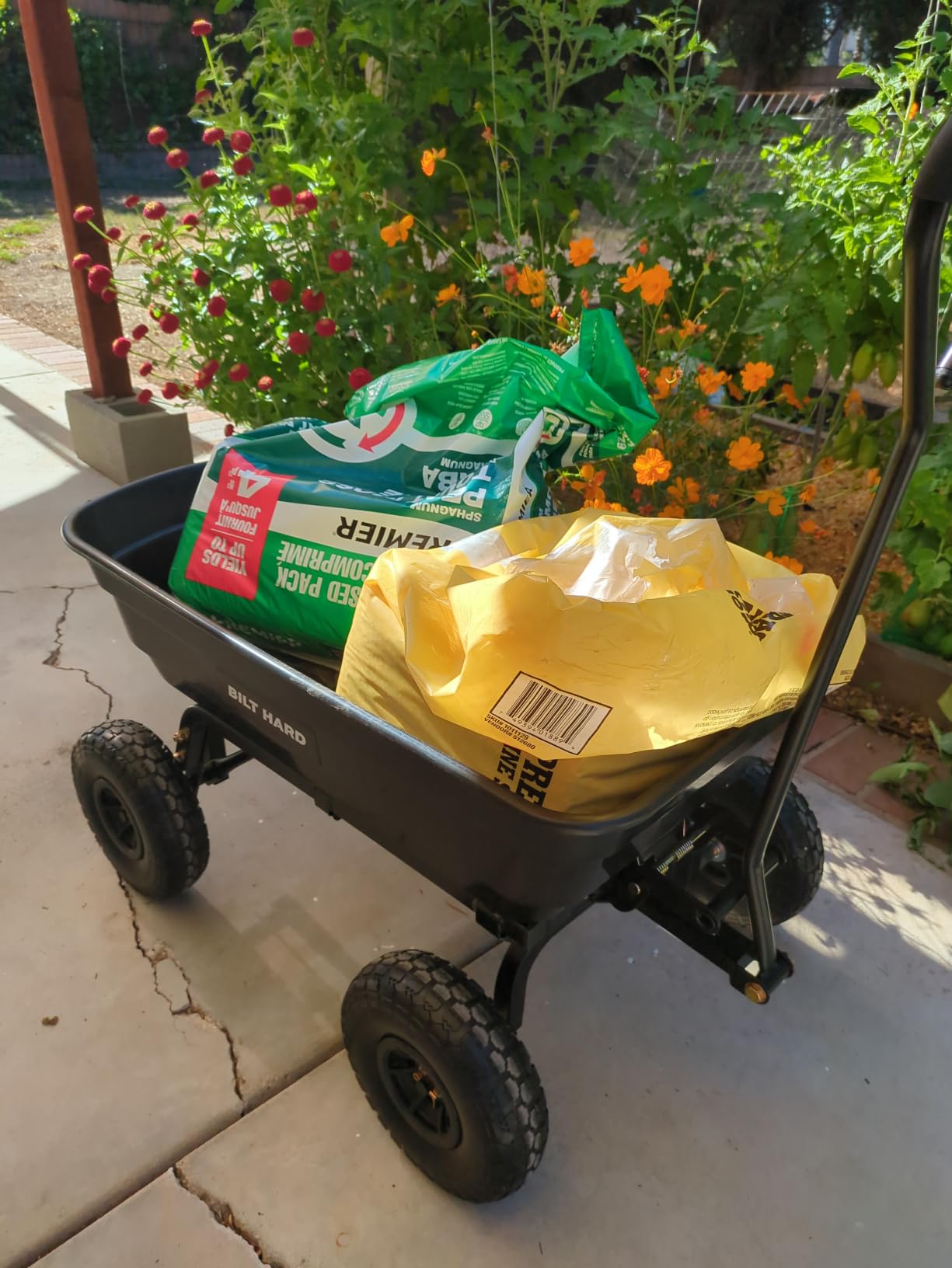
Best fit for large properties with a tractor on site
When the tractor is already out for mowing, towing beats pushing. This cart lets you move a full bed of firewood or mulch in a single pass rather than walking it back and forth.
The high sidewalls and 7 cubic foot bed also make it one of the better choices here for leaves in autumn, where volume matters and weight never approaches the rating.
Where it disappoints
The first thing most buyers notice is that the poly tub flexes and feels flimsy until every frame bolt is fully tightened. That is normal assembly behavior, but if you are not prepared for a torque-and-check step, it sets the wrong expectation.
Fine or damp material can require tipping the cart to empty it completely, assembly needs tools you supply, and at 76 pounds it is the heaviest cart here, which makes loading it into a vehicle genuinely awkward.
8. Rubbermaid Commercial 8.75 Cu Ft Yard Cart – 20 Inch Flat-Free Wheels
Rubbermaid Commercial Products 8.75 Cubic Foot, All-Weather, Big-Wheel Cart/Yard Cart/Lawn Cart/Wheelbarrow, Yardwork/Landscaping/DIY Projects, Durable/Weather Resistant, Black
300 lb capacity
8.75 cubic foot HDPE tub
20 inch 5-spoke flat-free wheels
Two-wheel format
49.5 lb item weight
Pros
- Largest volume in the roundup
- Seamless HDPE body resists cracks leaks and rust
- 20 inch wheels clear curbs and rough ground
- Ergonomic handles reduce back strain
- Made in the USA with a commercial warranty
Cons
- 300 lb rating is low for a tub this size
- Two wheels need more balancing than a four-wheel cart
- Fixed bed rather than a dump wagon
- Cost per cubic foot is high for a 300 lb rating
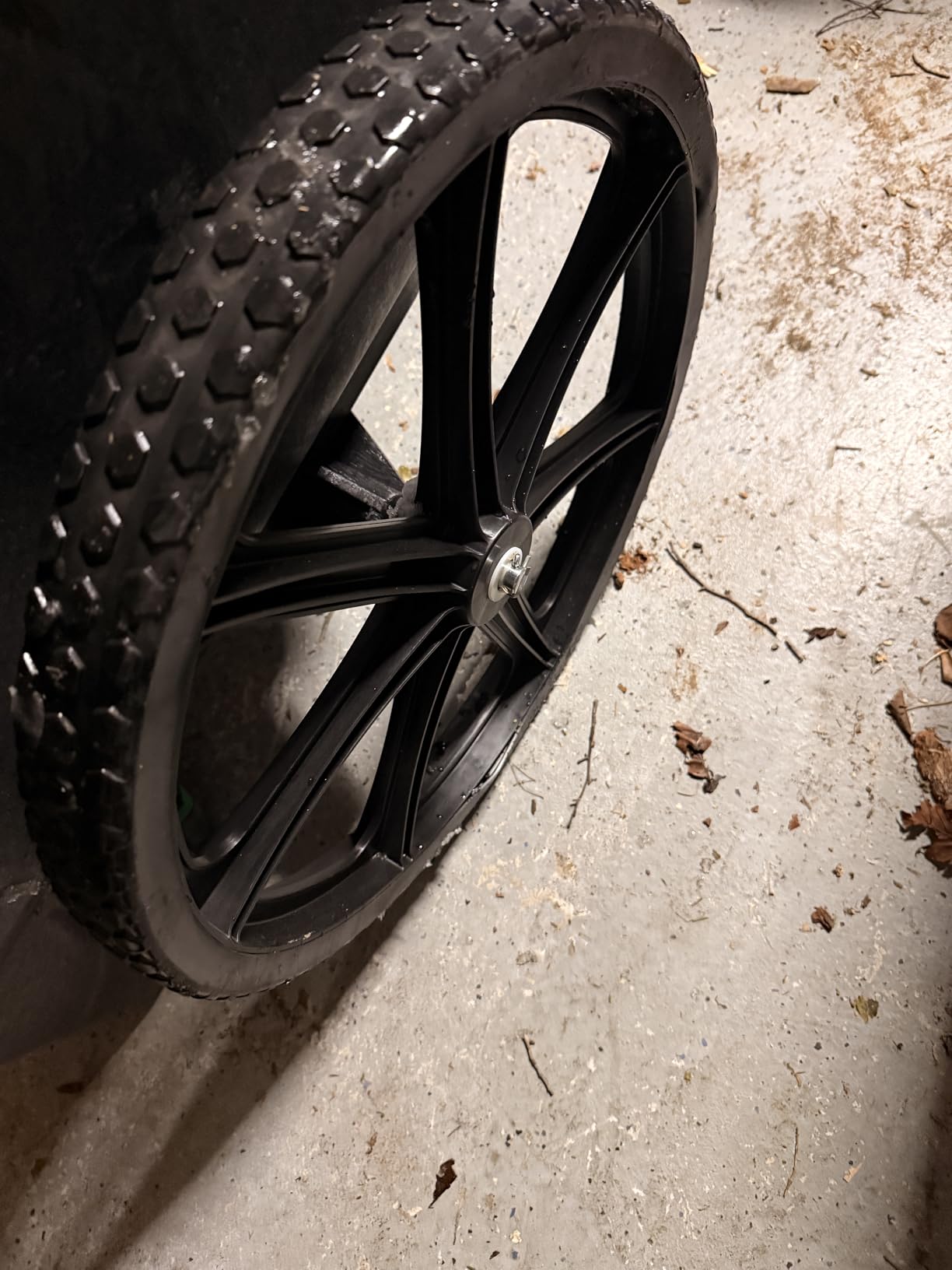
This is the volume specialist. At 8.75 cubic feet of level or heaped capacity, it is the largest stated tub in the roundup, and the 20-inch 5-spoke flat-free wheels roll over curbs, gravel and rough ground in a way that 10-inch wheels cannot. If you are moving bulk leaves, mulch or yard debris in volume rather than weight, the trip count drops dramatically.
The seamless high-density polyethylene body is crack, dent, chip, leak and rust resistant, and the smooth interior wipes clean. It is made in Winchester, Virginia and carries a commercial-grade warranty.
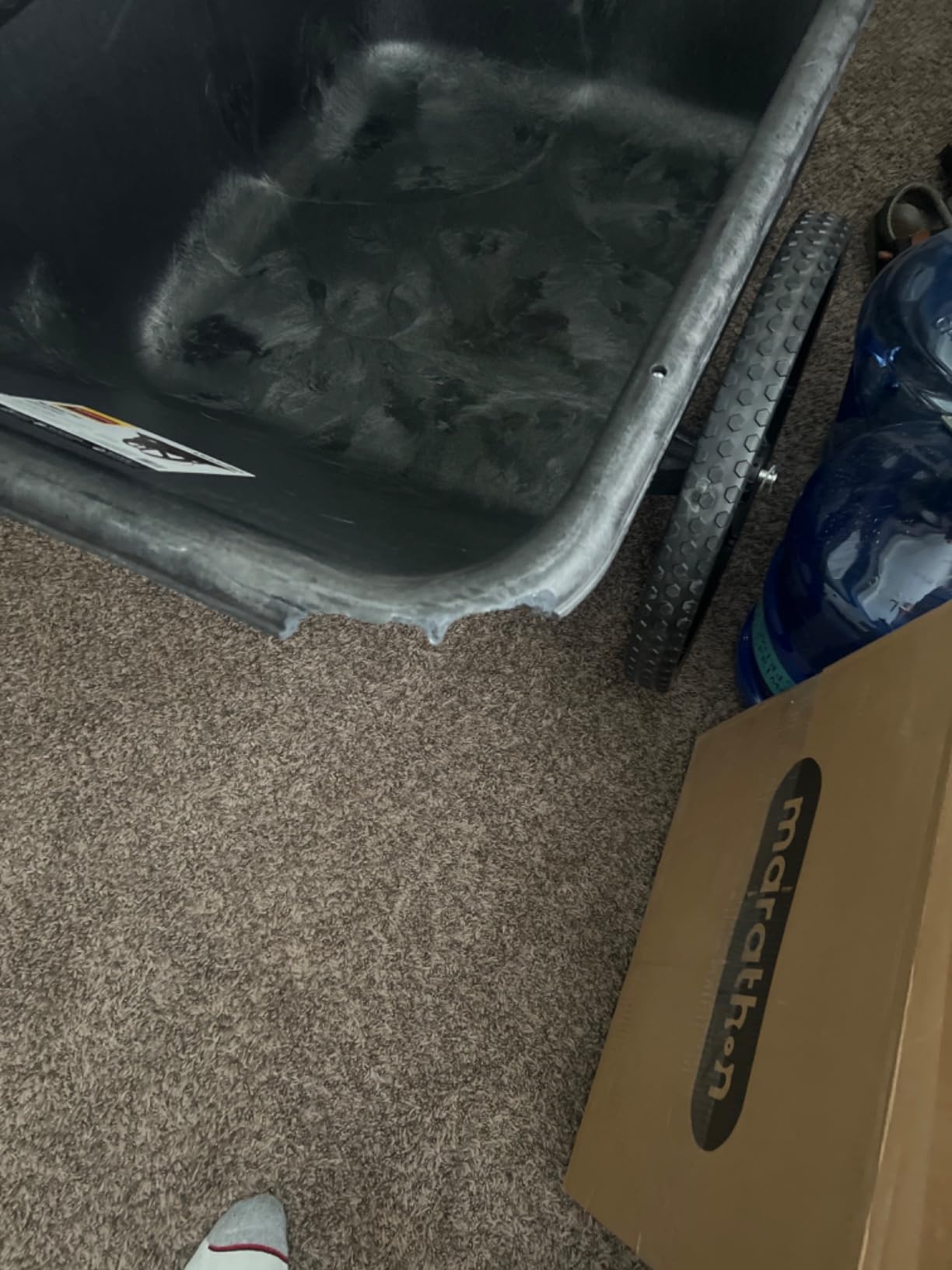
Owners treat it as a volume-first yard cart rather than a heavy-haul cart, and that framing is correct. The ergonomic handles are specifically designed to reduce strain on the back and shoulders during repeated yard days.
Item weight is 49.5 pounds and the overall dimensions are 32 inches deep, 29 inches wide and 54 inches tall, so check the height against your shed or garage door before buying.
Where volume beats weight
Leaves, dry mulch, hay, garden waste and light debris all weigh far less per cubic foot than gravel or concrete. For this cart the volume rating is the whole point, and it means fewer trips for seasonal cleanup.
The 20-inch wheel diameter is also the biggest here, and that matters on uneven ground and at curbs where smaller wheels stall.
Where it disappoints
The 300-pound rating is far lower than the dump carts in this roundup, despite the larger tub. That combination is fine for leaves and light material and wrong for gravel, soil or firewood.
It is a two-wheel design, so you are balancing a full tub rather than parking it, and it is a fixed yard cart rather than a tip-along-side dump wagon, which means you unload by hand rather than releasing a lever.
9. VIVOHOME 660 lb Convertible Cart – The Lightest Load in the Group
VIVOHOME 660lbs Wheelbarrow Dump Garden Cart with 2-in-1 Convertible Handle
660 lb capacity
27.8 lb item weight
Convertible tow handle
10 inch pneumatic tires
Reinforced poly tray
Pros
- Lightest item weight here and easy to reposition
- Handle converts to towing behind a tractor or ATV
- Assembly tools are included in the box
- 180-degree handle adjustment with 240-degree turning
- Reinforced poly tray with a thickened base
Cons
- Tub is shallower than expected
- Backwards tip risk on slopes when loaded
- Rating is debated because the tray flexes
- Load weight is not clearly stated in the manual
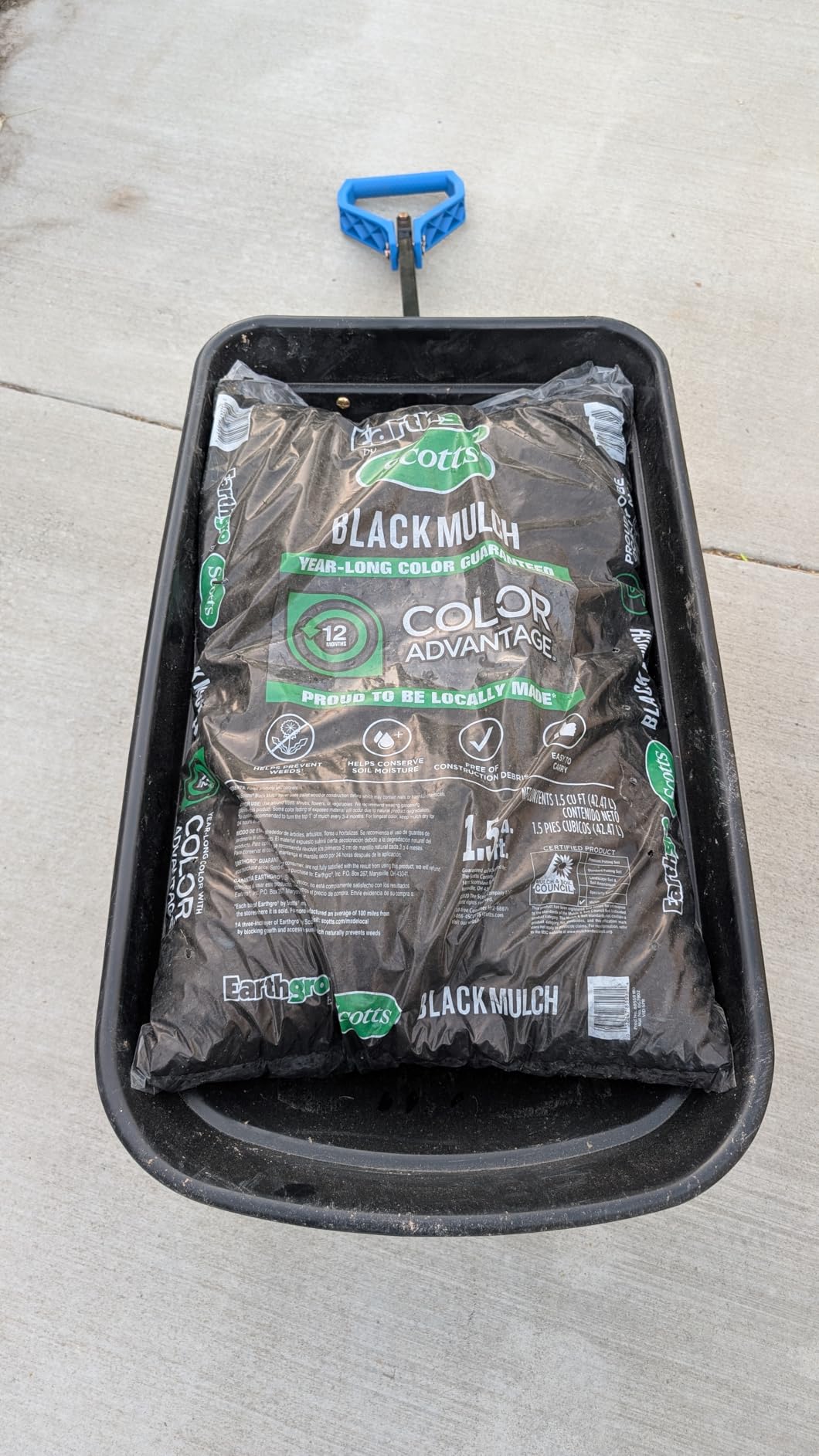
At 27.8 pounds, this is by a wide margin the lightest cart in the roundup, and that changes who can use it. If you are moving mulch up a step, repositioning across a lawn, or loading a cart into a vehicle by yourself, the empty weight is the number that decides whether the job happens at all.
The 2-in-1 convertible handle rotates between hand-pulling and towing behind an ATV, tractor or mower, and the assembly kit includes 5 wrenches and a screwdriver so you do not need to dig out a tool set. The reinforced poly tray has a thickened base and rust-proof walls.

The handle adjustment is damped, with 180-degree adjustment and 240-degree turning for tight pivots, and the 10-inch pneumatic tires have a deep tread for grass, gravel and slopes. There is a 90-degree quick-dump with a hook-plate release, plus a 1-year warranty.
It is a sensible companion cart for a narrow side yard, a small shed or a property where a full-size cart simply will not fit.
Who it suits
Older users, anyone with limited upper-body strength, and anyone working in a confined garden path. The empty weight is low enough to lift and the four-wheel layout means no balancing while loading, so you can fill it in stages rather than wrestling a full tub into position.
The tow-behind mode means one trip on a mower covers a long run, and 660 pounds is a meaningful payload for leaves, light soil, firewood and garden waste.
Where it disappoints
Size is the dominant complaint. The tub is shallower and smaller than most buyers expect, holding roughly three bags of material, so it is a supplementary cart rather than a one-cart solution for a large job.
Reviewers also report a backward tip risk on a slope when loaded uphill, some skepticism about the 660-pound rating given how much the poly tray flexes, and a manual that does not clearly state the rated load. The included 17 mm wrench is also closer to 18 mm and only one is supplied, so a socket set is useful for the handle.
10. WORX Aerocart WG050 – Turbo Lift Tilting Wheelbarrow Dolly
WORX Wheelbarrow Heavy Duty Dolly, 8-in-1 Aerocart Garden Cart, WG050
300 lb load capacity
200 lb lift capacity via Turbo Lift
All-metal frame
Flat-free tires
40.8 lb item weight
Pros
- Turbo Lift tilts a 200 lb load with minimal effort
- Handles up to 300 lb and converts into several tools
- Two-wheel layout with support legs for balance
- Flat-free tires need no inflation
- Narrow profile stores in small sheds and trunks
Cons
- Tub holds about half a standard wheelbarrow
- Solid wheels sink into soft soil
- 5/8-inch wheel bore needs a bushing on some setups
- Metal finish picks up surface rust outdoors
- Tack welds wear over time
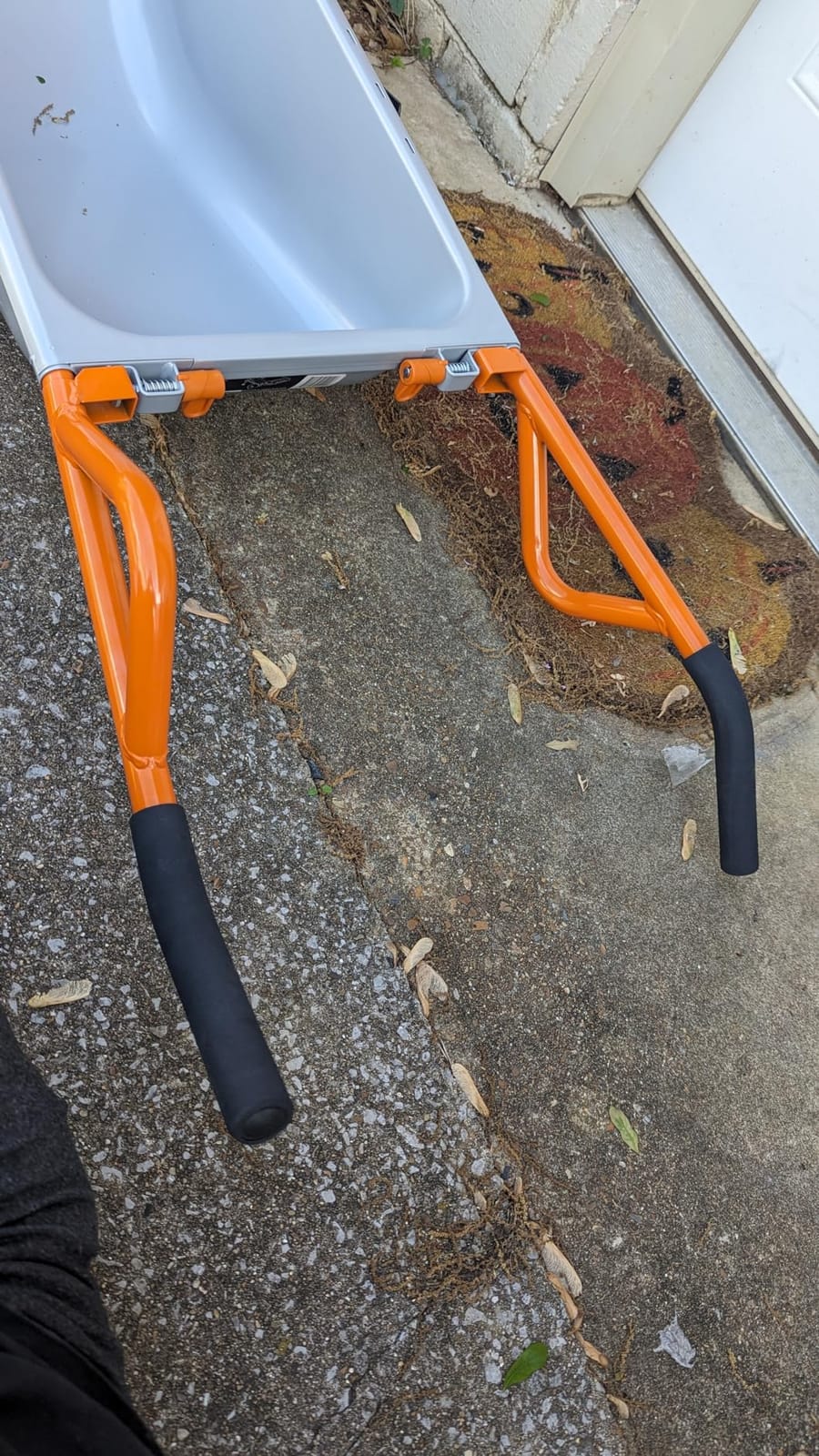
The Aerocart is the one here that is genuinely a wheelbarrow rather than a cart, and the reason is the Turbo Lift design. Instead of always pushing a full tub, you squeeze the handles and the tray tilts toward you, so a 200-pound load can be handled with dramatically less effort. Owners describe it as the difference between a manageable project and an abandoned one when the load is bags of soil or potting mix.
It is rated at 300 pounds of load and converts into 8 different configurations: wheelbarrow, hand cart, dolly, cylinder holder, bag holder, plant mover strap, rock mover mesh and an attachable wagon kit. The narrow profile is another quiet advantage, since it stores in a small shed, a courtyard or a vehicle trunk where a four-wheel cart will not.
Discussion on yard forums is broadly split on two-wheel versus four-wheel designs for heavy work, and the pattern that emerges is useful: two-wheel carts are preferred for weight in a tray, where leverage matters, while box and bag loads favor the four-wheel carts. If your heavy loads are bagged material, that guidance points away from this one.
Flat-free tires mean nothing to inflate, the frame is all-metal with a corrosion-resistant finish, and the warranty is 3 years. Assembly is minimal, mostly a pin per wheel.
Where the Turbo Lift earns its place
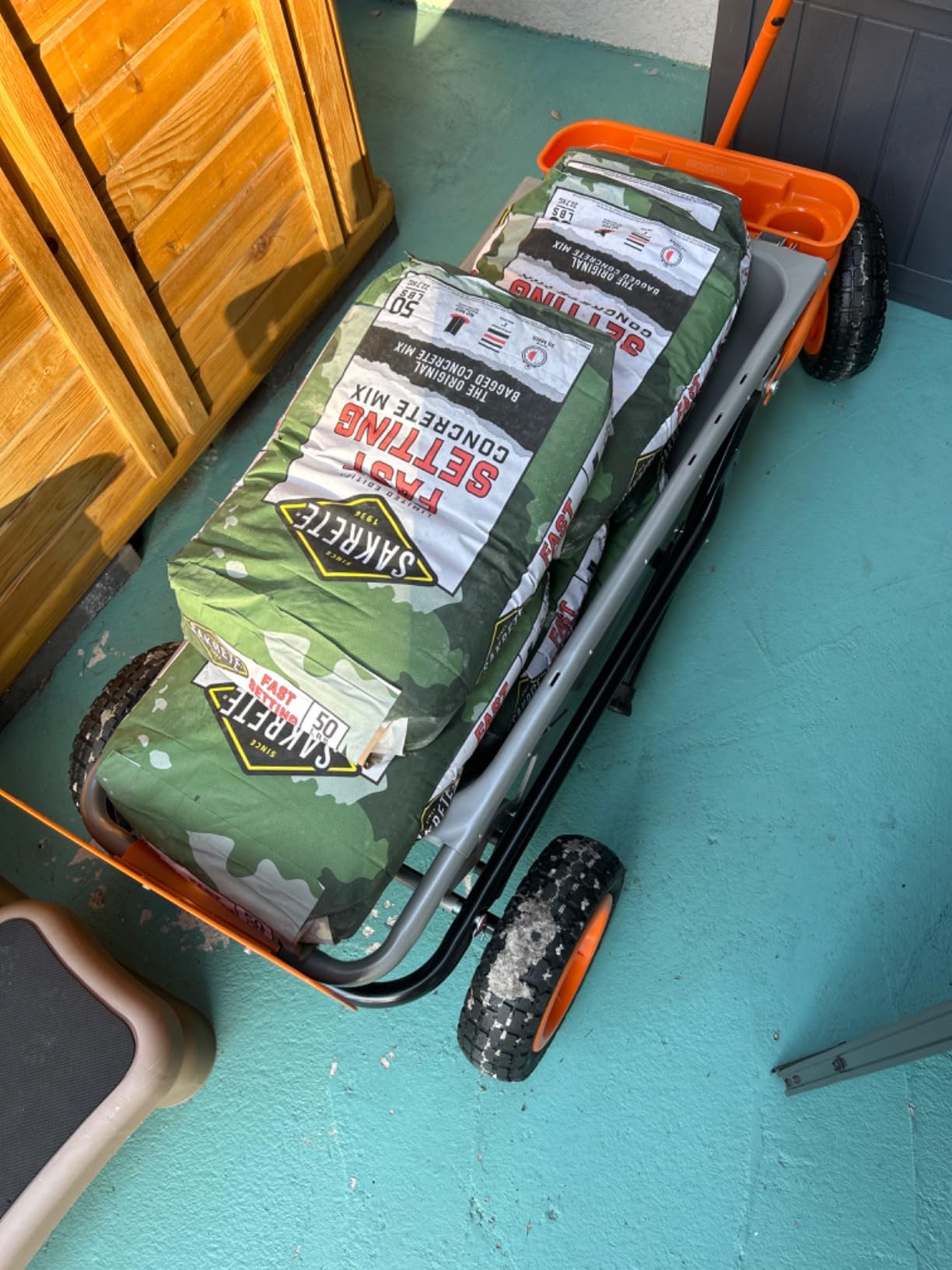
Bagged and boxed loads on flat or gently sloped ground, particularly potting mix, compost, fertilizer and firewood. Tilting the load toward your center of gravity is the most effective back-saving feature on this cart, because it takes weight off the push rather than just rolling it.
It is also among the easiest to store here and the least likely to be knocked over, since the two support legs hold it upright when parked.
Where it disappoints
The tub holds roughly half the volume of a standard wheelbarrow, so it is built for manageable loads, not for moving a yard of material. The flat-free wheels have no give, which means they sink into soft soil and can jam on rocks or curbs when loaded, and several owners fit aftermarket pneumatic wheels to fix that.
Also worth knowing: the wheels use a 5/8-inch bore that needs a bushing on some axle setups, the metal finish picks up surface rust quickly when stored outdoors, the foam grips deteriorate, tack welds at the joints are reported to wear over time, and the handle is shorter than a standard hand truck, so ratchet straps are needed for tall loads.
What Counts as a Heavy Load? Volume, Weight and Trips
The single most useful thing you can learn before buying is that volume and weight are different measurements. A tray rating in cubic feet tells you how big the bucket is. A payload rating in pounds tells you what the frame, wheel and axle can survive. For dense material, only the second number matters.
Here is roughly what you are dealing with per cubic yard, and a cubic yard is 27 cubic feet. Dry mulch comes in around 800 pounds, wet horse manure around 1,600 pounds, screened topsoil around 2,200 pounds, gravel close to 3,800 pounds, and wet concrete about 4,000 pounds. Firewood depends on the species and how dry it is, which is why firewood gets measured by volume and loose material by weight.
Run those numbers against a 6 cubic foot tray, which is a little under a quarter of a cubic yard, and the picture gets clear. That tub heaped with dry mulch is roughly 180 pounds. Filled with wet topsoil it is around 500 pounds, with gravel it is close to 850 pounds, and with wet concrete it tops 900 pounds and will keep climbing as you pack it.
That is the answer to how heavy a wheelbarrow full of concrete really is: a 6 cubic foot tray of wet concrete is roughly 900 to 1,000 pounds. No residential wheelbarrow will survive that, and the 1,200-pound carts here are at the edge of it. Concrete and mortar work belongs in a smaller tray loaded in partial loads, or in a powered unit.
For trips, a cubic yard is 27 cubic feet. A 6 cubic foot cart needs about 4.5 loads to move one cubic yard, a 7 cubic foot cart needs close to 4, and the 8.75 cubic foot Rubbermaid needs just over 3. Mulch, leaves and topsoil are where those numbers pay off. Gravel and concrete are where they do not, because you will hit the weight rating long before the tray is full.
The practical rule that comes out of all of this: volume is the budget for light material, weight is the budget for dense material, and you should size the cart to whichever of the two your project runs out of first.
How to Choose a Wheelbarrow That Survives Heavy Loads
1. Pick a capacity tier that matches the material
Capacity tiers give you a fast shortlist. A 300-pound rating suits bagged goods, firewood and light yard waste, and it is the rating of a standard residential wheelbarrow and the two two-wheel carts here. A 500 to 600-pound rating is the entry point for soil, gravel and moderate firewood. A 900-pound rating covers heavy soil, stone and dense landscaping debris. Above 1,000 pounds you are looking at the 1,200 and 1,500-pound carts, which are built for moving material in bulk rather than for maneuvering around a tight yard.
Overloading is the root cause of most frame and handle failures, and the common advice from experienced users is to haul in smaller loads even with a big cart. A cart rated for 1,200 pounds is not an instruction to fill it to 1,200 pounds.
2. Steel or poly: the honest verdict for heavy loads
Poly wins on material you will leave sitting wet. A polypropylene or HDPE tub will not rust, will not dent, and a hose rinses it clean after manure, soil or concrete work. It also flexes slightly, which absorbs shock when you drop a load in rather than transmitting it to the frame.
Steel wins on impact, heat and stiffness. Steel takes hits from stone and lumber without cracking, does not soften or deform in summer heat, and feels more solid when you lever a heavy load out of it. Its weakness is rust, and once a steel tray starts to pit from wet material sitting in it, the corrosion spreads under the paint and along the seams.
For heavy loads specifically, poly is the better default because heavy loads are usually wet loads. Choose steel when the material is hard and sharp, the cart will live in a shed, or you are moving stone and lumber rather than soil.
3. Pneumatic or flat-free tires: the downtime decision
Tire failure is the most common complaint in this whole category. Pneumatic tires roll smoothly, conform to uneven ground and are far kinder on the frame and your arms, but they need air and they take punctures. Flat-free or no-flat tires remove that risk entirely and are the practical choice for contractor work and for ground with rocks, thorns and debris.
The cost of flat-free tires is ride feel. With no air cushion, every bump hits the load and the frame directly, and solid tires can sink into soft soil and jam on rocks. If you are working on a lawn or a smooth driveway, pneumatic is the more comfortable and better-rolling option. If you are working on gravel, broken ground or a job site, flat-free saves more time than it costs in comfort.
4. One wheel, two wheels or four
Single-wheel barrows are the most maneuverable in a narrow space but the least stable under a heavy load, because the entire load balance depends on you. Two-wheel designs trade some maneuverability for a much better weight-to-effort ratio, and the tilting designs in this category let you pull a load toward you instead of pushing it away.
Four-wheel carts are the most stable and the easiest to load, because you park the cart and load it. The cost is turning radius, and you should measure your narrowest gate and path against the cart’s overall width before buying. If most of your work happens on slopes, note that narrow wheelbases tip backward when loaded uphill.
5. Understand what breaks first
Wheels and tires go first, then bearings and rims, then the welds at the frame joints and the handle attachment. Overloading accelerates all four. The prevention habits are unglamorous and effective: keep loads centered over the axle, avoid dropping material into the bed from height, tighten the frame bolts fully after the first few loads, and check tire pressure on pneumatic models at the start of each project.
Load restraint matters too. Ratchet straps for tall or awkward loads, a tarp for fine material on a slope, and balancing the load side to side so the cart does not want to tip.
6. Check the ergonomics and the storage
Handle height is the most overlooked spec. A handle that is too low for your height causes back and wrist strain over a full day of work, and padded grips matter more than buyers expect. Adjustable or rotating handles solve this for many carts in this roundup and are worth paying a little extra for if you are the main user.
Storage catches people just as often. Measure your shed door and gate opening, and check the cart’s height as well as its width, because the taller carts here stand 54 inches and more, and some shed doors are lower than that.
7. Know when a powered wheelbarrow makes more sense
Every cart here is a push tool, and pushing several hundred pounds of wet soil across uneven ground is still a lot of strain per trip. If your project is measured in cubic yards rather than barrow-loads, a powered unit removes the largest single source of fatigue. Our guide to the [8 best electric wheelbarrows for landscaping](https://www.patincarrera.com/best-electric-wheelbarrows-for-landscaping/) covers the current powered options and what to check on battery platform compatibility before you commit to one ecosystem.
Frequently Asked Questions
What is the weight limit for a wheelbarrow?
A standard residential wheelbarrow is typically rated for 300 to 400 pounds. Heavy-duty wheelbarrows start at 500 pounds, and the four-wheel dump carts in this roundup are rated from 660 pounds up to 1,500 pounds. Check the payload rating rather than the cubic feet, because a 6 cubic foot tray of wet concrete runs close to 1,000 pounds.
Is it better to get a steel or poly wheelbarrow?
For heavy loads, poly is the better default because heavy material is usually wet material, and a poly tub will not rust, dent or leak. Choose steel instead when you are moving stone, brick or lumber, when impacts are likely, or when the cart will be stored in a shed. Steel is stiffer and more impact-resistant; poly is more corrosion-resistant and easier to clean.
How much weight can a typical wheelbarrow hold?
Most home wheelbarrows hold 300 to 400 pounds, which is enough for mulch, soil, firewood and yard debris in modest loads. If you are moving gravel, wet topsoil or firewood regularly, move up to a cart rated for 900 to 1,200 pounds. Haul in partial loads even with a large cart, since overloading causes most frame and handle failures.
How heavy is a wheelbarrow full of concrete?
Very heavy. Wet concrete weighs about 4,000 pounds per cubic yard, so a 6 cubic foot tray of it lands near 900 to 1,000 pounds and will exceed the rating of most carts. Mix and move concrete in smaller partial loads, and consider a powered wheelbarrow for a large pour.
How many cubic yards can a wheelbarrow hold?
A cubic yard is 27 cubic feet, so the number of loads depends on the tray size: about 4.5 loads with a 6 cubic foot cart, close to 4 with a 7 cubic foot cart, and just over 3 with an 8.75 cubic foot cart. For gravel and concrete you will reach the weight rating long before the tray is full, so count on more loads than the volume math suggests.
Do wheelbarrow tires go flat?
Pneumatic tires do, and they are the first thing to fail under heavy loads on rough ground. Flat-free and no-flat tires cannot be punctured, which is why they are the standard choice for contractor work, at the cost of a harsher ride and more transmitted vibration. If most of your work is on soft or uneven ground, pneumatic tires roll better but need periodic inflation.
The Best Wheelbarrow for Heavy Loads in 2026
After putting all ten through the same materials, the best wheelbarrows for heavy loads divide cleanly by job. For most people moving soil, mulch, firewood and debris, the Gorilla Carts 6 cubic foot poly dump cart is the pick: a 1,200-pound rating, a one-hand quick-release dump and the deepest review history in the group, which is how you find out its weak spots before you buy.
Work over gravel and rough ground? Take the 7 cubic foot Gorilla with 13-inch flat-free tires, the highest-rated cart here. Moving bulk leaves in volume? The Rubbermaid 8.75 cubic foot yard cart cuts the trip count more than any other option. And if your back is the limiting factor rather than the load, the WORX Aerocart tilting design is worth a look.
Whatever you choose, size the cart to the weight of your material rather than the size of its tray, haul partial loads, and measure your narrowest gate before the cart arrives.