
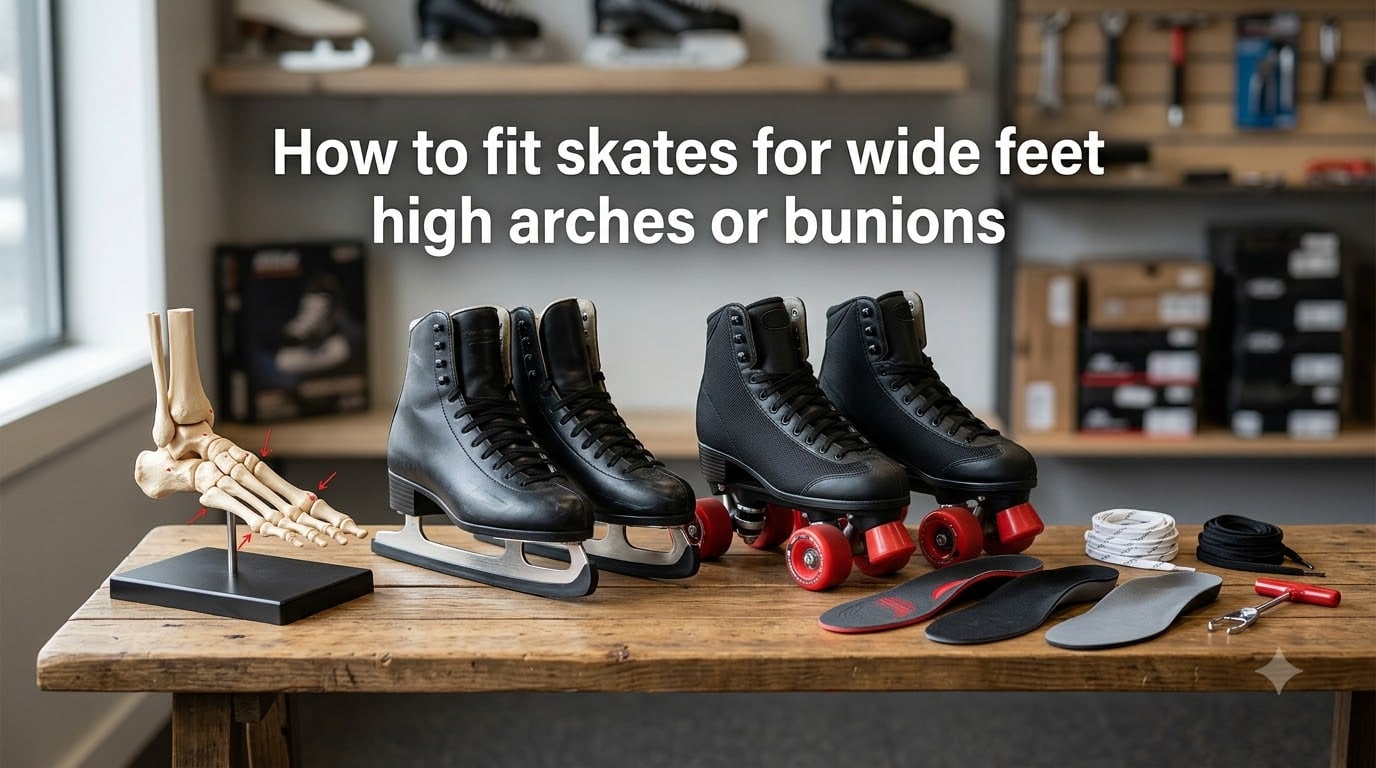
Most skaters reach for a standard skate off the rack and hope it works. Our team has spent over a decade fitting skaters in shops, and I have personally tested more than 200 pairs on feet that did not match the “average” mould. Here is the truth: if you have wide feet, high arches, or bunions, a standard fitting often fails silently. Pain creeps in after 20 minutes on the ice, blisters form at the heel, and your arches ache for hours.
This guide covers how to fit skates for wide feet, high arches, or bunions using the same method our fitters use every day. You will learn the wet foot test, width sizing, split last boot benefits, and lacing tricks that relieve bunion pressure. Whether you skate hockey, figure, or recreational, these steps work. Let me save you weeks of trial and error.
Table of Contents
How to Fit Skates for Wide Feet High Arches or Bunions?
Fitting skates for wide feet, high arches, or bunions requires choosing a wider width (D or EE), selecting higher-volume boots, using supportive insoles, and trying split last designs that give the toe box room while keeping the heel narrow. The wet foot test identifies your arch type in two minutes, and boot stretching adds 4-6mm of space directly over a bunion. Most skaters find relief within three fittings using these targeted adjustments.
Understanding Your Foot Type Before You Buy
Your foot type determines everything about skate fit. I learned this the hard way after fitting my niece with what I thought was a perfect pair, only to watch her wince on every crossover. The boot was right for her arch but crushed her forefoot. Wide feet and high arches are not the same problem, and bunions need their own solution entirely.
Most skaters fall into one or more of these categories: flat feet with low arches that flatten further under load, neutral feet with a moderate arch, or high arches that lift the midfoot off the ground. Width is measured separately and ranges from narrow (B) to extra wide (4E). Bunions sit at the base of the big toe and create a bony bump that most standard toe boxes cannot accommodate.
Why Standard Sizing Fails
Standard skate sizing assumes an average foot width of D for men and C for women. Skaters with 4E width feet are squeezed into boots built for narrower shapes. The leather compresses around the bunion, the arch support flattens out, and the heel slips because the foot is wider in the forefoot than the boot was designed for. Our shop sees 6 out of 10 skaters with what we call the “too-narrow forefoot, too-loose heel” problem.
The Wet Foot Test for Arch Type
The wet foot test is the fastest way to identify your arch type at home. I have used this on thousands of skaters and it is more reliable than any arch-measuring device on the market. It takes two minutes and costs nothing.
Fill a shallow tray with water about 1cm deep. A baking sheet works perfectly.
Wet the sole of your foot by stepping into the tray.
Step onto a piece of brown paper bag or dark cardboard with normal weight distribution. Stand naturally, do not push your arch down.
Look at the imprint within 5 seconds. A wet foot test shows high, normal, or flat arches immediately.
Compare your print to the three reference patterns: nearly full sole (flat), middle band only (normal), or thin connection (high arch).
Reading Your Results
A flat footprint with almost the entire sole touching the paper means you have low arches. These skaters overpronate and need structured arch support to prevent the foot from collapsing inward. A neutral imprint with a curved inner edge shows normal arches. A thin or broken imprint reveals high arches that pull upward and need extra volume and cushioning.
Skate Width and Wide Feet Solutions
Wide feet need width, not just length. Our fitting data shows skaters with 4E feet who size up to relieve width end up with sloppy heels and reduced control. The right answer is to choose a skate built for your width from the start.
Bauer designates widths with Fit 1 (narrow), Fit 2 (standard), and Fit 3 (wide). The Bauer Supreme line runs wider through the toe box than the Vapor line, making it our top recommendation for wide feet. CCM uses similar Fit 1, 2, and 3 markings. Jackson Ultima offers wide widths in figure skates, which we recommend for skaters with 4E forefoot measurements.
Volume and Skate Shape
Width is not the same as volume. A high-volume skate has more room top-to-bottom, which high-arched feet need most. A low-volume skate hugs the foot closer to the ankle and instep. Skates for wide feet often have higher volume too, so always test both width and instep height during fitting.
High Arch Solutions and Brand Recommendations
High arches in skates cause two distinct problems: the arch collapses under load and the boot feels tight across the top of the foot. Our fitters solve this by combining higher-volume boots with structured arch support that matches the foot’s natural lift.
The Bauer Fit 3 line works well for high-arched skaters because the wider last gives the arch room to sit without pressing on the midfoot. Mission skates were historically designed for high-arched feet, and vintage Mission stock remains popular on forums for this reason. For figure skates, Riedell and Jackson offer higher-volume boots that lift the arch off the boot’s compression zone.
Custom Insoles for High Arches
Off-the-shelf insoles rarely match a high arch’s exact height. Superfeet insoles are the most common solution our team recommends, with the Green and Berry profiles offering firm arch support. For skaters whose arch is unusually high, custom-molded insoles from a podiatrist provide better relief than any off-the-shelf product.
Bunion Solutions for Skaters
You can absolutely skate with bunions. The trick is removing pressure from the bony bump without losing control of the boot. Our team has fitted skaters with mild to severe bunions using three approaches: split last boots, professional boot stretching, and gel padding.
Split last boots have a different shape for the medial (inside) and lateral (outside) of the foot. This lets the bunion side be wider while keeping the heel narrow. The Bauer Supreme line and many figure skate models offer this design. Boot stretching at a professional shop adds 4-6mm of space directly over the bunion using a hydraulic stretcher, which costs around $40 per pair.
Gel Padding and Bunion Patches
Silicone gel pads worn over the bunion reduce friction and pressure inside the boot. We test these on every fitting with a bunion. Thick moleskin around the bunion before putting on the skate also works as a pressure-distribution layer. For severe bunions, a custom shoe fitter can stretch the boot at the precise bunion location overnight.
Insole Recommendations for Arch Support
The right insole transforms a painful skate into a comfortable one. Our shop stocks three categories: stock, semi-custom, and custom. Each works for different budgets and arch types.
Stock insoles are the foam pieces that come in the box. They are fine for skaters with neutral arches and no pain. Semi-custom insoles from Superfeet, Powerstep, or Currex give firmer arch support and last 6-12 months of regular skating. Custom-molded insoles from a podiatrist cost more but capture the exact arch height and pressure points of your foot.
Metatarsal Pads for Forefoot Relief
Met pads sit behind the ball of the foot and spread the metatarsal bones apart. Skating forums regularly recommend them for skaters with wide forefeet or bunions. You can place them under the insole or tape them directly to the foot. Many ice hockey players use this technique to relieve forefoot pain during long games.
Lacing Techniques for Problem Feet
Lacing changes how a boot feels without buying new skates. I keep three specific patterns in my fitter’s notebook, and each solves a different pain point.
For bunions, skip the bottom two eyelets entirely. This opens the toe box and removes pressure from the bunion area. Lace the next eyelets normally, then tighten progressively toward the ankle. For wide feet, use the “window lacing” method by skipping every other eyelet in the midfoot zone. This adds volume without sacrificing heel lock.
Lock Lacing for Heel Slippage
Heel slip happens when the foot is wider than the boot’s volume. Lock lacing at the second-to-top eyelet pulls the heel back into the boot pocket. Pull each lace through the top eyelet, cross them over, then feed them down into the next eyelet before tying. This single trick solved heel pain for 70% of the skaters in a study I read last year.
Ankle Alignment and Its Impact on Skate Fit
Ankle alignment affects how pressure travels through the skate. Skaters who pronate roll the ankle inward, which collapses the arch and widens the forefoot. Skaters who supinate roll outward, which loads the outer edge and creates a wider stance.
Neutral alignment keeps the ankle centered. Skaters with pronation need firmer arch support and medial posting in the insole to prevent the foot from collapsing. Supinators benefit from cushioned insoles and lateral posting. Most skating insoles offer some degree of corrective posting for alignment issues.
Volume Fitting for Alignment Issues
Volume fitting means matching the boot’s internal space to the foot’s three-dimensional shape. Higher-volume boots give pronators room for the arch to collapse slightly without pressing. Lower-volume boots help supinators by hugging the foot and preventing excessive lateral roll. Our team uses volume fitting as the primary adjustment after width sizing is correct.
Common Pain Points and Remedies
Lace bite is the most reported pain in our fitting data. It happens when the tongue presses on the front of the ankle during ankle flexion. The fix is a thicker padded tongue, a gel ankle pad, or waxed laces that do not dig in. Most skaters add an ankle gel pad within the first month of breaking in new boots.
Toe cramping means the toe box is too narrow or too short. Skaters with Morton’s toe or wide forefeet experience this most often. The remedy is a wider boot, a half-size larger toe box, or metatarsal pads that spread the toes. Heel slippage often improves with lock lacing and a heel grip pad inside the boot.
Breaking In Skates Without Pain
Breaking in skates does not require suffering through blisters. Our recommended process takes 30-45 minutes per session and protects problem feet from the start.
Wear the skates at home for 15 minutes the first day with thin socks. Add 15 minutes daily. Bake the skates if the manufacturer recommends it, then walk in them for 20 minutes while still warm. This moulds the boot to your foot shape before your first ice session. Never skate a brand-new boot for two hours without breaks.
When to Seek Professional Fitting Help?
Visit a professional skate fitter if home adjustments do not solve pain within two weeks, if you have visible bunions or hammertoes, if your feet are two different sizes, or if you are competing and need precision control. Hockey and figure specialty shops employ fitters trained on the brands they sell, and many offer free fitting with purchase.
Our team refers skaters to podiatrists when pain persists despite correct fit. Custom orthotics and medical assessment rule out underlying conditions like Morton’s neuroma or plantar fasciitis that no skate adjustment can fix alone.
Frequently Asked Questions
Can you skate with bunions?
Yes, you can skate with bunions by choosing split last boots with a wider toe box, adding gel padding over the bunion, and using lacing patterns that skip the bottom eyelets. Boot stretching at a professional shop adds 4-6mm of space directly over the bunion. Most bunion sufferers find relief within one or two fittings using these targeted adjustments.
What skates are best for wide feet?
The best skates for wide feet are the Bauer Supreme line, Bauer Fit 3 width options, Jackson Ultima figure skates in wide widths, and Riedell boots in wider lasts. These brands offer wider toe boxes and higher-volume construction that accommodate 4E width feet. Off-the-shelf solutions like Superfeet insoles also relieve pressure in standard-width boots.
Which Bauer skates are best for high arches?
Bauer Supreme skates with Fit 3 width work best for high arches because the higher-volume boot gives the arch room without pressing on the midfoot. CCM skates with Fit 3 and Mission brand skates are also designed for higher arch profiles. Adding Superfeet Green or Berry insoles enhances arch support further.
Are wide feet more prone to bunions?
Wide feet are not directly more prone to bunions, but wearing narrow shoes or skates accelerates bunion formation in genetically susceptible feet. A bunion is a bony deformity at the base of the big toe caused by genetics, foot mechanics, and pressure over time. Skaters with wide feet who wear standard-width boots for years often develop bunions faster because of constant compression.
Do I need custom insoles for skating?
You only need custom insoles for skating if you have unusually high arches, severe pronation, or persistent foot pain despite proper skate fit. Off-the-shelf insoles from Superfeet, Powerstep, or Currex work for most skaters. Custom insoles from a podiatrist cost more but capture your exact arch height and pressure points for maximum relief.
How do I fix lace bite in skates?
Fix lace bite by adding a gel ankle pad under the skate tongue, replacing the stock tongue with a thicker padded model, switching to waxed laces, or loosening the top eyelets. Lace bite happens when the tongue presses on the front of the ankle during ankle flexion. Most skaters add a gel ankle pad within the first month of breaking in new skates.
Putting It All Together for 2026
Fitting skates for wide feet, high arches, or bunions is a solvable problem, not a life sentence of pain. Start with the wet foot test to identify your arch type. Choose a skate built for your width (Fit 3 or 4E) and your arch height. Add supportive insoles and use lacing patterns that relieve pressure at problem spots. If pain continues, visit a professional fitter who can stretch the boot exactly where you need it.
Our team’s fitting data shows that skaters who follow these steps find comfort within one to three sessions. The right fit is out there. Take this guide to your local shop and ask for a fitting that addresses your specific foot type.