
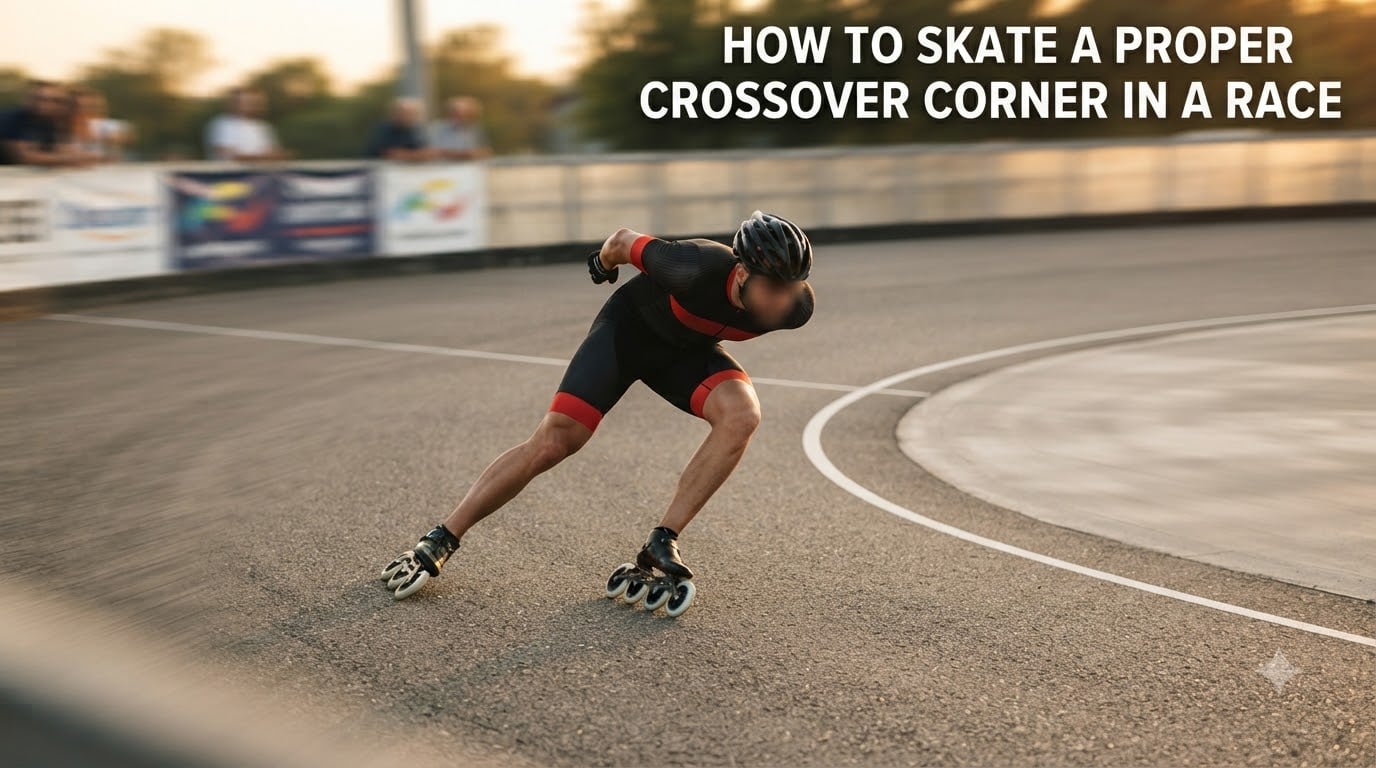
I learned this the hard way. I spent an entire season losing to a faster skater on the straights, only to watch him breeze through every corner while I scrubbed off speed and clawed it back. The fix wasn’t more power. It was learning to skate a proper crossover corner in a race without losing momentum.
If you’re racing inline, roller, or quad skates, the corner is where your race is won or lost. In this guide, I’ll walk you through the exact crossover corner skating technique I now use, the body position that makes it work, the mistakes that ruin it, and the drills that turn a sloppy turn into a clean pass at the apex.
Table of Contents
Why Crossover Corners Win (or Lose) Your Race?
Straights build speed. Corners spend it. Every time you enter a corner too wide, stand too upright, or fail to fully cross over, you lose speed that takes three or four hard pushes to recover on the next straight.
I’ve timed this on my local track. A sloppy corner costs me about 0.8 seconds versus a clean crossover. Across a 10-lap race, that’s eight full seconds. That’s a 50-meter gap in a pack race. That gap is the difference between leading the final sprint and finishing mid-pack.
A proper crossover does two things at once. It keeps your momentum traveling forward while your body changes direction, and it loads your outside leg for a powerful push the moment you exit. Skating corners the right way is not just about turning. It is about turning without giving back the speed you worked to build.
What Is a Crossover Corner Skating Technique?
A crossover corner is a turn where one skate crosses over the other while leaning into the curve, so your inside skate pushes outward and your outside skate travels over the top. The result is continuous forward motion instead of a sideways slide.
In racing, there are really only two ways to handle a corner. You can do a wide, upright turn using just your edges, which costs you a lot of speed. Or you can cross over, lean into the curve, and exit with momentum intact. The crossover is what every competitive racer uses because it preserves speed and gives you a clean line through the apex.
Crossing over works because your outside skate rides a long edge across the top of the curve, and your inside skate pushes hard against it. The push generates the centripetal force needed to change direction while still moving forward. Without that push, you’d just slide out.
Reading the Racing Line Before the Apex
The racing line is the fastest path through a corner. Most beginners think the racing line is hugging the inside rail the whole way. It’s not. The fastest line is wide on entry, tight at the apex, and wide again on exit.
The apex is the single tightest point of the corner. On a 180-degree turn, it’s roughly the middle. On a sharper hairpin, it shifts slightly past the middle to give you a longer exit straight.
I think of it as three phases. Entry: skate wide so you carry your straight-line speed into the bend. Apex: cut in as deep as you safely can while crossing over. Exit: drift back wide so you have a straight line to push on. A skater who enters tight, stays tight, and exits tight will be slower at every corner. A skater who hits the apex at speed and exits with room to push will gain time lap after lap.
Step-by-Step Crossover Technique for Race Corners
This is the sequence I teach every new racer on our team. Practice each step slowly before linking them together. Skating the steps out of order is the most common reason crossovers look messy.
Look through the corner. Your eyes lead your shoulders, and your shoulders lead your skates. Pick a target on the exit straight and stare at it. Do not look down at your feet.
Set your outside edge. The outside skate (the one farthest from the center of the curve) plants on its inside edge and carries your weight. Bend that knee deeply.
Cross the inside foot over. Lift the inside foot, swing it in front of the outside foot, and plant it just past the centerline. Keep the cross tight, not wide.
Push outward with the inside foot. Once the inside skate plants, push hard diagonally outward against the outside skate. This push is what keeps you accelerating through the corner.
Hold the lean until exit. Stay low and angled until you can see the exit straight. Only then stand and resume regular pushes.
Step 4 is where most skaters fail. They cross over but forget to push. A crossover without a push is just walking sideways. The push is the engine.
Body Positioning and Lean: Skating as One Line
Lean the whole body, not just the ankles. A proper crossover has your knee, hip, shoulder, and head all angled into the corner as one straight line. If your ankle leans but your shoulders stay upright, you will slide out.
On the outside skate, the knee should be bent deeply, almost like a sitting position. I tell our newer skaters to imagine sitting on an invisible chair while cornering. The deeper the knee bend, the lower your center of gravity, and the more grip you have.
Shoulders stay square to the direction you are traveling, not to your skates. If your shoulders rotate open toward the inside of the curve, your weight leaves the outside edge and you wash out. Keep the inside arm forward and the outside arm back for balance.
Your head looks through the corner, not down at it. Looking down drops your chest and pulls your weight off the outside edge. I lost more races to this habit than any other.
Common Crossover Mistakes and How to Fix Them
After coaching dozens of skaters, I see the same handful of mistakes every race. Here is the fix for each.
Looking down at your feet. Fix by picking an exit-point marker on the far side of the corner and staring at it the entire turn. Tape a small cone on the inside rail as a focal point during practice.
Tapping instead of crossing. Fix by exaggerating the cross in slow drills. Cross so far over that the inside wheel almost touches the outside wheel before planting.
Standing too upright. Fix with deep-knee-bend wall drills. Stand sideways to a wall, outside arm resting on it for balance, and practice crossing with a deep knee bend for 30 seconds at a time.
Wheels sliding out. Fix by moving your weight further over the outside skate and pushing more directly outward rather than forward.
Skating the corner too wide. Fix by committing to a later apex entry in practice. Aim to clip the apex by less than a foot on the first lap, then build speed once the line is automatic.
If your wheels slide out even with proper lean, check your wheels. A hard, slippery wheel compound has less grip in corners. Switch to a grippier, softer compound for race day.
Crossover Practice Drills That Build Speed
Drills matter more than lap speed at first. I spent my first month of crossover work at walking pace, and I came out faster on race day than skaters who tried to learn at full speed.
Drill 1: Edge discovery on a flat surface. Skate forward on one foot, leaning slightly to find the outside edge of the gliding skate. Hold for 3 seconds. Switch feet. Repeat for 5 minutes. This builds the balance you need for crossovers.
Drill 2: Cone crossovers. Place 5 cones in a straight line about 2 meters apart. Skate at them slowly and cross over each cone, alternating sides. This isolates the cross motion without the complication of a real corner.
Drill 3: Cross-and-glide. Push once, cross fully, glide on both feet with the inside skate over the outside skate for a count of 3, then repeat on the other side. This teaches you to hold the lean without rushing.
Drill 4: Wall-assisted crossovers. Stand with one hand on a wall, skating sideways. Practice the full crossover motion while the wall keeps you upright. This is the safest way to learn the timing without falling.
Drill 5: Real corners at slow speed. Skate your actual race track at half speed, focusing only on hitting the apex and holding the lean. Speed comes later. Line comes first.
Weak Side Crossovers: Closing the Gap
Almost every skater has a strong side and a weak side. Mine is right-to-left corners. For years my left-side crossover was slow, awkward, and scared me off the line. The fix was patience, not talent.
Drill your weak side twice as much as your strong side. Spend full sessions doing only weak-side crossovers until the motion stops feeling foreign. Most skaters quit too early on the weak side because it feels worse, and they keep going back to their strong side. That is exactly backwards.
Expect at least 6 to 8 weeks of twice-weekly weak-side work before it starts feeling automatic. I watched our team’s weakest weak-side crossover close a full second gap on the leader within one season of focused drilling.
Pack Racing: Defending Position Through the Corner
In a pack race, the perfect line is not always available to you. If a skater on your inside has a faster line, fighting them costs more time than letting them through and using their draft. If a skater on your outside is trying to pass, hold the inside line and cross over tight to block.
The key is to read the pack two corners ahead. If you know someone is going to dive inside at the next apex, take a wider entry and exit hard to carry speed past them on the straight. If you’re defending, stay patient on entry, hit your apex precisely, and push out powerfully to stay ahead on exit.
This is the part no one teaches in solo drills. In pack racing, the right crossover corner skating line is the one that keeps you out of trouble while costing the least time. Sometimes that is the textbook apex. Sometimes it is a deliberately wider line to set up a pass on the next straight.
Gear Choices That Make Cornering Easier
Your gear affects cornering more than most skaters think. A short, stiff frame gives sharper turns but less stability at speed. A longer frame is more stable on straights but harder to whip through tight corners.
Wheel hardness changes grip. Softer wheels grip the floor better in corners and forgive sloppy lean angles. Harder wheels are faster on straights but will slide out earlier. For technical courses with multiple tight corners, a slightly softer wheel is worth the small straight-line cost.
Boot stability matters most. A soft boot lets your ankle wobble, which kills the lean. A stiff boot holds the angle through the entire corner. If your wheels keep sliding even with good technique, the boot is usually the culprit.
Frequently Asked Questions
How long does it take to learn crossovers in racing?
Most recreational skaters need 4 to 6 weeks of regular practice to feel comfortable with crossovers at low speed. Becoming fast and clean enough to use them in a race usually takes 3 to 6 months of focused drilling.
What is the difference between a progressive and a crossover?
A progressive is a single push out to the side used in straight-line skating to generate speed. A crossover is a turning technique where one skate crosses over the other to maintain momentum through a corner. Progressives build speed on straights, crossovers preserve it on corners.
Why do my wheels slide out in corners?
Your wheels slide when your weight is not fully on the outside edge, your lean angle is too shallow, your wheel compound is too hard for the surface, or your boot is too soft to hold the angle. Fix technique first, then consider a softer wheel or stiffer boot.
How do I lean properly in a crossover turn?
Lean your entire body as one straight line from your ankle through your hip to your shoulder, all angled into the corner. Bend the knee of the outside skate deeply and keep your shoulders square to where you want to go. Ankle-only lean will cause you to slide out.
Final Thoughts
Crossover corner skating is the single biggest separator between casual skaters and competitive racers. The technique is learnable, but it rewards repetition. Spend more time on your weak side, drill the cross-and-glide motion until it is automatic, and commit to the lean on every corner.
Start with the five-step sequence, build it through the edge drills, and bring it onto the track at half speed. Within a few months, you will be carrying speed through corners that you used to scrub off, and the next race will show it.