
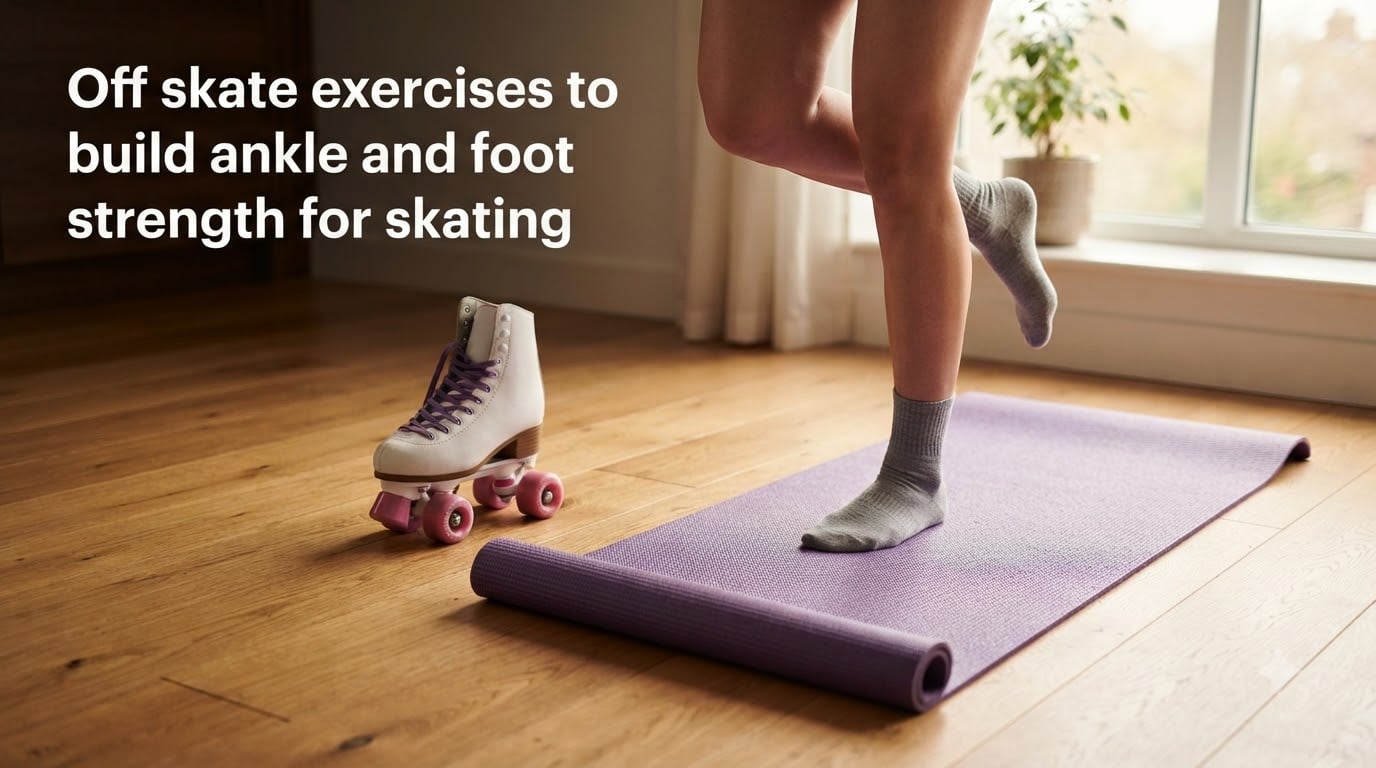
Every roller skater knows that wobbly ankle feeling. You lace up your skates, push off, and your ankles cave inward like they have never stood on wheels before. I spent my first three months of skating thinking I just had “bad ankles” until a derby veteran told me the truth. Weak ankles are not permanent. Off-skate exercises to build ankle and foot strength for skating can completely transform how stable, confident, and powerful you feel on eight wheels.
The problem is that most ankle training content online targets figure skaters or hockey players. While the physiology overlaps, roller skating demands specific patterns of lateral stability, edge control, and sustained balance that deserve their own training approach. I built this guide after working through ankle instability myself and testing dozens of exercises recommended by the roller skating community on Reddit and Facebook groups.
Here is what you will learn: a complete progression of off-skate exercises from absolute beginner to advanced, organized into five training categories that require zero equipment. I include specific rep schemes, common mistakes to avoid, and a weekly schedule you can follow whether you skate twice a week or five times. By the end, you will have everything needed to build bulletproof ankles for roller skating.
Table of Contents
Why Ankle and Foot Strength Is the Foundation of Skating?
Your ankles and feet handle your entire body weight while balancing on eight small wheels. That job requires contributions from over 20 muscles, 26 bones, and more than 30 ligaments in each foot alone. When those structures are weak, your body compensates by recruiting larger muscles that are not designed for fine balance work. The result is wobbling, poor edge control, and ankles that collapse inward or outward under load.
Roller skating puts unique demands on your lower legs compared to walking or running. You spend significant time on one foot during strides, transitions, and tricks. Each wheel contact point is narrow, requiring constant micro-adjustments from your ankle stabilizers. Without targeted off-skate training, those small muscles fatigue quickly and your skating suffers after just 15 or 20 minutes.
Proprioception is the other critical piece. This is your body’s ability to sense where it is in space. Skating demands high-level proprioception because your brain needs constant feedback from your feet to make split-second balance corrections. The good news is that off-skate exercises train both strength and proprioception simultaneously, and research shows improvements transfer directly to skating performance.
5 Best Off-Skate Exercises for Ankle and Foot Strength (Quick Answer)
Looking for a fast answer? Here are the five most effective off-skate exercises to build ankle and foot strength for skating:
Single-leg balance hold – Stand on one foot for 30-60 seconds, eyes closed for extra challenge
Calf raises (heel raises) – 3 sets of 15-20 reps, progress to single-leg over time
Resistance band ankle circuits – 4 directions (up, down, in, out) for 15 reps each
Toe spreads and towel scrunches – 20 reps to strengthen foot arch muscles
Barefoot heel-to-toe walks – 10 steps forward and back on a straight line
Do these 3-4 times per week for 10-15 minutes total. Consistency matters more than duration. Now let me break down each exercise category in detail.
Single Leg Balance Exercises to Build Skating Stability
Single-leg balance is the single most important off-skate skill for roller skaters. Every stride, transition, and spin involves standing on one foot while controlling your balance. Training this off-skates builds the neural pathways and stabilizer strength that make on-skate balance feel effortless.
Exercise 1: Basic Single-Leg Stand
Stand on one foot with your weight distributed evenly across the ball and heel of your standing foot. Keep your standing knee slightly bent, not locked. Hold for 30 seconds, then switch sides.
Most beginners can hold this for 15-20 seconds before wobbling. That is completely normal. Your goal is to gradually increase to 60 seconds on each side without touching the floor with your lifted foot. Do 3 sets per leg.
Exercise 2: Eyes-Closed Balance
Once you can hold a single-leg stand for 30 seconds comfortably, close your eyes. This removes visual balance cues and forces your ankle proprioceptors to work harder. The first time you try this, have a wall or chair nearby. Most people see a significant increase in ankle wobble immediately.
Work toward 30 seconds eyes-closed on each leg. This exercise dramatically improves your ability to recover from balance disruptions on skates. If you skate outdoors on rough surfaces or uneven pavement, eyes-closed balance training translates directly to fewer falls.
Exercise 3: Single-Leg Reach
Stand on one foot and slowly reach your free leg forward, then to the side, then behind you in a controlled arc. Each reach should take 3-4 seconds. This trains your ankle to stabilize while your center of gravity shifts, exactly what happens during skating strides and transitions.
Complete 5 reaches in each direction per leg. The slower you move, the harder your ankle stabilizers work. If you wobble, slow down even more. Speed comes later after your foundation is solid.
Exercise 4: Pillow or Cushion Balance
Stand on a firm cushion, folded towel, or pillow with one foot. The unstable surface forces your ankle to make constant micro-corrections. Hold for 30 seconds per side and progress to 60 seconds over several weeks.
This exercise mimics the sensation of skating on rough pavement or slightly soft surfaces. It also prepares you for balance board work if you choose to add equipment later. I found cushion balance to be one of the fastest ways to improve ankle stability after just two weeks.
Calf Raises and Ankle Strength Drills for Skaters
Calf raises build the strength needed for ankle push-off, edge control, and shock absorption on wheels. The calf complex includes the gastrocnemius and soleus muscles, both of which support ankle stability from below. Strong calves reduce ankle rolling and help you maintain proper knee-over-toe alignment while skating.
Two-Leg Calf Raises
Stand with feet hip-width apart. Rise onto the balls of your feet as high as possible, lifting your heels off the ground. Hold the top position for 1 second, then lower slowly over 3 seconds. Complete 3 sets of 15-20 reps.
The lowering phase is where most of the strength benefit happens. Resist the urge to drop quickly. Slow eccentric lowering builds tendon strength and is what protects your Achilles from strain during high-impact skating moves.
Single-Leg Calf Raises
Progress to single-leg calf raises once two-leg raises feel manageable. Stand on one foot near a wall for light support. Rise onto the ball of your standing foot, hold for 1 second, lower over 3 seconds. Aim for 3 sets of 8-12 reps per leg.
Single-leg work addresses strength imbalances between your left and right sides. Most skaters discover one ankle is significantly weaker, and this exercise will reveal it quickly. Focus extra attention on the weaker side until it catches up.
Incline Calf Raises
Stand with the balls of your feet on the edge of a step or thick book, heels hanging off the edge. Lower your heels below the step to stretch the calf, then rise onto your toes. This increases your range of motion and builds strength through the full ankle movement pattern.
Complete 3 sets of 12-15 reps. If you feel any sharp pain in the Achilles area, reduce the depth and build gradually. Full-range ankle mobility is important for skating, but pushing too hard too fast can cause tendon irritation.
Heel Walks
Walk on your heels with toes lifted off the ground for 30-45 seconds. This strengthens the muscles on the front of your shin (tibialis anterior) which controls dorsiflexion. Skaters often neglect this muscle, but it plays a critical role in preventing ankle collapse forward.
Do 3 sets with 30 seconds of rest between. Heel walks also improve shin splint prevention, a common issue for skaters who train frequently on hard surfaces.
Resistance Band Exercises for Ankle Mobility and Strength
Resistance bands are the most versatile and affordable training tool for ankle strength. A single loop band under $15 can target every ankle movement direction. These exercises isolate the small stabilizer muscles that are difficult to train with bodyweight alone.
For each exercise, sit on the floor with your leg extended. Loop the band around your foot and anchor it to a stable object or hold the ends with your hands. The resistance should feel challenging but controllable.
Exercise 1: Dorsiflexion (Pulling Toes Up)
Anchor the band to a low point in front of you and loop it over the top of your foot. Pull your toes toward your shin against the resistance, then return slowly. This strengthens the muscles that prevent your ankle from collapsing forward on skates. Complete 3 sets of 15 reps per foot.
Exercise 2: Plantarflexion (Pointing Toes Down)
Hold the band ends and loop it under the ball of your foot. Press your toes down against the resistance as if pressing a gas pedal. This builds calf strength in isolation and supports ankle push-off power for strides. Do 3 sets of 15 reps per foot.
Exercise 3: Inversion (Foot Turning Inward)
Anchor the band to the outside of your foot. Turn the sole of your foot inward against the resistance. Inversion strength is critical for inside edge control on skates and helps prevent ankle sprains from rolling outward. Complete 3 sets of 15 reps per foot.
Exercise 4: Eversion (Foot Turning Outward)
Anchor the band to the inside of your foot. Turn the sole of your foot outward against the resistance. Eversion supports outside edge control and balances the inversion strength. Do 3 sets of 15 reps per foot.
These four directions cover the complete range of ankle movement. Together, they build a stable base of strength around the joint. I recommend doing this circuit twice a week if you skate regularly. The bands are light enough to use while watching television.
Foot Arch Strengthening for Better Edge Control
Your foot arches act as natural shock absorbers and stability platforms. When arch muscles are weak, your foot collapses inward (overpronation), which destabilizes your entire ankle and knee alignment. Strong arches give you a solid foundation for edge work and reduce foot fatigue during long skate sessions.
Towel Scrunches
Place a small towel flat on the floor. Using only your toes, scrunch the towel toward you until it is fully gathered. Release and repeat. This strengthens the intrinsic foot muscles that support your arch. Do 3 sets of 10 scrunches per foot.
If this feels easy, add a small weight like a book or can of food on the far end of the towel for extra resistance. Towel scrunches are one of the most effective exercises for preventing the foot fatigue that many skaters feel after 30-45 minutes.
Toe Spreads
Sit or stand barefoot and actively spread your toes apart as wide as possible. Hold for 5 seconds, then relax. This exercise combats the toe compression caused by tight skate boots and improves your proprioceptive connection to the ground.
Complete 3 sets of 15 toe spreads per foot. Over time, you should be able to spread your toes wider and control them more independently. This translates to better weight distribution and balance feedback on skates.
Short Foot Exercise
This is a subtle but powerful exercise. Sit barefoot and gently draw the ball of your big toe toward your heel without curling your toes. The arch of your foot should lift slightly. Hold for 5 seconds, relax, and repeat for 3 sets of 10 per foot.
The short foot exercise trains the muscles that actively support your arch under load. Skaters who master this can engage their arch on skates, creating a more stable platform for edges. It feels awkward at first, but the control improves within a few sessions.
Barefoot Calf Raises on Towel
Fold a towel into a small pad and place the ball of your foot on it with your heel on the floor. Perform slow calf raises while focusing on keeping your arch lifted and your toes spread. This combines arch activation with ankle strength in one movement.
Do 3 sets of 12 reps per foot. The towel creates a slight instability that forces your foot muscles to engage more than they would on flat ground. This is one of the most skating-specific exercises in the guide.
Beginner to Advanced Progression System
One of the biggest mistakes skaters make is jumping into advanced exercises before mastering the basics. Ankle training works best when you build progressively, allowing tendons and ligaments to adapt gradually. Muscles strengthen faster than connective tissue, so patience prevents injury.
Week 1-2: Foundation (Absolute Beginner)
Focus exclusively on these four exercises for the first two weeks:
Single-leg stand, 3 sets of 30 seconds per leg
Two-leg calf raises, 3 sets of 15 reps
Towel scrunches, 3 sets of 10 per foot
Heel-to-toe walks, 2 sets of 10 steps
Do this routine 4 times per week. It takes about 10 minutes total. If your ankles feel sore the next day, drop to 3 sessions and let your body adapt. There is no rush.
Week 3-4: Stability Builder
Add eyes-closed balance and single-leg calf raises to your routine:
Eyes-closed single-leg stand, 3 sets of 20 seconds per leg
Single-leg calf raises, 3 sets of 8-10 reps per leg
Toe spreads, 3 sets of 15 per foot
Single-leg reaches, 3 sets of 5 per direction
Short foot exercise, 3 sets of 10 per foot
Train 4 times per week for 15-20 minutes. You should notice a difference in your skating by the end of week 4. Many skaters report feeling more stable on strides and transitions at this point.
Week 5-8: Strength and Power
Introduce resistance band work and unstable surface training:
Resistance band ankle circuit (all 4 directions), 3 sets of 15 per foot
Cushion or pillow single-leg balance, 3 sets of 45 seconds per leg
Incline calf raises, 3 sets of 12-15 reps
Barefoot calf raises on towel, 3 sets of 12 per foot
Single-leg reach on cushion, 3 sets per leg
Train 3-4 times per week for 20-25 minutes. At this stage you can start integrating some exercises before skating sessions as a warm-up, particularly the balance work.
Week 9 and Beyond: Advanced Maintenance
Once you reach this level, shift to maintaining your strength and challenging yourself with new variations. Consider adding a balance board or BOSU ball for greater instability. Continue all previous exercises but reduce frequency to 2-3 times per week as maintenance.
Advanced variations include single-leg eyes-closed balance on a cushion, single-leg incline calf raises, and dynamic balance reaches on unstable surfaces. Listen to your body and back off if any exercise causes joint pain (as opposed to muscle fatigue).
Common Mistakes Skaters Make With Ankle Training
The roller skating community on Reddit and Facebook is full of skaters who tried ankle exercises and gave up because they did not see results. In nearly every case, one of these common mistakes was the cause. Avoid these pitfalls and your training will pay off.
Mistake 1: Skipping the Basics
Too many skaters start with resistance bands or balance boards before they can hold a basic single-leg stand for 30 seconds. This is like trying to do jumps before learning to stride. Master the fundamental balance exercises first. They build the neural foundation that makes advanced exercises effective.
Mistake 2: Training Through Sharp Pain
Muscle soreness after ankle training is normal and expected. Sharp pain in the joint, Achilles, or tendons is not. If you feel sharp pain, stop immediately and reduce the intensity. Tendons take longer to adapt than muscles, so progress slowly even when the exercises feel easy from a strength perspective.
Mistake 3: Inconsistent Practice
Ankle training requires consistency more than intensity. Doing a brutal 45-minute session once a week will produce far less improvement than 10 minutes four times a week. The small stabilizer muscles and proprioceptive systems need frequent, repeated stimulation to strengthen. Set a daily reminder if you need to.
Mistake 4: Only Training One Movement Direction
Some skaters do calf raises religiously but ignore inversion, eversion, and foot arch work. This creates imbalances that can actually increase injury risk. Make sure your routine covers all four ankle movement directions and includes foot-specific exercises. A balanced approach builds a balanced ankle.
Mistake 5: Expecting Overnight Results
Most skaters see noticeable improvements after 3-4 weeks of consistent training. Significant changes in ankle stability and skating confidence typically take 6-8 weeks. Commit to the process and trust that the work is accumulating even when you cannot see it yet.
Frequently Asked Questions
How to strengthen feet and ankles for skating?
Strengthen your feet and ankles for skating with five key off-skate exercises: single-leg balance holds (30-60 seconds per side), calf raises (3 sets of 15-20 reps), resistance band ankle circuits covering all four movement directions (15 reps each), towel scrunches for foot arch strength (3 sets of 10 per foot), and heel-to-toe walks for proprioception. Do these 3-4 times per week for 10-15 minutes. Consistency over 4-6 weeks produces noticeable improvements in skating stability and edge control.
How to increase ankle strength for skating?
To increase ankle strength for skating, focus on progressive calf raise variations (two-leg, then single-leg, then incline), resistance band exercises targeting dorsiflexion, plantarflexion, inversion, and eversion, and single-leg balance work on stable then unstable surfaces. Train 3-4 times per week, increasing reps or difficulty every 2 weeks. Most skaters see measurable strength gains within 4-6 weeks of consistent training.
Can weak ankles be strengthened for skating?
Yes, weak ankles can absolutely be strengthened. What feels like weak ankles is usually underdeveloped stabilizer muscles, poor proprioception, or weak foot arches. All of these respond well to targeted off-skate exercises. With consistent training 3-4 times per week, most skaters see significant improvement within 4-6 weeks. The term genetically weak ankles is rarely accurate.
How to fix weak ankles in skates?
Fix weak ankles in skates with a combination of off-skate training and equipment checks. Start with single-leg balance exercises, calf raises, and resistance band ankle circuits done 3-4 times weekly. Also verify your skate boots provide adequate ankle support and are properly laced. Many skaters discover their ankle issues improve dramatically after 4-6 weeks of targeted exercises combined with properly fitted, supportive skates.
How often should I do off-skate ankle exercises?
Do off-skate ankle exercises 3-4 times per week for best results. Sessions of 10-15 minutes are sufficient for beginners. Consistency matters more than duration, so daily 5-minute sessions are more effective than one long weekly session. As you advance, you can reduce frequency to 2-3 times per week for maintenance while increasing exercise difficulty.
Do I need equipment for off-skate ankle training?
No equipment is required for effective off-skate ankle training. The most important exercises (single-leg balance, calf raises, towel scrunches, heel-to-toe walks) use only your body weight and household items like a towel. A resistance band costing under $15 can add variety, but it is optional. Start equipment-free and add tools only when you outgrow the basics.
Conclusion: Start Building Your Skating Foundation Today
Off-skate exercises to build ankle and foot strength for skating are not optional extras. They are the foundation that every confident roller skater builds on. Start with 10 minutes of single-leg balance and calf raises today, and you will feel the difference on skates within weeks. Your ankles are not permanently weak. They are just waiting for the right training.