
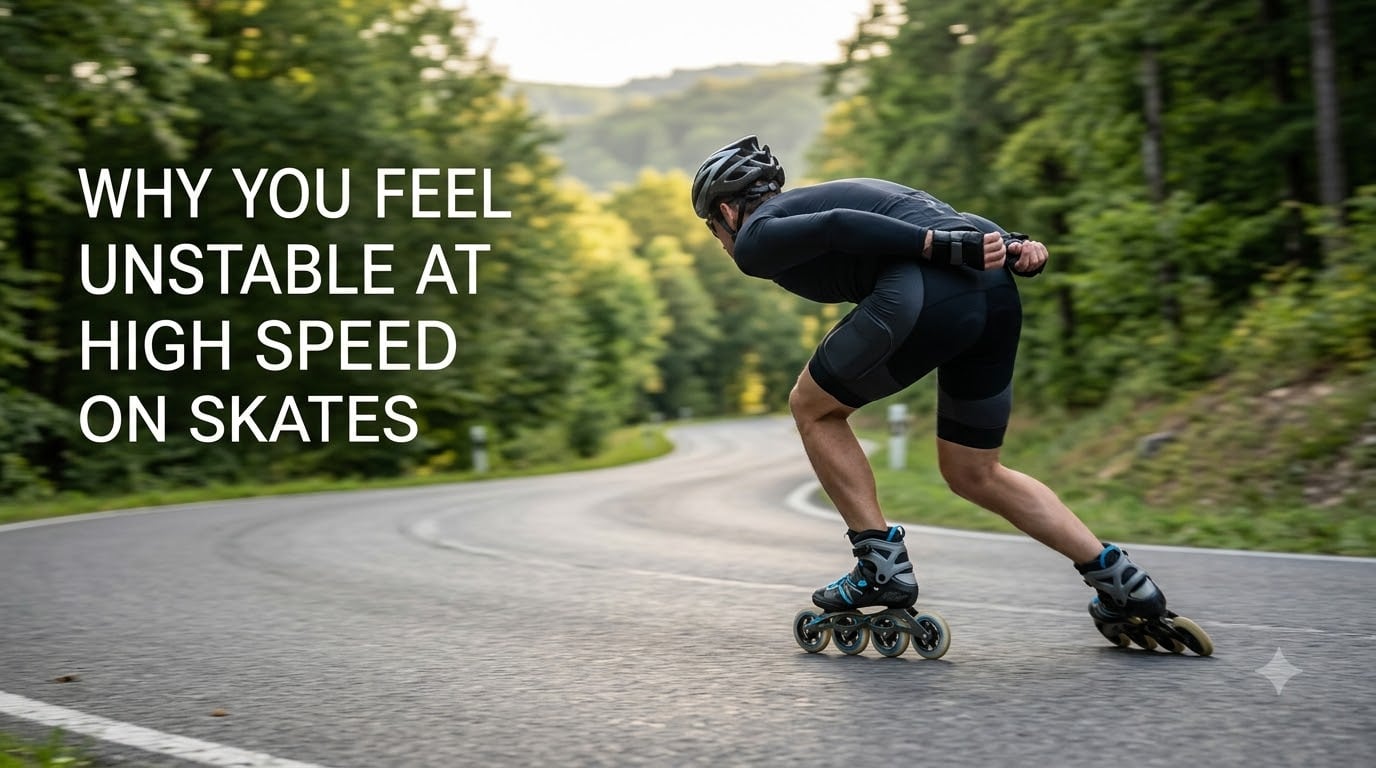
You finally build up to a good pace, the wind picks up, and suddenly your skates start dancing underneath you. That scary, rattling sensation is one of the most common experiences shared across roller skating, inline skating, and longboarding communities. If you have ever felt unstable at high speed on skates, you are not alone, and the fix is more straightforward than you might think.
Speed wobble is an uncontrolled side-to-side oscillation of your skates that kicks in at higher velocities. It happens when small steering corrections get amplified through your wheels and trucks, creating a feedback loop that intensifies unless you break the cycle. The good news is that almost every case of high-speed instability traces back to a few fixable causes.
In this guide, I will break down exactly why you feel unstable at high speed on skates, the physics behind the wobble, the technique fixes that work, and the equipment tweaks that add stability. Whether you are a beginner hitting your first hills or an experienced skater pushing past 20 mph, these principles will help you skate faster with confidence.
Table of Contents
Why You Feel Unstable at High Speed on Skates: The Root Causes
Feeling unstable at high speed on skates almost always comes down to a combination of body position, weight distribution, and equipment setup. When you skate slowly, your body can compensate for small balance errors without much effort. At higher speeds, those same small errors get magnified, and the margin for recovery shrinks dramatically.
The five main culprits behind high-speed instability are: backward weight shift, stiff knees and locked joints, an upright posture, loose or mismatched equipment, and panic reactions that make the wobble worse. Skaters on Reddit who reported wobbles at 20 to 25 mph almost universally traced the issue back to one or more of these factors. Let us look at each cause in detail so you can identify what is happening under your feet.
What Is Speed Wobble and Why Does It Happen
Speed wobble is a self-reinforcing oscillation where your skate trucks or wheels rapidly shift side to side, creating a frightening vibrating sensation. It is the same phenomenon that affects longboarders, motorcyclists, and even shopping cart wheels. Once the oscillation starts, it feeds on itself, growing stronger with each cycle unless you interrupt the pattern.
The trigger is usually a small steering input, a bump in the road, or a subtle shift in your weight. At low speed, your body absorbs these micro-corrections without noticing. At high speed, the same tiny movement sends a wave through your setup that the trucks try to correct, overshoot, and correct again. This back-and-forth correction is the wobble you feel.
Forum skaters consistently report that the wobble tends to kick in at a specific personal threshold speed. For many recreational inline skaters, that threshold lands somewhere between 15 and 25 mph depending on setup and skill. Below that speed you feel fine. Above it, the same body position suddenly becomes unstable because the feedback loop activates.
The Physics Behind High-Speed Instability
No competitor in the current search results explains the actual physics of why high speed causes instability, so let me break it down. Stability on skates depends on keeping your center of gravity directly above your base of support, which is the narrow line between your wheels. At standstill, your base feels narrow but manageable because you have plenty of time to correct.
As speed increases, the time available to make corrections shrinks. A wobble that takes half a second to develop at 5 mph takes only a fraction of that at 20 mph. Your nervous system simply cannot react fast enough to dampen the oscillation, so the wobble grows instead of fading. This is why a position that feels perfectly stable at low speed can suddenly feel terrifying when you accelerate.
Another physics factor is rotational momentum. When your weight sits behind the axis of your skates, each wobble input rotates the skate more aggressively, like a pendulum swinging harder when pushed from the top. Shifting your weight forward shortens that rotational lever, dampening the wobble mechanically before your reflexes even need to kick in. This is why forward lean is the single most effective speed wobble fix.
Finally, resonance plays a role. Every skate setup has a natural frequency at which it wants to oscillate. When your speed pushes inputs close to that frequency, the wobble builds rapidly. Tighter trucks and stiffer bushings raise that resonant frequency, which is why equipment adjustments make such a big difference for high-speed stability.
Weight Distribution: The #1 Stability Factor
Of every factor that affects how stable you feel at speed, weight distribution matters the most. Experienced downhill skaters and forum contributors agree almost universally that the most common cause of speed wobble is weight sitting too far back on the skates. When your weight drops behind your heels, the front of your skate loses traction authority and the rear becomes a pivot point for oscillation.
The ideal weight distribution for high-speed skating places roughly 60 to 70 percent of your body weight over the front wheels or the balls of your feet. This forward loading does three things at once: it shortens the rotational lever that feeds the wobble, it pins the steering axis so small inputs cannot amplify, and it keeps your center of gravity ahead of the unstable rear section of the skate.
A quick self-check is to notice where your hips sit relative to your toes. If your hips trail behind your heels when you skate fast, you are in the danger zone. If your knees and hips stack over or slightly ahead of your toes, you are in a stable position. Many beginners instinctively lean back when they feel speed because it feels safer, but this is the exact opposite of what creates stability.
The fix is to actively press your shins into the front of your skate cuffs and imagine driving your chest forward over your leading foot. This small mental cue shifts your weight where it needs to be without forcing you to think about numbers. Practice it at low speed first so the position becomes automatic before you need it at high velocity.
Proper Body Position at High Speed
Body position and weight distribution work together, but they are not the same thing. Your overall stance determines whether your weight can actually stay forward when the road gets rough. The high-speed skating stance combines three elements: a forward lean from the ankles, bent knees, and a low center of gravity.
The forward lean should come from your ankles, not from bending at the waist. Think of pressing your shins into the tongue of your skate boots. This keeps your torso stacked and balanced rather than tipping forward awkwardly. Bending at the waist throws your weight around unpredictably and actually reduces your ability to react to the road.
Bent knees act as shock absorbers. Locked knees transfer every bump straight into your upper body, which then translates into steering inputs that feed the wobble. Soft, bent knees absorb those micro-impacts so they never reach the skate trucks in the first place. The deeper the knee bend, the more stable you will feel, up to the point where your legs fatigue.
A lower center of gravity also reduces the leverage that any wobble has over your body. Crouching drops your mass closer to the wheels, shortening the pendulum effect that makes high skating feel top-heavy. Combine a slight crouch with forward lean and soft knees, and you have what experienced skaters call the ready position, the foundation of stable high-speed skating.
How to Fix Speed Wobble: 5 Technique Fixes
When you feel unstable at high speed on skates, these five technique fixes will help you regain control and prevent the wobble from building in the first place.
1. Shift your weight forward immediately. The moment you feel a wobble starting, press your shins into your skate cuffs and drive your chest over your front foot. This is the single most effective in-the-moment fix because it shortens the rotational lever feeding the oscillation.
2. Bend your knees deeper. Drop your center of gravity by bending your knees another inch or two. This absorbs road chatter and reduces the leverage the wobble has on your upper body. Soft knees are your built-in suspension system.
3. Initiate a carve. Turning slightly redirects the energy of the wobble into a controlled arc rather than a straight-line oscillation. A gentle carve breaks the resonance pattern and gives you something active to focus on instead of freezing up.
4. Do not panic-brake. Stomping on the brake or throwing your weight backward in fear almost always makes the wobble worse. Stay calm, keep your weight forward, and bleed speed gradually with controlled carves or a snowplow if you know how.
5. Look ahead, not down. Where you look is where your body goes. Staring at your skates drops your head and shifts weight backward. Lock your eyes on a stable point 20 to 30 feet down the road so your posture stays tall and forward.
Equipment Factors That Affect Stability
Technique solves most speed wobble problems, but the wrong equipment can make even good skaters feel unstable. If you have dialed in your body position and still feel wobbly at speed, your setup may be working against you.
Loose trucks or soft bushings are the most common equipment culprit. Soft cushions create a dead zone where there is no resistance to small movements, which lets the wobble build before you feel it. Switching to harder bushings or tightening your kingpin nut a quarter turn can dramatically reduce high-speed twitchiness without sacrificing low-speed maneuverability.
Wheel size and durometer also play a role. Larger wheels roll faster and hold momentum, but they raise your center of gravity and extend your wheelbase feedback, both of which amplify wobble inputs. Inline skaters running 84mm or larger wheels often report wobble thresholds 3 to 5 mph lower than skaters on 76mm wheels, all else being equal.
For roller skaters, the relationship between truck tightness and skating style matters. Looser trucks feel great for dance and park skating but become unpredictable above 15 mph. Many derby skaters run one setting for practice and tighten up for any high-speed work. If you skate fast regularly, consider a stiffer setup specifically tuned for stability.
Mental Aspects of Speed Confidence
None of the competitors in the current search results address the mental side of speed wobble, but it is one of the biggest factors. Fear of falling makes you stiffen up, and stiffness is the enemy of stability. When your body tenses, your knees lock, your weight shifts backward, and your reactions become jerky, all of which feed the wobble.
The skaters who stay stable at speed are the ones who have trained themselves to relax under pressure. They keep their breathing steady, their hands low and loose, and their focus on the road ahead rather than on the fear of falling. This mental calmness directly translates into the soft, athletic posture that physically prevents the wobble.
Building this mental confidence comes from progressive exposure. You cannot jump from nervous 10 mph skating to confident 25 mph runs overnight. Skating slightly faster than comfortable, holding it for a few seconds, and backing off trains your nervous system to stay calm at speed. Over weeks and months, your comfort ceiling rises naturally.
Drills to Build Speed Stability
Practical drills bridge the gap between knowing what to do and actually doing it when the wobble hits. Add these to your regular skating sessions to build speed stability progressively.
Single-leg balance holds: Stand on one skate at low speed and hold your balance for as long as possible. This trains the small stabilizer muscles and the neural pathways that keep you centered when the road gets rough.
Carving sprints: Skate at moderate speed and carve wide S-turns back and forth across your path. This builds confidence in weight transfer and teaches your body that turning is always available as a speed-control tool.
Speed ladders: Pick a straight, flat section and skate progressively faster intervals, starting at a comfortable pace and adding 1 to 2 mph each run. Stop and reset between runs so you never push into panic territory. Over time, your stable ceiling rises without you ever crossing into the wobble zone during practice.
Soft-knee bumps: Find a section of slightly rough pavement and skate over it at low speed, focusing purely on absorbing the bumps with bent knees rather than fighting them. This trains the suspension reflex that saves you when a bump catches you off guard at speed.
Frequently Asked Questions
How to feel more stable when ice skating?
Bend your knees deeply, keep your weight forward over the balls of your feet, and press your shins into the boot tongues. A lower center of gravity and forward lean are just as important on ice as on wheels, and they prevent the backward weight shift that causes most high-speed instability.
How to react when you get too fast on inline skates?
Stay calm, press your shins forward to shift weight over the front wheels, bend your knees deeper, and initiate a controlled carve to bleed speed gradually. Avoid panic-braking or leaning back, because both feed the wobble and increase your fall risk.
What causes skateboard speed wobble?
Speed wobble on a skateboard comes from the same feedback loop as on skates. Loose trucks, soft bushings, backward weight distribution, and stiff legs all amplify small steering inputs into a self-reinforcing oscillation that grows worse the faster you go.
How to get rid of speed wobble?
Shift your weight forward, bend your knees to drop your center of gravity, and initiate a carve to break the resonance pattern. Tightening your trucks or switching to harder bushings also raises the speed at which wobble activates.
Does carving prevent speed wobbles?
Yes, carving helps prevent and stop speed wobbles. Turning redirects the oscillation energy into a controlled arc, which breaks the resonance pattern. Carving also keeps your weight moving and engaged, rather than frozen in a straight line where the wobble can build.
Conclusion
Feeling unstable at high speed on skates is a fixable problem, not a permanent limitation. Almost every case traces back to backward weight distribution, stiff knees, an upright posture, loose equipment, or panic reactions, and each of these has a clear, actionable solution.
The most important takeaway is that forward lean changes everything. Pressing your shins into your skate cuffs and driving your chest over your front foot shortens the lever that feeds the wobble and mechanically dampens the oscillation before it can build. Pair that with soft knees and a low center of gravity, and you have the foundation of stable high-speed skating.
If technique alone does not solve it, look at your equipment. Tighter trucks, harder bushings, and appropriately sized wheels raise the speed at which your setup wants to wobble. And if fear is part of the equation, build your confidence with progressive speed drills so your nervous system learns to stay calm when the road tilts downhill.
Understanding why you feel unstable at high speed on skates is the first step. The next time the wobble starts, you will know exactly what is happening under your feet and exactly how to fix it. Skate smart, build up gradually, and the speed that once felt scary will start to feel like freedom.