
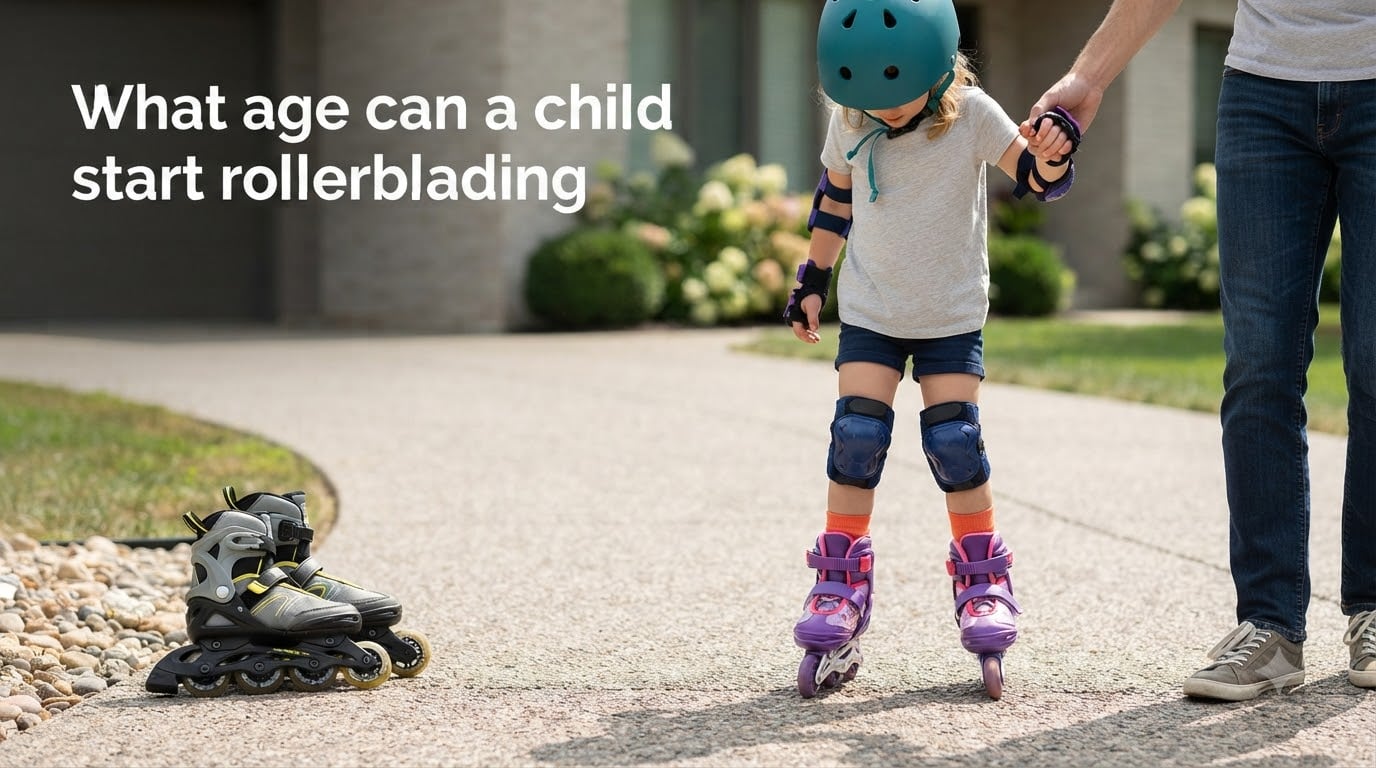
If you are wondering what age can a child start rollerblading, the short answer is around 3 years old for basic roller skates and 5 to 6 years old for true inline skates. Most children develop the balance, coordination, and core strength needed to stand on wheels by age 3, but rollerblading specifically requires more stability than quad skates.
What matters more than a specific number is whether your child shows signs of developmental readiness. Some 3-year-olds take to skating naturally, while some 5-year-olds need more time to build confidence. In this guide, I break down exactly what to look for, age-by-age recommendations, and practical tips for getting your child started safely.
Table of Contents
What Age Can a Child Start Rollerblading?
Children can typically start roller skating on quad skates around age 3, but the American Academy of Pediatrics (AAP) recommends that children under 5 should not use inline skates (rollerblades). For rollerblading specifically, ages 5 to 6 is the sweet spot for most kids.
According to the AAP guidelines shared by Children’s Hospital of Pittsburgh, children younger than 5 years should not ride on inline skates, and children ages 6 to 10 years should always have close adult supervision when inline skating. This is because inline skates have a narrower wheel base, making them significantly harder to balance on than traditional quad roller skates.
Here is the key distinction parents often miss: roller skates have four wheels arranged in a two-by-two pattern (like car wheels), while inline skates (rollerblades) have three to five wheels in a single line. That wheel configuration makes a big difference in how young a child can safely learn.
For toddlers and preschoolers, start with quad roller skates. Save inline skates for when your child has mastered balance on quads or reaches age 5 or 6.
Signs Your Child Is Ready for Rollerblading
Age is a useful starting point, but developmental readiness tells a much more accurate story. Our team reviewed parent experiences across skating forums, and the general consensus is clear: if your child can run and stop with control, they are probably ready to try skating.
Here are the physical signs to look for:
Your child can balance on one foot for at least 5 seconds without wobbling excessively
They can run, stop quickly, and change direction without falling
They have enough core strength to stand upright on uneven surfaces
They can walk up and down stairs independently without holding a rail
They can jump with both feet together and land with control
Physical ability is only half the equation. Behavioral readiness matters just as much:
They follow multi-step instructions consistently
They are willing to wear a helmet and protective gear without a fight
They show genuine interest in skating, not just because a sibling does it
They can handle falling down without becoming panicked or hysterical
They listen to safety rules and respect boundaries
Some red flags suggest your child may not be ready yet. If they cannot yet run with control, tire quickly after 5 minutes of physical activity, or resist wearing safety gear, it is worth waiting a few more months. Forcing skating too early often leads to fear and frustration that can stick with kids for years.
One parent on Reddit shared that temperament and willingness to learn matter far more than exact age. Their 4-year-old picked up skating in two sessions, while their older child needed an entire summer. Every child develops on their own timeline.
Age-by-Age Guide to Kids Rollerblading
Different ages call for different approaches. Here is a breakdown of what to expect and recommend at each stage of your child’s skating journey.
Ages 2-3: First Steps on Wheels
At this age, focus on fun rather than skill. If you want to introduce skating to a 2 or 3-year-old, use strap-on quad roller skates that fit over their regular shoes. These are toy-grade skates designed specifically for toddlers, not real performance skates.
Keep sessions to 10 minutes or less, always indoors or on soft carpet, and hold your child’s hand the entire time. The goal is simply to get them comfortable with the feeling of rolling, not to teach technique. Many parents on forums report starting their children at 18 to 24 months with skate walkers or balance toys before transitioning to actual skates.
Avoid inline skates entirely at this age. A toddler’s center of gravity is still developing, and the narrow wheel base of rollerblades makes falls nearly inevitable.
Ages 4-5: Building Confidence
This is where skating starts to get real. Most 4 and 5-year-olds have the coordination to use proper adjustable quad skates with real wheels. Look for skates with a lock mechanism that prevents backward rolling, which helps beginners build confidence without fear of rolling away.
At this age, children can start learning basic skills like marching forward, the duck walk (heels together, toes apart), and controlled stopping using the toe stop. Keep practice sessions to 15 or 20 minutes, and always use full protective gear.
Can a 4-year-old learn to rollerblade on inline skates? Some physically advanced 4-year-olds can manage adjustable inline skates with close supervision, but the AAP recommendation against inline skates before age 5 is based on injury data. Stick with quad skates for this age group unless your child has already mastered them and is hungry for a new challenge.
Ages 6-7: Ready for Inline Skates
Six is the magic number for rollerblading. By this age, most children have the balance, core strength, and cognitive development to handle inline skates safely. This aligns with the AAP guideline that children 6 to 10 can use inline skates with close adult supervision.
Start with adjustable inline skates that can grow with your child’s feet. These typically cover three or four shoe sizes, which makes them a smart investment for fast-growing kids. Begin on flat, smooth surfaces like a driveway or empty tennis court.
Teach the basic forward stride, the heel brake stop, and how to fall safely (knees first, hands up). At this age, children can handle practice sessions of 30 minutes or more, but watch for fatigue since tired kids make more mistakes.
Ages 8 and Up: Skating Independently
By age 8, most kids have the skills and judgment to skate more independently. They can learn advanced techniques like crossovers, backward skating, and basic jumps. They still need a helmet and pads every single time, but you may not need to hover as closely.
This is also a good age to consider structured lessons. A professional instructor can correct bad habits early, teach proper technique, and help your child progress faster than YouTube tutorials alone. Many skating rinks offer beginner group lessons specifically for this age range.
Even at 8 and older, set clear rules about where skating is allowed. Busy streets, hills, and areas with vehicle traffic remain off-limits regardless of skill level.
Roller Skates vs Inline Skates for Kids
This is one of the most common sources of confusion for parents, and most articles do not explain the difference clearly. Let me break it down.
Roller skates (quad skates) have four wheels arranged in a rectangular pattern, two in front and two in back. This wider wheel base provides more stability, making them the better choice for beginners and younger children. Think of them like training wheels on a bike.
Inline skates (rollerblades) have three to five wheels arranged in a single line down the center of the boot. This design is faster and more maneuverable but requires much better balance. It is like riding a bike without training wheels.
For children under 5, quad roller skates are the clear recommendation. They are easier to stand up in, easier to stop, and far more forgiving when a child loses balance. Between ages 5 and 6, children who have mastered quad skates can transition to inline skates.
Adjustable skates are available in both styles. These let you resize the boot as your child grows, often fitting across three or four shoe sizes. For families on a budget, adjustable skates are the smartest investment because they can last several years.
One thing to avoid: cheap plastic skates from big-box toy stores. They often have poor-quality wheels and bearings that make skating harder and less enjoyable. A mid-range pair from a reputable skating brand will make learning significantly easier for your child.
Essential Safety Gear for Young Skaters
No child should ever step onto skates without full protective gear. This is the one area where there is no room for negotiation or shortcuts. The Children’s Hospital of Pittsburgh and the AAP are unanimous on this point.
Here is your safety gear checklist:
Helmet: A properly fitted helmet is non-negotiable. It should sit level on the head, not tilted back, and the chin strap should be snug. A bike helmet works, but a multisport helmet rated for skating offers better back-of-head coverage.
Knee pads: These protect the most common impact zone when children fall forward. Look for hard-shell caps, not just foam sleeves.
Elbow pads: Children instinctively reach out when falling, making elbows highly vulnerable.
Wrist guards: Wrist fractures are one of the most common skating injuries. Rigid wrist guards with a splint prevent the wrist from bending backward during a fall.
Properly fitted skates: Skates that are too loose cause blisters and ankle rolls. Skates that are too tight cause pain and discourage practice.
Beyond gear, choose the right skating surface. Smooth, flat, dry surfaces free of cracks and debris are ideal. Empty tennis courts, smooth driveways, and skating rinks are excellent choices. Avoid rough pavement, wet surfaces, gravel, and any area with vehicle traffic.
How to Teach Your Child to Rollerblade
Teaching your own child to skate can be rewarding, but it requires patience and a structured approach. Here is a step-by-step method that experienced skating instructors and parents recommend.
Step 1: Start on grass or carpet. Have your child put on the skates and simply try standing on a soft surface where the wheels will not roll. This builds confidence in the boots without the fear of moving. Let them walk around, fall a few times, and get comfortable.
Step 2: Practice the ready position. Teach your child to stand with knees bent, feet shoulder-width apart, and weight slightly forward. This is the fundamental skating stance. If they stand up straight with locked knees, they will fall backward.
Step 3: Move to a smooth surface and march. Transition to a flat driveway or smooth floor. Have them march in place, lifting each foot deliberately rather than trying to push off and glide. Marching forward builds the muscle memory for the skating stride.
Step 4: Practice falling and getting up. Before they go any further, teach them how to fall safely (drop to knees, keep hands up) and how to get back up (one knee down, push off with the other foot). This removes the fear of falling.
Step 5: Introduce the brake. Teach your child how to use the toe stop on quad skates or the heel brake on inline skates. Stopping is actually more important than starting, so prioritize it early.
Keep each session short. Ten to fifteen minutes of focused practice is more valuable than an hour of frustrated stumbling. Children lose focus quickly, and fatigue leads to sloppy technique and avoidable falls.
If your child gets scared or frustrated, stop. Pushing through tears or tantrums builds negative associations with skating that can last for years. Try again another day when they are fresh and enthusiastic. Some children need weeks or months of short, positive sessions before everything clicks.
Make it fun rather than feeling like a lesson. Play follow-the-leader, set up obstacle courses with toys, or have them skate to their favorite music. The more enjoyable the experience, the faster they will learn.
Frequently Asked Questions
Can I take my 2 year old roller skating?
You can introduce a 2 year old to skating using toy-grade strap-on quad skates over their shoes, but only indoors or on carpet with constant hand-holding. The AAP recommends against inline skates for children under 5. At age 2, keep sessions under 10 minutes and treat it purely as play, not instruction.
Can a 4 year old learn to rollerblade?
A 4 year old can start on adjustable quad roller skates, but true inline skates (rollerblades) are not recommended before age 5 according to the AAP. Some physically advanced 4 year olds can try inline skates with close supervision, but quad skates are safer and more appropriate for this age.
Can a 3 year old use roller skates?
Yes, a 3 year old can use roller skates if they can already run and stop with control. Start with adjustable quad skates designed for toddlers, use full protective gear, and keep practice sessions to 10 or 15 minutes. Always supervise closely and skate on smooth, flat surfaces away from traffic.
What is a good age for kids to start rollerblading?
The best age for kids to start rollerblading on inline skates is 5 to 6 years old. For quad roller skates, children can start as young as 3. The American Academy of Pediatrics recommends children under 5 should not use inline skates, and children 6 to 10 should always skate with adult supervision.
The Right Age Is About Readiness, Not Numbers
So, what age can a child start rollerblading? The answer depends on the type of skating. Quad roller skates are appropriate from age 3, while true inline skates (rollerblades) should wait until age 5 or 6 based on AAP guidelines. But the most reliable indicator is whether your child can run, stop, balance, and follow instructions with confidence.
Start with the right skates for their age, invest in quality safety gear, and keep early sessions short and fun. Every child develops at their own pace, so focus on readiness rather than rushing to hit a specific age milestone.