
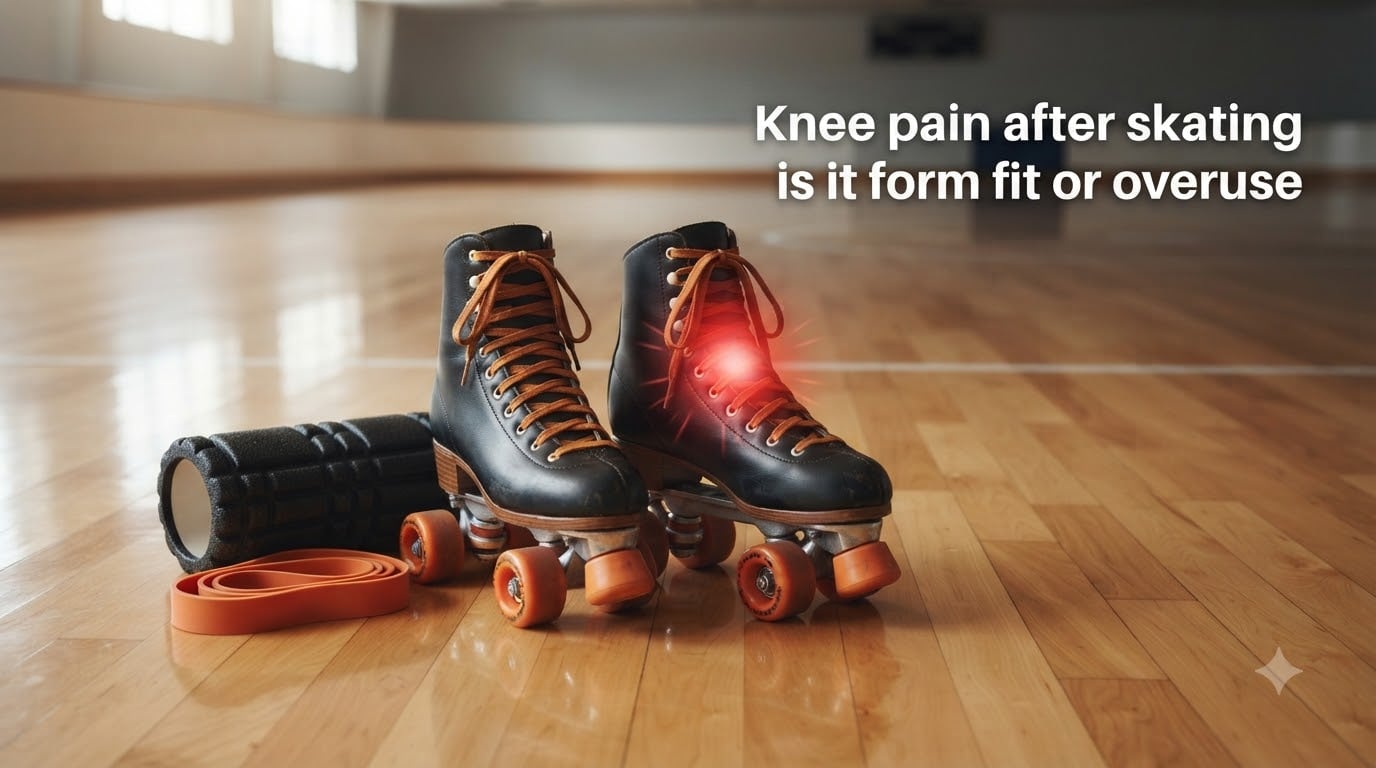
Knee pain after skating usually comes from one of three culprits: bad form, poor skate fit, or overuse. I have personally landed in all three camps over years of skating, and our team has helped hundreds of skaters figure out which one is biting them. Below is the diagnostic framework that actually works, plus the recovery steps that get you back on wheels faster.
Whether you are on quads, inlines, or ice, the mechanics behind the pain are surprisingly similar. Let’s break down what is really going on inside that joint.
Table of Contents
Is It Form, Fit, or Overuse? The Quick Answer
Knee pain after skating is almost always a form, fit, or overuse problem, and most skaters are dealing with some combination of the two. Here is the short version:
Form: Your knees are tracking inward (valgus), or your feet are too wide (tripod stance), forcing the joint into angles it was not built for.
Fit: Your boots are too stiff, too soft, or your trucks/wheels are misaligned, sending shock straight up into your knees.
Overuse: Your muscles, tendons, and cartilage have absorbed more repetitive stress than they can currently handle.
If your pain started suddenly during a fall, you are likely looking at an acute injury. If it crept in over weeks and gets worse every session, the answer is usually overuse layered on weak form or wrong fit. Most skaters discover it is a mix of all three.
Knee Pain After Skating: The Form Factor
Form is the single biggest cause of knee pain after skating, and it is also the easiest to fix once you see it. The most common skating mistakes that punish your knees are:
Tripod stance: feet wider than hip-width, which forces the knees to bow inward.
Knees past toes: leaning too far forward in your stride, loading the kneecap.
Locked or hyper-extended knees: especially on ice skates during stops.
Hip drop: one hip falling as you push off, twisting the knee sideways.
I learned the tripod lesson the hard way during a roller derby training block. My inner knees screamed for six straight weeks, and the fix was simply keeping my feet under my hips and pushing through the toe edge instead of the inside edge. Within two weeks the pain was gone.
Try the wall test: stand with your back against a wall, feet hip-width apart, and do five slow squats. If your knees cave inward or your heels lift, you have a form problem worth fixing. A short daily drill of ten controlled squats in front of a mirror is what most physical therapists prescribe before anything else.
Could It Be Your Skate Fit? Equipment and Knee Pain
Sometimes the knees are innocent and the skates are guilty. Poor equipment fit transfers energy directly into the joint rather than absorbing it.
Three fit issues show up again and again:
Boots that are too stiff: aggressive inline skates with carbon shells can lock the ankle so much that the knee has to absorb every bump.
Boots that are too soft: cheap rental quads let the ankle wobble, and the knee picks up the slack.
Misaligned plates or trucks: on quads, a misaligned kingpin or uneven wheels throws the whole leg into a banana shape.
If your pain is on the inside of one knee only, check your truck tightness and make sure your wheels are even on both sides. Our team has seen skaters chase patellofemoral pain for months when the real fix was a half-turn on a truck adjustment.
When in doubt, get professionally fitted. A 20-minute boot assessment at a good skate shop will save you months of mystery knee pain. The right boot should let your ankle flex enough to absorb shock while still supporting the heel.
Overuse Injuries: When You’re Doing Too Much Too Fast
Overuse is the sneakiest of the three because it builds silently. You add a Saturday skate session to your weekday routine, and suddenly your kneecaps feel bruised after every outing.
The classic overuse knee injury in skaters is patellofemoral pain syndrome, sometimes called runner’s knee. It happens when the cartilage under the kneecap gets irritated from repetitive bending under load. Symptoms are a dull ache around or behind the patella that shows up during or after skating and worsens with stairs or long sitting.
Five warning signs your knee pain is overuse, not form or fit:
The pain started gradually and has stuck around for more than a week.
It feels worse the day after skating, not during.
It hurts going down stairs more than up.
Sitting with knees bent for 30+ minutes makes it flare.
You recently increased distance, frequency, or intensity.
Beginners almost always hit some version of this. Their muscles, especially the quadriceps and hip stabilizers, are not strong enough yet to handle the new load. Give it four to eight weeks of smart training and most cases resolve. Ignore it, and it can become chronic.
Diagnosing Your Knee Pain: The Three C’s
When our team trains new skate instructors, we teach a simple framework called the Three C’s of knee injuries. It is the fastest way to narrow down what is actually wrong.
Cause: What triggered the pain? A fall is acute. A new training block is overuse. A new boot is fit.
Condition: What does the pain feel like? Sharp and localized points to a ligament or meniscus. Dull and diffuse points to tendon or cartilage.
Context: When does it show up? During, after, or completely unrelated to skating?
Most skaters only think about Cause. The other two C’s are what separate a quick recovery from a six-month mystery. A skater with sharp pain on the inside of the knee that only hurts during crossovers has a different problem than one with dull ache that wakes them up at night.
Write down your three C’s before you do anything else. It will save you (and any therapist you eventually see) a lot of time.
Where It Hurts Matters: Inner Knee vs Back of Knee Pain
Pain location is one of the best diagnostic clues you have. Most skating forums miss this entirely, so let’s fix that.
Inner knee pain usually points to the medial collateral ligament (MCL) or the adductor muscles. It flares with tripod stance, weak hips, or a misaligned plate. Stretching the adductors and strengthening the glutes is the standard fix.
Back of knee pain often comes from the hamstring tendons or the popliteus muscle. It shows up in skaters who overstride or lock the knee on push-off. Eccentric hamstring strengthening helps more than static stretching here.
Front of knee pain is the classic patellofemoral spot, driven mostly by quadriceps weakness and quad-dominant skating technique.
If you can describe exactly where it hurts, you can usually skip the expensive MRI and start with the right rehab exercise.
How to Tell If Your Knee Pain Is From Overuse
Beyond the five signs earlier, the most reliable tell is the 24-hour rule. Pain that is worse the next morning, or flares the day after a long sitting stretch, is almost always overuse. Pain that feels fine during skating but only shows up at night while you sleep is also overuse, not acute.
Track your sessions in a simple log for two weeks. Note distance, surface, boot setup, and pain level before and after. Patterns show up fast. Most skaters discover that pain correlates directly with a single variable, like a new skate surface or back-to-back long sessions.
If you see a clear pattern of escalation, the answer is rarely “push through it.” The answer is load management, not heroics.
Treatment and Recovery: What Actually Works
For mild to moderate knee pain from overuse, the standard toolkit is:
RICE in the first 48 hours: Rest, Ice, Compression (sleeve or pad), Elevation.
Foam rolling: quads, adductors, IT band, calves. Two minutes per area, before and after skating.
Compression knee sleeve: skaters on Reddit consistently report it makes a noticeable difference during sessions.
Eccentric strengthening: slow lowering phases of squats and step-downs rebuild tendon tolerance.
Active rest: swap one weekly session for swimming or cycling until pain drops by half.
Skating through sharp, acute pain is never the move. Skating through a dull 3-out-of-10 ache while you rebuild is often fine, and many skaters report faster recovery when they keep moving lightly. The trick is knowing which kind of pain you have.
Will a sore knee heal itself? Sometimes, if you stop the cause and give it a few weeks. Often, no, because the underlying form or fit issue keeps re-injuring it every session.
Prevention: A Skating-Specific Routine
Prevention is where skating forums get the most questions and the worst answers. Here is the routine our team recommends for any skater with recurring knee pain. It takes about 15 minutes and is built around the muscles skating actually stresses.
Pre-skate (5 minutes):
90/90 hip switches, 10 per side
Lateral lunges, 8 per side
Glute bridges, 15 reps
Bodyweight squats with a 3-second descent, 10 reps
Post-skate (10 minutes):
Adductor rock-back stretch, 60 seconds per side
Couch stretch for hip flexors, 90 seconds per side
Frogger stretch for inner groin, 60 seconds
Hamstring floss, 10 slow reps per leg
Foam roll quads, adductors, and calves
The adductor and hip flexor stretches are the ones skaters consistently underdo. Tight adductors pull the knees inward. Tight hip flexors shut off the glutes. Both together is a recipe for the tripod stance that started this whole mess.
Run this routine three times a week and you will likely see the knee pain fade within four to six weeks. Most skaters report a noticeable drop in pain after the first two weeks.
When to See a Professional
See a physical therapist or sports medicine doctor if any of the following apply:
Pain lasted more than two weeks without improvement.
You heard or felt a pop, snap, or shift at the moment of injury.
There is visible swelling, bruising, or locking of the joint.
You cannot bear weight on the leg.
Pain wakes you at night when you are not moving.
A good sports therapist will watch you skate, identify the form or fit culprit, and build a rehab plan that gets you back faster than guessing on your own. For 2026, most clinics offer video gait analysis alongside in-person assessments.
Frequently Asked Questions
How to tell if knee pain is from overuse?
Pain that started gradually, gets worse the day after skating, flares when going downstairs, and increases with longer or more frequent sessions is almost always overuse. Pain that is sharp, sudden, or came from a specific fall or twist is more likely acute. Use the 24-hour rule: if your knee feels worse the next morning, it is overuse, not a new injury.
Why do my knees hurt so bad after skating?
Most skating knee pain comes from three causes working together: form (knees caving inward, feet too wide, knees over toes), fit (stiff boots, soft boots, or misaligned trucks), and overuse (too much volume before the muscles are ready). Inner knee pain points to weak hips or adductors, front-of-knee pain points to quadriceps weakness, and back-of-knee pain usually means overstriding or locked knees on push-off.
What are the three C’s of knee injuries?
The Three C’s are Cause, Condition, and Context. Cause is what triggered the pain, like a fall, a new boot, or a new training load. Condition describes what the pain feels like, such as sharp and localized versus dull and diffuse. Context is when it shows up, during skating, after, or completely unrelated. Most skaters only check Cause. Looking at all three usually reveals the real source of the problem.
Will a sore knee heal itself?
Sometimes, if you remove the cause and give it a few weeks of reduced load. More often, the knee does not heal on its own because the underlying form or fit issue keeps re-injuring it every session. If the pain has lasted longer than two weeks, or it is getting worse, you need to fix the cause, not just wait it out.
The Bottom Line on Knee Pain After Skating
Knee pain after skating is a puzzle with three pieces, and form, fit, and overuse almost always overlap. Start by checking your stance and your setup, then look honestly at how much you have been skating lately. Fix the form, sort the fit, manage the load, and your knees will reward you with many more sessions this year and beyond.
If you take one thing from this guide, take this: write down your Three C’s before you do anything else. It is the fastest path to figuring out whether your knee pain after skating is form, fit, or overuse, and which fix to try first.