
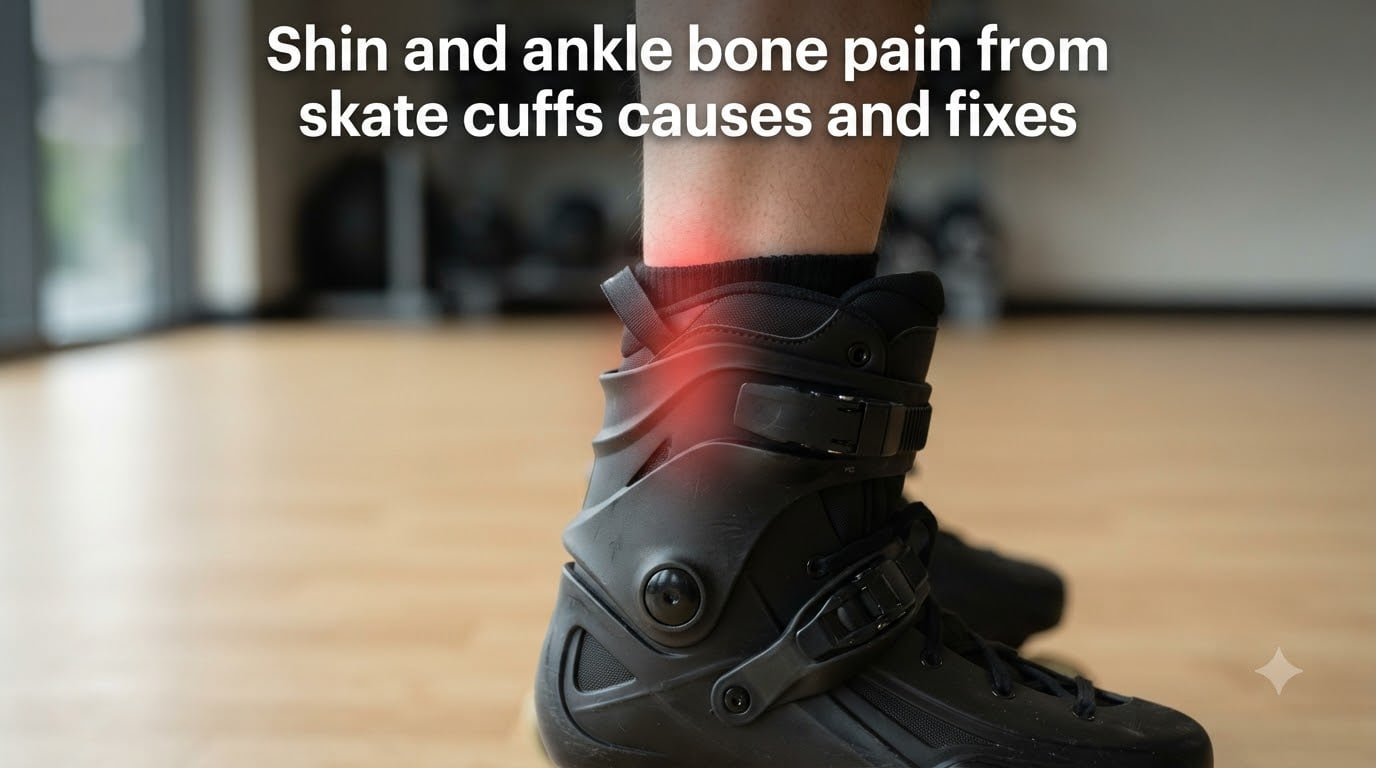
That sharp sting on your inner ankle bone after a 30 minute skate. The dull ache running up your shin that lingers for hours after you unlace. I have felt both, and so have thousands of skaters posting on r/rollerblading and hockey forums every week. Shin and ankle bone pain from skate cuffs is one of the most common complaints in inline skating, and almost nobody talks about it clearly. This guide breaks down exactly what causes that bone-level pain, why your cuffs are doing it, and how to fix it today so you can actually enjoy your next session.
Most skaters assume pain means they need new boots. The truth is that 80 percent of cuff pain comes down to fit, lacing, and posture. By the end of this article, you will know which one is hurting you and how to fix it without buying anything.
Table of Contents
What Is Skate Cuff Pain and Where Does It Come From?
The skate cuff is the rigid or semi rigid section that wraps around your lower leg, just above the ankle. It transfers force from your calf to the boot and keeps your ankle stable during pushes. When it works, you barely notice it. When it does not, it grinds directly against two bony landmarks: the medial malleolus (the bony bump on the inside of your ankle) and the anterior crest of the tibia (the front ridge of your shin bone).
Unlike muscle soreness, which fades in a day or two, cuff pain feels sharp, specific, and localized. You can usually point to the exact spot with one finger. That is a pressure point, not a workout. It happens because the cuff is either pressing too hard, sitting in the wrong place, or moving slightly as you skate and rubbing against the same patch of skin and bone over and over.
Common Causes of Shin and Ankle Bone Pain From Skate Cuffs
After talking to skaters, triagers, and reading hundreds of forum posts, I narrowed cuff pain down to five repeatable causes. Any of them, or a combination, can be your problem.
1. Boots that are too stiff for your current strength level. A carbon or carbon-blend cuff on a recreational skater is a recipe for shin and ankle pain. Carbon boots flex less and transfer more force directly to the cuff, so the cuff has to do more work holding your ankle. Users report this exact issue with stiff new upgrades from brands like THEM 909s and high end hockey skates.
2. Cuff that is too narrow or too tall. A cuff that pinches the tibia or sits above the medial malleolus will create a hot spot within minutes. Skaters frequently describe “unbearable pain on the inside ankle bone when pushing on the outside edge.” That is cuff binding.
3. Lacing or strap pressure that is uneven. If you crank the ankle strap tight but leave the upper laces loose, all the force sits in one spot. That localized load is what bruises the bone underneath.
4. Knee bend and posture. When skaters ride with locked or nearly locked knees, every push drives force into the cuff instead of flexing through the leg. The result is repeated micro-impact against the shin and ankle. This is the technique piece that most skaters miss.
5. The break-in period of new boots. Even well fitted new skates will create hot spots for the first 5 to 15 hours of use. If your pain is mild and disappears after a few sessions, it is likely break-in. If it is sharp, worsening, or asymmetric, it is a fit problem.
Why Cuffs Cause Shin Pain Specifically?
Shin pain from a skate cuff almost always traces back to two mechanisms: lace bite and anterior tibial loading. Lace bite happens when the tongue shifts or the laces press directly into the front of your tibia, the part with the least padding between bone and skin. You feel a line of tenderness that runs straight down the front of your shin.
Anterior tibial loading is more subtle. Every time you push off, the cuff pulls forward on the soft tissue that connects to the tibia. Over hours of skating, that repeated load stresses the periosteum (the tissue layer around the bone). The result feels like a deep, dull shin splint. Many skaters who come in with “shin splints” are actually dealing with cuff mechanics, not muscle inflammation.
The fix is rarely more padding on the shin. The fix is changing how force reaches the cuff in the first place. We will cover that in the fix section below.
Why Cuffs Cause Ankle Bone Pain Specifically
The medial malleolus (inside ankle bone) sticks out further than almost any other bone in your foot and ankle complex. There is almost no muscle or fat covering it. So when a cuff edge, strap, or rivet touches it, you feel it immediately. This is also why skaters consistently report “inner ankle pain” more than outer ankle pain. The inside is bony, the outside has the peroneal muscles buffering it.
Two specific conditions appear often in skaters with chronic ankle cuff pain. The first is anterior ankle impingement, where bone or soft tissue gets pinched at the front of the ankle joint during deep knee bend or aggressive pushes. The second is a peroneal or saphenous nerve irritation, where the cuff edge compresses a small nerve running close to the surface.
If you can trace your pain to a thin line along a bone, or feel tingling or burning, nerve involvement is likely. If the pain feels like a bruise that worsens when you push, it is bone bruise or stress response. Both are fixable, but they need slightly different approaches.
Immediate Fixes: How to Stop Skate Cuff Pain Right Now
You do not need new skates to solve this. Try these steps in order, one at a time, and test after each change. Most skaters get relief within one or two adjustments.
Step 1: Re-lace from the bottom up. Loosen the bottom two eyelets completely. Lace the middle (instep) snug but not tight. Then tighten the top eyelets only as much as you need for forward lean support. This removes pressure from the front of your shin and the bony ridge above the ankle.
Step 2: Re-position the ankle strap. Place the strap directly across the middle of your ankle, not above or below it. If the strap has a buckle, angle it slightly toward the outside of your ankle so the hard edge does not press into the medial malleolus.
Step 3: Add a thin gel or foam pad to the cuff edge. Moleskin, thin adhesive foam, or a gel ankle pad from a pharmacy all work. Stick it directly on the cuff where you feel the hot spot, not on your skin. This shifts the pressure contact area by a few millimeters, which is often enough.
Step 4: Re-tongue the boot. Make sure the tongue is centered and not folded. A shifted tongue pushes the cuff out of alignment and concentrates pressure on one ankle bone. Take 30 seconds before every skate to check.
Step 5: Reduce cuff ratchet tension. If your cuff has a ratchet buckle, try one click looser than you normally use. Many skaters over-tighten the ratchet out of habit. The boot should feel secure, not squeezed.
Here is a quick video walkthrough of the lacing and cuff adjustment process if you want to see it in action.
Long-Term Fixes: Boot Fit, Posture, and Strengthening
Once the immediate pain is gone, you want to make sure it does not return. Three things have to line up: the boot has to fit your foot shape, your knee bend has to absorb force correctly, and your ankle has to be strong enough to share the load with the cuff.
Boot fit: Your toes should lightly touch the front of the boot when standing, with about 5mm of clearance. The midfoot should feel snug without pinching. The cuff should clear the medial malleolus by a finger’s width at minimum. If it does not, the boot is the wrong shape for your foot. Skaters with wider forefeet often need to size up and adjust lacing rather than sizing down.
Knee bend: Aim for a soft, athletic stance with knees bent at roughly 110 to 120 degrees. Avoid the “locked knee cruise” where you stand nearly straight. Bent knees absorb push force through the quads and calves, not through the cuff. This single change eliminates most shin pain skaters report after long sessions.
Ankle strengthening: Strong ankles can handle more cuff force without bruising. Two exercises make the biggest difference. First, single-leg balance on a foam pad for 60 seconds, three times per side, daily. Second, resisted ankle eversion with a band, three sets of 15 reps per side. Both build the small stabilizers that share load with the cuff.
Prevention Strategies and Break-In Tips
If you just bought new skates, do not log a 3 hour session on day one. Break them in for 30 to 45 minutes at a time across the first 5 to 10 sessions. Walk around the house in them for 10 minutes before your first skate. This softens the cuff materials and lets the boot mold to your ankle shape before you load it with full skating force.
Before every session, take 60 seconds to recheck lace tension, strap position, and tongue alignment. Most cuff pain that appears “out of nowhere” is actually a small shift in fit that builds up over a session. Treat the boot up like a pilot’s preflight check.
If your skates are more than 4 to 5 years old and the cuff padding has compressed flat, that is a sign to consider replacement. Cuff padding does not bounce back forever, and once it compresses, the cuff edge moves closer to your bone.
When to See a Doctor About Skate Cuff Pain
Most cuff pain is mechanical and clears up with the fixes above. Some pain is not. Stop skating and book an appointment if you notice any of the following: pain that is sharp, localized, and worsening over days rather than weeks, swelling or redness over a bone, tingling or numbness that does not go away within an hour of unlacing, pain that wakes you at night, or pain that started after a specific hard impact or twist.
These are signs of stress fracture, ligament tear, or nerve compression. Early diagnosis on any of these usually means a much shorter recovery. A sports medicine physician or physiotherapist who treats skaters specifically will understand the mechanism and can guide rehab without telling you to stop skating forever.
A quick rule of thumb: if the pain fits the bone bruise pattern (sharp, pinpoint, hurts more when you press on it directly), it likely needs imaging. If it fits the soft tissue pattern (dull, diffuse, eases with warmth), the fixes above will probably solve it.
Frequently Asked Questions
Why does my ankle bone hurt when I skate?
Ankle bone pain when skating is usually caused by the skate cuff pressing directly on the medial malleolus (the bony bump on the inside of your ankle). Stiff cuffs, narrow cuff shapes, uneven ankle strap pressure, and locked-knee posture all force the cuff edge into the same spot repeatedly. Re-lacing from the bottom up, repositioning the ankle strap away from the bony bump, and bending your knees more during pushes are the fastest fixes.
Why does skating hurt my shins?
Skating hurts the shins when the cuff and laces load the front of the tibia (shin bone) without enough soft tissue buffering. Two common mechanisms are lace bite, where laces press directly into the bone ridge, and anterior tibial loading, where repeated cuff pull stresses the tissue around the bone. Fixes include loosening the top laces, padding the tongue, and maintaining a soft knee bend so the cuff does not do all the work.
How to relieve shin and ankle pain from skate cuffs?
To relieve shin and ankle pain from skate cuffs, work through five steps. First, re-lace from the bottom up and only snug the top eyelets for forward lean. Second, reposition the ankle strap across the middle of your ankle and angled outward. Third, add thin foam or gel padding to the cuff edge where you feel the hot spot. Fourth, check the tongue is centered. Fifth, soften your knee bend and skate with knees at about 110 to 120 degrees so force does not load into the cuff. Most skaters feel relief within one or two sessions after these changes.
Is skate cuff pain normal when breaking in new skates?
Mild, even pressure that fades within a few sessions is normal break-in discomfort. Sharp, asymmetric, or worsening pain is not normal and usually means a fit problem. A safe break-in protocol is 30 to 45 minute sessions across 5 to 10 outings, walking around the house in the boots beforehand, and rechecking lace and strap tension before each session. If pain is sharp or lingers more than 48 hours, treat it as a fit issue rather than break-in.
The Bottom Line on Skate Cuff Bone Pain
Shin and ankle bone pain from skate cuffs is fixable in most cases without buying new skates. Start by re-lacing from the bottom up, repositioning the ankle strap, and softening your knee bend. Add cuff padding if a hot spot persists, then work on ankle strengthening to share the load over the long term. If pain is sharp, worsening, or asymmetric, see a sports medicine clinician to rule out stress fracture or nerve involvement. The bones under your cuff are tough, but they need the cuff to fit and your technique to give them a break.