
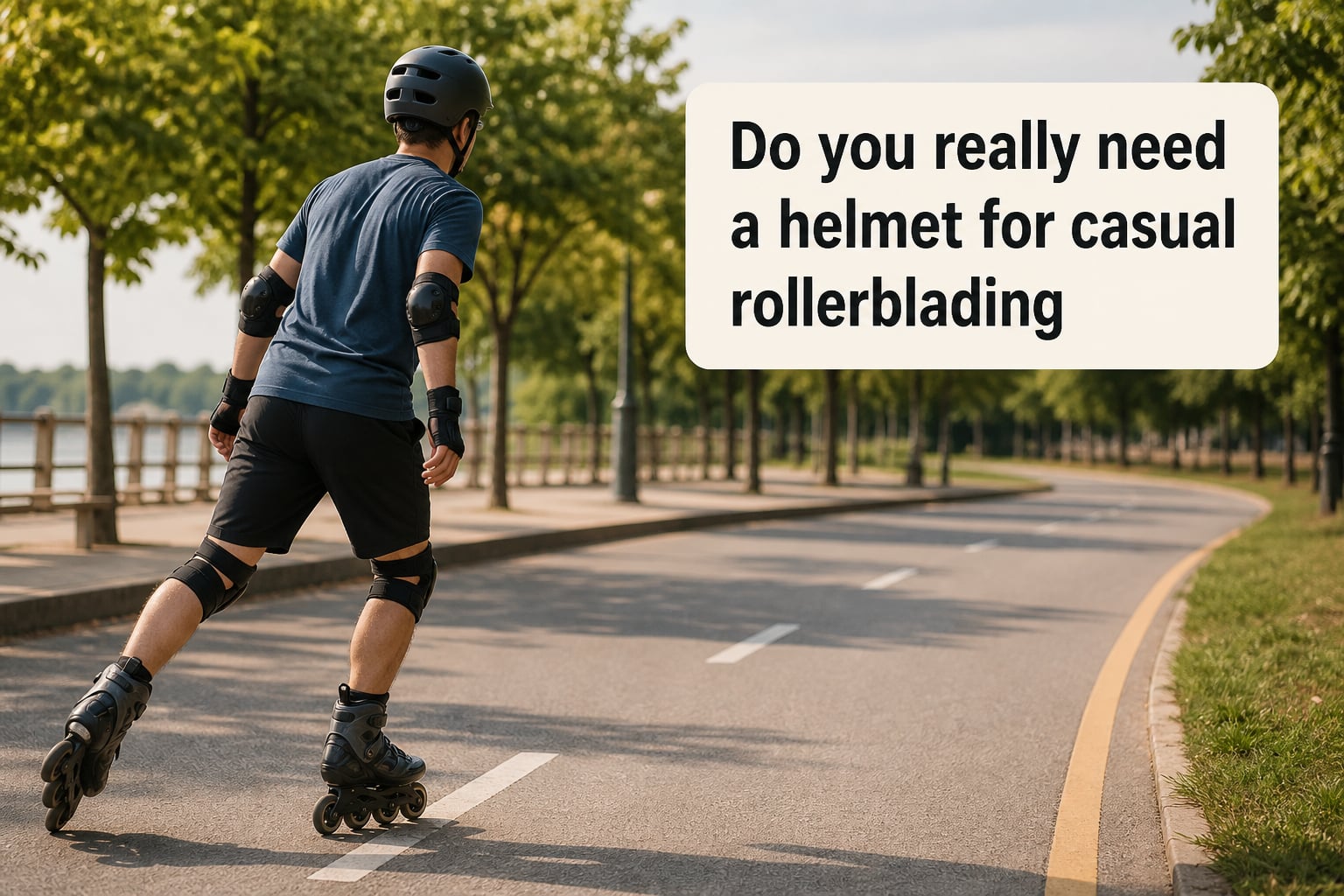
Yes, you need a helmet for casual rollerblading. Research from Johns Hopkins Medicine shows that wearing a properly certified helmet reduces the risk of head injury by up to 85 percent. For any skating activity, look for a helmet that meets CPSC, ASTM F1492, or Snell N-94 certification standards. These certifications confirm the helmet has passed rigorous impact testing for wheeled sports, including inline skating.
That is the short answer. But I know the question runs deeper than a simple yes or no. Most casual skaters I talk to are not convinced by statistics alone. They want to understand the real risk level of a relaxed Sunday skate on a flat bike path. They wonder whether that old bike helmet in the garage will work. And honestly, many of them just do not want to mess up their hair.
In this guide, I will walk you through the injury data, explain what helmet certifications actually mean, and address the real objections skaters have about wearing helmets. I have spent years in the skating community, and I want to give you a straight answer backed by medical research, not fear-mongering.
Table of Contents
Do You Really Need a Helmet for Casual Rollerblading?
You absolutely need a helmet for casual rollerblading. The word “casual” tricks a lot of people into thinking the risk disappears, but gravity does not care how relaxed your skating session is. A fall from standing height onto pavement can generate enough force to cause a traumatic brain injury. That risk exists whether you are cruising at 5 mph on a flat trail or bombing down a hill at 20 mph.
I see this mindset constantly in skating forums. People draw a line between “serious” skating that requires protection and “just messing around” skating that supposedly does not. This is a dangerous distinction. The data tells a different story.
According to the Consumer Product Safety Commission, emergency rooms treat tens of thousands of skating-related injuries every year. A significant portion of these injuries involves recreational skaters, not aggressive skaters performing tricks. Wrist fractures are the most common injury, but head injuries are the most dangerous. Head trauma accounts for the majority of skating-related hospital admissions and is the leading cause of death and disability in wheeled sports accidents.
Think about it this way. You probably would not ride a bicycle without a helmet on the same bike path. Rollerblading carries similar fall risks because you are traveling at comparable speeds on hard surfaces. The mechanics of inline skating, with wheels arranged in a line, can also make balance more challenging than on a bicycle, especially for newer skaters.
The bottom line: a helmet for casual rollerblading is not optional in my book. It is the cheapest insurance policy you will ever buy for your brain.
The Statistics: What the Data Says About Head Injuries
Let us look at the numbers, because they tell a clear story. Johns Hopkins Medicine reports that helmets reduce the risk of head injury by up to 85 percent. That is not a marginal improvement. It is the difference between walking away from a fall and spending weeks in a hospital.
Here is what the injury landscape looks like for inline skating. Wrist fractures top the list as the most common skating injury, followed by injuries to the lower arms, elbows, and knees. But when researchers look at severe injuries that require hospital admission, head trauma takes the lead. A study published in the Journal of Trauma found that skaters who did not wear helmets were significantly more likely to suffer skull fractures and brain bleeding compared to those who did.
The Centers for Disease Control and Prevention classifies traumatic brain injury as a major public health concern. TBI contributes to a substantial number of deaths and cases of permanent disability each year across all causes, and sports-related falls are a significant contributor. Inline skating falls squarely in that category because your head can hit the ground from a height of four to six feet at speeds of 10 to 15 miles per hour.
I want to be specific here because vague statistics are easy to dismiss. When a skater falls without a helmet and their head strikes pavement, the skull absorbs the full force of impact. The brain can collide against the inside of the skull, causing bruising, bleeding, or tearing of neural tissue. A certified helmet absorbs and distributes that force through its EPS foam liner and hard outer shell, dramatically reducing the energy that reaches your brain.
The comparison between helmeted and unhelmeted skaters is stark. Helmeted skaters who fall typically walk away with scrapes and bruises. Unhelmeted skaters who fall on their heads face a high probability of concussion at minimum, with more severe outcomes including permanent cognitive damage or death.
Certification Standards: What to Look For on a Helmet
When shopping for a helmet for casual rollerblading, certification is the single most important thing to check. A helmet without proper certification is just a piece of plastic. Here are the three standards that matter for inline skating.
CPSC (Consumer Product Safety Commission): This is the mandatory federal standard in the United States for all bicycle helmets. Because bicycle helmets are designed for similar impact scenarios (falling onto hard pavement at speed), a CPSC-certified helmet provides solid protection for casual rollerblading. If a helmet does not carry a CPSC sticker inside, do not buy it.
ASTM F1492: This is the specific ASTM International standard for helmets used in skateboarding and roller skating. Helmets certified to ASTM F1492 are tested for the types of falls common in skating, including lower-speed impacts and multiple impact scenarios. This is the gold standard certification for skating-specific helmets.
Snell N-94: The Snell Memorial Foundation sets some of the most rigorous helmet testing standards in the world. The N-94 standard covers multi-purpose helmets designed for skating, cycling, and other wheeled sports. A Snell N-94 certification means the helmet has passed testing that exceeds most government requirements.
Here is my advice. Look for a helmet that carries at least one of these certifications. Many quality helmets carry two or three. The certification sticker or label is usually printed on the inside of the helmet or on the packaging. If you cannot find certification information, contact the manufacturer before purchasing.
One important note on certification: do not confuse certification with brand reputation or price. A $40 helmet with proper CPSC and ASTM F1492 certification will protect your head better than a $150 helmet with no certifications. Always prioritize certification over aesthetics, brand name, or cost.
Casual vs Aggressive Skating: How Risk Levels Compare
This is where most safety guides drop the ball. No competitor I reviewed in the top search results clearly explains how risk differs between casual and aggressive skating. Let me fix that.
Casual rollerblading typically means skating on flat, smooth surfaces like bike paths, park trails, sidewalks, or rinks at moderate speeds. You are not jumping stairs, grinding rails, or hitting ramps. The risk level is lower than aggressive skating, but lower risk does not mean no risk.
The main risk factors in casual skating include unexpected surface hazards like cracks, gravel, wet patches, and potholes. Even experienced skaters can hit a pebble at the wrong angle and go down instantly. Collisions with pedestrians, cyclists, or other skaters also cause falls. And then there is the simple reality that inline skates require active balance. A momentary lapse in concentration, a muscle cramp, or a fatigue-related wobble can put you on the ground before you can react.
Aggressive skating involves ramps, rails, stairs, jumps, and high-speed maneuvers. The impact forces in a fall are typically much higher because skaters are dropping from heights and landing on hard surfaces. The risk of head injury per hour of skating is undeniably higher in aggressive skating. This is why even skaters who refuse helmets for casual skating often wear them when hitting the skatepark.
But here is the part people miss. Casual skaters tend to skate more total hours per year than aggressive skaters. They skate on public paths with unpredictable obstacles. They often skate alone or without proper technique training. When you combine more exposure time with unpredictable environments, the cumulative risk for casual skaters is real and meaningful.
My recommendation: wear a helmet for both. But if you absolutely insist on drawing a line, understand that the line is much thinner than you think.
Why Skaters Skip Helmets: Addressing the Real Objections
I spend a lot of time in skating communities, and the same objections come up over and over. Let me address them honestly.
“Helmets are uncomfortable and too hot.” This was true 15 years ago. Modern helmets have extensive ventilation channels that keep air flowing over your head. A well-fitted helmet should feel snug but not tight, and you should barely notice it after a few minutes of skating. If your helmet is uncomfortable, it probably does not fit correctly. Try a different size or model.
“Helmets look uncool.” Skate culture has a complicated relationship with helmets. I have read dozens of Reddit threads on r/rollerblading where skaters debate this exact topic. The reality is that helmet designs have improved dramatically. There are now low-profile, skate-style helmets that look good and protect well. The perception that helmets are uncool is fading as more professional skaters and influencers wear them openly.
“They mess up my hair.” I understand this one. Nobody wants to show up to brunch with helmet hair after a morning skate. But consider the alternative: showing up with a concussion. A quick fix is a thin skull cap or bandana under your helmet, which also helps with sweat. Most modern helmets have removable, washable padding that manages moisture well.
“I am experienced, so I do not need one.” This is the most dangerous objection of all. I have read forum posts from seasoned skaters who have been skating for 20 years without a helmet and never had a problem. But I have also read posts from equally experienced skaters who credit their helmet with saving their life after an unexpected fall. Experience helps you avoid some falls, but it cannot prevent a crack in the pavement, a dog darting across your path, or a mechanical failure like a wheel locking up.
“I only skate slowly on flat paths.” As I explained in the risk comparison section, slow and flat does not eliminate risk. The majority of head injuries in skating happen during routine, low-speed falls, not during dramatic high-speed crashes. Your head is roughly four to five feet above the ground when you are standing on skates. That is enough height to cause a serious brain injury if you fall backward.
One Reddit user on r/rollerblading put it perfectly: “It is your body, and you can do what you want. But do not pretend the risk is not real just because it has not happened to you yet.” That perspective resonates with a lot of skaters who eventually come around to wearing helmets.
Can You Use a Bike Helmet for Rollerblading?
Yes, you can use a CPSC-certified bike helmet for casual rollerblading, and many skaters do exactly this. Bike helmets are designed to protect against the types of impacts that occur in cycling, which are very similar to those in inline skating: falling onto pavement at speed.
There is one key difference to understand, though. Traditional bike helmets are designed for single-impact protection. After a significant impact, the EPS foam compresses and the helmet should be replaced, even if the damage is not visible. Skate-specific helmets, particularly those certified to ASTM F1492, are often designed for multiple lower-impact hits, which is more representative of the types of falls common in skating.
If you already own a CPSC-certified bike helmet and want to use it for casual rollerblading, go ahead. It will provide solid protection for recreational skating on bike paths and trails. Just make sure it fits properly and has not been in a previous crash.
If you are buying a new helmet specifically for skating, I recommend a multi-sport model that carries both CPSC and ASTM F1492 certifications. These helmets are versatile, well-ventilated, and designed for the full range of wheeled sports your family might participate in.
One thing to avoid: soft “skate-style” helmets without hard foam liners. These look like skate helmets but offer minimal impact protection. They are fashion accessories, not safety equipment. Always check for certification labels.
How to Fit a Helmet Properly: The 2-2-2 Rule
A helmet only works if it fits correctly. A loose helmet can shift during a fall, leaving your head exposed at the exact moment you need protection. Skaters and safety instructors use the 2-2-2 rule to check helmet fit. Here is how it works.
Step 1: Two fingers above the eyebrows. Place the helmet on your head so the front edge sits about two finger-widths above your eyebrows. This position protects your forehead, which is a common impact point in forward falls. If the helmet sits too far back on your head, your frontal bone is exposed.
Step 2: Two fingers for the V-straps. The side straps should form a V-shape just below and slightly in front of each ear. You should be able to fit about two fingers between the strap junction and your earlobe. This positioning keeps the helmet stable during impact.
Step 3: Two fingers under the chin strap. Buckle the chin strap and tighten it until you can fit no more than two fingers between the strap and your chin. If you can fit three or more fingers, the strap is too loose. When you open your mouth wide, you should feel the helmet pull down slightly on the top of your head.
Here are some common fitting mistakes I see all the time. The helmet tilts backward, exposing the forehead. The chin strap hangs loose, allowing the helmet to rock forward and back. The helmet is one size too large, relying on thick pads rather than a proper shell fit. None of these setups will protect you in a real fall.
Replace your helmet after any crash where your head hits the ground, even if the helmet looks fine. The internal foam may be compressed even when the outer shell appears intact. As a general rule, replace helmets every 3 to 5 years because the foam degrades over time from sweat, UV exposure, and temperature changes.
Frequently Asked Questions
Is it safe to rollerblade without a helmet?
No, it is not safe to rollerblade without a helmet. Research from Johns Hopkins Medicine shows that helmets reduce the risk of head injury by up to 85 percent. Even at low speeds on flat surfaces, a fall can cause your head to strike pavement with enough force to cause a concussion, skull fracture, or traumatic brain injury. All skaters, regardless of skill level, should wear a certified helmet.
What is the 2-2-2 rule for helmets?
The 2-2-2 rule is a quick helmet fit check. Place the helmet two finger-widths above your eyebrows, form a V with the side straps two finger-widths below your ear, and tighten the chin strap so no more than two fingers fit underneath. This ensures the helmet stays in place during a fall and protects the areas most vulnerable to impact.
Is a helmet required for rollerblading?
Helmet laws for rollerblading vary by location. Some states and municipalities require helmets for skaters under a certain age, typically 16 or 18. There is no federal law requiring helmets for adult rollerblading. However, major safety organizations including the Consumer Product Safety Commission, Snell Memorial Foundation, and Johns Hopkins Medicine strongly recommend helmets for all skaters regardless of age or local laws.
What is the most common injury in roller skating?
Wrist fractures are the most common injury in roller skating and inline skating. Skaters instinctively reach out with their hands to break a fall, which can fracture the wrist bones. Other common injuries include injuries to the lower arms, elbows, knees, and ankles. While wrist injuries are the most frequent, head injuries are the most severe and are the leading cause of hospitalization and death in skating accidents.
Final Thoughts
So, do you really need a helmet for casual rollerblading? Yes. Every time, no exceptions. The research is clear, the statistics are undeniable, and the real-world stories from skaters who have taken falls confirm it. An 85 percent reduction in head injury risk is not something to gamble with.
I get that helmets are not the most exciting part of skating. But putting one on takes five seconds, and it could save your life or prevent a permanent brain injury. Find a certified, well-fitting helmet, make it part of your routine, and go enjoy your skate with peace of mind. Your future self will thank you.