
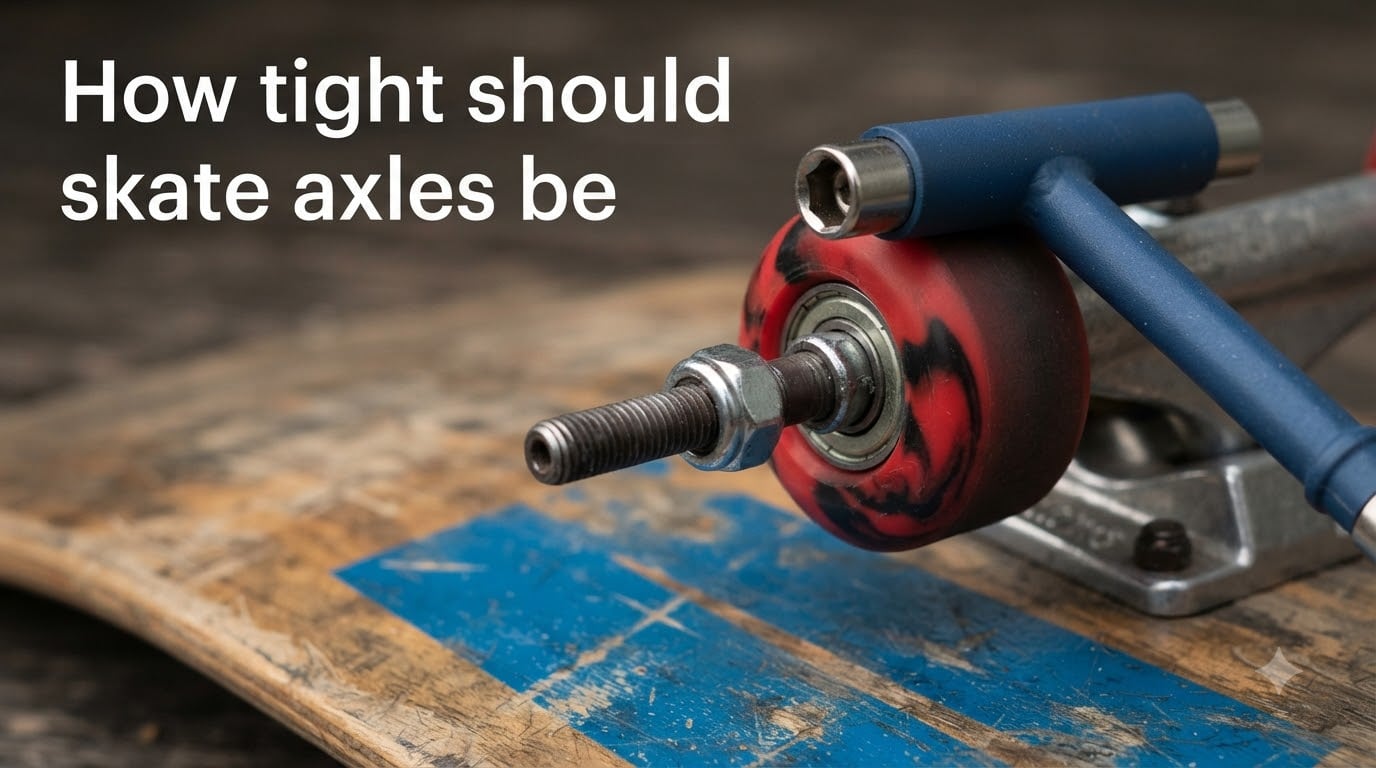
Skate axles should be tight enough that the wheel stays securely on the truck with no dangerous side-to-side movement, but loose enough that the wheel spins freely when you flick it with your finger. The sweet spot is about 1 to 2 millimeters of lateral play — you can barely feel it when wiggling the wheel by hand.
If you have ever wondered how tight should skate axles be, you are not alone. This is one of the most common questions on skating forums, and getting it wrong affects everything from your speed to your safety. Our team has spent years testing setups across street, park, cruising, and roller skate disciplines.
In this guide, I will walk you through the exact tightness you need, how to test it yourself, and what signs tell you when something is off. Whether you are a beginner tightening your first set of wheels or an experienced skater fine-tuning for a new terrain, this article has you covered for 2026.
Table of Contents
What Proper Skate Axle Tightness Actually Means?
Proper skate axle tightness means the axle nut sits snug against the outer bearing with just enough clearance for the wheel to spin without resistance. The wheel should not slide around on the axle, and it should not feel locked in place either.
There is an important distinction here that confuses many skaters. Axle tightness refers to the nut on the axle itself, which holds the wheel in place. Truck tightness is a completely separate adjustment — that is the kingpin nut that controls how stiff or loose your trucks turn. Both matter, but they serve different purposes.
When we talk about how tight should skate axles be, we are focused on the axle nuts. These keep your wheels from flying off while allowing the bearings inside to do their job. Get this wrong and you risk either a seized wheel or a wheel that walks off the axle mid-ride.
The community consensus from years of skating experience is simple: tight enough to be safe, loose enough to spin freely. That translates to roughly finger-tight plus a quarter turn, backed off until the wheel rotates without grinding.
The Spin Test: How to Know Your Wheels Are Correctly Tightened
The spin test is the most reliable way to check axle tightness without any special tools. Spin the wheel hard with your fingers and watch how it behaves. A properly tightened wheel should spin smoothly for several seconds and slow down gradually without any clicking or grinding sounds.
Here is how I perform the spin test on every setup I build:
Hold the skateboard or skate steady with the wheels off the ground
Flick the wheel as hard as you can with your index finger
Count how long it spins — anything under 3 to 5 seconds means it is too tight
Listen for grinding, clicking, or a harsh stop — these signal a problem
The wiggle test comes next. Grab the wheel at the top and bottom and try to move it side to side on the axle. You should feel almost no movement — about 1 to 2 millimeters at most. If you can see the wheel shift visibly, it is too loose. If there is zero movement at all and the wheel feels stiff, it is too tight.
Many skaters use a coin as a reference. A properly tensioned axle leaves about the thickness of a penny between the nut and the bearing race. This gives you a consistent benchmark to work from across multiple wheels.
Signs Your Skate Wheels Are Too Tight
Over-tightened skate wheels are a common beginner mistake. The symptoms show up quickly once you know what to look for. Here are the warning signs that your axle nuts are cranked down too hard.
The most obvious sign is sluggish spinning. If your wheel stops within a second or two of flicking it, the nut is pressing into the bearing and creating friction. Bearings are designed to spin with minimal resistance, and crushing them defeats the purpose entirely.
You may also notice a grinding or clicking sound when the wheel rotates. This happens when the inner race of the bearing gets compressed against the outer race. Over time, over-tightening can permanently damage the bearing shields and pit the ball bearings inside.
Other symptoms of over-tightened axles include:
The board or skates feel slow even on smooth ground
Wheels heat up after a short session
You feel vibration through the deck or boot
The nut leaves visible marks on the bearing shield
If you notice any of these, back the nut off slightly and re-run the spin test. A quarter turn is often the difference between a sluggish wheel and one that flies.
Signs Your Skate Wheels Are Too Loose
Under-tightened wheels are arguably more dangerous than over-tightened ones. The symptoms are subtle at first but escalate quickly. Here is what to watch for.
The clearest sign is visible side-to-side play. If you can wiggle the wheel on the axle and feel it click back and forth, the nut needs attention. Skaters on Reddit consistently report that the wheel should only move about a millimeter or two — you should barely feel it.
You may also hear a clacking sound when you ride over rough pavement. That is the wheel bouncing on the axle thread because there is not enough tension holding it seated against the bearings.
Other warning signs of loose axles include:
The wheel visibly slides outward when you push off
Uneven wear on the inside of the wheel bore
Speed wobble or instability at higher velocities
The axle nut itself spins freely by hand without resistance
The worst-case scenario from the community is real: wheels flying off mid-ride. This is a safety hazard that can cause serious injury, especially at speed or in traffic. If you feel any play at all, stop and re-tighten before your next run.
How to Tighten Skate Axles Step by Step
Tightening skate axles is straightforward once you have done it a few times. I recommend doing this with the skate or board on a flat surface where you can access each wheel easily. Here is the exact process I follow.
Step 1: Gather your tools. You need a skate tool or a 14mm socket wrench for the axle nuts. Most skateboards use a standard 5/16 inch axle with a 14mm hex nut. Roller skates use an 8mm Allen key or a 1/2 inch wrench depending on the model.
Step 2: Clean the axle thread. Wipe the axle with a dry cloth to remove dirt and old grease. Debris on the thread can cause the nut to bind and give you a false sense of tightness.
Step 3: Seat the bearings. Make sure both bearings are fully pressed into the wheel and the wheel is centered on the axle between the truck hanger and the nut.
Step 4: Tighten the nut by hand. Spin it on until finger-tight. This gives you a baseline where the nut sits flush against the outer bearing without any tool pressure.
Step 5: Snug with the tool, then back off. Use the skate tool to tighten a quarter turn past finger-tight. Then back it off slightly — about an eighth of a turn — until the wheel spins freely.
Step 6: Run the spin and wiggle tests. Confirm the wheel spins for at least 3 to 5 seconds and shows only 1 to 2 millimeters of lateral play.
Step 7: Repeat for all wheels. Consistency across all four wheels gives you predictable handling. Check each one with the same method.
A pro tip from experienced skaters: if you struggle to find the sweet spot, tighten fully and then back off one flat of the nut at a time. Each flat on a hex nut represents about 60 degrees of rotation, which is a fine enough adjustment to dial in the perfect tension.
Style-Specific Tightness Recommendations for Street, Park, and Cruising
Different skating styles call for slightly different setups. The basic axle nut tightness stays the same across disciplines — you always want that 1 to 2 millimeter sweet spot — but truck tightness and bushing choice vary significantly depending on what you skate.
Street skating typically calls for tighter trucks. Street skaters need stability for landing tricks and a predictable platform for technical footwork. Tighten the kingpin nut so the trucks resist easy turning but still lean when you apply pressure.
Park and bowl skating usually means looser trucks. Transition skaters rely on deep carves and fluid turns to maintain speed on ramps. Looser kingpin nuts let the trucks respond faster to weight shifts.
Cruising falls somewhere in the middle. You want enough looseness to carve and dodge obstacles comfortably, but enough stability to handle rough pavement at speed. Many cruisers run medium-tight trucks with softer bushings for a smooth ride.
Downhill skating demands the tightest setups. Speed wobble is a real danger above 25 miles per hour, and tight trucks with hard bushings keep the board tracking straight when you need it most.
Remember that axle nut tightness stays consistent across all these styles. What changes is the kingpin nut, the bushing durometer, and sometimes the truck geometry itself. The axle nut’s job is simply to hold the wheel safely on the truck.
Roller Skate vs Skateboard Axle Differences
This is a gap I noticed across most competitor articles. The question of how tight should skate axles be applies to both skateboards and roller skates, but the hardware differs in ways that matter.
Skateboards use a 5/16 inch axle with a 14mm hex nut. The nut tightens against the outer bearing shield with a washer between the nut and the bearing on most setups. Roller skates, especially quad skates, use a different system.
Quad roller skate trucks use either a standard axle with a locknut or a threaded axle with an 8mm Allen-key nut. Roller skate wheels also tend to run wider than skateboard wheels, which means more lateral load on the axle.
The tightness principle is the same: the wheel should spin freely with minimal side-to-side play. But roller skaters often check tightness more frequently because quad skate wheels experience different forces than skateboard wheels during jumps and spins.
If you are switching from skateboard wheels to roller skate wheels on a quad setup — a common move for ramp skaters — double-check the bearing seat depth. The axle nut tightness that worked on your old wheels may not transfer directly to a different wheel bore.
Wheel Bite, Bushings, and Why Setup Matters
Wheel bite is what happens when your wheel touches the underside of your deck during a sharp turn. The contact stops the wheel instantly and can launch you off the board. It is one of the most common causes of sudden falls.
Wheel bite is primarily a truck tightness and bushing issue, not an axle nut issue. But it connects to the broader question of how tight should skate axles be because both adjustments work together to keep your ride safe and responsive.
Loose trucks let the deck lean closer to the wheels, increasing bite risk. Tighter trucks and harder bushings resist that lean. Many skaters add riser pads between the truck baseplate and the deck to create more clearance.
Bushings are the rubber or polyurethane cushions inside the truck that control how it turns. Softer bushings (around 78A to 85A durometer) turn more easily but compress more. Harder bushings (90A to 98A) resist turning and provide stability.
If your trucks feel unpredictable even after adjusting the kingpin nut, the bushings may be worn out or too soft for your weight. Replacing bushings is cheaper than replacing trucks and often solves handling issues that tightening alone cannot fix.
Maintenance Schedule and When to Replace Components
I check axle tightness before every session. It takes about two minutes to spin each wheel and confirm nothing has loosened. Nuts can back off over time from vibration, especially on rough surfaces.
Every few weeks, I do a deeper check. I remove each wheel, clean the axle thread, inspect the bearings for rust or pitting, and re-seat everything. This catches problems before they become ride-ending failures.
Replace axle nuts if the nylon insert stops gripping the thread — usually after 5 to 10 removal cycles. Replace bearings when they make noise, feel rough when spun dry, or show visible rust. Replace bushings when they develop cracks or no longer spring back to center after a turn.
A good rule of thumb: if your setup feels different than it did last week and you have not changed anything, something has worn or loosened. Trust that instinct and investigate.
Common Mistakes Beginners Make When Tightening Skate Axles
New skaters consistently run into the same handful of problems when they first adjust their axles. I see these come up constantly on Reddit and in skating groups, and they are all avoidable.
The biggest mistake is cranking the axle nut down as hard as possible because it feels safer. Beginners often equate tight with secure. But over-tightening crushes the bearings, kills your speed, and shortens bearing life dramatically.
The opposite mistake is leaving the nut too loose out of fear of over-tightening. Skaters on the roller skating subreddit report wheels actually flying off because the nut was barely finger-tight. Neither extreme is safe.
Another common error is confusing axle nut tightness with truck tightness. Beginners sometimes loosen the kingpin nut thinking it will make their wheels spin faster. It will not — it just makes the trucks turn more easily and increases wheel bite risk.
Using the wrong tool is also a frequent problem. Pliers, adjustable wrenches, and improvised tools round off the nut edges and damage the axle thread. A proper skate tool costs a few dollars and saves you from stripped hardware.
Finally, many beginners skip the spin test entirely. They tighten by feel and assume it is fine. The spin test takes 10 seconds per wheel and tells you immediately whether you hit the sweet spot. There is no good reason to skip it.
Frequently Asked Questions
How tight should I tighten my skate wheels?
Tighten the axle nut until it is snug against the bearing, then back off slightly until the wheel spins freely. You want about 1 to 2 millimeters of side-to-side play — barely detectable when you wiggle the wheel by hand.
Is it better for skates to be tight or loose?
Neither extreme is good. Wheels that are too tight damage bearings and kill speed. Wheels that are too loose can fly off and cause injury. The ideal is snug enough to be safe but loose enough to spin freely for several seconds when flicked.
How do I know if my skateboard wheels are too tight?
If a wheel stops spinning within 1 to 2 seconds of flicking it, the nut is too tight. Other signs include grinding sounds, wheels heating up during a session, and a sluggish feel even on smooth pavement.
What happens if skateboard wheels are too loose?
Loose wheels develop visible side-to-side play, clack over rough pavement, and can slide off the axle entirely. At speed, loose wheels cause instability and wobble. In the worst case the wheel detaches mid-ride, which is a serious safety hazard.
How often should I check wheel tightness?
Check axle tightness before every session with a quick spin test. Do a full inspection — removing wheels, cleaning threads, and checking bearings — every few weeks or after skating on rough terrain.
Conclusion: Finding Your Axle Sweet Spot
Getting the right answer to how tight should skate axles be comes down to one principle: tight enough to be safe, loose enough to spin freely. That 1 to 2 millimeter sweet spot keeps your wheels secure without crushing your bearings.
The spin test and wiggle test are your two best tools for dialing in that tension. Run them every time you adjust your axles and any time your setup feels off. They take seconds and they catch problems before they become crashes.
Remember the distinction between axle nut tightness and truck tightness. The axle nut holds the wheel safely on the truck. The kingpin nut controls how your trucks turn. Adjust them separately and intentionally for your skating style.
If you are new to skating, do not be afraid to make adjustments. Start with finger-tight, back off slightly, and test. You will develop a feel for it within a few sessions. Your next step is to grab your skate tool, check all four wheels, and ride with confidence knowing your axles are dialed in for 2026.