
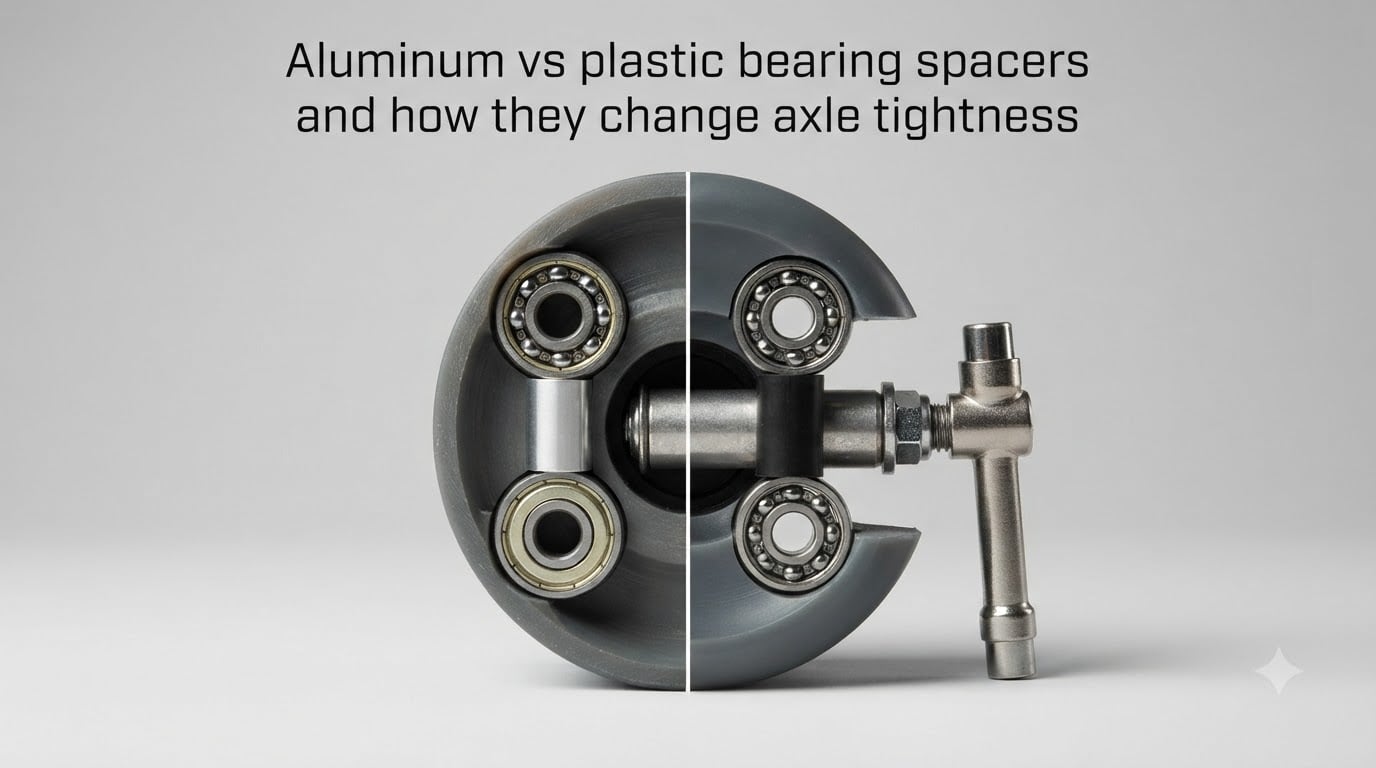
When you spin a fresh set of wheels and the bearings feel gritty, slow, or wobble the moment you tighten the axle nut, the bearing spacer is almost always the silent culprit. The aluminum vs plastic bearing spacers debate isn’t really about which cylinder looks cooler inside your wheel — it’s about how each material changes the way torque travels from your axle nut into the bearing races. I started paying attention to this after ruining two sets of bearings in three months on a pair of aggressive inline skates, and the difference once I switched spacers was night and day.
In this guide I’ll walk through what a bearing spacer actually does, how aluminum and plastic differ once the axle nut starts to bite, and how to dial in axle tightness so your wheels spin freely without any wobble. Whether you skate street, downhill longboard, or aggressive inline, the spacer inside your wheels quietly sets the ceiling for how well your setup performs.
Table of Contents
What Bearing Spacers Actually Do Inside a Wheel?
Bearing spacers are precision-machined cylinders — usually 8mm, 6mm, or 6.3mm long — that sit between the two 608 bearings inside a wheel hub. Their entire job is to keep the inner races of both bearings perfectly parallel and exactly the right distance apart. When two flat, parallel surfaces sit on either side of an axle and the inner races are pushed inward, the balls inside the bearing roll smoothly instead of binding.
Without a spacer, the inner races have a tiny amount of play. The moment you tighten the axle nut, that play collapses and the balls start pressing sideways against the race walls. This adds friction, makes the wheel feel sluggish, and slowly murders the bearing. With a spacer in place, the races cannot drift inward — the spacer hits its stops and the wheel stays free.
The reason material matters is that the spacer is the very piece that transfers compressive force from your axle nut into the bearing assembly. If that spacer deforms, the whole geometry drifts. That’s the heart of the aluminum vs plastic bearing spacers question and the answer to how they change axle tightness.
The Three Parts of a Bearing That Talk to the Spacer
Inner race: the smaller ring that slides onto the axle and receives force from the spacer.
Outer race: the larger ring pressed into the wheel hub — stays stationary.
Ball bearings: the seven (or nine) steel or ceramic balls rolling between the races. Side-load on these balls is what causes friction.
Every torque decision you make with a skate tool is, mechanically, an attempt to clamp the inner races together without crushing the balls. The spacer is what makes that balance repeatable.
Why Spacers Change How an Axle Nut Feels
The instant you start tightening an axle nut with a properly sized spacer, you can feel resistance right away. That firm “stop” feeling is the spacer bottoming out against the inner races. Now reverse that: if you have no spacer, or a spacer that’s slightly too short, the nut keeps turning until something else gives — usually the balls grinding against the outer race, or the axle itself flexing inside the hub. The wheel either feels loose or it feels grinds. There’s no clean in-between.
That’s the practical answer to how spacers affect axle tightness: a correct spacer gives you a wide usable torque window between “wheel wobbles” and “wheels bind.” A worn or compressed spacer collapses that window until you’re left chasing the feel every ride.
The Two Forces at Play When You Crank the Nut
When you turn an axle nut, two things compete. First, the axle wants to clamp inward and crush the bearing assembly. Second, the spacer wants to spread that force evenly across both inner races. A rigid spacer wins this fight predictably. A soft spacer loses it slowly, which is why plastic and aluminum spacers feel completely different after a few sessions.
Aluminum vs Plastic Bearing Spacers: Material Comparison
Aluminum spacers are CNC-machined from hard alloys, usually 6061 or 7075. Plastic spacers — typically nylon, Delrin, or generic ABS — are injection-molded for low cost. The manufacturing difference shows up the first time you grip a skate tool. Here is how the two materials stack up on the metrics that matter for skating.
| Property | Aluminum Spacers | Plastic Spacers |
|---|---|---|
| Compressive strength | Very high (does not deform under normal axle loads) | Moderate (slowly creeps under repeated clamping) |
| Dimensional stability | Holds exact size over years | Length can shrink 0.05–0.2mm after extended use |
| Weight (per spacer) | ~1.0g for 8mm | ~0.3g for 8mm |
| Friction against inner race | Low, with consistent finish | Low initially, can rise as surfaces glaze |
| Vibration transmission | Higher (rigid feel) | Lower (slight dampening) |
| Cost per set of 8 | Mid to high | Low |
| Lifespan under heavy use | Years | Months to a couple of seasons |
| Best for | Skateboard, longboard, aggressive inline, roller derby | Casual cruising, beginners, kids’ adjustable skates |
At a glance the table makes aluminum look like the obvious winner, but the picture isn’t black and white. Plastic spacers do one thing aluminum can’t: they absorb micro-vibration. On a cheap setup with soft wheels and rough ground, that slight dampening can feel smoother even if it’s technically slower.
Compression and Creep: Why Plastic Spacers Loosen Over Time
Every material deforms under sustained load. Engineers call the slow, permanent version “creep,” and plastic creeps far more than aluminum. A nylon spacer torqued to a normal skate axle will lose roughly 0.05 to 0.2mm of length over a season of regular use. That is exactly the slack you feel when wheels suddenly start to wobble after months of trouble-free skating.
Aluminum spacers have a creep rate so low it’s effectively zero at the forces a human generates with a skate tool. You can leave them torqued for years and they will not measurably shorten. This is the single biggest mechanical reason aluminum vs plastic bearing spacers behaves so differently when you compare long-term axle tightness.
Speed and Spin Feel: What Skaters Notice on the Road
A controlled free-spin test — drop the wheel, count revolutions — usually shows aluminum spacers letting bearings spin 10 to 25 percent longer than plastic spacers in identical wheels. That gap comes from two sources: the plastic spacer sometimes adds a tiny amount of bearing pre-load even when the axle nut feels snug, and the plastic itself introduces more surface friction against the inner race.
On pavement the difference shows up as roll speed. A skater cruising with plastic spacers often reports the wheels feeling “fine for the first ten minutes, then noticeably slower.” Aluminum spacers tend to feel consistent from the first push to the last. In the r/longboarding and r/rollerblading communities this is the exact pattern that pushes most riders toward metal once they’ve tried both.
How Tight Should Axle Nuts Be With Each Spacer Material?
Here is the part most guides skip: the right axle tightness is not the same with aluminum and plastic spacers, even when the bearing, wheel, and hardware are identical. The material changes how torque translates into clamp load.
With aluminum spacers, the axle nut reaches a firm “stop” almost immediately — usually about a quarter to a half turn past first contact with a fresh skate tool. That is the correct tightness. Go another half turn and you’ll feel drag in the spin test.
With plastic spacers, the stop is mushy. The nut keeps turning for a full turn or more past first contact because the nylon is slowly compressing. The trap here is over-tightening. Many skaters assume “more is safer” and crank until the wheel barely spins, then wonder why their bearings cooked in a month. If your spacer is plastic, treat first contact plus a small eighth of a turn as the upper limit, then verify with a free-spin test.
Quick “Drop Test” You Can Do Right Now
Tighten the axle nut until firm resistance starts.
Spin the wheel by hand — it should rotate at least three full revolutions on a flat surface.
Grams the axle nut at the wheel and try to wobble it side-to-side. There should be no play.
If play exists, tighten by one-eighth turn and re-check the spin.
If you can’t satisfy both steps 2 and 3 at the same time, the spacer is the wrong length or has compressed past its limit — replace it.
Choosing the Right Spacer Size: 8mm, 6mm, and 6.3mm
Spacer length has to match the hub depth of your wheel. The most common sizes and where they fit:
8mm cylindrical: the modern standard for most skateboard, longboard, and inline skate wheels with shielded 608 bearings.
6mm cylindrical: used in older inline skate wheels and some lightweight scooter hubs.
6.3mm: a half-step size left over from older metric tolerances; still common in classic roller skate wheels.
When in doubt, measure the empty distance between the two bearing seats in your wheel hub with a pair of calipers. The spacer should match that distance almost exactly — within 0.05mm. If you don’t have calipers, the spacer should drop into the hub and rest against both inner races without any wiggle room in the axle direction.
Common Problems Without Proper Spacers
A missing or wrong-size spacer usually shows up as one of four symptoms. If you’ve experienced any of these, the spacer is the first thing to check before replacing bearings.
Wheel wobble at slow speeds: bearings aren’t held parallel, so the wheel rocks on the axle.
Wheels that suddenly “lock up” mid-roll: inner races drifted inward and balls are binding.
Slide chatter during longboard slides: side-load on the bearing isn’t being absorbed by the spacer.
Bearings that die in weeks: consistent micro-binding wears the race surfaces.
These symptoms match almost exactly what the r/longboarding users described when they talked about chatter, and they’re a clear signal that the spacer isn’t doing its job. A replacement spacer — usually aluminum — almost always solves all four.
How to Install Bearing Spacers the Right Way
Putting a spacer in is straightforward but worth doing methodically. I do this every time I refresh my inline skate wheels, and the consistency matters more than the speed.
Remove the wheel and bearings. Use a bearing press or a properly-sized socket to push both bearings out cleanly.
Clean the hub. Wipe out grit and old lubricant so nothing is trapped between spacer and race.
Drop in the spacer. It should seat flat against the inside of the hub without protruding.
Reinstall the bearings. Press them in square against the spacer end and the opposite hub wall.
Mount the wheel and start the axle nut finger-tight. Spin the wheel to confirm no grinding before tightening further.
Tighten to firm contact. Stop as soon as you feel resistance — over-tightening is the most common mistake.
Do the drop test. Verify free spin and zero wobble before you skate.
Tip: if you have spacers in a sealed bag, don’t open them with a knife near your bearings. A single aluminum shaving across a ball race will destroy the bearing in minutes. I learned that the hard way rebuilding a scooter wheel.
Signs Your Spacers Need Replacing
Spacers don’t last forever. Plastic ones in particular wear out faster than most skaters expect. Watch for these signs and swap early — replacing a spacer is cheap, replacing bearings is not.
Visible flattening or burrs on the spacer ends.
Wheels that progressively wobble more over a few weeks even with the axle nut fully torqued.
Plastic spacers that no longer drop fully into the hub — they sit low.
Any aluminum spacer with a scratch, dent, or corrosion on the contact surface.
Frequently Asked Questions About Bearing Spacer Materials
What material is best for bearing spacers?
Aluminum spacers are the best choice for most skaters. They hold their dimensions under repeated axle tightening, give a clearer tightening feel, and let bearings spin more freely. Plastic spacers are acceptable for casual or budget setups but will compress and shorten over time.
What should aluminum spacers be torqued to?
Aluminum spacers do not need a torque wrench. Tighten the axle nut with a skate tool until you feel firm resistance at first contact, then add about a quarter turn. Verify with a free-spin test — the wheel should turn freely with zero side-to-side play.
Do spacers hurt wheel bearings?
No. Correctly sized spacers actually extend bearing life by keeping the inner races parallel and preventing the ball bearings from binding against the race walls. Bearings wear out faster when spacers are missing, wrong size, or worn out themselves.
How strong are aluminum wheel spacers?
A machined 6061 aluminum spacer can handle compressive loads over 30,000 psi without any measurable deformation. The forces generated by a skate tool are many times smaller, so aluminum spacers will not crush under normal skating, including aggressive and downhill use.
Should I use bearing spacers on my skateboard?
Yes, any standard skateboard with two 608 bearings benefits from a spacer. It improves roll speed, prevents wheel wobble, and makes your bearings last longer. The only time to skip a separate spacer is when the bearings themselves have a built-in spacer.
How tight should skateboard wheels with spacers be?
With an aluminum spacer, tighten until firm contact plus a quarter turn. With a plastic spacer, stop at firm contact plus an eighth turn at most. Always finish with a hand-spin test to confirm the wheel rotates freely with no wobble.
Are there downsides to wheel spacers?
The only real downsides are weight (a few grams per set) and cost for aluminum versions. Cheap plastic spacers can compress and lose effectiveness. None of these downsides outweigh the bearing protection and roll speed a proper spacer provides.
Final Thoughts on Aluminum vs Plastic Bearing Spacers
Pulling this all together, the aluminum vs plastic bearing spacers comparison comes down to one question: do you want your axle tightness to stay the same across the life of the wheel, or do you want to keep chasing the right feel every few months? Aluminum wins on stability, speed, and bearing protection. Plastic wins on cost and a slight vibration dampening that some casual skaters prefer.
For anyone skating more than a few times a month — whether that’s longboard commutes, roller derby, or aggressive inline — switching to aluminum spacers is the single cheapest upgrade for better wheel feel. For beginners or kids on adjustable skates, plastic is fine as long as you replace them at the first sign of wobble.
Pick the right spacer size for your hub, install it square, and stop tightening the moment you feel firm contact. That’s the whole recipe for wheels that spin free, last longer, and feel the same ride after ride. If you want to keep learning, check the rest of our 2026 guides for more hands-on skate setup tips.