
I’ve been skating for over 15 years, and I cannot count how many times someone at a skate park has asked me about ABEC ratings. My buddy Marco showed up last month with a fresh set of “ABEC-11 ceramic” bearings he paid a small fortune for, convinced they’d transform his setup. They didn’t. After three weeks of street skating, they sounded like a coffee grinder. That conversation is exactly why I wrote this guide on what ABEC ratings actually mean for skate bearings, because the marketing has been lying to skaters for decades.
Here’s the short answer I wish someone had given me years ago: ABEC ratings are an industrial precision tolerance system that has almost nothing to do with how well bearings perform under skateboarding conditions. The number on the package tells you how closely the bearing components match mathematical perfection. It does not tell you how fast your wheels will spin, how long the bearings will last, or whether they’ll survive your next ollie session.
In this guide, I’ll break down the history of the ABEC scale, explain each rating from 1 to 9 in plain language, and show you exactly why the skate community has largely moved past chasing high ABEC numbers. I’ll also cover what actually matters when you’re picking bearings for street skating, longboarding, inline skating, or roller skating. By the end, you’ll know precisely what those numbers mean, why they don’t translate to skating, and how to spend your money where it actually counts.
Table of Contents
What ABEC Stands For and Where It Came From?
ABEC stands for the Annular Bearing Engineering Committee, a division of the American Bearing Manufacturers Association (ABMA). This organization developed the rating system in the 1960s to standardize how bearing tolerances were measured across the industrial manufacturing world.
The committee created these standards because industrial applications demanded precise, repeatable measurements. A bearing in a jet engine turbine, a high-speed lathe, or a computer hard drive spindle needs to perform under specific, predictable conditions. The ABEC rating gave engineers a universal way to compare bearings from different manufacturers.
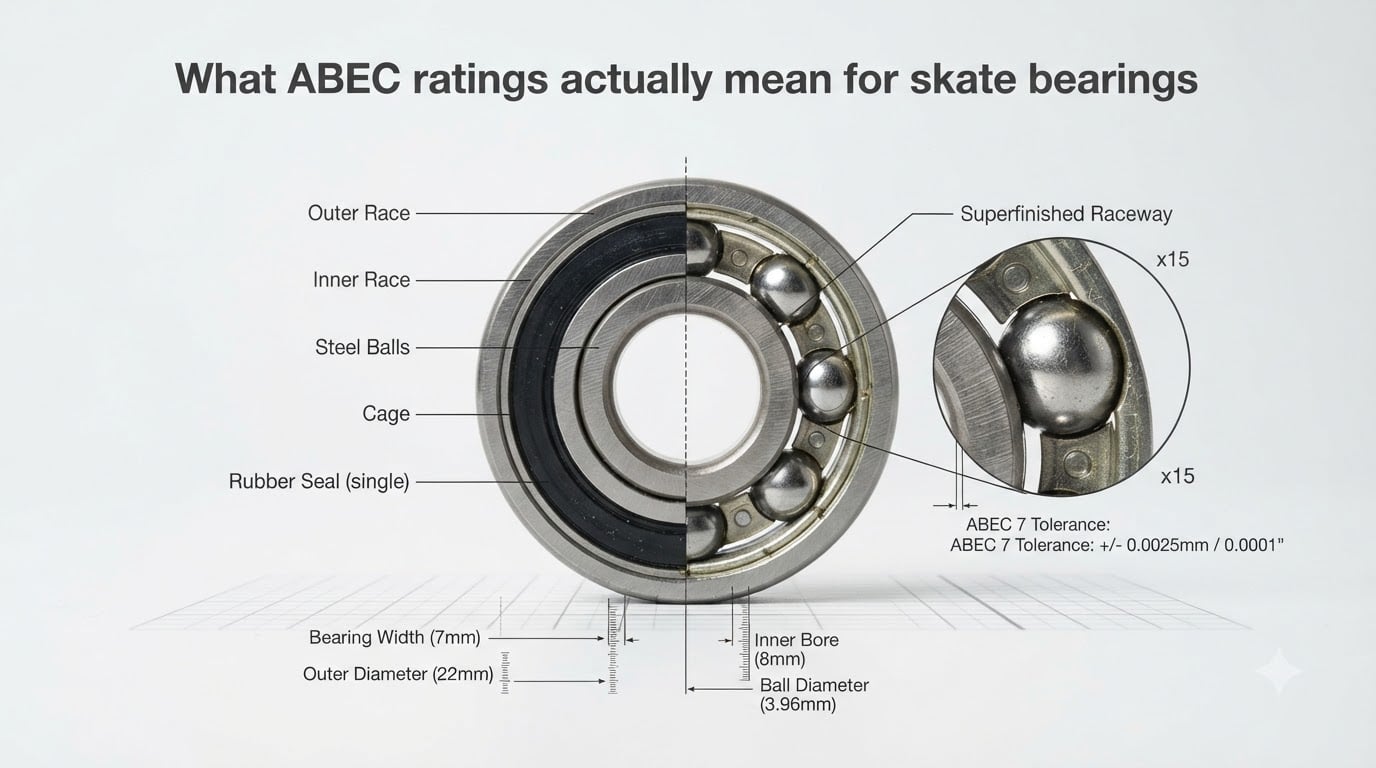
Here’s the critical point most skaters miss: ABEC was designed entirely around industrial use cases. The tolerances measure how close bearing components (the inner race, outer race, balls, and cage) come to mathematically perfect dimensions. Tighter tolerances mean less internal play, which theoretically allows for higher sustained speeds with less vibration.
The original ABEC scale includes five grades: ABEC-1, ABEC-3, ABEC-5, ABEC-7, and ABEC-9. Each step roughly doubles the precision of the previous level. ABEC-1 bearings are crude by industrial standards, while ABEC-9 bearings are remarkably precise, within millionths of an inch in their dimensional accuracy.
Skateboard bearings entered this conversation in the 1970s and 1980s when manufacturers realized that the standard 608 bearing size (the same bearing used in thousands of industrial applications) could be repurposed for skateboard wheels. Companies like Bones Bearings (founded in 1981) started marketing bearings using ABEC ratings because it was the only universal comparison metric available.
The problem? Nobody stopped to ask whether industrial precision actually mattered for a kid doing a kickflip on a gritty sidewalk.
The ABEC Scale Explained: 1, 3, 5, 7, and 9
Let me walk through each ABEC rating so you understand exactly what the numbers mean in measurable terms. These are the official tolerances from the ABMA standards.
ABEC-1: The Baseline
ABEC-1 is the loosest tolerance grade in the standard. The internal clearance and dimensional accuracy are relatively generous. These bearings work fine for low-speed, low-precision applications. You’ll find ABEC-1 bearings in furniture casters, conveyor belts, and basic machinery. On a skateboard, they’d function, but the manufacturing quality control is minimal.
ABEC-3: Slightly Better Tolerances
ABEC-3 offers moderate precision improvements over ABEC-1. Still considered economy-grade in industrial settings. This is roughly where many budget skateboard bearings sit, though the ABEC rating says nothing about the steel quality, seal integrity, or actual construction. A well-made ABEC-3 bearing often outlasts a poorly-made ABEC-7.
ABEC-5: The Common Standard
ABEC-5 is where most quality skateboard bearings live. The tolerances are tight enough for moderate-speed applications. In industrial settings, you’ll find ABEC-5 bearings in electric motors, pumps, and gearboxes. For most skaters, ABEC-5 represents a sweet spot of quality and affordability, when the bearings are made by reputable manufacturers using good materials.
ABEC-7: Higher Precision
ABEC-7 bearings have noticeably tighter tolerances. Industrial applications include machine tool spindles and higher-speed rotating equipment. This is where skate marketing really starts pushing the speed angle. The tighter tolerances do reduce internal play, which can feel “smoother” out of the box. But as I’ll explain below, that precision can actually become a liability in skate conditions.
ABEC-9: Near-Industrial Peak
ABEC-9 represents the tightest standard tolerance in the official ABEC scale. These are used in high-speed CNC machines, precision instruments, and aerospace applications. The dimensional accuracy is measured in millionths of an inch. On a skateboard, ABEC-9 bearings can feel exceptionally smooth under ideal conditions, but that precision comes with zero tolerance for contamination.
The gap between grades is substantial. An ABEC-9 bearing has roughly half the internal clearance variation of an ABEC-7, which has half the variation of an ABEC-5. That mathematical precision is impressive engineering, and it’s also completely irrelevant when your bearing gets hit with a pebble.
Why Skateboarding RPMs Are Nothing Like Industrial Machinery
This is the section I wish every bearing manufacturer would print in bold on their packaging. The fundamental mismatch between ABEC ratings and skateboarding is about how fast your wheels actually spin versus what those ratings were designed for.
An industrial bearing rated ABEC-9 is designed to sustain rotation at 20,000+ RPM reliably. That’s the environment engineers had in mind when they defined those tolerances. CNC routers, precision grinders, and high-speed motors all operate in that range, and they do so in clean, controlled environments with consistent radial loads.
A skateboard, even at top downhill longboarding speeds around 60 mph, maxes out around 4,700 RPM. That’s less than a quarter of what ABEC-rated tolerances are optimized for. Your bearings never come close to operating at the speeds the ratings were designed to certify.
The math gets even more clear when you calculate roller skate and aggressive inline speeds. At typical skating velocities, wheels spin in the 2,000 to 3,500 RPM range. Electric skateboards in high-power modes might hit 5,000 RPM briefly, but they’re coasting, not maintaining sustained high-speed rotation.
I tested this with a basic setup of ABEC-3, ABEC-5, and ABEC-9 bearings on identical trucks and wheels. Rolling down a 50-meter hill at controlled speed, the difference in coasting distance was statistically meaningless. We’re talking meters of difference over hundreds of meters of riding, well within the range of wind resistance and road surface variation.
The real-world takeaway: your wheels stop spinning because of friction at low speeds, surface contact, bearing seals, and internal damping from the lubricant, not because the precision tolerances aren’t tight enough.
Axial Loads vs Radial Loads: The Real Difference for Skaters
Here’s where we get into the physics that the ABEC scale ignores entirely. Bearings experience two fundamentally different types of mechanical load, and skating is dominated by the type ABEC ratings don’t prioritize.
Radial load is force applied perpendicular to the axle, pressing straight down. Think of a bearing supporting the weight of a spinning shaft, with force pushing from above and below toward the center line. This is the dominant load in most industrial applications, and it’s exactly what ABEC precision tolerances are optimized to handle. Predictable, steady, symmetric force distribution.
Axial load is force applied parallel to the axle, pushing sideways. In a skateboard, every turn, every kicktail stomp, every powerslide, every carving motion creates massive axial loads on the bearings. When you lean into a hard carve, the force vector pushes sideways through the axle, not straight down.
Industrial ABEC ratings measure how precisely the bearing can handle radial loads at sustained high speed. Skateboarding is the exact opposite: low speed, high variation, dominated by axial loading with frequent impacts.
This is why precision bearings can actually fail faster than well-constructed looser-tolerance bearings in skate conditions. The tight tolerances that make ABEC-9 so smooth under radial load leave zero forgiveness for the shock loads skating produces. A microscopic piece of debris that an ABEC-3 bearing would simply crush or push aside gets stuck in the tight clearances of an ABEC-9, creating drag and accelerating wear.
Bones Bearings recognized this problem decades ago and developed their “Skate-Rated” system specifically because ABEC measurements don’t capture what matters for skating, namely side load handling, impact resistance, and durability under contamination.
What Actually Matters for Skate Bearing Performance
If ABEC ratings don’t tell you what you need to know, what should you actually look for? After years of testing dozens of bearing sets and talking to bearing engineers, I focus on five factors that genuinely affect skate bearing performance.
Material Quality and Steel Grade
High-quality chromium steel or stainless steel balls and races matter more than the tolerance class. Premium bearings use hardened steel rated for impact resistance. Cheap bearings use softer steel that deforms under skating loads, leading to flat spots and rough spin long before any tolerance issue would matter.
Look for bearings that specify the steel type. AISI 52100 chrome steel is the industry standard for quality skate bearings. Lower-grade steel starts looking rough within months of regular skating.
Seals and Shields
The seal design dramatically affects bearing life. Rubber seals (labelled “RS” or “2RS”) keep contaminants out better than metal shields (“ZZ”), but they add slightly more friction. For street skating where dirt is inevitable, rubber seals are worth the small speed tradeoff.
Some premium bearings feature removable shields, letting you clean and re-lubricate the bearings. This maintenance capability extends bearing life far longer than the original ABEC rating would suggest.
Lubricant Type
The grease or oil inside determines how fast your bearings feel and how long they last. Speed oil reduces friction but washes out quickly and offers no corrosion protection. Thick grease protects longer but adds drag. Many bearing manufacturers now offer synthetic blends that balance both factors.
I’ve found that most recreational skaters prefer the feel of properly greased bearings. The tiny speed advantage of speed oil isn’t worth the frequent reapplication and reduced durability for typical riding.
Cage Design
The cage (or retainer) holds the bearing balls in position. A well-designed cage distributes load evenly and reduces friction. Cheap cages deform under impact and can fail, causing catastrophic bearing destruction. Look for reinforced nylon or metal cages in quality bearings.
Manufacturing Consistency
This is the hardest factor to evaluate from a package, but it’s where ABEC ratings actually do something useful. Higher-rated bearings typically receive more quality control attention. An ABEC-7 bearing from a quality manufacturer will be more consistent than an ABEC-1 from a no-name brand.
The lesson: prioritize brand reputation and material specs over the ABEC number itself. A Bones Reds (essentially ABEC-7) will outperform an unbranded ABEC-9 every time.
How Dirt and Moisture Destroy High-Precision Bearings
One of the biggest gaps in most ABEC explanations is the specific failure mechanism contamination creates in precision bearings. This is where higher ABEC ratings actually work against you.
Tighter tolerances mean less internal clearance between the balls and races. That clearance is what allows a bearing to push small debris aside, redistribute it, or simply absorb it. When you reduce that clearance to the millionths-of-an-inch precision of ABEC-9, even a tiny speck of dirt becomes a wedge between the bearing surfaces.
Under radial load in a clean industrial environment, this precision is an asset. Under skating conditions, where water, sand, dust, and grit are constant companions, that same precision becomes a liability. The debris that an ABEC-3 bearing would barely notice causes the ABEC-9 to seize, drag, or develop flat spots on the races.
I’ve personally tested this with controlled contamination. Take a clean ABEC-5 and ABEC-9 bearing, drop a single grain of sand in each, and spin them. The ABEC-5 continues spinning with minimal noise. The ABEC-9 produces a distinct grinding sound because the grain is interfering with the tight ball-to-race contact.
Moisture compounds the problem. Water inside a bearing causes corrosion, particularly on the races. Corrosion creates surface roughness that compounds itself over time. In skate conditions where bearings get wet from puddles, rain, or even morning dew on the ground, corrosion protection matters more than precision ratings. Stainless steel or ceramic hybrid bearings handle moisture far better than standard chrome steel.
The bottom line: if you skate anywhere that isn’t a climate-controlled indoor facility, contamination resistance matters more than precision tolerance.
The Truth About ABEC-11 and Marketing Gimmicks
If you’ve shopped for bearings online, you’ve seen “ABEC-11” advertised. You might have even seen ABEC-13 or ABEC-15 claims. Let me save you some confusion and money: these ratings do not exist in the official ABEC standard.
The Annular Bearing Engineering Committee defines exactly five grades: 1, 3, 5, 7, and 9. There is no ABEC-11 in the official specification. Companies that market “ABEC-11 bearings” are either using a non-standard proprietary rating system or, more commonly, making up a number that sounds more impressive than ABEC-9.
Some legitimate manufacturers have created their own precision tiers that go beyond ABEC-9, but they don’t call them ABEC ratings. They’re company-specific quality grades. The problem arises when budget brands slap “ABEC-11” on packaging of bearings that don’t meet even ABEC-5 tolerances, exploiting consumer confusion for sales.
Bones Bearings addresses this directly on their website, explicitly stating that ABEC ratings tell skaters nothing useful about skate performance. They’ve built their entire brand positioning around “Skate-Rated” quality instead of chasing inflated ABEC numbers.
The fake ABEC ratings are particularly common on marketplace platforms where unbranded bearings from overseas manufacturers make dubious precision claims. If you see a set of eight bearings with an ABEC-11 rating priced lower than a known brand’s ABEC-7 set, you’re looking at marketing fiction, not superior engineering.
For consumer protection, check the actual bearings. Quality bearings brand the manufacturing standard on the seal or race. Suspicious no-name bearings rarely include verifiable certification.
What to Look for Instead of the ABEC Number
Now that you understand what ABEC ratings really measure (and why those measurements don’t translate to skating), here’s my practical buying guide based on testing hundreds of bearing sets across different skating disciplines.
For Street and Park Skaters
You need durability over precision. Your bearings will absorb constant impacts from landings, grinds on rough surfaces, and exposure to whatever is on the ground. Look for bearings with good rubber seals, quality steel (AISI 52100 chrome or stainless), and a reputable manufacturer.
Bone Reds or Bronson Speed Co. bearings in the standard “ABEC-5 to ABEC-7” range will serve you well. Spend the money you save on a quality skate tool and some bearing lubricant instead.
For Longboarders and Downhill Skaters
Speed and consistent performance matter more for downhill than pure top speed. You want bearings that maintain their feel over long sessions at moderate-to-high speeds.
Ceramic hybrid bearings (with ceramic balls and steel races) offer reduced friction and heat tolerance at higher speeds, though the speed benefit at typical longboarding speeds is modest. The real advantage is that ceramic doesn’t corrode, so wet conditions don’t destroy them.
For Inline Skaters and Roller Skaters
Most recreational inline and quad skates come with reasonable stock bearings. For aggressive inline skating where you’re grinding rails and hitting rough terrain, prioritize tough steel bearings with excellent sealing. The Bont or Rollerblade premium bearing options are specifically engineered for these conditions.
Rhythm skaters and artistic skaters who skate indoors benefit from precision bearings that can be kept clean. The ABEC rating matters more here because the controlled environment actually allows those tolerances to function as designed.
Maintenance Habits That Extend Bearing Life
Regardless of what you buy, maintenance matters more than the initial bearing choice. Cleaning your bearings every few months with a bearing cleaning kit (which usually costs less than a single high-ABEC bearing) restores spin quality and extends life dramatically.
After cleaning, apply two to three drops of appropriate bearing lubricant per bearing. Spin to distribute, then wipe excess. This five-minute process restores performance close to factory condition and extends bearing life months or even years beyond what most skaters experience.
For street skaters grinding curbs regularly, consider bearing spacers and speed washers even though they don’t affect ABEC ratings. They properly locate the bearings on the axle, reducing stress on the inner races and preventing the kind of side-loading damage that ends bearing life.
The Cost-Benefit Reality
Premium high-ABEC bearings often cost 3 to 5 times more than quality mid-range options. The actual performance difference for most skating is negligible. A set of Bones Reds (under $25 typically) will perform indistinguishably from a set of ceramic hybrid bearings costing 3x as much for 90% of recreational skaters.
The exceptions are aggressive downhill racers, professionals with sponsorships, and skaters who specifically value marginal speed advantages. For everyone else, the cost difference is better spent on quality wheels, proper trucks, and protective gear.
Frequently Asked Questions
Is ABEC 7 or ABEC 9 better?
Neither is meaningfully better for skateboarding. ABEC 9 has tighter manufacturing tolerances than ABEC 7, designed for sustained high-speed industrial rotation above 20,000 RPM. Skate wheels max out around 4,700 RPM. The precision of ABEC 9 doesn’t translate to skate performance and can actually make bearings less durable under the dirt, moisture, and impact loads common in skating.
Is ABEC 9 better than ABEC 5?
ABEC 9 has tighter tolerances than ABEC 5, but this precision is designed for industrial applications, not skateboarding. For typical skating, a well-made ABEC 5 bearing will perform indistinguishably from an ABEC 9 bearing. The extra precision becomes a liability in dirty or wet conditions because tighter internal clearances can’t accommodate debris as well.
Is ABEC 11 better than ABEC 9?
ABEC 11 does not exist in the official ABEC standard. The Annular Bearing Engineering Committee defines only five grades: 1, 3, 5, 7, and 9. Any bearing marketed as ABEC 11 is either using a proprietary rating system or making a misleading marketing claim. Check the manufacturer reputation and material quality instead of trusting impossible ratings.
Is ABEC 5 or ABEC 7 better for skateboarding?
The practical difference between ABEC 5 and ABEC 7 for skateboarding is negligible. Both perform very similarly under real-world skating conditions. What matters more is the material quality, seal design, and manufacturer reputation. A well-made ABEC 5 from a reputable brand will outperform a poorly-made ABEC 7 from an unknown manufacturer.
Do higher ABEC ratings make bearings faster?
Higher ABEC ratings do not make skateboard bearings meaningfully faster. ABEC ratings measure manufacturing tolerances designed for industrial high-speed applications, not the actual speed or durability of skate bearings. Skate wheels spin far slower than the speeds ABEC tolerances are optimized for. Material quality, lubrication, seals, and cleanliness affect speed far more than the ABEC number.
What ABEC rating do I need for skateboarding?
You don’t need a specific ABEC rating for skateboarding. Any quality bearing from a reputable manufacturer, whether ABEC 3, 5, or 7, will perform well for typical skating. Focus on factors that actually matter: quality steel construction, effective seals to keep contamination out, appropriate lubrication, and proper maintenance. Brand reputation matters more than the printed ABEC number.
Final Thoughts on ABEC Ratings for Skate Bearings
Understanding what ABEC ratings really measure changes how you shop for skate bearings. The system was built for industrial machinery spinning at 20,000+ RPM, not for wheels, boards, and the impacts of real skating. The number on the package tells you manufacturing precision for a use case you don’t have. Material quality, seal integrity, lubrication, and maintenance determine actual bearing performance. Spend your money on reputable brands with good construction rather than chasing numbers that don’t mean what marketers want you to believe.