
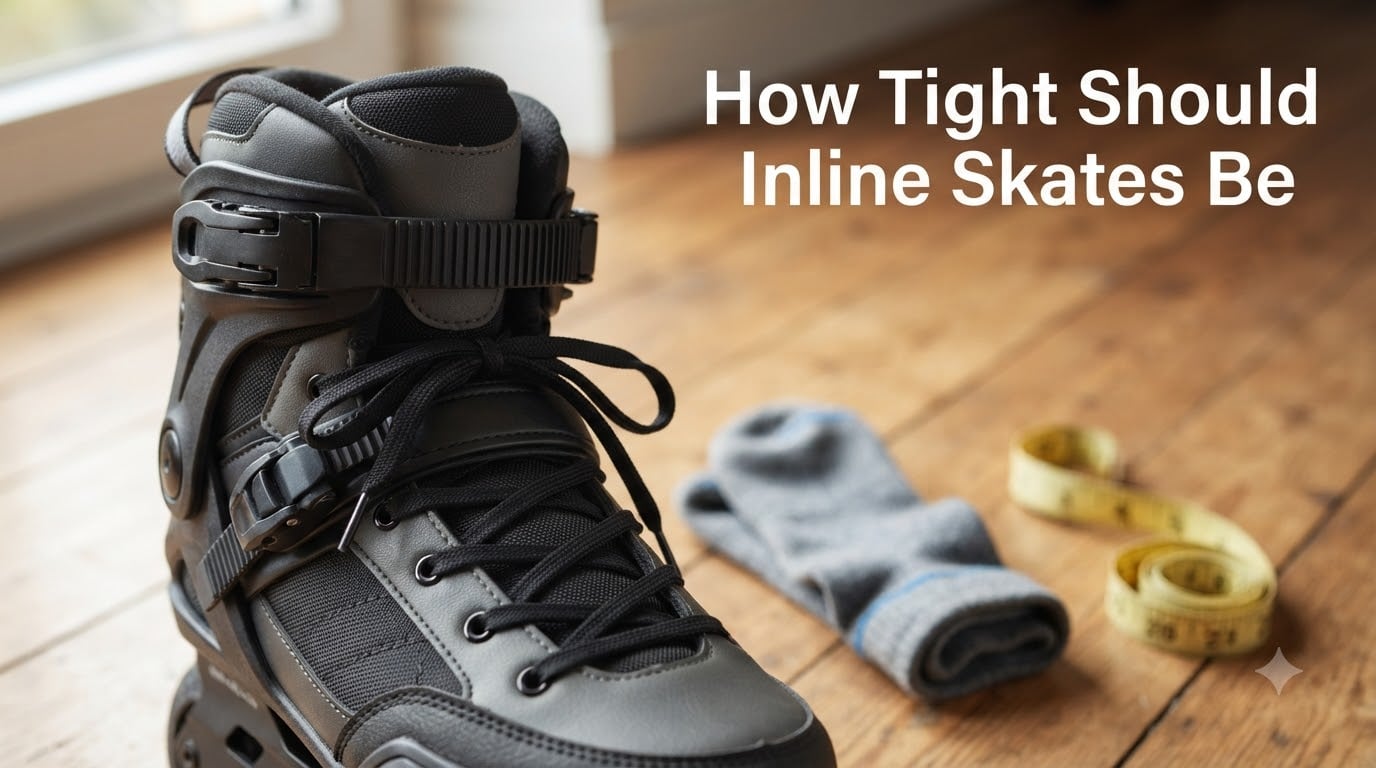
If you have ever laced up a brand new pair of inline skates and wondered whether the squeeze across your toes meant “right fit” or “wrong size,” you are not alone. I have spent the last few years helping skaters dial in their fit, and the short answer to how tight should inline skates be is this: snug like a firm handshake. Tight enough that your foot does not slide inside the boot, but loose enough that blood keeps flowing and your toes can wiggle a little when you crouch.
That single sentence captures the whole philosophy. Everything in this guide is built around helping you find that exact point on your foot. I will walk you through the three-zone fit test, the heel lock check, how to tell break-in discomfort from real pain, and how things like sock thickness or foot swelling during exercise change the equation. By the end, you will be able to put on any pair of skates and know in 60 seconds whether they belong on your feet or back in the box.
Table of Contents
How Tight Should Inline Skates Be (The Firm Handshake Rule)
The gold standard across skate shops, coaches, and experienced skaters on Reddit is the firm handshake metaphor. Think about the pressure of a confident handshake from someone you respect. Your foot should feel that same firm, even pressure all around it inside the boot. Not a bone-crusher, not a gentle hug, but firm.
What “Snug Fit” Actually Means
Snug means there is no empty space between your foot and the liner. When you push your heel back into the boot and try to lift it, your skin should not move. When you skate, your foot should feel like part of the boot, not a passenger inside it. Inline skates transfer energy from your leg to the wheel through the boot, and any slack in the system is power you are losing with every stride.
The Three Zones of Proper Fit
Every inline skate has three zones that need their own kind of tightness. The ankle needs firm support so your heel cannot lift. The midfoot needs even pressure so your arch sits on the footbed without pinching. The forefoot and toes need just enough room to spread slightly when you push off, but not so much that your foot slides forward into the toe box. Getting these three zones right is the real answer to how tight should inline skates be.
How to Check If Your Inline Skates Fit Correctly
This is the bulleted checklist I give to anyone buying skates in our shop. Run through all three tests before you commit to a pair.
Heel lock test: Push your heel all the way back, lace up, and try to lift your heel inside the boot. If it rises more than a few millimeters, the skate is too loose or your laces are not tight enough.
Toe space check: Stand up straight. Your toes should barely brush or lightly touch the front of the boot. Crouch into a skating stance with knees bent. Your toes should pull back and have a few millimeters of clearance.
Width and midfoot check: Press your thumb against the outside of the boot over your widest forefoot joint. You should feel your foot against the liner with no gap, but no pinching either.
If any of these checks fail, the answer is not “skate through it.” The answer is to adjust the laces, try a different size, or try a different last. Most fit problems I see are really lace problems in disguise.
Performance Fit vs Comfort Fit: Which Do You Need?
Inline skates come in two general fit philosophies, and the right one depends on what you actually do in them.
Performance fit is what racers, hockey players, and aggressive street skaters prefer. The boot hugs every contour of your foot, the toe box is closer to your toes, and the liner is often heat-mouldable for a custom shape. You give up some comfort for maximum response and energy transfer.
Comfort fit is what recreational skaters, beginners, and fitness skaters usually want. The boot has a softer liner, a slightly roomier toe box, and more padding around the ankle. You give up a little response for a fit you can wear for two hours without thinking about your feet.
Beginners almost always do better in a comfort fit, because they are still learning balance and posture, and a softer boot forgives more mistakes. Experienced skaters tend to migrate toward performance fit as their technique sharpens and they start demanding more from the skate. Neither choice is wrong. The mistake is buying performance skates with the expectation that they should feel like slippers.
How to Lace and Strap Inline Skates the Right Way
Most skaters I see are not using their laces correctly. The trick is to think of the skate as having two separate jobs: the laces lock the heel, and the strap or buckle holds the closure together.
Loosen every lace and buckle completely before putting the skate on.
Slide your foot in, push your heel firmly back, and tap your toe on the ground to seat your foot.
Lace up starting at the toe, pulling each section snug but not maxed out. The bottom laces control forefoot width.
Tighten the middle and upper laces firmly. This is where your heel gets locked in place.
Pull the tongue forward slightly before you tighten the top laces so it does not cut into your shin.
Close the ratchet buckle or Velcro strap over the laces at the ankle. This strap should be firm, not crushing. Its job is to keep the laces from loosening mid-skate.
Stand up, bend your knees, and re-check. Most skates need one small adjustment after you stand.
The ratchet strap should be tight enough that you cannot slide a finger under it easily, but not so tight that it leaves a red line on your skin after 10 minutes. Your toes should still be able to wiggle freely.
Signs Your Inline Skates Are Too Tight
A skate that is too tight is not just uncomfortable, it is unsafe. Watch for these warning signs.
Tingling or “pins and needles” in the toes. This is the first sign that the strap or laces are cutting off circulation. Stop, loosen one notch, and skate again. Pins and needles are different from soreness. Soreness in the arch or ball of the foot is normal during break-in. Tingling is never normal.
Toes that go numb or turn white or blue. This means blood is not reaching the front of your foot. Take the skate off immediately. Persistent numbness can damage nerves over time, and it is not something to push through.
Sharp pain in one specific spot, like a hot spot on the side of your foot. This usually means a pressure point where the boot is pressing on a bone or tendon. Loosening the laces will not fix it. You may need a wider boot, a different insole, or a heat-mouldable liner.
Toes that curl under or claw when you try to skate. Your toes are trying to grip the front of the boot because they have nowhere else to go. The skate is too short or too narrow in the toe box.
Signs Your Inline Skates Are Too Loose
A skate that is too loose is the more common problem, and it sneaks up on you because it feels comfortable at first.
Your heel lifts when you push off. This is the classic sign of a poor heel lock. Your heel should stay planted in the boot while the rest of your foot and ankle do the work. If your heel rises, you will get blisters on the back of your heel and lose power with every stroke.
Your foot slides side to side inside the boot. This means the width is wrong. You can compensate slightly with thicker socks or a wider insole, but if your foot is visibly moving, you probably need a different shell width.
Hot spots and blisters on the ball of your foot or toes. When your foot slides forward inside the boot, friction builds up on the front. Blisters appear after one or two sessions. The boot is too long, the laces are too loose, or both.
You cannot feel the edges of your skate. If you have to look down to know what your skate is doing, your foot is swimming in the boot. Tighten the laces first. If that does not help, the boot is the wrong size.
Breaking In New Inline Skates Without Pain
New inline skates will feel stiff and tight even when they are the right size. The liner padding has not yet compressed to match your foot, and the shell has not flexed to your stride. Plan for a break-in period of roughly 5 to 10 hours of skating over two to three weeks.
Start with shorter sessions of 20 to 30 minutes, then add 10 minutes each outing. Wear the skates around the house with the buckles done up to speed up the moulding process. Heat-mouldable liners can be baked at home or in a shop and will skip most of this waiting period.
One thing many skaters miss: your feet swell during exercise. By the end of a long skate, your foot can be a half size larger than when you started. A skate that feels perfect at the start of a session might feel slightly loose at the end. That is normal. A skate that feels painful at the start will only get worse.
How Foot Swelling, Socks, and Liners Affect Fit?
The fit you feel in the shop at 10 a.m. is not the fit you will feel after an hour of skating in the afternoon sun. Foot swelling is real, predictable, and easy to plan for.
Most people have slightly larger feet at the end of the day and slightly larger feet in warm weather. If you can, try skates on in the late afternoon, after you have been walking for an hour or two. Your foot will be closer to its skating size.
Sock thickness changes everything. Thin skating socks give you the most accurate fit and the best control. Thick cotton socks feel cozy in the shop but compress unevenly and trap heat, which makes your foot swell faster. If a skate feels too tight with thin socks, do not try to fix it by going up a sock size. Go up a skate size, or get a wider boot.
If you use custom orthotics or insoles, bring them when you try on skates. Removing the stock insole and replacing it with a thicker orthotic can completely change how the boot fits. Some brands make skates with removable liners specifically to accommodate this.
If you have tried multiple sizes and lacing techniques and your skates still hurt after two weeks of break-in, see a podiatrist. There is no shame in it. Some feet need a wider boot, a custom insole, or a different brand with a different last. We cover sizing and fit tips in our buying guides if you want to dive deeper.
Frequently Asked Questions
Should inline skates fit tight or loose?
Inline skates should fit snug, not loose or painfully tight. The right feel is firm all around the foot, like a firm handshake, with your heel locked in place and toes able to wiggle slightly when you crouch.
Is it better for skates to be tight or loose?
Tight is better than loose, but only up to the point of cutting off circulation. A skate that is too loose causes blisters, heel lift, and loss of power. A skate that is too tight causes numbness, nerve pain, and cold toes. The goal is snug with full blood flow.
Should my rollerblades be tight?
Yes, rollerblades should be tight enough to lock your heel in place and prevent your foot from sliding. They should not be so tight that your toes go numb, you feel pins and needles, or you get sharp pain in any one spot on your foot.
How tight is too tight for inline skates?
Your skates are too tight if you feel tingling or numbness in your toes, your toes turn white or blue, you develop sharp pain in one spot, or your toes curl under to grip the front of the boot. Any of these signs mean loosen the laces or try a larger size.
Why do my inline skates hurt my feet?
Most foot pain in new inline skates comes from one of three things: the wrong size, laces that are too loose or too tight, or normal break-in pressure. Tighten or loosen laces first, then give the skates 5 to 10 hours of break-in time. If pain continues, see a podiatrist.
How should inline skates fit for beginners?
Beginners should choose a comfort fit, which is slightly roomier than a performance fit. The boot should still lock the heel and feel snug across the midfoot, but the toe box should have a little extra room so beginners can focus on balance instead of foot pain.
Final Verdict: How Tight Should Inline Skates Be
So how tight should inline skates be in the end? Snug like a firm handshake, with three checks: heel locked, toes barely touching when standing, and even pressure across the midfoot. That is the whole game.
If you take one thing from this guide, take the fit checklist. Run through the heel lock test, the toe space check, and the width check on your next pair of skates. If all three pass, you have the right size. From there, it is just about lacing them correctly, giving them a few sessions to break in, and paying attention to your feet. If something feels off, do not push through it. Adjust the laces, try a different size, or talk to a fitter. Your feet will thank you.