
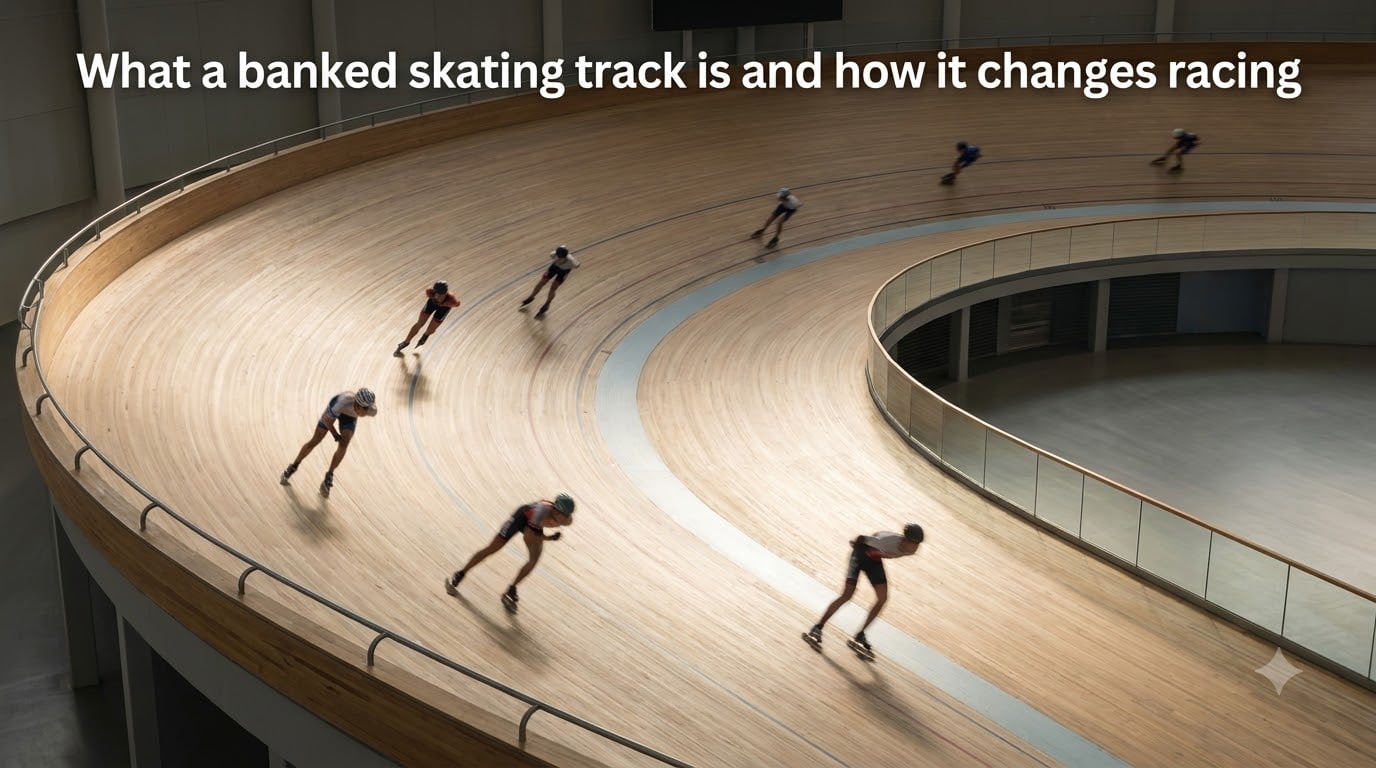
If you have ever watched roller derby or inline speed skating and noticed that the track curves inward like a bowl, you were looking at a banked skating track. That angled surface is not just for show. It changes how fast skaters move, how they block, how penalties work, and even which direction they are allowed to skate. I have spent years around both flat and banked track racing, and the differences go far deeper than most newcomers expect.
In this guide, I will break down exactly what a banked skating track is, why the banking angle matters, and how it transforms racing compared to a flat surface. Whether you are a skater thinking about transitioning, a fan trying to understand the sport better, or just curious about the physics, you will find clear answers here.
We will cover the science behind the banking, the rule differences that catch flat track skaters off guard, and practical tips from real skaters who have made the switch. Let us start with the basics.
Table of Contents
What Is a Banked Skating Track?
A banked skating track is an oval racing surface where the turns are inclined upward at an angle, rising from the inner edge to the outer edge. This design lets skaters lean into corners and maintain speed instead of fighting centrifugal force on a flat surface. The banking angle on most roller derby banked tracks ranges between 10 and 45 degrees depending on the venue and intended use.
The purpose of a banked track is simple: it helps skaters carry more velocity through turns. On a flat track, a skater heading into a curve must lean inward and push against lateral force to avoid drifting wide. On a banked surface, the incline itself does part of that work. The slope pushes back against the outward force, so the skater spends less energy fighting the turn and more energy driving forward.
Banked tracks are most commonly associated with roller derby, particularly the original banked track format that dates back to the 1930s. They are also used in inline speed skating and quad speed skating events. The surface is typically made of polished wood, composite panels, or coated concrete, and the entire oval usually measures around 80 to 100 feet in length for derby use.
One thing that surprises many first-time spectators is how steep the banking actually feels in person. Standing at the top of the curve, you realize skaters are essentially riding along a tilted wall. That tilt is what makes banked track racing faster, more physical, and visually distinct from anything you see on a flat surface.
How a Banked Skating Track Changes Racing?
A banked skating track changes racing in five major ways: it increases speed through turns, eliminates the back-and-forth skating pattern, alters how blockers position themselves, modifies the penalty system, and restricts skating direction. Each of these shifts the entire flow of a race or bout.
On a flat track, skaters constantly move forward and backward, weaving in and out of the pack. Banked track racing removes much of that. Because the track is narrow and the banking makes stopping and reversing awkward, the action stays in continuous forward motion. This creates a faster, more relentless pace.
The blocking strategy changes too. Skaters who have played both formats often mention that banked track relies heavily on flat walls — solid lines of blockers holding position together. The combination of speed and banking means positional blocking is more about holding ground than chasing opponents around the track.
Penalties also work differently. On a banked track, skating in the non-derby direction is immediately penalized, whereas flat track allows more movement freedom. Penalized skaters sit out an entire jam rather than serving a timed penalty in the box. These rule differences fundamentally change how teams manage risk and strategy.
The Physics Behind Track Banking
To understand why a banked skating track produces faster racing, you need to look at the physics. The key concept is centrifugal force — the outward push a skater feels when moving through a curved path. On a flat surface, that force tries to pull the skater wide on every turn, and the skater must lean inward and grip with their wheels to resist it.
A banked track counters centrifugal force through its incline. When the track surface tilts upward toward the outside of the curve, the slope itself supplies the resistance that the skater would otherwise have to generate through lean and edge control. The banking angle essentially transforms part of the skater’s downward weight into a force that keeps them pressed into the curve rather than sliding outward.
This matters because of force application. On a flat track, a skater turning at high speed must direct significant effort sideways just to stay on course. On a banked surface, more of that effort can go directly into forward propulsion. The result is that skaters maintain higher velocity through turns without needing extra exertion.
Indoor banked tracks in other sports have demonstrated speed improvements of roughly 1 to 2 percent compared to flat surfaces. While that may sound small, in competitive racing a 2 percent gain can translate to several meters over a single lap. Over a full race, the advantage compounds.
The banking angle also affects the optimal turn radius. Steeper banking allows tighter turns at speed, which is why high-speed oval tracks tend to have more aggressive inclines. Roller derby tracks typically use a moderate banking angle that balances speed with the physical contact and pack dynamics the sport requires.
Banked vs Flat Track: Key Differences
The difference between banked track and flat track comes down to surface design, speed potential, skating direction rules, penalty mechanics, and blocking strategy. Here is how they compare across the categories that matter most to skaters and fans.
| Feature | Banked Track | Flat Track |
|---|---|---|
| Surface Design | Inclined oval, 10-45 degree banking | Flat marked oval on floor |
| Speed Potential | Higher — banking reduces lateral force | Lower — skaters fight centrifugal force |
| Skating Direction | Forward only — reverse is a penalty | Forward and backward allowed |
| Penalty Serving | Sit out the entire jam | Timed penalty in the box |
| Blocking Style | Flat walls and positional holding | More chasing and dynamic movement |
| Pace of Play | Continuous forward motion | Back-and-forth within the pack |
As the table shows, banked track is not just a flat track tilted on its side. The banking changes the physics, the rules, and the tactics. Skaters who switch between the two formats often say the banked version feels faster and more intense, while flat track feels more strategic and free-flowing.
Skating Technique on a Banked Track
Skating technique on a banked track differs from flat track in ways that catch even experienced skaters by surprise. The biggest adjustment is learning to trust the banking. On a flat surface, you control every degree of lean. On a banked track, the surface leans for you, and fighting it slows you down.
The continuous forward motion is another shift. Flat track skaters are used to stopping, reversing, and circling back to reposition. Banked track penalizes skating in the non-derby direction, so you must plan your positioning proactively rather than reacting after the fact. Skaters who have made this transition say it took them several sessions to stop instinctively turning backward.
Crossing the infield is also restricted on a banked track. The elevated surface means there is a clear boundary between the track and the interior, and cutting across is not the same as stepping over a taped line on flat ground. New banked track skaters need to develop spatial awareness specific to the elevated oval.
Finally, the speed changes how you approach contact. Because everyone is moving faster and the track is narrower, collisions happen at higher velocity. Skaters need stronger edges, better balance recovery, and more confidence holding position under pressure. This is why many banked track leagues emphasize fundamental stability before letting new skaters enter full-contact jams.
Penalty System Differences
The penalty system on a banked track differs from flat track in three important ways: direction penalties, how penalties are served, and the impact on team strategy. These differences are among the first things that trip up skaters transitioning between formats.
On a banked track, skating in the non-derby direction is an immediate penalty. Flat track allows skaters to move backward within the pack, but banked track does not. This rule exists because the banking and narrow width make reverse skating dangerous at the speeds involved. The directional restriction keeps the flow of play moving forward at all times.
Penalty serving also works differently. On flat track, a penalized skater goes to the penalty box for a set time — typically 30 seconds — and then returns to play. On a banked track, a penalized skater sits out the entire jam. This means penalties carry more weight strategically, since a single penalty can remove a key skater for the remainder of a scoring period.
The cumulative effect is that banked track teams tend to be more conservative with risky plays. Because every penalty costs a full jam rather than half a minute, the strategic cost of fouling is higher. Teams that play clean, positional defense tend to perform better than those that rely on aggressive, penalty-prone tactics.
Equipment Considerations for Banked Track
Banked track skating calls for equipment that can handle higher speeds, harder contact, and the demands of an inclined surface. While much of your flat track gear will carry over, a few specific upgrades make a real difference.
Wheels are the most important consideration. The polished surface of a banked track typically offers more grip than a flat sport court, so skaters often switch to slightly harder wheels to avoid bogging down in the turns. Finding the right durometer depends on the specific track surface, your weight, and your skating style.
Quad skates are standard for roller derby on both track types, but inline skates are more common in banked speed skating disciplines. The boot stiffness and plate configuration matter more on banked tracks because the forces involved are greater. A stiffer setup helps transfer power efficiently when you are leaning into a banked curve at full speed.
Protective gear is equally important. The higher impact speeds on banked track mean that quality knee pads, elbow pads, wrist guards, and a certified helmet are non-negotiable. Many banked track skaters also use padded shorts or crash pants because falls on an inclined surface can send you sliding into the railing.
Transitioning From Flat Track to Banked Track
If you currently skate flat track and want to try banked track, the good news is that the learning curve is manageable. Skaters who have made the switch consistently report that once you adjust to the banking and the directional rules, your existing skills transfer well.
Here are the steps that experienced transition skaters recommend:
Step 1: Skate the track slowly first. Before attempting any drills or contact, spend time just skating laps at a comfortable pace. Feel how the banking supports your turns and practice letting the surface do the work instead of forcing your lean.
Step 2: Practice stopping and starting on the incline. Stopping on a banked surface feels different because gravity is working with and against you depending on where you are on the curve. Master your stops before adding speed or other skaters into the mix.
Step 3: Learn the directional rules. Drill yourself to never turn backward. This is the most common penalty for transitioning flat track skaters, and breaking the habit takes conscious repetition. Skate with a partner who can call you out when you instinctively reverse.
Step 4: Build up to contact gradually. The higher speeds on banked track mean hits land harder. Start with light positional blocking before progressing to full-contact jams. Give your body time to adapt to the new forces.
Step 5: Watch experienced banked track skaters. Study how they hold their edges, where they position themselves in the pack, and how they use the banking to their advantage. Visual learning accelerates the physical transition significantly.
One insight that came up repeatedly in community discussions: skaters who train on banked tracks often develop skills that make them better flat track skaters too. The edge control, balance, and speed awareness you build on the banked surface carry over and sharpen your overall skating.
A Brief History of Banked Track Racing
Banked track roller derby is the original format of the sport. When roller derby emerged in the 1930s as a televised spectacle, it was played on banked tracks designed to maximize speed and visual drama. The inclined surface made the action faster and more intense, which was exactly what audiences wanted.
For decades, banked track was the only form of roller derby. It was not until the early 2000s revival that flat track derby emerged as a more accessible alternative. Flat tracks could be set up on any smooth floor, required no specialized construction, and allowed the sport to spread to cities and communities that could never build a banked oval.
Today, both formats thrive. Flat track dominates in terms of the number of leagues worldwide, largely because of its low barrier to entry. Banked track remains the faster, more physical format and carries the historical weight of being the original version of the sport. Many top flat track skaters got their start on banked tracks, and the skills developed there are widely respected across the derby community.
Frequently Asked Questions
Do you skate faster on a banked track?
Yes. The banking angle counteracts centrifugal force on turns, allowing skaters to maintain higher speeds without fighting lateral drift. Banked tracks typically produce speeds 1 to 2 percent faster than flat surfaces, which compounds over a full race.
What is the purpose of a banked track?
The purpose of a banked track is to help skaters carry more speed through turns. The inclined surface reduces the lateral force skaters must overcome, letting them direct more energy into forward propulsion rather than fighting to stay on their line.
What is the difference between banked track and flat track?
Banked tracks have inclined turns (10-45 degrees), higher speeds, forward-only skating direction, full-jam penalty serving, and flat-wall blocking. Flat tracks are level surfaces that allow backward skating, timed penalties, and more dynamic movement within the pack.
Why is skating in the wrong direction a penalty on a banked track?
The narrow width and high speeds of banked track racing make reverse skating dangerous. The banking is designed for forward motion, and skating the wrong direction risks collisions. Flat track allows backward movement because the surface and slower speeds make it manageable.
Is banked track roller derby more dangerous than flat track?
Banked track generally involves higher speeds and harder impacts due to the banking and continuous forward motion. However, the directional restrictions and positional blocking style reduce some types of chaotic contact. Proper protective gear and gradual skill progression manage the risk effectively.
Conclusion
A banked skating track is an oval racing surface with inclined turns that reduces centrifugal force, allowing skaters to carry more speed and apply more power into forward motion. It changes racing by increasing velocity, eliminating back-and-forth skating, altering blocking strategy, modifying penalty systems, and restricting skating direction. Whether you are a skater considering the switch or a fan deepening your understanding, the banking is what makes this format faster, more physical, and historically significant. If you want to experience it yourself, find a local banked track league and ask about open skate sessions — most welcome newcomers and offer guided introductions to the surface.