
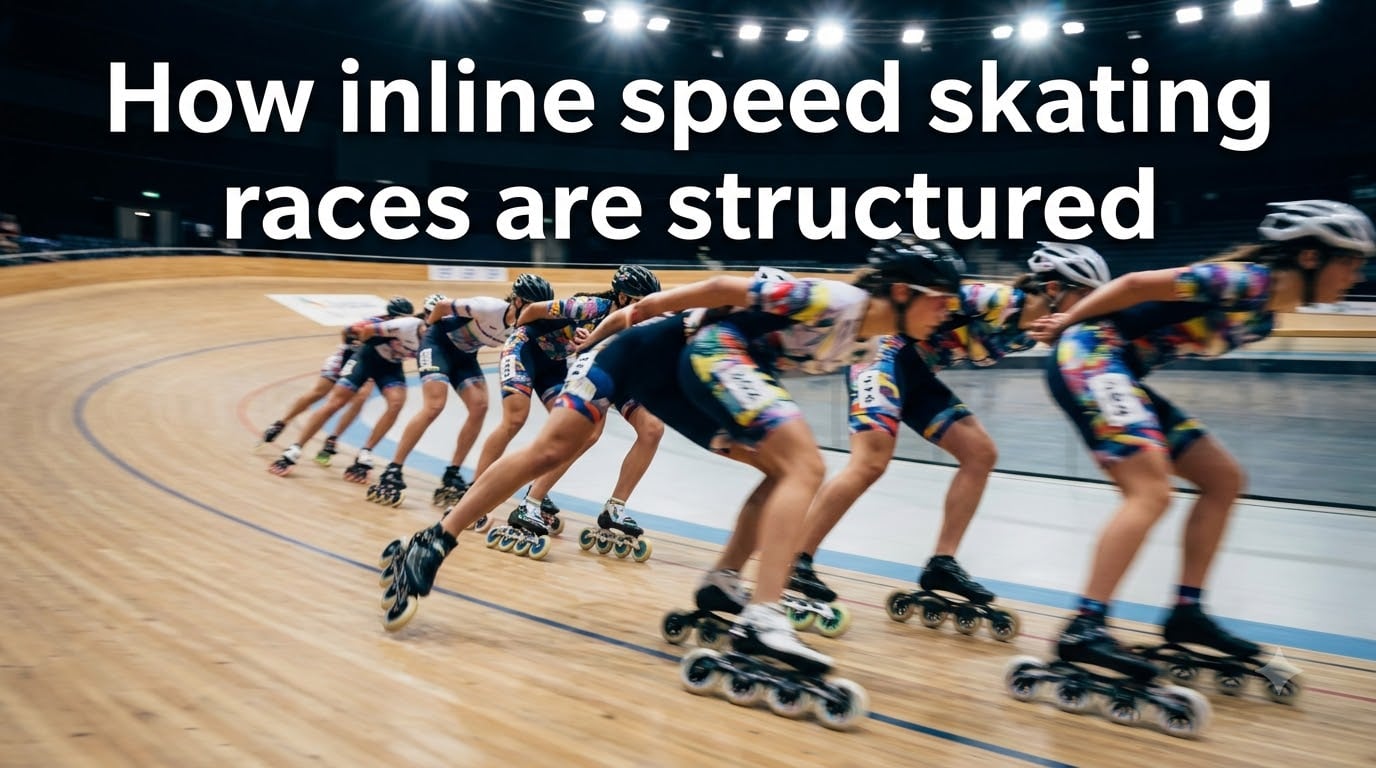
If you have ever watched a pack of skaters blur past in a tight formation at 35 mph and wondered how the whole thing actually works, you are in the right place. Understanding how inline speed skating races are structured opens up a sport that combines raw sprint power with endurance tactics, team strategy, and precise rule sets governed by World Skate, the international federation for roller sports.
Inline speed skating races are organized into three primary formats: time-trial, pack style, and marathon. Each format breaks down further into specific distances, start types, and progression systems that determine who advances and who takes home the medal.
In this guide, our team breaks down every layer of race structure so you can follow a meet from the first heat to the final bell lap. Whether you are a parent of a new skater, an adult looking to enter your first marathon, or a fan trying to understand the sport, this breakdown covers it all.
Table of Contents
What Is Inline Speed Skating?
Inline speed skating is a competitive roller skating discipline where athletes race on inline skates (typically three to five wheels in a line) across a range of distances and formats. Skaters wear aerodynamic skinsuits, protective helmets, and specialized boots mounted on lightweight frames with large wheels designed for maximum speed.
The sport is governed internationally by World Skate, which sets the rules for race formats, track standards, equipment regulations, and competition progression. In the United States, USA Roller Sports (USARS) serves as the national governing body, organizing sanctioned meets and selecting athletes for international competition.
Race meets are typically structured so that skaters from numerous age groups compete in three or four distances over the course of a day or weekend. This multi-event format means a single skater might race a 300m time trial in the morning, a 1000m pack race after lunch, and a relay in the evening.
How Inline Speed Skating Races Are Structured: The Three Race Formats
Every inline speed skating competition falls into one of three core formats. Each format uses different rules for starting, scoring, and determining winners.
1. Time-Trial Format: Skaters race individually or in pairs against the clock. The fastest time wins. There is no drafting, no pack tactics, and no direct interaction with competitors. This format pure-tests speed, technique, and pacing over a set distance.
2. Pack Style (Mass Start) Format: All skaters in a heat start together and race as a group. Drafting, positioning, and tactical decisions determine the outcome as much as raw fitness. Most mid-distance and long-distance events use pack style racing.
3. Marathon Format: A mass-start race covering 42.195 km (the standard marathon distance), typically held on closed road circuits. Marathons blend endurance, fueling strategy, pack dynamics, and breakaway tactics into a single grueling event.
Within these three formats, organizers layer in specific rules. Pack style events may use elimination rules, points sprints, or straightforward first-across-the-line scoring. Time trials may be solo or dual (two skaters on the track simultaneously). Marathons may be standalone events or the finale of a multi-race weekend.
Sprint Distances: 100m, 200m, and 500m
Sprint events in inline speed skating test explosive power, reaction time, and top-end speed. These races are short, fast, and intensely tactical in the opening seconds.
100m Sprint
The 100m sprint is the shortest race in inline speed skating. It is a pure acceleration event run from a standing start. Skaters launch off the line, reach peak velocity within the first few strides, and hold maximum speed to the finish.
This event demands a powerful start, a low aerodynamic posture, and flawless technique. Races are often decided by hundredths of a second.
200m Dual Time Trial
The 200m dual time trial puts two skaters on the track at the same time, each racing in a separate lane. The skaters start simultaneously from a standing position and sprint a single lap on a standard 200m indoor track.
Because each skater occupies their own lane with a minimum 2.60m lane width, there is no drafting or physical contact. The fastest overall time across all pairings wins, making this a pure speed test against the clock.
500m Sprint
The 500m sprint bridges pure sprint power with short endurance. On a 200m track, skaters cover two and a half laps. This distance typically uses a mass start, where pack positioning and the ability to hold an inside line through the final turn often determine the winner.
Tactics matter here. Skaters who draft behind a leader to conserve energy, then slingshot past in the final straightaway, frequently beat skaters with higher raw speed who lead from the front.
Middle and Long Distance Events: 1000m to 10000m
As distances increase, the sport shifts from explosive power to sustained speed, tactical awareness, and cardiovascular endurance. Pack racing dominates these events.
1000m Sprint
The 1000m sits at the crossroads between sprint and distance. Skaters cover five laps on a 200m track in a mass-start pack race. The pace is fast enough to demand sprint-level power but long enough that energy management and positioning become critical.
Most 1000m races come down to a final-lap sprint. Skaters jockey for position through the middle laps, then unleash everything in the closing 200m.
1500m
The 1500m extends the tactical dimension further. Over seven and a half laps, pack dynamics intensify. Drafting becomes essential: sitting behind another skater can reduce aerodynamic drag by 20 to 30 percent, allowing the trailing skater to save significant energy.
Breakaways are common in the 1500m. A skater or small group may surge ahead, forcing the main pack to decide whether to chase or let them go.
5000m and 10000m
The 5000m (25 laps) and 10000m (50 laps) are true endurance events. These races often use specialized rules like elimination or points sprints to keep the racing competitive and strategic across a long duration.
On the road circuit, equivalent distances may stretch to 15000m or beyond. Energy conservation, team tactics, hydration, and mental focus all play roles in determining the outcome.
In long-distance pack racing, teams may designate a lead skater and support skaters who shield the leader from wind, chase down breakaways, and set the pace. The final laps typically feature an all-out sprint among the freshest skaters.
Elimination Race Format Explained
The elimination race adds a layer of pressure to pack-style racing. Here is how it works.
Skaters start together as a pack and race a set number of laps. At designated intervals (typically every few laps), a bell signals an elimination lap. On the bell lap, the last skater or last pair of skaters to cross the finish line is eliminated from the race.
This process repeats until only a small group remains, often three to five skaters. That final group then sprints for the win. Elimination races reward skaters who can hold a safe mid-pack position early, avoid getting boxed in on the inside, and have enough speed to stay ahead when the field thins.
The format creates constant tension. Skaters cannot simply sit at the back and wait for a sprint finish, because being last on a bell lap means instant removal. Positioning near the front becomes safer but more energy-intensive, creating a strategic balancing act.
Elimination races are a fan favorite at World Skate events because the shrinking field produces dramatic, head-to-head racing in the closing laps.
Points Race Scoring System
Points races layer a scoring system on top of pack-style racing. Instead of (or in addition to) a final sprint finish, skaters earn points on designated intermediate laps throughout the race.
Here is how the points race works in practice. Every few laps, a bell signals a points sprint lap. The first skater across the line on that sprint lap earns the most points, with decreasing points awarded to the next finishers (for example, 5-3-2-1 for the top four).
The skater who accumulates the most points across all sprint laps wins the race. If two skaters are tied on points, the higher finisher in the final sprint typically wins the tiebreak.
Points races reward versatility. A skater needs the endurance to survive the full race distance, the sprint speed to win or place in intermediate sprints, and the tactical intelligence to be in the right position at the right moment.
A variation called the points-elimination race combines both systems. Skaters are eliminated periodically, and points sprints occur on separate laps. This hybrid format tests every aspect of a skater’s ability.
Team Relay Format
Relay events bring team strategy into inline speed skating. Teams typically consist of two to four skaters who take turns racing, with exchanges occurring through physical contact rather than baton passes.
The two primary relay exchange methods are:
Push with hands: The incoming skater approaches from behind and pushes the outgoing skater on the lower back or hips with both hands, transferring momentum. This is the most common exchange method in track relays.
Hip relay: The incoming skater grabs the hip of the outgoing skater and slings them forward. This technique requires precise timing and trust between teammates.
Relay distances vary by competition level and category. World Skate rules specify standard relay distances including 3000m for women, 5000m for men, and 2000m for mixed teams. The team whose final skater crosses the line first wins.
Relay racing demands more than individual speed. Teams must coordinate exchange timing, position the outgoing skater correctly, and avoid collisions with other teams in the exchange zone. A botched exchange can cost several seconds and end a team’s medal chances.
Marathon Distance Racing (42.195 km)
The inline speed skating marathon covers exactly 42.195 kilometers, matching the standard running marathon distance. These races are typically held on closed road circuits, though some take place on large outdoor tracks.
Marathons use a mass start, meaning the entire field begins together. Elite fields may include 50 to 100 skaters, while amateur marathons can draw several hundred participants across multiple waves.
The race unfolds in phases. The early kilometers are about establishing position and conserving energy in the pack. The middle section often features breakaway attempts and tactical maneuvering. The final 5 to 10 kilometers turn into a strategic battle, with teams setting up their sprinters for a final push.
Drafting is the defining tactical element of marathon racing. A skater sitting in the middle of a pack expends far less energy than one leading into the wind. Over 42 km, this energy savings is enormous, which is why the eventual winner often comes from deep in the pack rather than the front.
Notable marathon skaters like Bart Swings have built careers on mastering this combination of endurance, sprint speed, and race intelligence. The community atmosphere at inline marathons, from the NorthShore Inline Marathon in Duluth to the Berlin Inline Marathon, makes them a highlight of the racing calendar.
Heats and Finals: How Skaters Advance
One of the most confusing aspects for newcomers is how skaters progress through a competition. Here is the step-by-step breakdown.
When a race has more entrants than the track can safely accommodate, skaters are divided into heats. Each heat is a separate race run over the full distance. The top finishers from each heat, plus a set number of fastest remaining times (called “lucky loser” spots), advance to the next round.
The progression typically follows this path:
Step 1: Quarterfinals (Heats). The full field is split into multiple heats. Top finishers in each heat advance.
Step 2: Semifinals. Advancing skaters from the quarterfinals are re-seeded into fewer semifinal heats. Again, top finishers advance.
Step 3: Finals. The remaining skaters race in the final. In large events, an A-final determines the medalists, while a B-final ranks the remaining skaters.
The number of heats and rounds depends on the field size and the distance. Sprint events with large fields may have four or five rounds, while longer distance events with fewer entrants may go straight to a final.
For time trials, advancement is simpler: every skater posts a time, and the fastest times advance. No heats are needed, though the top qualifiers may be seeded into an A-final for placement.
Track Types: Indoor, Outdoor, and Banked Tracks
The surface a race is held on shapes everything about how it unfolds. Inline speed skating uses three main venue types.
Indoor Track (200m)
The standard indoor track is a 200-meter oval, typically laid on a polished wood or synthetic surface inside a sports hall. The minimum lane width is 2.60m, and the track is flat (not banked). Indoor tracks host sprint and mid-distance events at World Skate championships.
Indoor racing emphasizes tight cornering, quick acceleration out of turns, and precise lane discipline. The smooth, controlled surface allows skaters to maintain high cadence and use technical wheel setups.
Outdoor Road Circuit
Road races take place on closed asphalt or concrete circuits, often 400 meters or longer per lap. Road courses may feature gentle elevation changes, wider lanes, and longer straightaways compared to indoor tracks.
Marathons and long-distance events commonly use road circuits. The larger surface area accommodates bigger fields, and the longer laps create different tactical rhythms. Road surfaces also demand harder wheel compounds for durability.
Banked Track
A banked track features corners that slope upward, allowing skaters to maintain higher speeds through turns without sliding outward. Banked tracks are less common in inline speed skating than in ice short track but appear at some high-level facilities.
The banking allows for faster racing and different line choices. Skaters can ride high on the banking to set up a wider, faster entry into the straight, or stay low to cover less distance.
Start Types in Inline Speed Skating
How a race begins shapes the entire event. Inline speed skating uses several distinct start types.
Standing Start
The standing start is the most common start in inline speed skating. Skaters line up behind a start line in a staggered formation, stationary, with one skate behind the line. On the starting signal (a gun or whistle), they push off and accelerate.
Standing starts are used for sprints, pack races, and time trials. Reaction time and the first three strides often determine who reaches the first corner in the lead.
Dual Time Trial Start
In dual time trials, two skaters start simultaneously from different points on the track, each in their own lane. They race against the clock rather than each other, though the visual of a skater across the track adds a competitive element.
The 200m dual time trial is the signature event using this format. Skaters are seeded so that faster skaters start in later pairings.
Mass Start
Mass starts begin with all skaters in a heat lined up together behind a single start line. The gun fires once, and everyone accelerates as a group. Mass starts are used for pack-style racing, points races, elimination races, and marathons.
The first few seconds of a mass start are chaotic. Skaters jostle for position, trying to reach the first corner without getting trapped at the back of the pack.
Age Group Divisions in Competition
Inline speed skating welcomes competitors across a wide age range. Competitions are divided into age-group categories to keep racing fair and developmentally appropriate.
Typical age divisions include the following categories, though exact age ranges vary by federation and event:
Youth divisions cover the youngest competitors, often starting around age 6 or 7. Distances are shortened, and the focus is on skill development and fun.
Junior divisions cover teenage skaters, typically ages 12 to 17. Junior racing introduces full-distance events and more complex tactical formats.
Senior (Elite) divisions are for skaters roughly 18 and older competing at the highest level. Senior events at World Skate championships represent the peak of the sport.
Master divisions cater to adult skaters who continue competing beyond the elite window, often starting around age 30 or 35. Master racing is popular at national and regional meets, keeping lifelong skaters engaged in competition.
At most meets, skaters from multiple age groups race the same distances in separate flights. This structure lets an entire family compete on the same day, with parents racing masters while kids race youth divisions.
Frequently Asked Questions
How do speed skating races work?
Inline speed skating races work by grouping skaters into heats that advance through semifinals to finals. Three main formats exist: time-trial (racing against the clock), pack style (mass start where positioning and drafting matter), and marathon (42.195 km endurance events). Winners are determined by fastest time, first across the line, or accumulated points depending on the format.
What is the format for speed skating competition?
Speed skating competitions follow a structured format: skaters enter events by distance and age group, race in heats with top finishers advancing to semifinals and finals, and compete in one of three race types. Time-trials test pure speed against the clock, pack style races use mass starts with drafting tactics, and marathons cover 42.195 km on road circuits. Most meets include multiple distances so skaters can compete in several events.
Why is inline skating not an Olympic sport?
Inline speed skating is not currently an Olympic sport despite repeated bids for inclusion. The International Olympic Committee has cited factors including limited global participation depth, the existing presence of ice speed skating, and constraints on the total number of events. World Skate continues to advocate for inclusion, and roller speed skating has appeared in other multi-sport events like the Pan American Games and the World Games.
How fast can the average person go on inline skates?
A recreational inline skater typically reaches speeds of 8 to 15 mph on flat ground. Experienced fitness skaters can sustain 15 to 20 mph. Elite inline speed skaters hit sprint speeds of 30 to 35 mph and maintain average race paces above 25 mph over marathon distances, especially when drafting in a pack.
At what age do speed skaters peak?
Most inline speed skaters reach their competitive peak in their mid-to-late 20s, though elite skaters often remain competitive into their early 30s. Sprint specialists may peak slightly younger, while endurance and marathon skaters can extend their peak longer due to the aerobic demands of longer events. Many masters skaters continue racing competitively well into their 40s and 50s.
Are inline skates hard for beginners?
Inline skates have a learning curve but are accessible to most beginners with proper instruction. Starting with a staggered stance, learning to brake safely, and practicing on smooth flat surfaces builds confidence quickly. Most beginners can skate comfortably within a few sessions. Joining a local club accelerates learning through coached drills and group support.
Wrapping Up: Understanding Race Structure
Understanding how inline speed skating races are structured transforms watching from a blur of wheels into a readable, tactical sport. The three core formats (time-trial, pack style, and marathon) each create distinct racing, from the solo precision of a 200m dual time trial to the chaos of a 100-skater mass-start marathon.
Layered on top are the details that make each event unique: elimination rules that trim the field lap by lap, points sprints that reward consistent positioning, relay exchanges that demand trust and timing, and the progression from heats through semifinals to the final sprint.
If you want to experience the sport firsthand, the best next step is finding a local club through USA Roller Sports or your national federation. Most clubs welcome newcomers, loan equipment for first sessions, and provide coaching that covers starts, pack positioning, and race strategy.
Once you understand the structure, every race becomes more exciting to watch and more rewarding to skate.