
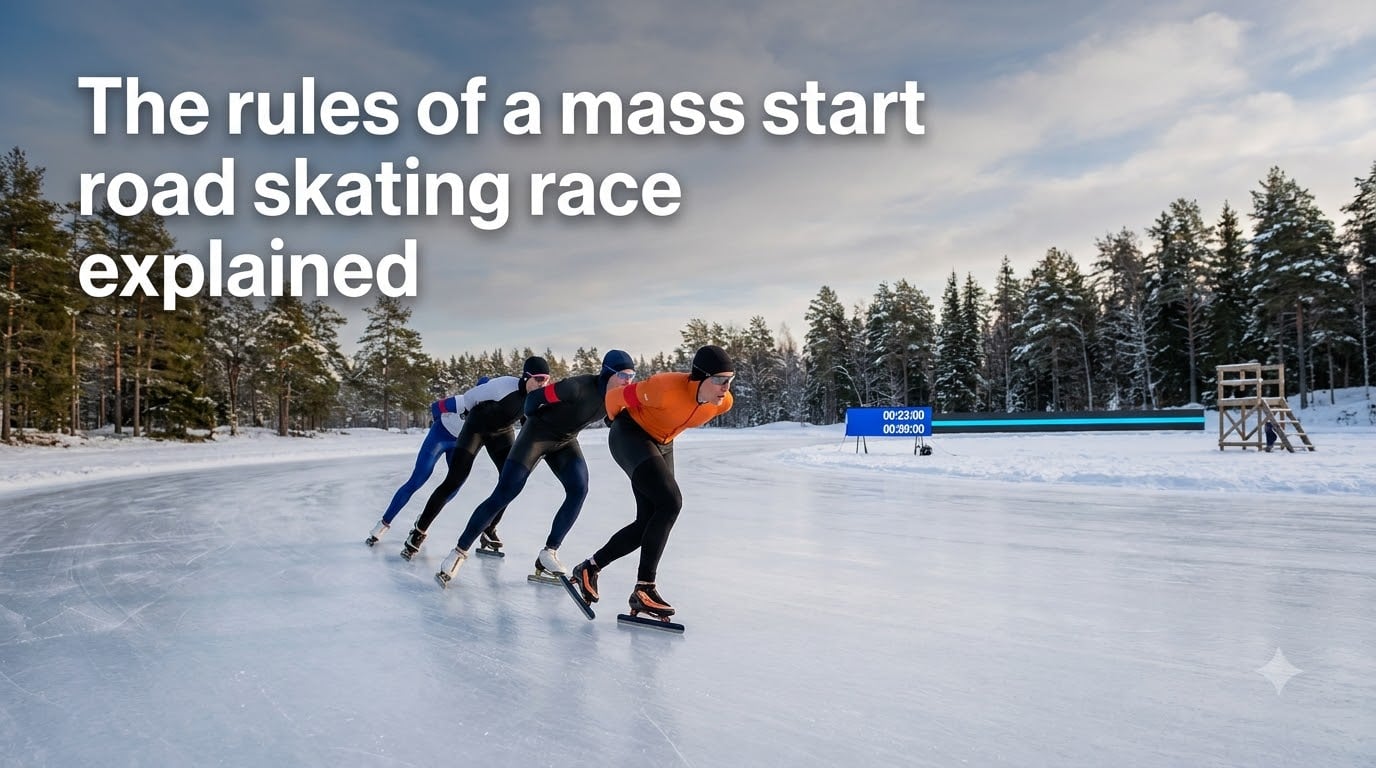
If you have ever watched a long track speed skating event and wondered why everyone crosses the line together, you are not alone. The mass start road skating race is the format that breaks the mold. Instead of two skaters racing the clock in separate lanes, you get 16 to 24 skaters charging around the oval shoulder to shoulder. It looks chaotic, it looks fast, and it pulls in athletes from inline skating, marathon racing, and traditional long track all at once.
I have spent weeks breaking down the rules, watching race footage, and digging into how this format actually runs at the World Cup and Olympic level. In this guide I will walk you through exactly what mass start road skating means, how the points and sprints work, what tactics matter, and where this event came from. By the end you will be able to watch a final and predict what is about to happen.
One quick note before we dig in. The mass start is sometimes called “mass start road skating” or “mass start speed skating” depending on context. For the purposes of this article I will use both terms interchangeably, since the same rules apply whether you are watching an ISU World Cup event, an Olympic final, or a regional championship run under international standards.
Table of Contents
What Is the Mass Start Road Skating Race?
The mass start road skating race is a pack-style long track speed skating event where every competitor starts at the same time and races together. Skaters cover 16 laps of a 400 meter oval, and the first skater to cross the finish line wins. It is the only long track discipline that rewards head-to-head racing instead of time trial performance.
Traditional long track events, like the 500m or 1500m, send skaters out in pairs racing against the clock. Each skater stays in their own lane on the inner and outer part of the oval, switching sides only on the back straight. The mass start throws all of that out the window. Every participant lines up on the starting line together, and from the first stroke the pack is moving as one.
This is what gives the mass start its character. You see jostling for position, slingshot moves, and a peloton that breathes together. The format was built to make long track speed skating more accessible to fans who love the tactical chess of cycling and marathon running. It also opened the door to athletes whose backgrounds come from inline skating, where pack racing is the default.
The format sits somewhere between a time trial and a marathon. The distance (6.4 kilometers) is short enough to allow sustained speed, but long enough that strategy and energy management decide outcomes. Athletes cannot simply sprint for 16 laps, so they spend the first half of the race reading each other and protecting position.
Another key distinction is track usage. In standard long track events, skaters are restricted to inner and outer lanes. In mass start, they can use the full width of the oval. This is why mass start races often look more like road cycling than conventional skating. Skaters cut diagonals, fan out on the straights, and squeeze together on the curves.
How the Race Format Works?
The race format of a mass start road skating event follows a strict structure set by the International Skating Union. Each race covers 16 laps, which equals 6.4 kilometers for men and women on a standard 400m oval. The maximum field size is 24 skaters, and most major finals start with exactly 16 skaters after qualifying rounds trim the field.
Here is how the race is organized from start to finish:
Starting line: All skaters line up behind a line on the inner edge of the track, similar to a running race start.
The rolling lap: The first lap is treated as a controlled rolling start. Skaters pace around the curve at moderate speed to settle the pack and avoid early crashes.
The green flag: After the first lap, the race officially begins and skaters can sprint, attack, or hold position as they choose.
The pack: For the next 14 laps, the field stays roughly bunched together. Breakaways are allowed but hard to sustain.
The finish: On lap 16, the race ends when the leader crosses the finish line. Skaters are ranked in the order they finish.
The rolling lap rule matters more than most casual viewers realize. Without it, you would see 24 skaters fighting for the inside line at full speed, which would cause dangerous pileups on the tight curves. Limiting the first lap to controlled pace keeps the field orderly and sets up the real racing on laps two through sixteen.
Skaters also use more of the track than in traditional long track. While standard events restrict skaters to the inner and outer lanes, mass start allows full use of the entire ice surface. You will see skaters cut across the middle on the curves to save distance, which is another reason it looks and feels different.
Most championship weekends run two semifinal heats of up to 24 skaters each. The top finishers from each semifinal advance to a final of 16. This means a skater needs to survive at least two races over the weekend to reach the medal round, and the cumulative fatigue makes energy management even more important.
Penalties do exist, though they are rare. A skater who dangerously blocks another, intentionally causes contact, or crosses into an unsafe line can be disqualified by the referee. In Olympic finals, the racing has historically been clean, with most contact coming from incidental bumps rather than deliberate fouls.
Intermediate Sprints and Points System
The points system is what gives a mass start road skating race its tactical depth. During the race there are three intermediate sprints and one final sprint, and each awards points based on finishing order. These points decide not only who wins medals in some races, but also who advances from semifinals to finals at championships.
The standard points distribution looks like this:
Intermediate sprint at lap 4: 3 points to first, 2 points to second, 1 point to third.
Intermediate sprint at lap 8: 3 points to first, 2 points to second, 1 point to third.
Intermediate sprint at lap 12: 3 points to first, 2 points to second, 1 point to third.
Final sprint at lap 16: 60 points to first, 40 to second, 20 to third, 10 to fourth, 6 to fifth, and 3 to sixth.
That huge jump in the final scoring (60 points compared to 3) is intentional. It makes the final sprint the deciding moment in most races, while still rewarding skaters who were aggressive throughout. If a skater sweeps all three intermediate sprints, they earn 9 points. That is meaningful, but it cannot overcome a skater who simply wins the final sprint and grabs 60 points.
In Olympic finals, the points from intermediate sprints technically still count, but the race winner is determined by finishing position. Whoever crosses the line first takes gold, regardless of how many sprint points they accumulated. This is why you sometimes see skaters ignore the intermediate sprints entirely, conserve energy, and attack only at the end.
During World Cup qualification rounds, however, points matter a lot. Skaters ranked by total points after the intermediates get priority for finals. This forces racers to push for sprints in early rounds and creates two very different versions of how the same race can unfold.
You might wonder why the sprints exist at all if finishing order decides the medals. The short answer is strategy. Intermediate sprints force the pack to stay engaged and prevent the race from becoming a slow tactical procession until the final lap. They also reward versatility. A skater who can both win sprints and finish strong is rare, and the points system highlights that skill.
Forum discussions among fans often point out confusion about what happens if a skater wins all three intermediate sprints but finishes fifth overall. The answer depends on the event. In a World Cup semifinal, their 9 sprint points might still place them high enough in the standings to advance. In an Olympic final, they finish fifth regardless, because medals are awarded on position alone.
Tactics, Drafting, and Race Strategy
Tactics in a mass start road skating race are a mix of cycling strategy and pure skating instincts. The main goal is simple: stay near the front, save energy, and time your final attack. The execution of that goal is anything but simple. Skaters use the peloton, drafting, bluffing, and breakaways to give themselves an edge.
Drafting is the biggest physical lever. When you skate directly behind another skater, you cut wind resistance by a meaningful percentage. Olympic champion Bart Swings has described how drafting in the pack lets him save energy for the final laps. You will see packs where one skater pulls the group for a few laps, then deliberately drops back to let someone else lead. It is cooperative racing, even between competitors.
Breakaways are the dramatic exception. A skater will sprint away from the pack, hoping to build a gap of a few seconds before the leaders decide to chase. Most breakaways fail because the pack works together to close them down. But if the timing is right, the lap counter is near 16, and the pack hesitates, a breakaway can roll all the way to the finish line.
Positioning matters constantly. Being stuck at the back of the pack means you cannot respond quickly to attacks. Being too far forward means you are working against wind resistance all by yourself. The ideal spot is usually second to fourth wheel, where you are close enough to react and sheltered by the leader.
Mind games also play a role. Skaters will fake attacks, change lanes, and make sudden moves to test the nerves of competitors. Some racers bluff by surging forward and then backing off, hoping to draw out another skater who is hiding in the peloton. It is part chess, part sprint, and pure entertainment once you understand the layers.
Teamwork is technically forbidden, since each skater represents their own result. But in practice, skaters from the same nation often cooperate informally. They share pacing duties, block wind for each other, and coordinate attacks. Olympic champions have openly admitted that you try to stay on good terms with everyone, because burning bridges early in the race can cost you help later on.
The transition from lap 12 to lap 16 is where races are won or lost. This is the moment skaters decide whether to chase, attack, or sit in. A common mistake among inexperienced racers is panicking at the first sign of a breakaway and chasing too hard, burning matches they need for the final 400 meters. Veterans will let a small gap form and trust their kick to close it at the line.
Equipment and Safety Requirements
Equipment standards for a mass start road skating race are stricter than for traditional long track events. Because 24 skaters race in close quarters at high speed, the ISU mandates specific protective gear to keep athletes safe during inevitable contact and crashes.
Every skater must wear:
An approved helmet: Hard shell with chin strap, similar to short track speed skating helmets.
Cut-resistant suit: Full body suit made of slash-resistant material to protect against skate blades in a fall.
Cut-resistant gloves or wrist protection: To guard hands during contact and falls.
Standard long track blades: Clap skate design is allowed, with blade length up to 18 inches.
The cut-resistant suit is especially important. It is made from materials like Kevlar or Dyneema that resist slicing from skate blades. Without it, a crash could turn a simple tumble into a serious medical emergency. Mandatory cut-resistant gear was largely adopted in the 2010s and is now standard at every World Cup and Olympic level mass start.
Long track race blades are permitted for traditional skaters. The skates used in mass start events are the same clap-style blades used in the 5000m and 10000m, which means elite inline skaters transitioning to ice need to adjust their stride and balance. Some athletes compete in both formats by switching between inline setups and ice clap skates.
Skin suits are also tightly regulated. They cannot have loose fabric that could snag another skater, and all logos and sponsorship patches must meet ISU size guidelines. This keeps the racing fair and prevents any equipment advantage beyond what the rules explicitly allow.
If equipment fails during a race, the skater generally has to continue without stopping. There is no neutralization or restart for broken blades, which is why pre-race equipment checks are rigorous and why athletes carry backup skates to the warmup area. A snapped blade at lap 14 can end an Olympic medal bid instantly.
History and Evolution of the Mass Start Event
The mass start has roots in inline skating and marathon racing. For decades, long track skating was dominated by time trial formats and individual pursuit races. Inline skating, by contrast, was always a pack sport with tactics, blocking, and team play. When the ISU searched for a more spectator-friendly event, the inline world had the blueprint ready.
The mass start entered the ISU World Cup circuit in the early 2010s and was refined over several seasons. It joined the Olympic program at the 2018 PyeongChang Games for men, and women got their Olympic mass start debut at Beijing 2022. Today it is a permanent fixture of the long track World Cup and a medal event at every Winter Olympics.
The event brought a wave of inline and marathon skaters to long track competition. Athletes like Bart Swings of Belgium, who built his career on inline marathon victories, became Olympic champion on ice. Francesca Lollobrigida of Italy also crossed over from wheels to blades. This crossover changed how the sport is coached, with many national teams now training both inline and ice skaters side by side.
The early years of the format were not always smooth. Initial experiments included both points races and elimination formats, where the last skater across the line on specific laps was pulled from the race. The ISU eventually settled on the points-based format we see today, which balances excitement with athletic fairness. Elimination versions still exist in some inline marathon circuits.
Traditional long track powerhouses initially resisted the mass start. Dutch skaters who grew up on time trial formats were skeptical of pack racing and the chaos that came with it. Over time, that skepticism faded as the event drew bigger crowds and produced dramatic finishes. Today most national federations actively recruit for mass start talent alongside their conventional programs.
Looking ahead, the format continues to evolve. The ISU has tested changes to lap counts, qualifying structures, and sprint point values to balance entertainment with athletic integrity. Expect the mass start to remain a fan favorite at every major long track event, with rule tweaks announced ahead of each Olympic cycle.
Frequently Asked Questions
What are the rules for mass start skating?
The mass start is a pack-style race over 16 laps of a 400m oval. Up to 24 skaters start together, with intermediate sprints at laps 4, 8, and 12 awarding 3, 2, and 1 points. The first skater to cross the finish line at lap 16 wins.
Do points matter in mass start speed skating?
Points matter in qualification rounds and World Cup standings, where skaters are ranked by total points from intermediate sprints. In Olympic finals, finishing order at lap 16 decides medals, so points affect strategy but not the final winner.
How does mass ice skating work?
Skaters line up together on the starting line. The first lap is a controlled rolling start. After that, the field races 16 laps as a pack, with intermediate sprint points at laps 4, 8, and 12. The race ends when the leader crosses the line at lap 16.
How is mass start different from short track speed skating?
Mass start is run on a long track 400m oval with up to 24 skaters. Short track runs on a 111m oval with up to 6 skaters per race. Mass start uses full track width and long track clap blades, while short track uses shorter blades and tighter turns.
Why does the winner need to finish first if they already won the points?
In Olympic finals, finishing position is what determines medals. Intermediate sprint points can break ties or decide rankings, but the gold medal goes to the first skater across the finish line. This is why the final sprint is worth 60 points.
Final Thoughts on Mass Start Road Skating Rules
The mass start road skating race is a fast, tactical, and deeply entertaining format that has reshaped long track speed skating. With 16 laps, up to 24 skaters, and a points system that rewards both aggressiveness and patience, it rewards athletes who can read a race as well as skate one. You now know how the rolling lap works, how intermediate sprint points shape strategy, and why the final sprint carries 60 points.
Next time you tune in to a World Cup or Olympic mass start event, watch for the breakaway attempts at lap 11, the positioning battles at lap 14, and the explosive final sprint at lap 16. You will see exactly why this format has become a fan favorite and a magnet for inline skaters around the world. The rules of a mass start road skating race explained here should give you everything you need to enjoy every lap.