
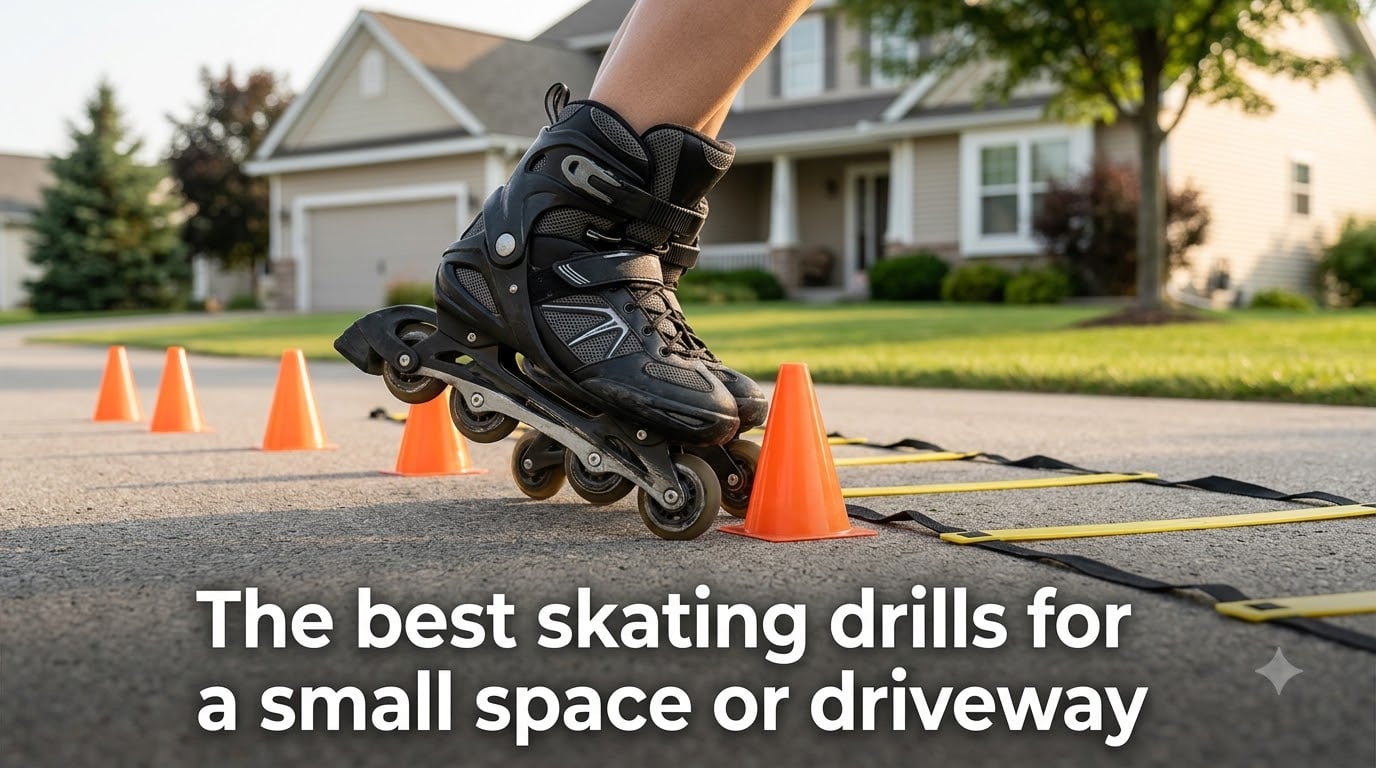
If your “rink” is a strip of driveway or a corner of the basement, you can still build real skating speed and skill. I started training in a single-car garage years ago, and those tight-space drills are still the foundation of my footwork today. The trick is choosing exercises built for short distances, not fighting to recreate full-rink patterns in a 20-foot zone.
This guide covers the best skating drills for a small space or driveway you can run today, whether you’re a hockey player working on edge work in the off-season, a roller skater trying to nail multi-directional agility, or a beginner skating in their first backyard. Every drill here was tested in a residential setting and adjusted for limited room, hard surfaces, and tight turns.
Table of Contents
Why Small Space Skating Drills Work (And When to Use Them)
Limited space forces sharper technique. When you cannot rely on long strides to build momentum, your edges, balance, and quick feet have to do the work. That is exactly what translates to a game, a race, or a crowded roller rink.
I like to think of small area work as “engine tuning.” You are not building top-end speed in the driveway, you are sharpening the gear changes that show up every time you pivot, stop, or accelerate out of a corner. Players who drill this way consistently report better first-step quickness and tighter crossovers within weeks.
Use small space drills when you want to:
- Practice skating at home between rink sessions or team practices
- Maintain edge work during travel, injury recovery off-ice, or summer months
- Build confidence for skaters who feel unsteady at full stride
- Work on multi-directional agility without a partner or full sheet of ice
Equipment You Need for Driveway Skating Drills
You do not need a training facility to get started. Most of what I use in our team’s at-home setup is a mix of off-the-shelf gear and household items.
Here is the short list I recommend:
- Cones or markers: Traditional cones work best, but anything roughly ankle-height works: water bottles, soup cans, taped X marks, or even a row of sneakers.
- Agility ladder (optional): Tape a flat ladder on the driveway with painter’s tape if you do not own one. It blends flat into the surface and provides the same foot pattern cues.
- Stick (for hockey players): Many of these drills involve stickhandling patterns and add a layer of hand-eye coordination.
- Safety gear: Helmet, knee and elbow pads, wrist guards, and a mouthguard. Hard surfaces are unforgiving.
- Smooth surface check: Sweep the area first. One pebble under your wheel or skate can end a session in a single fall.
One tip from r/Rollerskating users that I now swear by: lay a yoga mat or a piece of plywood over a rough asphalt patch to create a smoother transition zone. It is a 30-second fix that prevents most of the “stuck wheel” frustration that drives beginners indoors.
8 Best Skating Drills for a Small Space or Driveway
These are the eight skating drills I run most often in a driveway or garage. Each one is built for a 15 to 25 foot area and can be done in five to ten minutes. Start with the first three as a beginner circuit, then layer in the rest as your foot speed grows.
1. Quick Feet Stop and Start Drill
The single best drill for hockey skating at home. It builds the first-step burst that decides most plays.
- Set two markers 10 feet apart in any open strip.
- Start at the first marker in an athletic stance, knees bent, weight forward.
- Explode forward for 2 to 3 strides, then stop dead on the second marker.
- Reverse immediately and skate hard back to start.
- Repeat 8 to 10 reps, resting 30 seconds between sets.
Focus on a complete stop with both feet perpendicular to your line of travel. Do not slow down into the stop, commit to it.
2. Icky Shuffle Agility Drill
A classic multi-directional agility move borrowed from roller derby. It rewires your footwork for lateral movement in tight zones.
- Place four cones in a line, one skate length apart.
- Face sideways to the line, knees bent.
- Step in front of the first cone with the lead foot, then bring the back foot behind and over.
- Move down the line keeping your shoulders square and hips low.
- Reverse direction. Repeat 4 passes total.
3. Toe Stop Side Steps
If you have roller skates with a toe stop, this is the move that unlocks the entire sport in a small space. Even on inline skates the lateral pattern transfers.
- Stand with feet together, knees soft.
- Shift weight to your right foot and engage the toe stop.
- Step the left foot out to the side, then bring the right foot to meet it.
- Repeat for 10 steps right, then 10 steps left.
- Add a turn at the end of each line for an extra balance challenge.
4. Backwards Crossovers in a Box
Four cones, five by five feet, and a brain-bender that mirrors small area games.
- Lay out a tight square of four cones.
- Skate backwards around the square using crossovers at each corner.
- Maintain shoulder check habits even though no one is chasing you.
- Go counter-clockwise for 30 seconds, then switch.
When I coached 12U last fall, this was the drill that separated the skaters who could play versus the skaters who could just skate.
5. Edge Work Figure Eight
The cleanest way to practice edge work without enough space for full-length weaving. Two cones, six feet apart, and pure ankle control.
- Set two cones in a straight line, six feet apart.
- Skate a figure-eight pattern around them using only inside edges on one loop, outside edges on the other.
- Keep knees deeply bent the entire pass.
- Run three 45-second sets, switching lead foot each round.
6. Multi-Directional T-Drill
T-drills are power skating staples that translate directly to limited space because they only need a T-shape laid out in cones.
- Place four cones in a T shape: one base, three across the top one skate length apart.
- Sprint to the middle top cone, side-shuffle left to the next, touch the cone.
- Side-shuffle right all the way across, touch.
- Side-shuffle back to middle, then backpedal to start.
- Rest, then repeat. Aim for 5 reps.
7. Jump 180 Pivot Drill
This drill is a confidence builder. It teaches skaters that direction changes can happen in zero space, which is half the battle in tight rink corners.
- Mark a single X on the driveway with tape.
- Skate forward toward the X at a moderate pace.
- Two strides out, jump and rotate 180 degrees in the air.
- Land in a backward stance and continue for three strides.
- Repeat 6 to 8 reps per direction.
8. Back Spin Drill
The showpiece drill, and one that needs almost no space at all. Just enough room to rotate.
- Find a flat, clean spot about 4 feet across.
- Start with feet shoulder-width apart, knees bent.
- Rotate the upper body while pulling the front foot back and around.
- Bring the back foot through and complete one full rotation.
- Practice both directions for 10 spins each.
Expect to fall the first few times. That is the point. Hard surfaces teach you to bail safely, which is a real skill.
Beginner vs Intermediate: How to Progress
Most of the questions I see on skating forums come from people unsure whether they are ready to push past the basics. Here is the simple progression I use with younger players and it scales up to adults.
Beginner (first 4 to 6 weeks): Focus on the Quick Feet Stop and Start, the Toe Stop Side Steps, and the Backwards Crossovers in a Box. Run each drill at 50% effort. The goal is balance and clean technique, not speed. Spend 15 minutes per session, three times a week.
Intermediate (weeks 6 and beyond): Add the Icky Shuffle, the Figure Eight, and the T-Drill. Start layering two drills back-to-back with a 60-second rest between them. You should feel your heart rate climb and your ankles start to complain in a healthy way.
Advanced progressions: Once the eight drills above feel automatic, swap in a stick or a tennis ball for added hand-eye work, or time each rep and try to beat last week’s number. That measurable feedback loop is what separates off-ice training from just going through motions.
Safety Tips for Practicing on Concrete and Asphalt
Concrete and asphalt do not forgive mistakes the way rubberized sport surfaces do. A fall on a driveway can end a season. Treat small space drilling like a contact practice for safety purposes.
- Gear up every session. Helmet on, wrist guards on, knee pads on. No exceptions, even for “just five minutes.”
- Check the surface. Sweep first. Cracks, oil spots, standing water, and loose gravel are deal-breakers.
- Avoid extreme temperatures. Asphalt softens in heat and gets slick in cold. Mid-morning on a moderate day is your friend.
- Stay visible to drivers and family. Face the street when doing forward sprints. Have someone watching if you are near a curb.
- Stop when tired. Most driveway injuries happen in the last five minutes of a session when ankles are gassed.
Common Mistakes to Avoid in Small Space Skating Drills
The same coaching mistakes show up over and over, both in person and on skating forums. Here is what to watch for.
Trying to build real speed in a tiny area. You cannot. Stop trying. Driveway drills are about foot speed under control, not top end. Save the speed work for bike sprints or treadmill strides.
Skipping the warm-up. Cold ankles meet hard pavement, then meet the emergency room. Five minutes of marching in place and ankle rotations saves seasons.
Practicing on uneven or slick surfaces. If your driveway is steep, broken, or shaded and damp, pick a different spot. A flat garage floor is better than a dangerous driveway.
Doing random stuff instead of structured drills. Floating around in circles feels productive. It is not. Pick two or three drills from the list above, run them in order, track the reps, then stop.
Frequently Asked Questions
What are the best skating drills to improve speed?
The best skating drills to improve speed in a small space are the Quick Feet Stop and Start Drill and the Multi-Directional T-Drill. Both force explosive first steps without needing long distances. Combine them with bodyweight squats and lunges three times a week for visible speed gains within a month.
Can you practice hockey skating in a small driveway?
Yes. Most power skating coaches now build entire off-season programs around driveways and garage spaces. Stick to multi-directional drills, edge work patterns, and quick feet exercises rather than trying to simulate full-length strides. A 15 by 30 foot area is enough for 80% of the skills you would train at a rink.
How do you practice edges without enough space?
Use circle patterns instead of long arcs. The Figure Eight drill uses two cones six feet apart and locks in inside and outside edges on every pass. Tight crossovers in a small box also build edge strength. Keep your knees deeply bent and your weight over the balls of your feet to make the most of every inch.
What muscles make you skate faster?
Skating speed comes mostly from the glutes, quads, hamstrings, and hip flexors. The core and inner thigh muscles stabilize every push. Off-skate work like squats, lunges, planks, and lateral band walks builds that base, which is why small space drills feel faster once overall lower body strength improves.
Final Thoughts: Building Skills One Square Foot at a Time
The best skating drills for a small space or driveway are not a compromise, they are a sharpener. Used consistently, they build the edges, balance, and quick feet that show up in every game and every rink session.
Pick three drills from the list above, run them twice this week, and track your reps. That is how small space skaters become the most reliable players on their team. The square footage is small. The gains are not.