
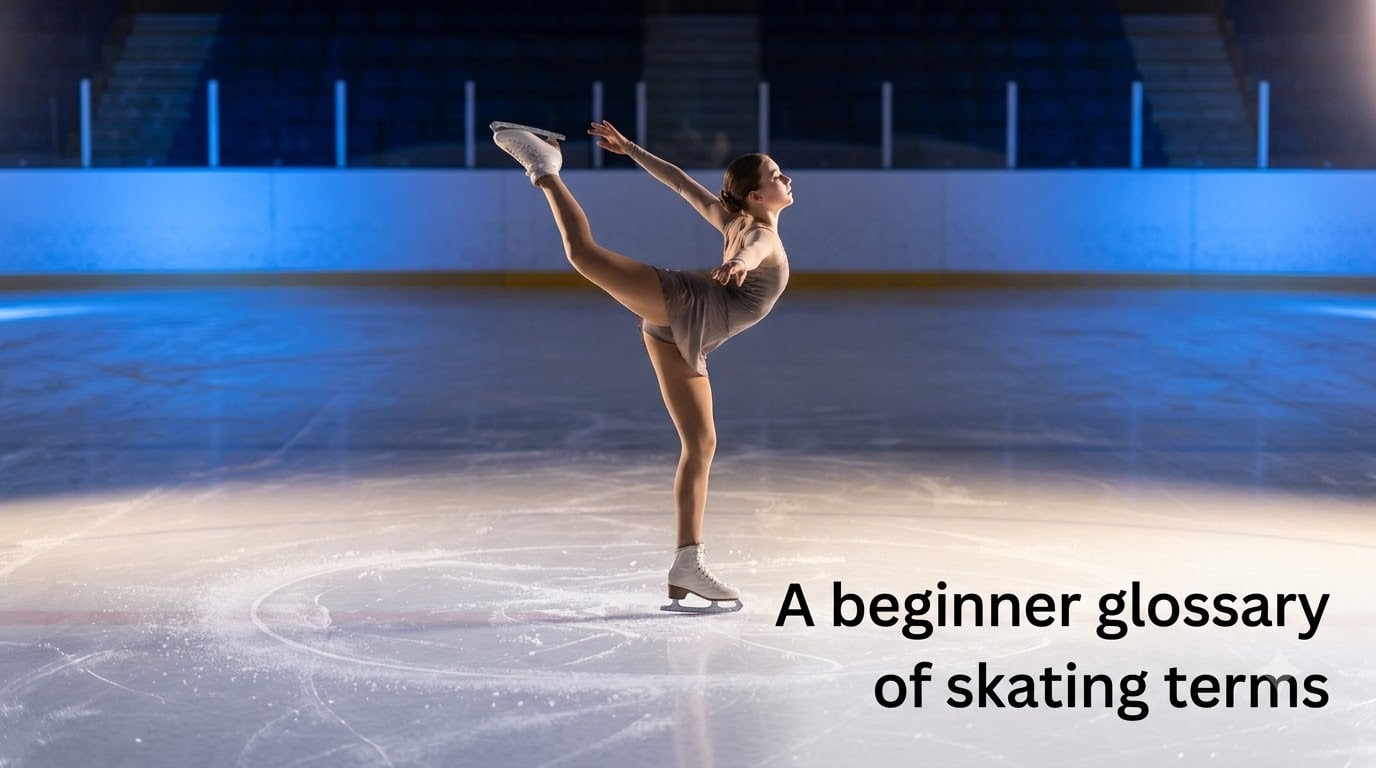
Walking into an ice rink for the first time can feel like landing in a foreign country. Coaches shout about “T-stops” and “crossovers,” commentators mention “triple Lutzes” and “Biellmann spins,” and you nod politely while secretly wondering what any of it means. I have been there, and I built this beginner glossary of skating terms so you do not have to feel lost at the boards again.
In this guide, I will walk you through the most common figure skating terms in plain English. We will cover the foundations first, then jumps, spins, footwork, competition scoring, and even the slang you will hear at the rink. By the end, you will recognize the seven jumps, the main spin positions, and the six basic skating skills that every beginner learns first.
Whether you are an adult learner stepping onto the ice for the first time, a parent supporting a young skater, or a fan trying to follow the next Olympics, this figure skating glossary is your starting point.
Table of Contents
Skating Foundations: The Words You Need First
Before you can talk about jumps or spins, you need a few building-block terms. Coaches use these words constantly, and once you understand them, everything else clicks into place.
Edge refers to the side of the blade that contacts the ice. Every skate blade has two edges. The inside edge is the side curving toward the inside of the foot. The outside edge is the side curving toward the outside. Skaters glide on either an inside or outside edge, and the choice of edge defines almost every move in the sport.
Forward and backward describe the direction you are skating relative to your body. Forward skating means your chest faces the direction of travel. Backward skating means your back faces the direction of travel. Combining direction with edge gives you four basic edge types: forward inside, forward outside, backward inside, and backward outside.
The toe pick is the jagged set of teeth at the front of the blade. New skaters often try to avoid it, but advanced skaters use it deliberately. Toe picks help launch toe jumps and stop forward motion during certain turns. Knowing what the toe pick is for clears up a lot of confusion later.
Your free leg is the leg that is not bearing your weight at any moment. Your skating leg (also called the standing leg) is the one supporting you. Almost every skating term describes what both legs are doing, so understanding this pair is critical.
A crown or rocker describes the curve of the blade from front to back. A flat is the small middle section of the blade where neither edge is engaged. These subtle blade features affect how a turn feels and looks.
Figure Skating Jumps Explained: From Waltz to Axel
Jumps are the most exciting part of any figure skating program, and they have the most colorful names. There are seven standard figure skating jumps, and skaters land them in singles, doubles, triples, and quads. The number in front tells you how many full rotations are completed in the air.
Waltz Jump is the very first jump every beginner learns. It is a half-rotation edge jump taken off the left forward outside edge, and it does not use the toe pick. You will hear it long before you hear any of the others.
Toe Loop uses the right toe pick to launch into the air. It is the simplest toe jump because the takeoff and landing happen on the same edge (right back outside). Most coaches teach it after the Waltz.
The Salchow (pronounced SAL-kow) is named after Ulrich Salchow, who invented it in 1909. It takes off from the left back inside edge and lands on the right back outside edge. The pronunciation is “SAL-kow,” with the emphasis on the first syllable.
The Loop jump takes off and lands on the same edge (right back outside) but uses the toe pick on the entry. It looks similar to the Toe Loop but has a different entry pattern. Pronounce it as the simple English word “loop.”
The Flip takes off from the left back inside edge and uses the right toe pick. It is often confused with the Lutz, which is one rotation away.
The Lutz (pronounced LUTS) takes off from the left back outside edge using the right toe pick. It is one of the hardest jumps because the takeoff edge is counter-rotation and easy to mess up. A skater who accidentally does a Lutz takeoff on the inside edge is called “flutzing.”
The Axel (pronounced AX-el) is the only jump with an extra half rotation, so a single Axel is actually 1.5 turns. It takes off from the left forward outside edge and lands backward. Named after Axel Paulsen, the Axel is considered the hardest single jump in the sport.
Edge jumps include the Salchow, Loop, and Axel. They launch from a gliding edge. Toe jumps include the Toe Loop, Flip, and Lutz. They launch from the toe pick. The Waltz is technically a half-rotation edge jump used to introduce beginners.
When you hear commentators say “triple-triple combination,” they mean two jumps performed back-to-back with no step in between. A combination jump is two or more jumps linked together, and it counts as a single element in the score.
Spins Glossary: Every Spin Position Defined
Spins are rotations on one foot at the center of the rink. They are judged on speed, control, position, and number of rotations. Three basic positions cover almost every spin a beginner will see or learn.
Upright spin is the starting position for new skaters. The body stands tall with the spinning leg straight or slightly bent. The free leg can be held in many ways, giving the upright spin many looks. The simplest upright is the scratch spin, where the free leg is tucked close to the body.
Sit spin lowers the body so the skating hip is below the skating knee. The free leg extends forward parallel to the ice. Skaters often hold their free leg to stretch the line. A sit spin is one of the most athletic-looking basic positions.
Camel spin is performed with the skating leg straight and the free leg extended backward, parallel to the ice. The torso leans forward so the back forms a horizontal line. It is named after the position because it looks like the back of a camel.
A layback spin is an upright spin where the head and shoulders drop backward, creating a dramatic arched back. It is common in women’s figure skating and requires significant flexibility.
The Biellmann spin (pronounced BEE-el-mahn) is an upright spin where the skater pulls the free leg up and over the head, holding the boot or blade behind them. It is named after Denise Biellmann and is one of the most photographed positions in skating.
A combination spin (or “spin combo”) changes position mid-spin. A typical combination includes a camel, then a sit, then an upright. The change must happen without stopping the rotation.
Spins also have levels from B (basic) up to 4 (level four). Judges award levels based on difficult features like difficult positions, change of direction, or specific arm movements. A clean level 4 spin is worth far more than a sloppy level 1.
Footwork, Turns, and Basic Skating Skills
Before any jumps or spins, every skater masters six basic skating skills. These are the foundation of the sport, and most learn-to-skate programs test them in sequence.
- Forward inside three-turn – turn from forward inside edge to backward outside edge using a three-point curve
- Two-foot turn (also called a bunny hop turn) – pivot on both feet to switch direction
- T-stop – use one skate as a brake by pressing it sideways behind the other
- Bunny hop – small forward jump off two feet, used to change direction or start moves
- Forward spiral – glide on one skate with the free leg extended behind, hip-level or higher
- Forward lunge – deep glide on a forward edge with the trailing leg extended behind and both knees bent
Crossovers are the cornerstone of skating speed. They use one outside edge, then the other outside edge, in a continuous figure-eight pattern. You use forward crossovers to skate a circle and backward crossovers to keep momentum on turns.
Edges in footwork refer to the deep curves skaters trace on the ice. A three-turn is a turn that changes edge direction. A Mohawk (pronounced MO-hawk) is a turn from forward to backward (or vice versa) that changes feet. A choctaw is the same idea but with a deeper outside-to-outside change.
Stops include the T-stop (described above), the hockey stop (both skates turn sideways at the same time), and the snowplow stop (toes turned inward to slow down, used by beginners).
A glide is simply sustained motion on one foot on a single edge. Glides sound simple, but they are the foundation of balance and edge control. Most lessons spend weeks on gliding before moving to turns.
Edges in general come in four flavors: forward inside, forward outside, backward inside, and backward outside. If you can identify the edge by feel, you have already passed the hardest part of beginner skating.
Competition and Scoring Terms You Will Hear
Once you start watching competitions, a whole new vocabulary shows up. The International Skating Union (ISU) governs most international events, and the scoring system has technical and presentation parts.
The short program (also called the “short” or “SP”) is a 2-minute-40-second program with required elements. The free skate (FS) is longer, usually 4 minutes for women and 4 minutes 30 seconds for men, with more freedom of music and element choice. Together they are called the competition or “event.”
The score has two main parts. The TES (Technical Element Score) adds up the base value of every element plus bonuses for clean execution. The PCS (Program Component Score) covers skating skills, transitions, performance, composition, and interpretation. The total score is the sum of TES and PCS minus any deductions.
A quad (quadruple) is a jump with four rotations. Underrotation (“UR”) is a deduction when a jump is missing a quarter rotation or more. A fall costs one point off the total score.
Singles, pairs, and ice dance are the three main disciplines. Pairs features lifts, throws, side-by-side jumps, and death spirals. Ice dance focuses on rhythm, lifts, and twizzles without overhead lifts or throws.
Rink Slang: Informal Terms Skaters Actually Use
Beyond the official glossary, you will hear shorthand at every rink. Here are common slang terms beginners pick up quickly.
A fall is also called a “pratfall” or “splat” in casual speech. A scratch spin is sometimes called a “scratch” or “upright.” A camel is shorthand for a camel spin, and a sit is shorthand for a sit spin.
When a coach says “do a three,” they almost always mean a three-turn, not the number three. “Edge work” or “edges” alone means tracing clean curves without flats. “Lutz” is sometimes jokingly pronounced “LUTZ” with extra emphasis to mock the pronunciation debates.
“Off-ice” means training without skates, usually in dance or conditioning studios. “Freestyle” is the practice session reserved for figure skaters, as opposed to public sessions.
If someone says they “passed pre-juvenile” or “tested up to senior,” they are talking about official skating test levels administered by skating federations. Each test level unlocks new competition opportunities.
Frequently Asked Questions
What are some skating terms?
Common skating terms include Waltz Jump, Toe Loop, Salchow, Loop, Flip, Lutz, and Axel for jumps; upright, sit, and camel for spins; and crossovers, three-turns, and Mohawks for footwork. You will also hear TES (Technical Element Score), PCS (Program Component Score), short program, free skate, and edge when watching competitions.
What are the six basic skating skills?
The six basic skating skills taught in most learn-to-skate programs are forward inside three-turn, two-foot turn, T-stop, bunny hop, forward spiral, and forward lunge. Mastering these six skills builds the foundation for all jumps, spins, and advanced footwork.
What is the forbidden move in ice skating?
There is no single universally forbidden move, but the backflip is banned in sanctioned figure skating competitions because of the high injury risk. Skaters risk landing on their head or neck. Some artistic moves, like backflips or Biellmann attempts with extreme flexibility, are also restricted at certain levels.
What are the four phases of skating?
The four phases of a figure skating element are preparation, entry, execution, and exit. Preparation includes the approach and set-up. Entry is the takeoff or transition into the move. Execution covers the main part of the element. Exit is the landing or finish position, including checking out of the move cleanly.
How do you pronounce Salchow and other skating terms?
Salchow is pronounced SAL-kow, with emphasis on the first syllable. Lutz is pronounced LUTS, like the name Lutz. Axel is pronounced AX-el. Biellmann is pronounced BEE-el-mahn. Mohawk is pronounced MO-hawk. Mispronouncing these is common among beginners and nothing to feel self-conscious about.
What is the easiest figure skating jump for beginners?
The Waltz Jump is the easiest figure skating jump. It is a half-rotation edge jump that does not use the toe pick and is usually the first jump taught in learn-to-skate programs. After the Waltz, most beginners progress to the Toe Loop, Salchow, and eventually the Loop, Flip, Lutz, and Axel.
Wrapping Up Your Skating Vocabulary
Learning the beginner glossary of skating terms is the first step toward actually enjoying the sport, whether you are lacing up skates or just watching from the stands. You now know the seven jumps (Waltz, Toe Loop, Salchow, Loop, Flip, Lutz, Axel), the three core spin positions (upright, sit, camel), and the six basic skating skills that every coach teaches first.
Keep this figure skating glossary handy on your phone for your first few weeks at the rink. As you watch more programs and take more lessons, the words will start to feel natural. Before long, you will be calling a “double Lutz-triple Toe Loop combination” without thinking twice.
Next, bring your new vocabulary to life. Skating basics like crossovers and three-turns come faster when you already understand the language, and a coach who sees you arrive prepared will spend more time on technique and less time on definitions.