
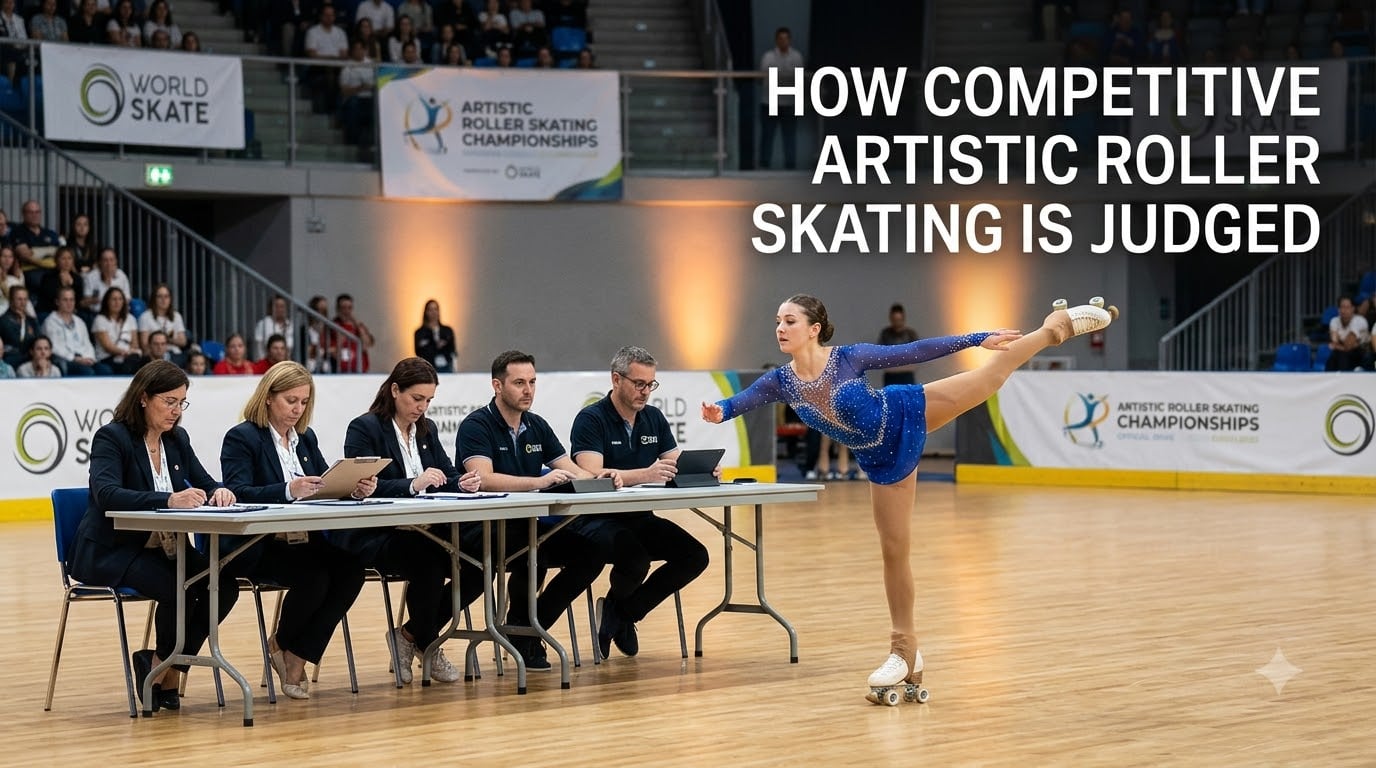
Competitive artistic roller skating is judged using a points-based system with two main components: a Technical Score that measures the difficulty and quality of executed elements, and a Program Components Score that evaluates skating skills, transitions, performance, composition, and interpretation of the music. Skaters earn base values for each identified element, then have Grades of Execution (GOE) applied from -5 to +5 by judges. Final scores combine both totals minus any deductions for falls or rule infractions. This system, governed internationally by World Skate, brings the same level of structured evaluation you see in figure skating to quad-wheel competition.
I have watched World Championship events for years and walked away from every judging panel meeting more curious than the last. The math is intricate, but the philosophy behind it is surprisingly elegant. In this guide, I will walk you through exactly how artistic roller skating is judged in 2026, breaking down every score component so you can follow competitions with confidence.
Table of Contents
What Is Artistic Roller Skating and Who Governs the Judging?
Artistic roller skating is a competitive discipline where athletes perform choreographed routines on quad roller skates, blending athletic jumps, spins, and footwork with artistic interpretation of music. It is one of the oldest recognized roller sports disciplines, with roots stretching back to the late 1800s when roller rinks first hosted figure skating-style competitions.
The international governing body is World Skate, a federation that oversees more than 120 member nations. World Skate publishes the official Code of Points used in sanctioned international events, including World Championships and the World Games. National federations like USA Roller Sports, the Federation of Italian Roller Sports, and the Confederacion Argentina de Patin translate those rules at the country level.
Within World Skate, the Committee of Artistic Skating (CIPA) maintains the technical rules, element tables, and judging guidelines. CIPA regularly updates the Code of Points, most recently with revisions tied to the newer RollArt scoring framework introduced for select international events starting in the mid-2020s. Understanding who sets the rules helps explain why a routine scored in Italy and a routine scored in Brazil can be compared on equal footing.
The Main Competition Categories Skaters Are Judged In
Judging criteria shift depending on which discipline a skater competes in. There are four primary competitive categories in artistic roller skating, each with its own element requirements and program length rules.
Figures (also called School Figures or Special Figures): Skaters trace precise patterns on the floor using circles, loops, brackets, and counters. Figures are judged on the accuracy of the tracings, edge quality, and the cleanliness of turns. Each figure is traced multiple times, and judges measure how closely the skate wheels follow the prescribed pattern. Higher-level figures include progressive and compound patterns that demand precise control.
Freestyle (Singles): This is what most spectators picture when they think of artistic roller skating. Skaters perform two programs: a Short Program of about 2 minutes 45 seconds and a Free Skate of about 4 minutes for seniors. Programs include jumps, spins, footwork sequences, and choreographic elements set to music.
Pairs: Two skaters perform together, executing side-by-side jumps, pair spins, throws, lifts, and death spirals. Pairs judging evaluates the difficulty and synchronization of both individual and shared elements.
Dance and Solo Dance: Skaters perform patterned dances to specified rhythms (waltz, tango, foxtrot, blues) plus an original dance segment. Dance is judged on rhythm accuracy, edge quality, pattern placement, and the aesthetic of the presentation. Solo Dance follows the same framework but with one skater.
Each category has its own technical panel and judging panel configuration, but all use the same two-component scoring philosophy. Skaters typically specialize in one category because the training demands differ substantially across disciplines.
Technical Score Explained: Base Values and Grades of Execution
The Technical Score rewards athletes for attempting and executing specific elements. It is calculated by a separate technical panel whose job is to identify every required element performed and assign it a base value from the official element table.
Base Values: Each jump, spin, footwork sequence, lift, and throw carries a predetermined numerical value based on difficulty. For example, a single toe loop might be worth 0.4 points, while a double axel carries a base value closer to 3.3 points, and a triple toe loop sits around 4.2 points. Combination jumps add their values together. The base value is the starting point before execution is evaluated.
Grades of Execution (GOE): Once the technical panel identifies an element, judges evaluate how well it was performed. GOE ranges from -5 (worst) through 0 (average) up to +5 (best). A skater who lands a triple jump with excellent height, flow, and position might receive a +4 GOE, while a skater who doubles a planned triple and steps out on the landing could receive a -2 or worse. Judges also consider the speed, flow, and ease with which each element is integrated into the program.
How the math works in practice: Imagine a skater performs a triple salchow (base value roughly 4.3 points) and receives a +3 GOE. The judge panel trims the highest and lowest marks, averages the rest, and applies a conversion factor. The element’s contribution to the Technical Score would be around 5.6 points. Multiply this across every required element in the program and you start to see how Technical Scores climb past 60 or 70 points for elite skaters.
The Technical Score is capped in some disciplines, meaning only the top elements count toward the final tally. For example, a senior Free Skate program might require seven jumps but only the three best jumping passes count toward the score, encouraging strategic program construction rather than padding with low-value elements.
Program Components Score: The Five Artistic Categories
The Program Components Score (PCS) captures everything that is not a countable technical element. It is where artistry, flow, and performance quality live. Judges award marks from 0.25 to 10.00 in increments of 0.25 across five categories.
1. Skating Skills: This evaluates edge quality, power, speed, flow, and the skater’s command of multi-directional skating. Judges look for clean curves, deep edges, effortless acceleration, and the ability to glide across the floor with control.
2. Transitions: Transitions are the movements connecting one element to the next, and the choreographic steps in between. Strong transitions add depth and demonstrate a skater’s ability to choreograph beyond the required elements. They often reveal how creatively a skater interprets the music.
3. Performance: Performance reflects the skater’s ability to project to the audience and judges. It is about physical, emotional, and intellectual involvement in the program. A skater with confident stage presence and clear communication through body language scores higher here.
4. Composition: Composition is the arrangement of all movements into a unified whole. Judges evaluate the use of space, pattern, shape, and the balance between different types of movements across the program. A well-composed program builds momentum, varies intensity, and feels intentional.
5. Interpretation of the Music and Timing: This measures how well a skater expresses the music’s character, rhythm, and phrasing. It is not simply hitting the beat. It is about translating the music’s mood and structure through movement choices.
Each PCS mark is multiplied by a factor that varies by discipline. In Senior Free Skate, for example, the five components are weighted and summed to produce the total PCS. World-class skaters regularly score 8.0 or higher per component, while a 7.5 indicates a strong mid-tier performance. Skating Skills and Performance typically receive the heaviest weighting for senior singles.
Understanding Deductions and Penalties
Deductions are subtractions applied after the Technical Score and PCS are combined. They exist to penalize rule infractions or moments where the program breaks down.
Fall Deduction: A fall is defined as a complete loss of balance resulting in contact with the floor by any body part other than the skate. A fall costs the skater 1.0 point in most senior disciplines. Multiple falls compound quickly and can change the outcome of a close competition.
Stumble vs Fall: A stumble is a brief loss of balance that the skater recovers from without full body contact with the floor. A stumble typically carries a smaller deduction, often 0.5 points, depending on severity. The line between a stumble and a fall is one of the more judgment-intensive calls officials make.
Time Violations: Programs that run short or long face deductions. Most competitions allow a small leeway (often 5 to 10 seconds) before a deduction kicks in, but consistently under-rotated or over-rotated programs cost points.
Costume and Prop Infractions: Costumes must meet technical regulations. Props that detach during the program, or costume elements that violate safety or modesty rules, can trigger deductions or even disqualification in extreme cases.
Illegal Elements: Performing an element that is not allowed in the discipline (for example, a throw jump in a singles event) results in the element being invalidated and may trigger a deduction. The technical panel flags any such issues immediately for the judges.
How the Judging Panel Structure Works
Two distinct groups of officials evaluate each performance. Separating technical identification from artistic judgment reduces the cognitive load on any individual judge and improves fairness.
The Technical Panel: This group includes a Technical Controller, a Technical Specialist, and an Assistant Technical Specialist. Their only job is to identify every element performed, call its level of difficulty, and verify that required elements are present. They do not score quality of execution. The technical panel’s decisions are final and cannot be overridden by judges.
The Judging Panel: This panel typically includes seven or nine judges depending on the event level. Each judge independently scores both the GOE for technical elements and the Program Components. The highest and lowest marks are trimmed, and the remaining scores are averaged. This trimming system reduces the influence of any single outlier, whether biased or simply mistaken.
Judge Training and Certification: World Skate runs formal judge certification programs. Officials progress through regional, national, and international levels, each requiring written exams, practical evaluations, and ongoing calibration work. Before major events, panels often participate in calibration sessions where they score the same routines and compare marks to ensure consistency.
Random Assignment and Rotation: Judges are typically assigned to panels by lottery and rotated between events to prevent long-term collusion. Events with multiple panels may use different judges for different skater groups to spread any potential bias.
The RollArt New Scoring System: What Changed
RollArt is a newer scoring framework designed to better balance the technical and artistic demands of competitive artistic roller skating. It was developed by CIPA and piloted at select international events before broader rollout discussions.
Background and Motivation: Critics of the traditional CIPA Code argued that it over-weighted classic quad-style jumps and under-rewarded innovation, choreography, and performance. The RollArt framework was created to address those gaps by recalibrating how base values are calculated and how Program Components are weighted.
Key Differences from the Traditional System: Under RollArt, the base values for some element families (particularly spins and footwork) have been adjusted to better reflect the time and skill required. The Program Components weighting has shifted to give slightly more influence to Interpretation and Composition, encouraging skaters to invest in choreographic depth.
Adoption Status: RollArt has been used experimentally at certain international competitions and is being phased into national federation rules in 2026. Some countries have fully adopted it, while others are running parallel competitions to gather comparative data. Skaters and coaches should check with their national federation for the specific ruleset in use at their events.
Why It Matters: For skaters, the RollArt system rewards well-rounded performers who can deliver strong technical content and engaging artistry in equal measure. For fans, it produces programs that feel more creative and expressive on the floor. For coaches, it shifts training priorities toward the artistic categories that were historically underdeveloped in many national programs.
Artistic Roller Skating vs Figure Skating Judging Compared
One of the most common questions I hear from new fans is whether artistic roller skating is harder than figure skating. The honest answer is that they are differently hard, and the judging systems reflect that difference.
Similar Frameworks: Both sports use a two-component scoring system with a Technical Score and Program Components. Both use Grades of Execution ranging roughly from -5 to +5. Both evaluate Skating Skills, Transitions, Performance, Composition, and Interpretation. The structural similarity is not a coincidence. World Skate’s Code of Points has historically drawn inspiration from the International Judging System used by the International Skating Union (ISU).
Key Differences: Quad roller skates have wheels, which changes how edges are executed compared to ice blades. Rollers do not allow the same kind of sliding entry into jumps, so takeoff mechanics differ. There are no throw jumps from lifts in singles roller skating the way there are in pairs figure skating. The floor surface also affects how spins are centered and how step sequences travel across the rink.
Code Differences: The ISU governs figure skating with its own Code of Points, updated for the current Olympic cycle. World Skate governs artistic roller skating with the CIPA Code and the newer RollArt framework. The two systems are not interchangeable, and scores cannot be directly compared across sports. Each federation maintains its own technical panel training, judging certification, and sanctioning process.
Surface Considerations: Artistic roller skating competitions often take place on sport floors or wooden rinks marked with figure circles. The surface is forgiving in some ways and unforgiving in others. Wheels grip more than blades, which changes how fast skaters can accelerate but also how much friction they fight during multi-rotation spins. Many elite skaters train on both surfaces to build well-rounded control.
What Makes a Champion in Artistic Roller Skating
Watching World Championship podiums over the past decade, I have noticed a clear pattern in the skaters who consistently medal. It is rarely the skater with the highest Technical Score alone, or the skater with the highest PCS alone. It is the skater who balances both.
Balance of Technical and Artistic: Champions invest equally in their jump arsenal and their performance quality. A skater who lands all their triples but reads as flat on the floor will lose PCS points that cannot be recovered elsewhere.
Consistency Across Programs: In championship formats with Short and Free Skate segments, skaters need to deliver two strong performances on consecutive days. The athletes who peak twice typically take the title.
Risk vs Reward: Attempting more difficult elements raises the ceiling but increases fall risk. Champions choose elements that push their personal limits without exceeding them. A clean triple toe loop often beats a popped quad attempt.
Mental Preparation: Artistic roller skating is performed under bright lights, in front of judges and crowds. The athletes who manage nerves well and project confidence earn higher Performance and Interpretation marks. Mental training is as much a part of championship preparation as physical training.
Frequently Asked Questions About Artistic Roller Skating Judging
How is artistic roller skating scored?
Artistic roller skating is scored using a two-component system. Skaters earn a Technical Score based on element difficulty and Grades of Execution (GOE) from -5 to +5. They also receive a Program Components Score (PCS) from 0.25 to 10.00 evaluating skating skills, transitions, performance, composition, and interpretation. The final score combines both totals minus any deductions for falls or time violations.
Is artistic roller skating harder than figure skating?
Both sports use similar judging frameworks with two scoring components, but artistic roller skating has its own Code of Points under World Skate. Technical demands differ because quad skates and floor surfaces change how elements like jumps and spins are executed. Most athletes who have tried both consider them comparably demanding.
What are the five Program Components?
The five Program Components judges evaluate are Skating Skills, Transitions, Performance, Composition, and Interpretation of the Music and Timing. Each is marked from 0.25 to 10.00 in 0.25 increments, then weighted and summed to produce the Program Components Score.
How does the Grade of Execution work?
Grade of Execution (GOE) measures how well an element is performed, ranging from -5 (worst) to +5 (best). The technical panel identifies each element and assigns a base value, then judges add or subtract from that base value based on quality of execution. The highest and lowest marks are trimmed and the remaining marks are averaged.
What is the RollArt scoring system?
RollArt is a newer scoring framework introduced to better balance technical and artistic elements in artistic roller skating. It adjusts how base values and component weights are calculated, aiming to reward creativity and performance alongside technical difficulty. RollArt is being phased into federation rules in 2026.
Who governs competitive artistic roller skating judging?
World Skate is the international governing body and publishes the Code of Points used in sanctioned events. The Committee of Artistic Skating (CIPA) maintains the technical rules. National federations like USA Roller Sports apply those rules at country-level competitions.
What counts as a deduction in artistic roller skating?
Common deductions include falls (1.0 point in most senior disciplines), stumbles (typically 0.5 points), time violations for programs running too short or long, illegal elements, and costume or prop infractions. Deductions are subtracted from the combined Technical Score and Program Components Score.
Final Thoughts on How Competitive Artistic Roller Skating Is Judged
Competitive artistic roller skating is judged through a sophisticated two-component system that rewards both technical difficulty and artistic quality. The Technical Score captures what skaters do, while the Program Components Score captures how they do it. Deductions ensure rule compliance, and the trimming system keeps any single judge from swinging the outcome.
If you are new to the sport, the best way to deepen your understanding of how competitive artistic roller skating is judged is to watch a live competition with the scoring rubric in hand. You will start to see why a clean double axel with strong performance can outscore a popped triple with weak artistry, and why balance between the two is the path to the podium in 2026 and beyond.