
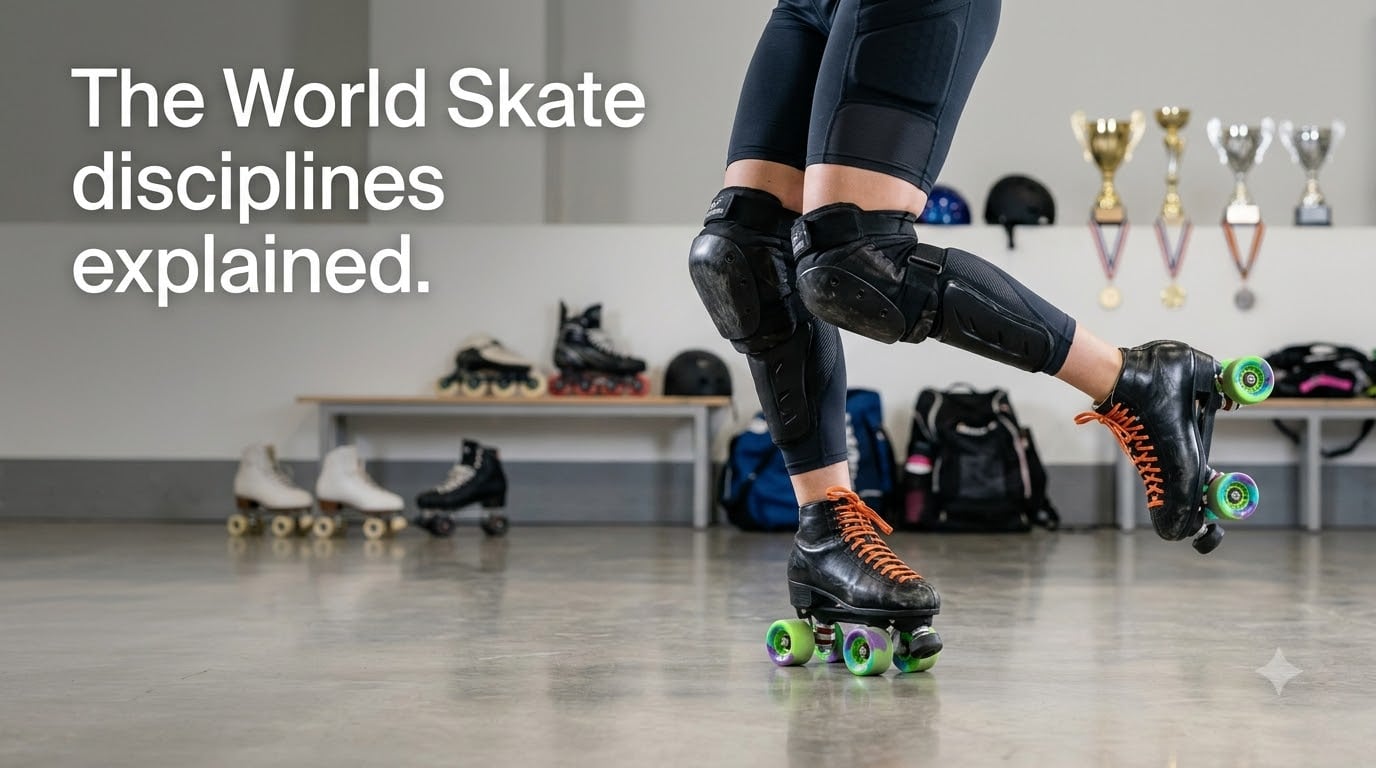
World Skate is the international governing body for skateboarding and all roller sports, officially recognized by the International Olympic Committee (IOC). Whether you are a longtime skater or someone just discovering the world of wheels, understanding the World Skate disciplines opens up a surprisingly diverse universe of competitive sports that goes far beyond what most people see at the Olympics.
In this guide, I break down every discipline that World Skate governs, explain how each one works, and share the history behind the federation itself. I have spent years following roller sports competitions and talking with skaters across different disciplines, and I can tell you that the variety here is staggering. From the high-flying ramps of park skateboarding to the tactical teamwork of rink hockey, there is something for everyone.
The World Skate disciplines explained here cover 11 official categories, each with its own rules, equipment, and competition formats. You will learn what makes artistic roller skating different from freestyle, why speed skating has multiple sub-disciplines, and how skateboarding earned its Olympic spot. I also cover the upcoming 2026 World Skate Games and how you can get involved as a competitor or fan.
If you have ever felt confused about the difference between roller derby and inline hockey, or wondered why some skating sports are Olympic while others are not, you are in the right place. This guide is designed to be beginner-friendly while still covering the details that serious fans and aspiring athletes need to know.
Table of Contents
What Is World Skate and Why Does It Matter?
World Skate is the sole international federation recognized by the IOC for all sports performed on skating wheels. That means every official international competition in skateboarding, roller skating, and related disciplines falls under its authority. The organization sets the rules, sanctions world championships, and manages the qualification pathways that lead athletes to the Olympic Games.
Founded originally in 1924 as the Federation Internationale de Roller Skating (FIRS), the organization rebranded to World Skate in 2017 to reflect its expanded role over skateboarding. This change was not just cosmetic. It came after the IOC awarded World Skate the governance of skateboarding ahead of its Olympic debut at Tokyo 2020.
Headquartered in Lausanne, Switzerland, World Skate currently oversees more than 140 national federations worldwide. It organizes World Championships across all its disciplines, maintains the official rulebooks, and works with continental confederations to develop the sport at regional levels. The federation also runs World Skate TV, which broadcasts competitions and results to fans around the globe.
What makes World Skate matter to everyday skaters is that its decisions shape the entire competitive landscape. When World Skate adds a new discipline, adjusts scoring rules, or creates a new event format, it ripples down to national federations and local clubs. Understanding how the federation works helps you make sense of the competitions you watch and the pathways available if you want to compete.
The Complete List of World Skate Disciplines
World Skate currently governs 11 official disciplines. Each one has its own world championship circuit, ranking system, and competition rules. Here is the complete list, grouped by category so you can see how they relate to each other.
Skateboarding disciplines:
– Skateboarding (Street and Park) — The Olympic discipline featuring tricks on street-style obstacles and bowl-shaped ramps.
Speed and racing disciplines:
– Speed Skating — Inline racing on track, road, and marathon courses at blistering speeds.
– Inline Downhill — High-speed descents on mountain roads, where athletes reach speeds over 100 km/h.
Artistic and freestyle disciplines:
– Artistic Roller Skating — Performances involving figures, freestyle programs, dance, and precision teams.
– Inline Freestyle — Slalom, speed slalom, and freestyle tricks performed on inline skates.
– Roller Freestyle — Creative trick skating on quad or inline skates, similar to aggressive inline.
Team and contact disciplines:
– Rink Hockey — Traditional roller hockey played on quad skates with a curved stick and ball.
– Inline Hockey — A faster-paced variant played on inline skates with a puck, similar to ice hockey.
– Roller Derby — A full-contact team sport where skaters score points by lapping opponents.
Other disciplines:
– Alpine — A skiing-inspired discipline featuring giant slalom and parallel slalom on skates.
– Scootering — Freestyle tricks and competitions performed on kick scooters, the newest addition to the World Skate family.
Some resources list additional sub-disciplines within these categories, but these 11 represent the main competitive branches that World Skate formally sanctions. Each has its own dedicated community of athletes, coaches, and fans.
Skateboarding Disciplines Under World Skate
Skateboarding is the newest and most visible World Skate discipline, thanks to its Olympic debut at Tokyo 2020. But there is more to competitive skateboarding than what you see at the Games. World Skate oversees several formats, and understanding the differences helps you appreciate the skill involved in each.
Street Skateboarding is the most recognizable Olympic format. Competitors skate on a course designed to mimic urban environments, complete with stairs, handrails, benches, and ledges. Athletes are judged on difficulty, execution, variety, and originality of their tricks. Each run gives skaters a set time to perform, and their best scores from multiple runs determine the ranking.
Park Skateboarding takes place in a bowl or pool-style course with curved transitions, allowing skaters to build speed and launch into aerial tricks. The judging rewards amplitude (how high you go), flow, and the complexity of tricks performed in sequence. Park competitions are fast and continuous, with skaters maintaining momentum throughout their run.
Vert Skateboarding is the discipline that many people associate with the X Games era. Skaters ride a vertical ramp (a halfpipe with near-vertical walls) and perform aerial tricks above the coping. While vert is not currently an Olympic event, World Skate has historically sanctioned vert competitions, and it remains a beloved discipline within the skateboarding community.
Freestyle Skateboarding is perhaps the oldest competitive skateboarding discipline. It involves performing technical flat-ground tricks on a smooth surface, often choreographed to music. Freestyle skateboarding predates street and park, with roots going back to the 1960s. Though less prominent today, it still has a dedicated following and periodic world-level events.
One common question from Reddit communities like r/Rollerskating and r/rollerblading is how World Skate skateboarding differs from organizations like Street League Skateboarding (SLS). The short answer is that World Skate is the official IOC-recognized body that runs Olympic qualifying and world championships, while SLS is a professional tour series. World Skate sets the rules that Olympic qualifying events must follow.
Speed Skating Disciplines Explained
Speed skating is one of the oldest and most physically demanding World Skate disciplines. It is also one of the most varied, with multiple race formats held on different surfaces. Inline speed skaters are among the fastest athletes on wheels, reaching speeds that would be terrifying on any other type of skate.
Track Speed Skating takes place on a banked oval track, typically 200 meters in length. Races range from sprint distances like 300 meters to endurance events covering thousands of meters. The banked curves allow skaters to lean into turns at high speeds without losing traction. Race formats include individual time trials, mass-start races, elimination races, and relays.
Road Speed Skating is held on closed road circuits, which can be point-to-point or loop courses. Road events include sprints, long-distance races, and marathons. The flat surface and longer straights create different tactical challenges compared to track racing. Drafting plays a huge role, with skaters forming packs and surging at strategic moments.
The marathon distance, typically 42 kilometers, is a marquee event in road speed skating. World Skate sanctions international marathon events, and many skaters specialize exclusively in this grueling distance. The combination of endurance, pack tactics, and sprint finishes makes marathon racing one of the most exciting disciplines to watch.
One detail that often confuses newcomers is the equipment. Inline speed skates use large wheels (usually 100mm to 125mm in diameter) mounted on long frames for maximum speed and efficiency. The boots are low-cut and carbon fiber, prioritizing ankle flexion and power transfer. This is very different from the recreational inline skates most people are familiar with.
Speed skating has produced some of the most dominant athletes in all of roller sports. Countries like Colombia, Italy, and South Korea have deep traditions in the sport, consistently producing world champions. If you want to see world-class speed skating, look for World Skate championship broadcasts, which are often available through World Skate TV.
Artistic Roller Skating and Dance
Artistic roller skating is the discipline that most closely mirrors figure skating on ice. It combines grace, athleticism, and precision, with skaters performing choreographed routines judged on technical merit and artistic impression. This discipline has been part of World Skate competitions since the federation’s earliest days.
Figures are the foundation of artistic skating. Skaters trace precise circular patterns on the floor, with judges evaluating the accuracy of the tracing, the posture, and the edge quality. Figures require intense focus and body control, and they are often compared to compulsory exercises in ice figure skating. This is where skaters develop the fundamental skills that translate to all other artistic events.
Freestyle is the showpiece event of artistic roller skating. Skaters perform programs set to music that include jumps, spins, and footwork sequences. The jumps in artistic roller skating are remarkably similar to those in ice figure skating, including the Axel, Salchow, and Lutz. Skaters on quads can perform multiple-rotation jumps, and the best in the world land triples with consistency.
Dance events come in two formats: compulsory dance and free dance. In compulsory dance, all skaters perform the same set pattern of steps to a specified rhythm. Free dance allows skaters to create their own choreography, blending different rhythms and creative elements. Dance can be performed solo or with a partner.
A common question from skating forums is why artistic roller skaters do not simply switch to ice figure skating. The answer comes down to technique differences. While the disciplines look similar, the physics of wheels versus blades create distinct challenges. Roller skates grip the floor, making certain edge movements feel different, and the wheelbase affects how spins and jumps rotate.
Precision (also called show groups) involves teams of skaters performing synchronized routines. This is one of the most visually spectacular events in artistic skating, with up to 24 skaters moving in unison. The choreography, formations, and synchronization required make precision a crowd favorite at world championships.
Hockey Disciplines: Rink Hockey, Inline Hockey, and Roller Derby
World Skate governs three distinct team sports that each offer a completely different experience. While all three are played on wheels, the rules, equipment, and culture of each are unique. Understanding these differences clears up a lot of confusion for newcomers.
Rink Hockey is the traditional form of roller hockey and has been part of World Skate since its founding. Played on quad skates, teams of five (including a goalkeeper) use curved sticks to move a hard ball and score goals. The game originated in Europe, and countries like Spain, Portugal, Argentina, and Italy dominate at the world level. Rink hockey is played on a smooth indoor surface, and the ball moves at high speeds despite the quad skate format.
Inline Hockey is the faster, more aggressive cousin. Played on inline skates with a puck rather than a ball, inline hockey closely resembles ice hockey in structure. The game moves quickly thanks to the speed of inline skates, and body contact rules vary by competition level. Inline hockey has a strong following in North America, where many ice hockey players cross over during the off-season. World Skate sanctions world championships that bring together teams from dozens of countries.
Roller Derby is the newest team sport under the World Skate umbrella and has one of the most passionate communities in all of roller sports. Played on quad skates on an oval track, two teams of five skaters compete in jams (short scoring periods). One skater per team serves as the jammer, who scores points by lapping opposing skaters. The other skaters play offense and defense simultaneously, blocking opponents and clearing paths for their jammer.
Roller derby grew from a grassroots movement into an internationally governed sport, and its inclusion under World Skate gave it official world championship status. The sport is known for its inclusive culture, with strong women’s and gender-expansive leagues around the world.
If you are trying to choose between these disciplines, consider what appeals to you. Rink hockey rewards tactical play and stick skills. Inline hockey offers ice-like speed and physicality. Roller derby combines athleticism, strategy, and a tight-knit community spirit.
Other Disciplines: Slalom, Downhill, Freestyle, and Scootering
Beyond the major disciplines, World Skate governs several specialized categories that attract dedicated communities of athletes. These disciplines may not have the Olympic spotlight, but they are no less impressive in terms of skill and excitement.
Inline Slalom is a precision discipline where skaters navigate through a row of cones spaced at fixed intervals. There are two main formats: classic slalom, where skaters perform creative tricks weaving through cones, and speed slalom, where the goal is to pass through all cones as fast as possible using only one foot. The footwork and balance required are extraordinary, and top slalom skaters make the most complex sequences look effortless.
Inline Downhill is the extreme sport of the World Skate family. Athletes race down mountain roads on inline skates, reaching speeds that can exceed 100 km/h. The aerodynamic tuck position, specialized equipment, and sheer courage needed make downhill one of the most adrenaline-fueled disciplines in all of roller sports. Safety is paramount, with full protective gear including leather suits and helmets mandatory at World Skate sanctioned events.
Roller Freestyle is the creative, expressive side of roller sports. Similar to aggressive inline or park skating, freestyle involves performing tricks on ramps, rails, and street obstacles. World Skate sanctions competitions where athletes are judged on difficulty, style, and creativity. This discipline has a strong youth culture and continues to grow as skateparks become more common worldwide.
Alpine skating brings skiing to wheels. Skaters navigate giant slalom and parallel slalom courses on specialized skates with short frames for quick turns. The discipline has a small but passionate following, primarily in European countries with strong winter sports traditions.
Scootering is the newest addition to the World Skate family. Using freestyle kick scooters, athletes perform tricks on ramps, rails, and street obstacles. The sport has exploded in popularity among younger riders, and its inclusion under World Skate provides a pathway for international competition and recognition. While some traditionalists were skeptical at first, scootering has proven to be a legitimate athletic discipline with a rapidly growing competitive scene.
The History of World Skate: From 1924 to Today
The story of World Skate begins in 1924, when roller sports enthusiasts founded the Federation Internationale de Roller Skating (FIRS) to organize international competition. At the time, roller skating was primarily a recreational activity with limited organized competition. The early federation focused on artistic skating and rink hockey, the two disciplines with the most established competitive traditions.
Over the following decades, FIRS expanded its scope. Speed skating joined the competitive roster, and the first official world championships were held. The federation worked to standardize rules across countries, creating a level playing field for international competition. By the 1960s and 1970s, roller sports had grown significantly, with new disciplines like inline skating emerging as equipment technology advanced.
A major milestone came in 1986 when the IOC granted provisional recognition to FIRS, acknowledging roller sports as part of the Olympic movement. Full recognition followed, and for decades, the federation pursued Olympic inclusion for its disciplines. This was a long and sometimes frustrating journey, with several near-misses before skateboarding finally broke through.
The inline revolution of the 1990s transformed several disciplines. Inline speed skating grew rapidly, and inline hockey emerged as a distinct sport from traditional rink hockey. The federation adapted, adding new disciplines and updating its competition formats to reflect the evolving landscape of roller sports.
In 2017, the organization officially rebranded from FIRS to World Skate. This change reflected the federation’s expanded role, which now included skateboarding. The IOC had awarded World Skate governance of skateboarding ahead of the Tokyo 2020 Olympics, and the new name signaled a broader, more inclusive identity covering all wheeled skating sports. Since then, World Skate has continued to add disciplines, with scootering being the most recent addition.
The Olympic Journey of World Skate Disciplines
For decades, the biggest question in roller sports was simple: when would these disciplines finally reach the Olympics? Roller sports had been recognized by the IOC since the 1980s, but recognition and inclusion are very different things. The journey to Olympic status was long, filled with disappointment before finally achieving a breakthrough.
Multiple times, roller sports were considered for Olympic inclusion and passed over. Speed skating and artistic skating were proposed for various Games but never selected. The frustration within the community was real, especially given the global participation and competitive depth of these sports.
The breakthrough came through skateboarding. When the IOC decided to add youth-oriented sports to attract younger audiences, skateboarding was a natural choice. In 2016, the IOC announced that skateboarding would debut at the Tokyo 2020 Olympics, with World Skate as the governing body responsible for organizing the competition and qualification process.
At Tokyo 2020, held in 2021 due to the pandemic, skateboarding made its Olympic debut in two formats: street and park. The events were a massive success, drawing huge global audiences and introducing millions of people to the sport. The inaugural Olympic champions in street were Yuto Horigome (Japan) for men and Momiji Nishiya (Japan) for women. In park, Keegan Palmer (Australia) won gold for men and Sakura Yosozumi (Japan) for women.
Skateboarding returned for Paris 2024, solidifying its place in the Olympic program. The competition format was refined based on lessons from Tokyo, and the level of skating reached new heights. World Skate managed the qualifying system, which spanned multiple years and included world championships, continental qualifiers, and world ranking events.
Looking ahead, the question many fans ask is whether other World Skate disciplines will follow skateboarding into the Olympics. Roller sports federations continue to push for the inclusion of speed skating and other disciplines. While nothing is guaranteed, the success of skateboarding has opened doors that were closed for decades.
The 2026 World Skate Games and Future Events
The World Skate Games are the premier multi-discipline event in roller sports, bringing together athletes from across all disciplines for a massive celebration of skating. Think of it as the world championships rolled into one mega-event, with medals awarded in every World Skate discipline over the course of several weeks.
The first edition of the World Skate Games was held in 2017 in Nanjing, China, under the name World Roller Games. The event was later rebranded to align with the federation’s new identity. Subsequent editions have been held in Barcelona, Spain (2019) and other locations, each drawing thousands of athletes from over 40 countries.
For 2026, World Skate continues to organize World Championships across all disciplines, along with continental championships and qualifying events for future Olympic cycles. These events are the lifeblood of competitive roller sports, providing ranking points, prize money, and the prestige of a world title.
If you want to follow the action, World Skate TV provides live streaming and on-demand coverage of major events. You can watch world championships in skateboarding, speed skating, artistic skating, rink hockey, and more throughout the year. Results and rankings are published on the official World Skate website, making it easy to track your favorite athletes and disciplines.
How to Get Started in Roller Sports?
One of the things I love most about roller sports is how accessible the entry point is. You do not need a massive budget or years of experience to start skating. What you need is a pair of skates, some protective gear, and a willingness to fall down a few times while you learn.
If you are drawn to artistic skating, look for a local roller rink that offers lessons. Many rinks have artistic clubs where you can learn figures, freestyle, and dance in a structured environment. For speed skating, search for inline speed clubs in your area. These clubs often have loaner skates and coaching programs designed for beginners.
Skateboarding has arguably the lowest barrier to entry. A board, helmet, and pad set are all you need to start learning at a local skatepark. Most skateparks have areas designed for different skill levels, and the community is generally welcoming to newcomers willing to learn skatepark etiquette.
For team sports like rink hockey, inline hockey, or roller derby, check your city for local leagues. Roller derby in particular is known for its beginner-friendly fresh meat programs that teach the fundamentals from scratch. Hockey clubs often run introductory sessions where you can try the sport before committing to equipment purchases.
The forum communities on Reddit and elsewhere are fantastic resources for beginners. Skaters are generous with advice about everything from choosing the right skates to finding local training groups. Do not be afraid to ask questions. Every skater was a beginner once, and the community loves helping newcomers find their footing.
Frequently Asked Questions
What are the World Skate disciplines?
World Skate governs 11 official disciplines: skateboarding (street and park), speed skating, inline downhill, artistic roller skating, inline freestyle, roller freestyle, rink hockey, inline hockey, roller derby, alpine, and scootering. Each discipline has its own world championship circuit and competition rules.
How many disciplines does World Skate govern?
World Skate currently governs 11 official disciplines across skateboarding, roller skating, and scootering. Some disciplines have multiple sub-categories or competition formats within them, such as artistic skating which includes figures, freestyle, dance, and precision events.
Is roller skating an Olympic sport?
Skateboarding is the only World Skate discipline that is currently Olympic, having debuted at Tokyo 2020 in street and park formats. Traditional roller skating disciplines like artistic and speed skating are not Olympic sports, despite being recognized by the IOC. World Skate continues to campaign for broader Olympic inclusion of roller sports.
What are the World Skate Games scheduled for 2026?
World Skate organizes World Championships across all disciplines throughout 2026, along with continental qualifiers and ranking events for future Olympic cycles. The World Skate Games, the federation’s flagship multi-discipline event, brings together athletes from all 11 disciplines in a single mega-competition. Schedules and locations are published on the official World Skate website.
What is the difference between World Skate and Street League Skateboarding?
World Skate is the official IOC-recognized international governing body that runs Olympic qualifying, world championships, and sets the rules for skateboarding globally. Street League Skateboarding (SLS) is a professional tour series and competition brand. SLS events may count toward World Skate rankings, but World Skate holds the ultimate authority over Olympic qualification and world titles.
How do I start competing in a World Skate discipline?
Start by joining a local club or league registered with your national roller sports federation. National federations are affiliated with World Skate and provide the pathway to international competition. Most clubs offer beginner programs, and you can progress from local events to national championships and eventually international ranking events sanctioned by World Skate.
Conclusion: Understanding the World of World Skate
The World Skate disciplines explained in this guide represent an incredible diversity of sports, each with its own community, culture, and competitive spirit. From the Olympic spotlight of street and park skateboarding to the grassroots passion of roller derby, the federation oversees a world that is far richer than most people realize.
What strikes me most after years of following these sports is how each discipline offers a completely different experience. Speed skating rewards endurance and tactics. Artistic skating demands precision and creativity. Hockey disciplines build teamwork and intensity. Downhill skating requires nerves of steel. There really is a World Skate discipline for every type of athlete and fan.
The history of World Skate, from its 1924 founding through decades of growth to its current role as an Olympic-level federation, shows how far roller sports have come. The inclusion of skateboarding at Tokyo 2020 was a landmark moment, and the federation continues to push for greater recognition of all its disciplines on the world stage.
If there is one thing I want you to take away from this guide, it is that roller sports are for everyone. Whether you want to compete at a world championship level, join a local roller derby league, or just learn to skate at your neighborhood rink, the World Skate community has a place for you. The disciplines may be diverse, but the passion that unites skaters across all of them is the same.
So pick a discipline that excites you, find a local club or community, and get rolling. The world of World Skate is waiting, and it is more accessible than you might think. Whether you are watching from the stands or strapping on skates for the first time, you are now equipped with the knowledge to understand and appreciate every discipline this federation governs.