
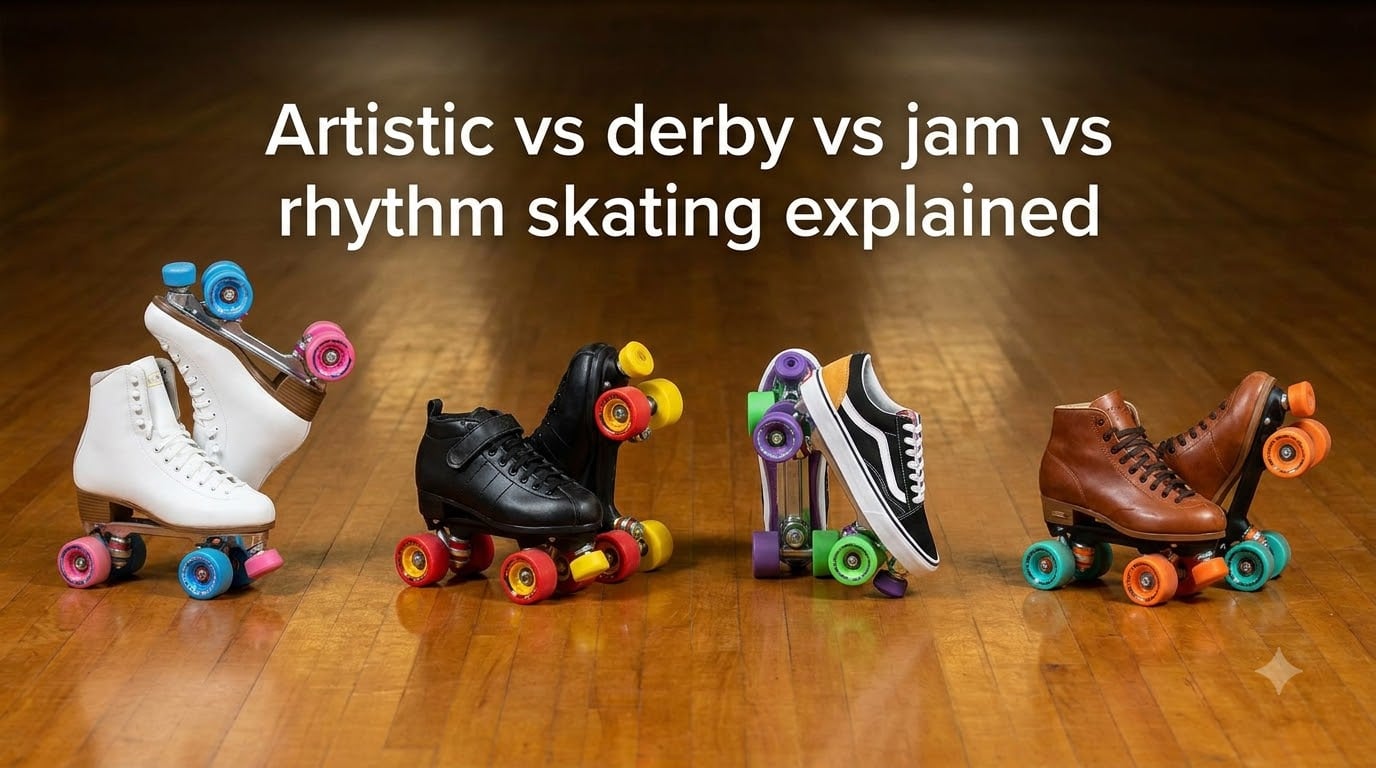
When I first stepped onto a rink, I assumed “roller skating” was one single activity. Then I watched someone glide through a soul routine on the same floor where a derby player later slammed a jammer into the wall. Same wheels, completely different sports. After dozens of sessions on quads and conversations with skaters from Atlanta to Detroit, here’s the breakdown I wish I’d had on day one.
This guide compares the artistic vs derby vs jam vs rhythm skating styles side by side so you can figure out which one matches your personality, music taste, and fitness goals.
Table of Contents
What Are the Main Roller Skating Styles?
The four major quad skating styles are artistic, derby, jam, and rhythm. Artistic skating focuses on technical figure-skating elements like spins and jumps. Derby is a contact team sport played on a track. Jam skating blends gymnastics and street dance with high-energy tricks. Rhythm skating is smooth, flowing movement that mirrors the beat of R&B and soul music. Each style uses different boots, plates, wheels, and music, so the skating you enjoy depends heavily on what feels natural to you.
Artistic Roller Skating Explained
Artistic roller skating is the closest quad-skating cousin to ice figure skating. Skaters perform choreographed routines judged on precision, balance, and technical difficulty. The style emphasizes control over creativity, and competitions feel similar to gymnastics or ice dance events.
There are four distinct artistic disciplines recognized by the International Federation:
Dance – solo or pairs routines set to a prescribed rhythm pattern.
Figures – tracing precise patterns on the floor without music.
Freestyle – high-energy solo routines with jumps, spins, and footwork.
Pairs – two skaters performing lifts, throws, and synchronized moves.
Artistic skates use tall leather boots for ankle support, lightweight plates, and narrow wheels that grip the floor for tight turns. I tried a basic figures session after months of rink skating and my ankles felt locked in for the first time — that’s the trade-off: more support means less mobility for tricks, but far better control for technical work.
Music for artistic routines is usually classical or orchestral because judges score the execution, not the mood. If you grew up watching figure skating on TV, artistic roller skating is the world you’ll recognize most.
Roller Derby Skating Explained
Roller derby is a full-contact team sport played on an oval track. Five players from each team skate together in a pack while one “jammer” tries to lap the pack to score points. The other four “blockers” defend their jammer and block the opposing one. Hits, falls, and strategy are part of every jam.
Derby skates are low-cut for a reason. A short boot lets the ankle flex deeply so skaters can push hard laterally, squat low for stability, and recover quickly from hip checks. Tall boots would actually slow you down and limit the ducking, leaning, and pivoting that derby demands. The ankle mobility built into a derby boot is what lets a blocker change direction in milliseconds.
Equipment matters more in derby than in any other style. Beyond skates, every player wears a helmet, wrist guards, elbow pads, knee pads, and a mouthguard. The hard toe stop is essential for sudden stops and quick starts. Plates are usually lightweight aluminum, and wheels are chosen for grip or speed depending on the track surface.
If you want a team sport with strategy, contact, and a strong community culture, derby delivers. Most leagues accept beginners through “fresh meat” programs where you learn skating basics before ever joining a scrimmage.
Jam Skating Explained
Jam skating is often described as breakdancing on wheels, and that phrase nails it. Skaters perform athletic tricks, power moves, and freestyle footwork set to hip-hop, funk, and R&B. Routines can be improvised or choreographed, but the energy level is always high.
The style draws from street dance, gymnastics, and even breakdancing. Common moves include:
Toe spins and heel-toe switches
Knee drops and low-level footwork
Power moves like spins on one knee or hand
Quick directional changes and stops
Jam skates usually have a medium-to-high boot for ankle protection during falls, a sturdy plate, and wheels chosen for grip when launching into spins. The toe stop is a frequent tool — it’s both a brake and a pivot point for many tricks.
Community culture is strong on social media. Rinks host jam nights where skaters take turns in the center showing off runs. Beginners often start by learning a few footwork patterns before adding power moves, because the footwork is what keeps your balance when the routine gets fast.
Rhythm Skating Explained
Rhythm skating is all about smooth, continuous movement to the beat. Instead of stopping to start a trick, rhythm skaters flow through side-to-side steps, cross-overs, and small footwork patterns that mirror the song’s groove. The vibe is closer to dancing on wheels than performing tricks.
The roots are in R&B, soul, funk, and disco music. Rhythm skating culture is huge in cities like Atlanta, Detroit, and the Carolinas, where rink nights are multi-generational social events. Regional styles have grown from those roots:
Detroit-style rhythm – deep knee bend, low center of gravity, side-to-side bounce.
Atlanta-style rhythm – smoother glide with crossovers and playful arm styling.
JB-style rhythm – footwork-heavy, with quick heel-toe work and stops.
Cali slide – slow, stylish transitions built around long glides and stops.
Rhythm skates often look like classic disco boots with a tall, padded collar for comfort. Wheels are typically softer and grippier so skaters can hold edges through cross-overs. The toe stop is smaller and sometimes swapped out, because rhythm skaters rely more on edge work than braking.
If you love dancing, music, and flowing movement rather than scoring tricks, rhythm skating will probably feel like home. Many skaters tell me it’s the style they return to after trying the others.
Side-by-Side Comparison Table
This table gives you a quick snapshot of the four styles. Use it as a reference when you’re deciding what to learn first.
| Style | Focus | Typical Music | Difficulty | Signature Gear |
|---|---|---|---|---|
| Artistic | Technical routines, spins, jumps | Classical, orchestral | High | Tall leather boots, narrow wheels |
| Derby | Contact team strategy, speed | Not music-driven | Medium to high | Low-cut boots, full pads |
| Jam | Power tricks, freestyle footwork | Hip-hop, funk, R&B | Medium to high | Mid/high boot, sturdy plate |
| Rhythm | Flowing steps to the beat | R&B, soul, funk, disco | Beginner friendly | Tall padded boot, grippy wheels |
How to Choose the Right Style for You
Picking a skating style isn’t really about which one is “best.” It’s about which one matches your personality and the kind of movement you enjoy. I tell friends to ask themselves four questions before they buy gear.
Do you want to compete solo or as part of a team? Artistic and jam skating lean solo — you’re judged on your own runs. Derby is the only team option, and rhythm falls somewhere in between depending on your rink.
What music do you already love? Your playlist is a strong hint. If classical and instrumental tracks fill your headphones, artistic will feel natural. Hip-hop and funk fans often gravitate to jam. Soul, R&B, and disco listeners usually land in rhythm skating.
How athletic do you want to be? Derby and jam require the most conditioning — falls, contact, and explosive tricks. Rhythm skating is gentler on the joints. Artistic skating is technical rather than intense but demands balance and flexibility.
What’s your budget? A basic pair of rhythm or recreational skates gets you rolling for the least money. Derby adds helmet, pads, and mouthguard costs. Artistic and jam setups can climb quickly once you upgrade plates, boots, and wheels.
The good news is styles overlap. Many skaters cross-train: rhythm skaters practice jam tricks, derby players work on jam-skating footwork, and artistic skaters dabble in rhythm for fun. Try one, see how it feels, and let your curiosity lead.
Frequently Asked Questions
What is the difference between jam skating and rhythm skating?
Jam skating focuses on high-energy tricks, power moves, and freestyle footwork inspired by breakdancing and gymnastics. Rhythm skating focuses on smooth, continuous movement that mirrors the beat of the music. Both use similar music genres, but jam emphasizes athletic tricks while rhythm emphasizes flow.
What are the 4 types of figure skating?
The four artistic roller skating disciplines are dance, figures, freestyle, and pairs. Dance follows prescribed rhythm patterns, figures are precise floor patterns without music, freestyle is solo routines with jumps and spins, and pairs includes lifts and synchronized moves.
What are the three types of skating?
Roller skating commonly breaks into artistic, derby, and dance-focused styles like jam and rhythm. Ice skating has figure, speed, and hockey. Inline skating splits into aggressive, speed, and recreational. The categories differ by surface, gear, and goals.
Why are derby skates low cut?
Derby skates are low cut so the ankle can flex deeply during lateral pushes, low squats, and quick directional changes. The extra mobility is essential for blocking, jamming, and recovering from contact. A tall boot would slow down the footwork derby demands.
Final Thoughts on Picking Your Style
The artistic vs derby vs jam vs rhythm skating debate really comes down to what kind of movement excites you. Artistic skating rewards precision and discipline. Derby rewards grit and teamwork. Jam rewards athleticism and creativity. Rhythm rewards musicality and flow. Each one is a real sport with its own community, gear, and culture.
If you’re brand new, start at a local rink night and watch. See which skater you keep looking at — that’s usually the style your body wants to try first. Rent the basic gear, take a lesson, and give yourself a few sessions before committing to a setup. Most skaters I know ended up loving more than one style anyway.