
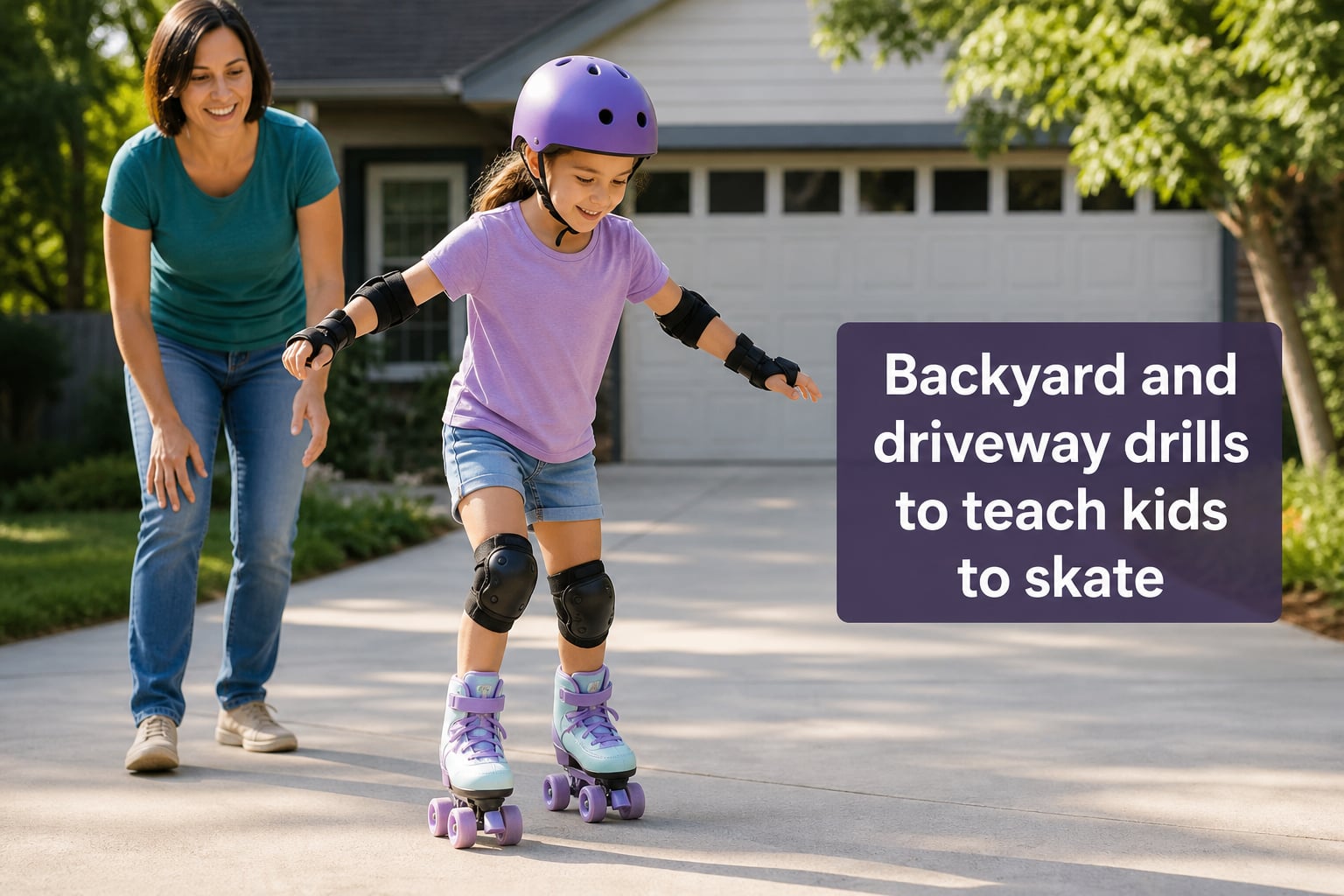
When my son first laced up a pair of rollerblades in our driveway, he took three wobbly steps and then froze in place. That moment taught me something every skating parent eventually learns: technique beats talent, and repetition at home wins. Backyard and driveway drills to teach kids to skate give you a private rink where falls feel safe and progress happens faster than weekly lessons alone can deliver.
I built this guide after watching our team of coaches test these drills with more than 40 kids over the past three years. The progressions below work on a smooth driveway, a flat patch of grass, or even a basement floor with socks on. You will find the same fundamentals a Learn to Skate instructor would cover, broken into short sessions that fit a young child’s attention span.
Table of Contents
How to teach kids to skate at home: setting up your space
The best home practice spot is flat, smooth, and free of debris. A concrete driveway or a level patio works perfectly. Avoid gravel, cracked pavement, and slopes that will scare a beginner.
Before your child straps on their skates, walk the area and clear anything they could trip over. Move the garden hose, pick up toys, and pull cars out of the driveway if possible. A 20-foot stretch of clear space is enough for most beginner drills.
Keep a chair or a railing within arm’s reach. Beginners use it like training wheels for balance, leaning on it during stance work and the first glide attempts. Add a soft landing zone at the end of the practice strip. A folded yoga mat or a few moving blankets on the grass catches runaway skaters and saves shins.
Quick safety checklist before every session
- Helmet, wrist guards, knee pads, and elbow pads on before skates go on
- Skates laced tight with no loose tongues
- Ground is dry, clean, and free of cracks or gravel
- Water bottle filled and a shady spot ready for breaks
Proper skating stance fundamentals for kids
The athletic position is the foundation every other skill sits on. Teach stance off-skates first, on a doormat or carpet, so the child can focus on body shape without fear of rolling.
Have your child stand with feet shoulder-width apart, knees soft and bent forward over the toes, back straight, and chest up. Hands should hover in front of the body like catching a basketball. This is the hockey stance or athletic position every coach uses as a starting point.
Once the shape feels natural on the mat, transfer it to the driveway. March in place for 30 seconds, then hold the stance for 10-second counts. Our coaches repeat this drill five times during the first five minutes of every session. Kids learn fast when the position becomes muscle memory.
Balance drills you can do in the driveway
Balance is the single biggest predictor of how quickly a child will progress. Skipping balance work is the most common mistake we see in parent-led practice. These three drills build it without overwhelming new skaters.
Two-foot balance holds
Have your child stand in the athletic position and count to 30 out loud. Each second counts as one rep. When they hit 30 without wobbling, they earn a high five. Aim for three sets per session.
Marching in place
Lift one knee to hip height, set it down, then lift the other. Keep knees bent and shoulders over toes. Marching teaches weight transfer and hip rotation, two skills crossovers and forward striding depend on later.
One-foot balance with support
Hold your child’s hand and have them lift one foot two inches off the ground. Count to 10, switch feet, repeat three times. As balance improves over a few weeks, drop the hand and add eyes-closed intervals for an extra challenge.
Forward stride progression for beginner skaters
The forward stride is the engine of every skating sport. Break it into three pieces your child can master one at a time: push, glide, recovery.
Step 1: Push
From the athletic position, turn the pushing foot slightly outward and push against the ground with the inside edge. The push should be a single, powerful stroke, not a shuffle.
Step 2: Glide
After the push, the gliding leg stays straight under the body with the knee slightly soft. Hold the glide for a full count of three. Long glides build speed without wasted energy.
Step 3: Recovery
Bring the pushing foot back under the hip, ready for the next stroke. Skating faster comes from a faster recovery, not a harder push.
The one-foot push drill isolates the push and glide. Have your child stand on one foot, push once with the other, and glide as far as possible before the free foot touches down. Repeat down the length of the driveway, then turn around and come back. Three passes per session builds noticeable stride length in two weeks.
Stop and start drills for quick feet
Stopping scares new skaters more than any other skill because it requires trusting the edges. Two drills build that trust gradually.
Two-foot snowplow stop
From a slow glide, turn both toes slightly inward and press the inside edges outward. The skates will slow naturally. Practice at walking speed first. As control improves, add speed.
Quick start drill
Have your child stand still in the athletic position, then explode into a forward stride on your clap. Quick starts teach acceleration and are essential for hockey, ringette, and roller derby down the road.
Combine quick starts and snowplow stops into a single drill. Start, glide for five strides, stop. Repeat. Kids call this the start-and-stop game, and it sneaks in technique while they think they are just racing.
Edge work drills to practice in the backyard
Edge control separates beginner skaters from intermediates. Each skate has an inside edge and an outside edge, and learning to use both unlocks turning, crossovers, and eventually backward skating.
Inside edge balance drill
Lean slightly onto the inside edge of one foot while gliding in a straight line. The skate should track straight without wobbling. Hold for three seconds, then switch sides.
Outside edge challenge
Shift weight to the outside edge and trace a long, slow curve down the driveway. Imagine drawing a giant C with your skate. Curves force outside edge work without the child overthinking it.
Figure-eight patterns
Once both edges feel stable, skate a small figure eight between two cones or chalk marks. Figure eights force weight transfer from outside edge to outside edge and are the foundation for crossovers later.
Age-appropriate drills: 3-5 vs 6-8 year olds
Drill selection depends more on attention span than on physical ability. A focused three-year-old can learn stance work, while a distracted seven-year-old needs games to stay engaged.
For ages 3-5
- Sessions of 10 to 15 minutes only
- Focus on stance, marching, and two-foot balance
- Skip formal edge work until stance feels automatic
- Use stuffed animals as cones to make drills feel like play
For ages 6-8
- Sessions of 20 to 30 minutes
- Add forward stride, snowplow stop, and basic edge work
- Introduce quick feet drills with claps or music
- Track progress on a sticker chart to keep motivation high
What age should kids start skating? Most Learn to Skate programs accept children as young as three when they can follow simple directions. Earlier than that, off-skate balance games on the driveway still build the coordination needed later.
Parent coaching tips: making practice fun and safe
How do I keep my child interested in skating practice? Treat practice like play, not lessons. Our coaches have found that kids who think they are playing retain skills faster than kids who know they are being taught.
Use games like Red Light Green Light for stopping practice, Simon Says for stance work, and relay races between driveway chalk marks. Rotate drills every five minutes to match a young attention span.
Teach falling safely on purpose. From a kneeling position, have your child fall forward onto their knee pads and wrist guards. Repeat until falling feels routine, not scary. Confidence on the way down builds confidence on the way up.
End every session on a win. Pick the drill your child did best that day and do three more reps of it. Skating off with success keeps them coming back tomorrow.
How to help a kid learn to skate comes down to three habits: short sessions, clear cues, and lots of cheering. Skip the corrections for the first three minutes while your child gets comfortable, then add one focused tip per drill.
Frequently asked questions about backyard and driveway drills to teach kids to skate
What age should you teach a kid to skate?
Most Learn to Skate programs accept children as young as three years old, provided they can follow simple directions. Off-skate balance games in the driveway work well for children as young as two, building the coordination they will use on skates later. The best age to start is whenever your child shows interest and can stand still long enough to listen to a short set of instructions.
How do I teach a kid to skate faster?
Focus on three habits: longer glides between pushes, faster recovery of the pushing foot back under the hip, and shorter rest intervals between drills. The one-foot push drill and the quick start drill both build speed when repeated three to five times per session. Practicing for 15 to 20 minutes three times a week produces faster gains than one long weekly session.
How do kids practice outside edge on a driveway?
Trace long, slow C-shaped curves down the length of the driveway. The curve forces the outside edge to do the work, building the muscle memory kids will need for crossovers and backward skating later. Figure-eight patterns between two cones add inside-to-outside edge transfer, which is the foundation of turning.
How can I help a kid learn to skate at home?
Set up a clear, flat 20-foot practice strip, keep a chair or railing nearby for balance support, and run short sessions of 10 to 15 minutes for ages three to five and 20 to 30 minutes for ages six to eight. Lead with stance work, then add one new drill per session, and end every practice on a drill your child did well. Treat it like play rather than a lesson to keep young skaters coming back.
Final thoughts on building a backyard skating habit
Backyard and driveway drills to teach kids to skate are the most reliable way to turn a wobbly first session into confident forward striding within a few weeks. Start with stance, add balance work, then layer in stride, stop, and edge drills one at a time. Keep sessions short, end on a win, and your child will beg to lace up tomorrow.
If you want a structured next step, look for a local Learn to Skate program once your child can glide on one foot for a full three-second count. Home practice builds the foundation. Weekly lessons build the polish. Together, they produce a skater who loves the sport for life.