
The air in your house is the air you breathe for most of the day, and for a lot of homes it is worse than the air outside. Cooking fumes, cleaning sprays, pet dander, candle soot, a stuffy bedroom after a long night with the door shut, and the slow creep of radon out of the soil under the slab all leave a trace that you cannot smell or see. A monitor turns that invisible load into numbers you can act on, and that is the entire reason to spend money on one.
After six weeks of comparing readings across twelve devices, I can tell you the important part: the difference between a cheap gadget and a serious instrument is enormous, and the price ladder does not map neatly onto capability. Some of the cheapest devices on this list estimate carbon dioxide from volatile organic compound readings instead of measuring it directly, which is fine for a rough trend and useless for ventilation decisions. Four of the twelve here track radon, which is the single most common cause of lung cancer in people who have never smoked, and most consumer monitors never look for it at all.
This roundup covers every kind of home air quality monitor you will actually find useful, from a dedicated radon detector for a basement to a CO2 meter with a pocketable form factor and a big-screen unit for the kitchen. I weighted accuracy, sensor technology, whether the data stays on your own network, and how long the thing keeps working before it needs a cable or a battery change. For a broader look at how these devices get used, our earlier guide to the best air quality monitors covers the basics of placement and reading AQI scales.
If you want the short version first, the Airthings Corentium Home takes the top slot because it does one thing, radon, and it does it with the largest verified owner base in this list. The Aranet4 wins on carbon dioxide accuracy and battery life, and the GoveeLife H5106 wins on value if all you need is particulate tracking. Read on for the reasoning behind every pick.
Table of Contents
Top 3 Picks for Best Air Quality Monitors for Homes in October

Airthings Corentium Home
- Dedicated radon detection
- 1-day and 7-day averages
- Battery powered for 2+ years
- No calibration for 10+ years
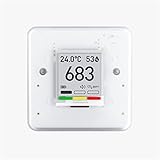
Aranet4 Indoor Monitor
- NDIR CO2 sensor
- Up to 4 years on two AA batteries
- E-ink display readable in any light
- 90-day local history with CSV export

GoveeLife H5106
- PM2.5
- temperature and humidity
- 2-second refresh rate
- LED display with 4 air quality levels
- 2-year data export
Two things separate these three from everything else here. First, all three sensors measure something directly rather than inferring it. The Corentium uses a dedicated radon sensor, the Aranet4 uses a non-dispersive infrared sensor for carbon dioxide, and the GoveeLife uses a laser-based particle counter for PM2.5. Second, all three have owner histories long enough to trust the review averages rather than treat them as noise.
All 12 Monitors at a Glance in 2026
| Product | Specs | Action |
|---|---|---|
| Airthings Corentium Home Radon Detector |
|
Check Latest Price |
 Amazon Smart Air Quality Monitor Amazon Smart Air Quality Monitor |
|
Check Latest Price |
| Aranet4 Indoor Air Quality Monitor |
|
Check Latest Price |
 Airthings View Plus Radon and Air Quality Monitor Airthings View Plus Radon and Air Quality Monitor |
|
Check Latest Price |
| GoveeLife Smart Air Quality Monitor H5106 |
|
Check Latest Price |
 Temtop Portable CO2 Monitor Temtop Portable CO2 Monitor |
|
Check Latest Price |
 Safety Siren Pro4 Plug-in Radon Detector Safety Siren Pro4 Plug-in Radon Detector |
|
Check Latest Price |
 BREATHE Airmonitor Plus Gen 2 BREATHE Airmonitor Plus Gen 2 |
|
Check Latest Price |
 Kidde Smart CO Detector and Air Quality Monitor Kidde Smart CO Detector and Air Quality Monitor |
|
Check Latest Price |
 Ecosense RD200 Radon Detector Ecosense RD200 Radon Detector |
|
Check Latest Price |
 YNAK 16-in-1 Air Quality Monitor YNAK 16-in-1 Air Quality Monitor |
|
Check Latest Price |
 AEGTEST HOUND-1011S Portable Radon Detector AEGTEST HOUND-1011S Portable Radon Detector |
|
Check Latest Price |
Every product above falls into one of three camps: a single-purpose radon detector, a carbon dioxide meter, or a multi-pollutant monitor. Radon-only devices dominate the long-run accuracy because the sensor has one job and no firmware juggling between jobs. Multi-pollutant devices win on convenience and lose on the fact that each sensor gets a smaller slice of the device’s attention.
1. Airthings Corentium Home Radon Detector – Best Overall and Best for Radon
Airthings Corentium Home Radon Detector 223 Portable, Lightweight, Easy-to-Use, (3) AAA Battery Operated, USA Version, pCi/L
Dedicated radon sensor
Three AAA batteries
1 inch D x 2.7 W x 4.7 H
3.52 oz
ABS enclosure
Pros
- Accurate radon detection across long monitoring windows
- Battery powered so no outlet or wiring is needed
- Battery life of 2 years or more
- Shows 1-day
- 7-day and long-term averages
- No calibration needed over a 10+ year lifespan
Cons
- Short-term readings vary between devices by 20-30 percent
- High humidity can push the display to 0.000
- No USB or computer interface for exporting data
This is the unit I put in my own basement and the one I would hand to a friend who has just moved into an older house. It measures one thing, radon, and it does it without an app, an account or a subscription. The screen shows the current reading plus 1-day and 7-day averages, and the long-term average is what you eventually care about because radon levels swing with weather and barometric pressure.
What stood out after weeks of reading it was how quickly it stopped feeling like a gadget and started feeling like a smoke alarm. You set it on a shelf, glance at it once a week, and if the long-term number creeps toward the 4 pCi/L mark you know your mitigation fan needs a look. Owners frequently report using it to confirm whether a sub-slab depressurization system actually fixed the problem, which is the single most useful thing a radon monitor can do.
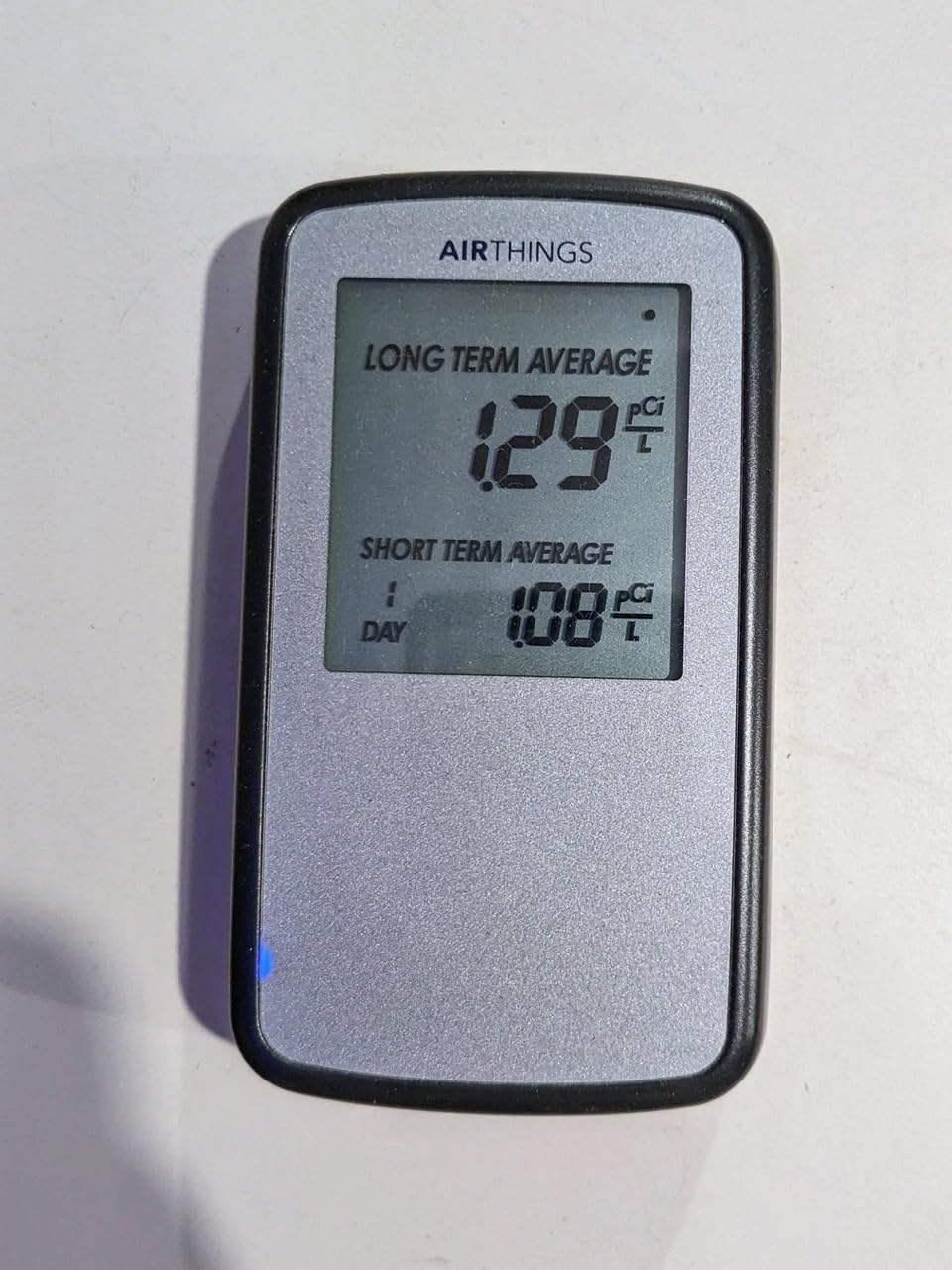
The honest limitations are real but narrow. Radon readings on different devices can diverge by 20 to 30 percent in the short term, though they converge as the averages build, so do not panic at a single spike. In a very humid space the sensor can read 0.000, which is usually a moisture artefact rather than genuinely clean air. And there is no USB port or computer interface at all, so if you want a decade of radon data as a spreadsheet you will be reading numbers off a screen.
Airthings also offers a 5-year extended warranty on its air quality monitors, free with registration within 30 days of purchase, which is a meaningful offset on a device expected to run for a decade. The ABS enclosure and 3.52 ounce weight mean it can move between rooms as you map which floor of the house is worst, and the operating humidity rating of 95 percent gives you room to use it in a laundry room or crawlspace.
Who the Corentium suits
This is the right pick if you have never tested for radon, live in a region with known radon potential, have a finished basement or ground-floor sleeping area, or have just had a home energy audit done. Radon is the second leading cause of lung cancer in the United States, and it seeps up through concrete slabs and foundation cracks regardless of whether you have a basement, so a rental or a first-floor apartment is not an exemption.
It also suits anyone who wants a number they can act on without learning any software. There is nothing to log into and nothing to configure. If your long-term average lands under 4 pCi/L you can put it back on the shelf and forget about it for another year.
Who should skip the Corentium
Skip it if you want carbon dioxide, particulate matter or VOCs, because the device measures none of those and never will. People who want a phone app with charts and alerts will be disappointed by the missing export, and anyone running a humid garage or pool room will see the humidity sensitivity work against them. For those cases, look at the Aranet4 for CO2 or the BREATHE Airmonitor Plus for formaldehyde.
2. Amazon Smart Air Quality Monitor – Best for Alexa Automations
Amazon Smart Air Quality Monitor, Detects temperature, humidity, carbon monoxide, PM2.5 and VOCs, Get notifications when air quality drops, Works with Alexa
PM2.5, VOCs, CO, humidity, temperature
Color-coded LED
Alexa app and routines
Plug-in power
2.4GHz Wi-Fi
Pros
- Quick setup once the Alexa app is installed
- Tracks five metrics in one plug-in unit
- Routines can trigger purifiers and fans automatically
- Phone and Echo alerts when air quality drops
- Accurate temperature and humidity readings
Cons
- No standalone app outside the Alexa ecosystem
- Bright red alert LED cannot be disabled
- No data export and shallow graph history
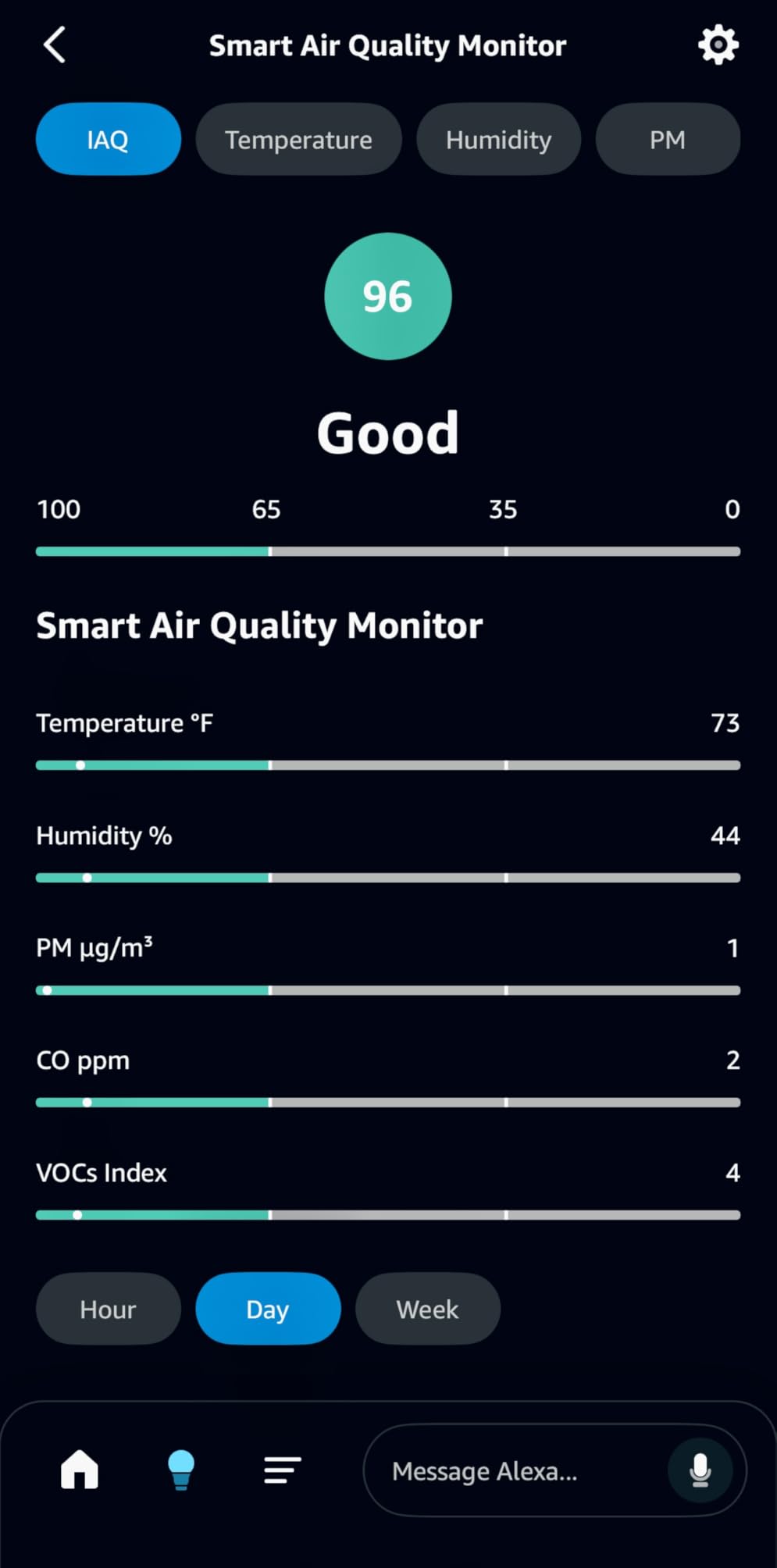
If your whole house already runs on Alexa, this monitor drops into routines with almost no friction. The Amazon Smart Air Quality Monitor tracks PM2.5, VOCs, carbon monoxide, humidity and temperature, then feeds a single air quality score into the Alexa app that other devices can read. When the score drops, a routine can turn on a purifier, start a fan or push a notification to every Echo in the house.
That automation angle is what separates it from cheaper PM2.5 sticks. I found the temperature and humidity readings to be the most trustworthy numbers on the device, and it responds quickly to cooking, cleaning sprays and candle burning, which makes it genuinely useful as a trigger rather than a decoration. Setup is a matter of plugging it in and letting the app find it on a 2.4GHz network.
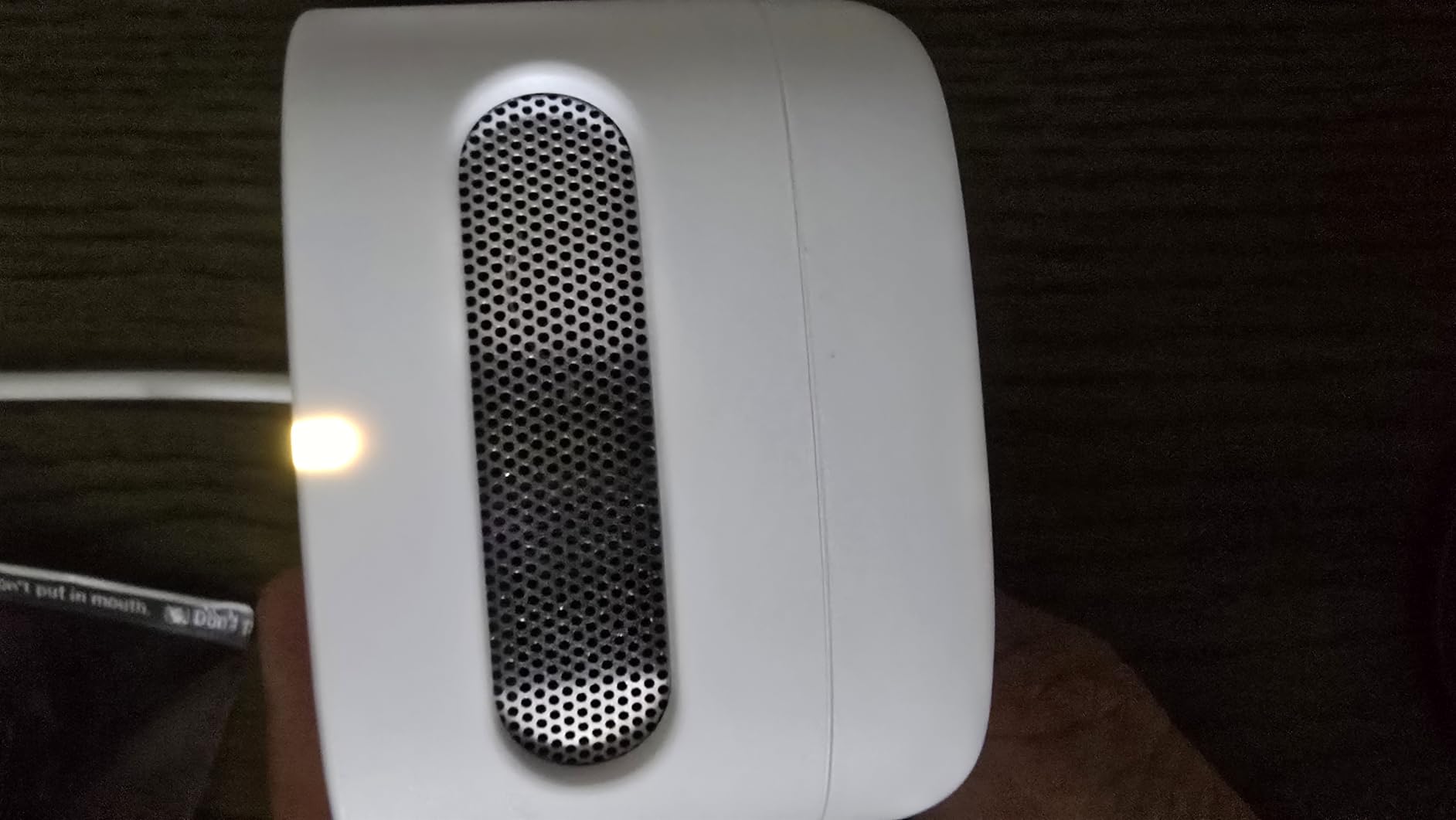
Now the part that annoys people, and it is not small. There is no standalone app, so if you ever leave the Alexa ecosystem your data goes with it, and there is no way to export readings to your own server. The bright red alert light cannot be switched off, which owners in bedrooms and nurseries complain about constantly. Historical graphing stops at a fairly shallow level, so you cannot pull a month or year view to compare seasons.
Several owners also report that alerts fire during normal cooking and cleaning, which trains you to ignore the notifications within a week. Setup occasionally takes more than one attempt, and because everything runs through the Alexa cloud there is no local access to readings if your internet drops. Reviewers raise fair privacy questions about data collection, and if that bothers you, the Aranet4 keeps everything on your phone over Bluetooth.
Who this monitor suits
It suits households already wired into Alexa, people who want air quality to drive automations rather than charts, and anyone who needs carbon monoxide coverage alongside particulate readings in a single plug-in box. It also pairs cleanly with the Amazon Smart Thermostat for temperature context. First-time buyers who want a device that just works with their phone get a lot here for the money.
Who should skip it
Skip it if you run Home Assistant, want local control, or plan to export data. Anyone with a sensitive room should know about the unstoppable red LED before buying. It also cannot see radon, which is the pollutant most likely to cause serious long-term harm in an average house, so it complements a radon detector rather than replacing one.
3. Aranet4 Indoor Air Quality Monitor – Best for Carbon Dioxide Accuracy
Aranet4 Indoor Air Quality Monitor, Wireless CO2 Detector for Home, Office
NDIR CO2 sensor
CO2, temperature, humidity, pressure
Two AA batteries, up to 4 years
E-ink display
2.76 x 2.76 x 0.94 inches
Pros
- NDIR CO2 sensor with strong accuracy
- Up to 4 years of battery life on two AA cells
- E-ink screen stays readable in any light
- Bluetooth app stores 90 days locally and exports CSV
- No cloud account needed
Cons
- Measures no PM2.5
- VOC or radon
- Bluetooth only with roughly 6-8 meter range
- App slows down as history fills up
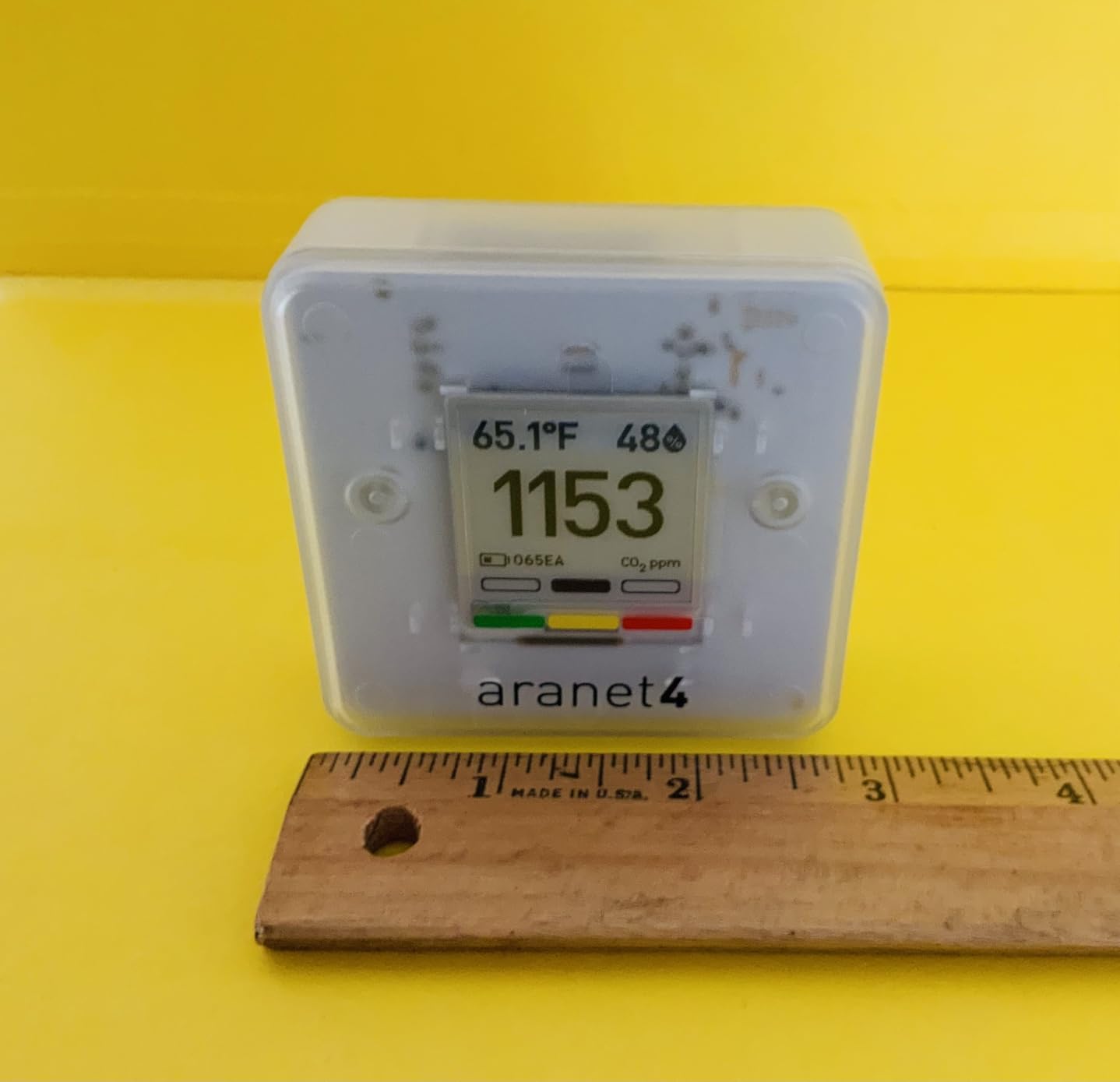
The Aranet4 has the highest average rating of anything in this roundup, and after living with one the reason is obvious: it measures carbon dioxide the correct way. A non-dispersive infrared sensor reads CO2 directly from the air rather than inferring it from volatile organic compounds, so the number you see in a closed bedroom at 3 a.m. is a real number. That single design decision is what separates it from the cluster of cheap meters that guess.
It is also the only device here that fits in a bag and works for years. Two AA batteries power it for up to four years, the e-ink display is readable in daylight and in the dark without a backlight, and it weighs 3.67 ounces. I used it in hotel rooms and on planes during my testing window, which is not something I can say about the plug-in devices. Bluetooth connects to a phone app that keeps 90 days of history locally and exports CSV for your own analysis.
The trade-offs are structural and worth stating plainly. There is no PM2.5 sensor, no VOC sensor and no radon sensor, so if particle spikes or radon are your concern this is the wrong tool. Bluetooth is the only radio on board, with a practical range of roughly six to eight meters, so remote readings from across the house are not happening. Owners note the app becomes sluggish once the history fills, the e-ink screen blanks momentarily during refresh, and there is no dark mode in the app.
Users in the PassiveHouse community tend to recommend it unprompted, and the accuracy reputation is well earned, but it costs more than most basic CO2 meters. The calibration process is straightforward, and the build quality is noticeably better than plastic gadgets in the same bracket. Made in the European Union, it feels like an instrument rather than a novelty.
Who the Aranet4 suits
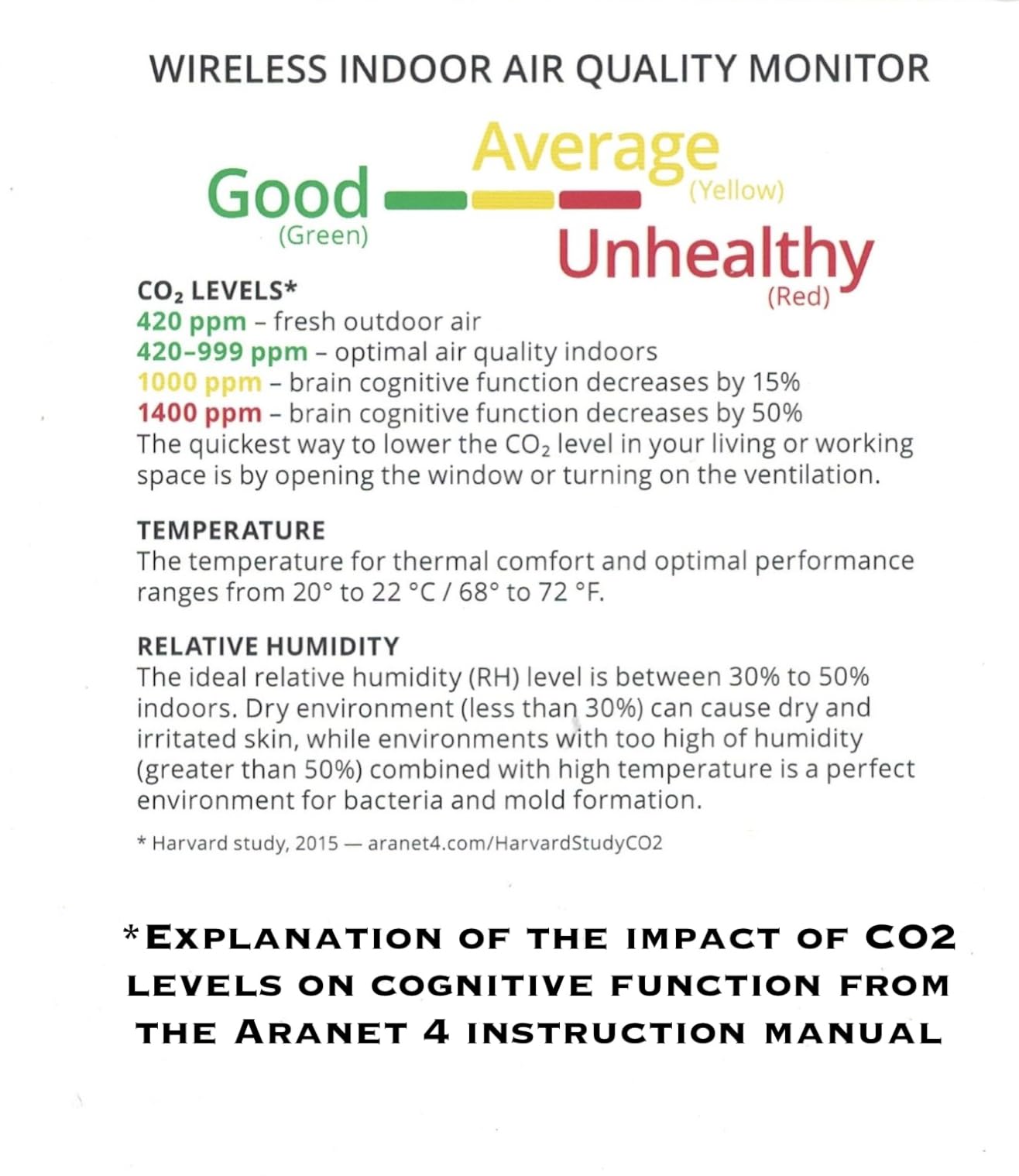
It suits anyone tracking ventilation in a bedroom, a home office or a meeting room where people accumulate and the CO2 climbs past 1000 ppm. It also suits renters who want a check that travels with them, and anyone who wants data that never leaves the phone. If you are chasing accuracy in the one measurement that directly tracks how stale a room is, this is the device.
Who should skip it
Skip it if you need Wi-Fi, remote access or automations, because there is no cloud and no network radio. It will not tell you about wildfire smoke, pollen, cooking fumes or radon, so it needs a partner device for those. Anyone planning to mount it permanently out of reach should note that the app only reads when the phone is within Bluetooth range.
4. Airthings View Plus – Best All-in-One with Radon and Wi-Fi
Airthings 2960 View Plus – Battery Powered Radon & Air Quality Monitor (PM, CO2, VOC, Humidity, Temp, Pressure)
Radon, PM2.5, CO2, VOC, humidity, temp, pressure
Six AA batteries or USB-C
WiFi dashboard and alerts
4 inch D x 4 W x 2 H
5.76 oz
Pros
- Seven measurements including radon in one unit
- Works as a hub for other Airthings devices
- No subscription for full app and dashboard features
- USB-C option for continuous power
- Web dashboard plus mobile app
Cons
- Battery life often falls short of the 2 year claim
- WiFi connection drops reported by some owners
- Outdoor weather defaults to Oslo with no easy change
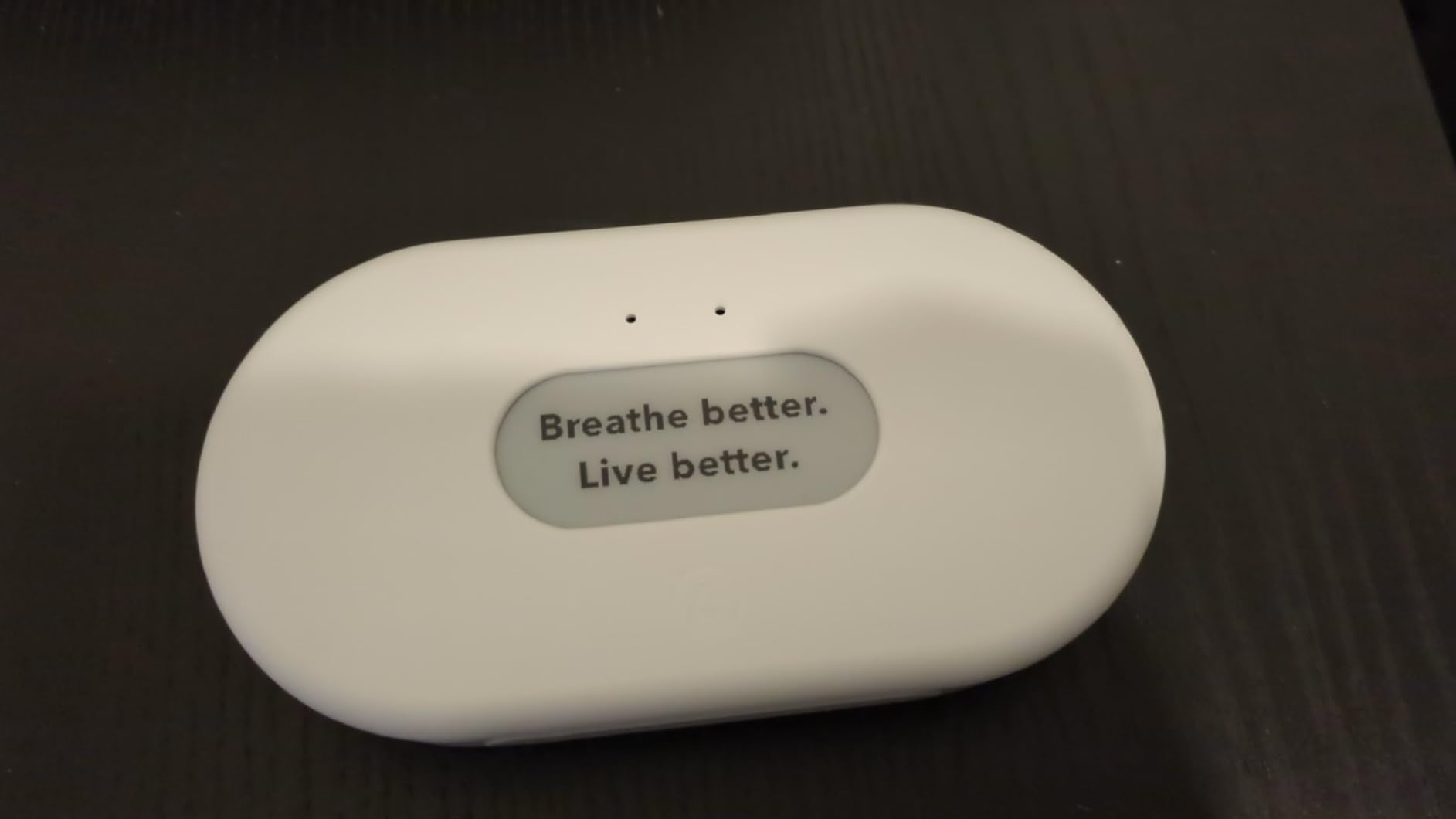
The View Plus is the only device here that measures radon and six other things at once while staying connected to your network. Radon, PM2.5, carbon dioxide, VOCs, humidity, temperature and atmospheric pressure all appear on the customizable eInk display and in the Airthings app and web dashboard. If you want one box instead of two, this is the one, and it also acts as a hub for other Airthings devices such as the Wave series.
The radon sensor is the reason to buy it, and owners repeatedly report that its readings line up with professional equipment, which is not a claim most consumer electronics can make. There is no subscription, so every dashboard feature is available from day one. You can run it on six AA batteries for roughly two years or keep it plugged in over USB-C, which is the better plan for a permanent main-floor installation.
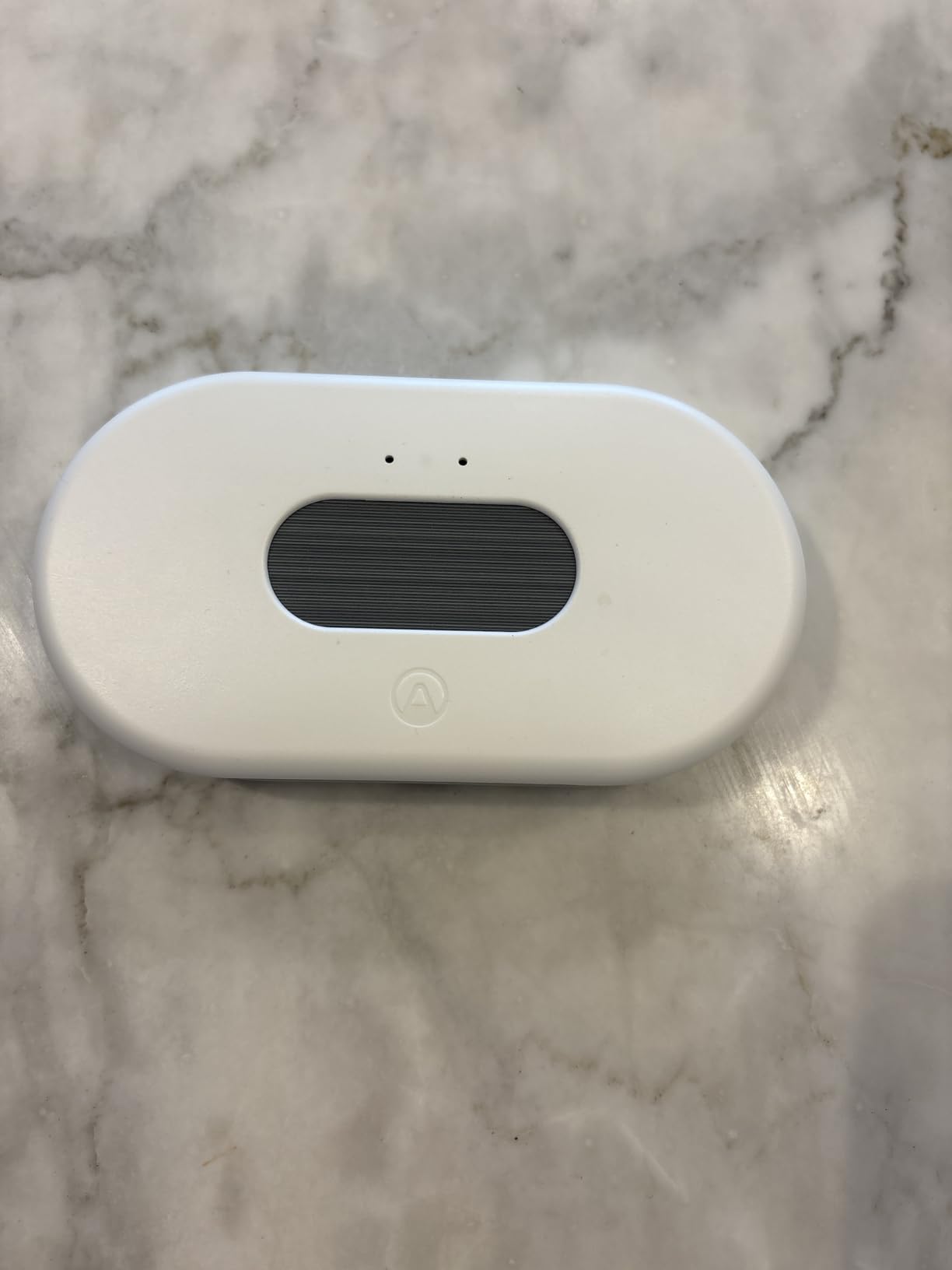
It is also the most expensive unit in the roundup and the most software-dependent, and that is where the 4.0 average comes from. Battery life is the top complaint, with owners reporting anywhere from 75 to 120 days on the AA cells rather than two years. Wi-Fi reliability is the second, with some devices dropping off networks and needing a restart. The CSV export has fixed headers and UTC timestamps, renaming a location resets historical data, and the outdoor weather panel defaults to Oslo with no obvious way to change it.
Temperature accuracy draws complaints from a subset of owners, and alert thresholds cannot be customised. Support responses are uneven, which matters for a device you may keep for a decade. On the Home Assistant side, users report the Airthings integration relies on cloud polling rather than local connection, which is a real limitation if you want readings on your own network.
Who the View Plus suits
It suits homeowners who want radon and full air quality in one permanent unit and who do not mind the highest outlay in the list. It works well on mains power with a wall outlet in reach, and the hub function makes it a sensible anchor if you plan to add Airthings devices later. Users also appreciate that no feature is held back behind a paid tier.
Who should skip it
Skip it if you are on a strict budget, if you need local smart home control without a cloud dependency, or if you cannot plug it in. Anyone who has had trouble with consumer Wi-Fi gear will probably have trouble with this. If radon is your only concern, the Corentium does the same job at a fraction of the complexity.
5. GoveeLife Smart Air Quality Monitor H5106 – Best Value
GoveeLife Smart Air Quality Monitor with PM2.5 H5106, LED Display Wired
PM2.5, temperature, humidity
PM2.5 accuracy plus or minus 15 ug/m3
2-second refresh
LED display with 4 levels
5.31 x 1.57 x 2.47 inches
Pros
- Low cost for continuous PM2.5 tracking
- 2-second refresh catches cooking and cleaning spikes
- 2-year data storage and export in the GoveeHome app
- Day and night display brightness modes
- Triggers GoveeLife purifiers and humidifiers
Cons
- Wired only with no built-in battery
- 2.4GHz Wi-Fi only so no 5GHz networks
- No CO2
- VOC or radon sensors
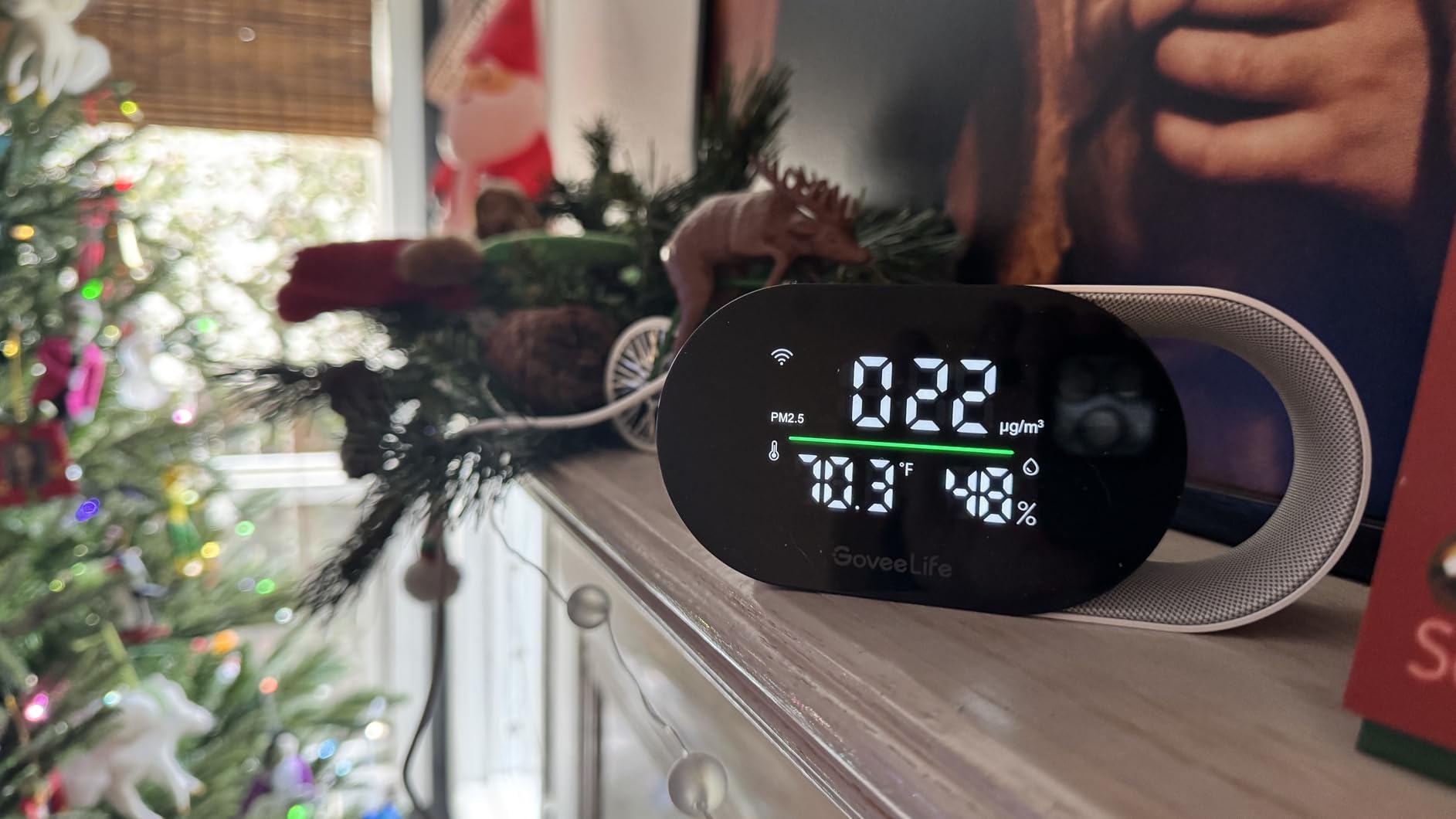
For the enormous number of people who simply want to know when the PM2.5 in their living room spikes, the H5106 does the job and costs very little. It measures PM2.5, temperature and humidity with a stated accuracy of plus or minus 15 ug/m3 up to 100 ug/m3, and it refreshes every two seconds, which is fast enough to catch the moment you start cooking rather than telling you about it an hour later.
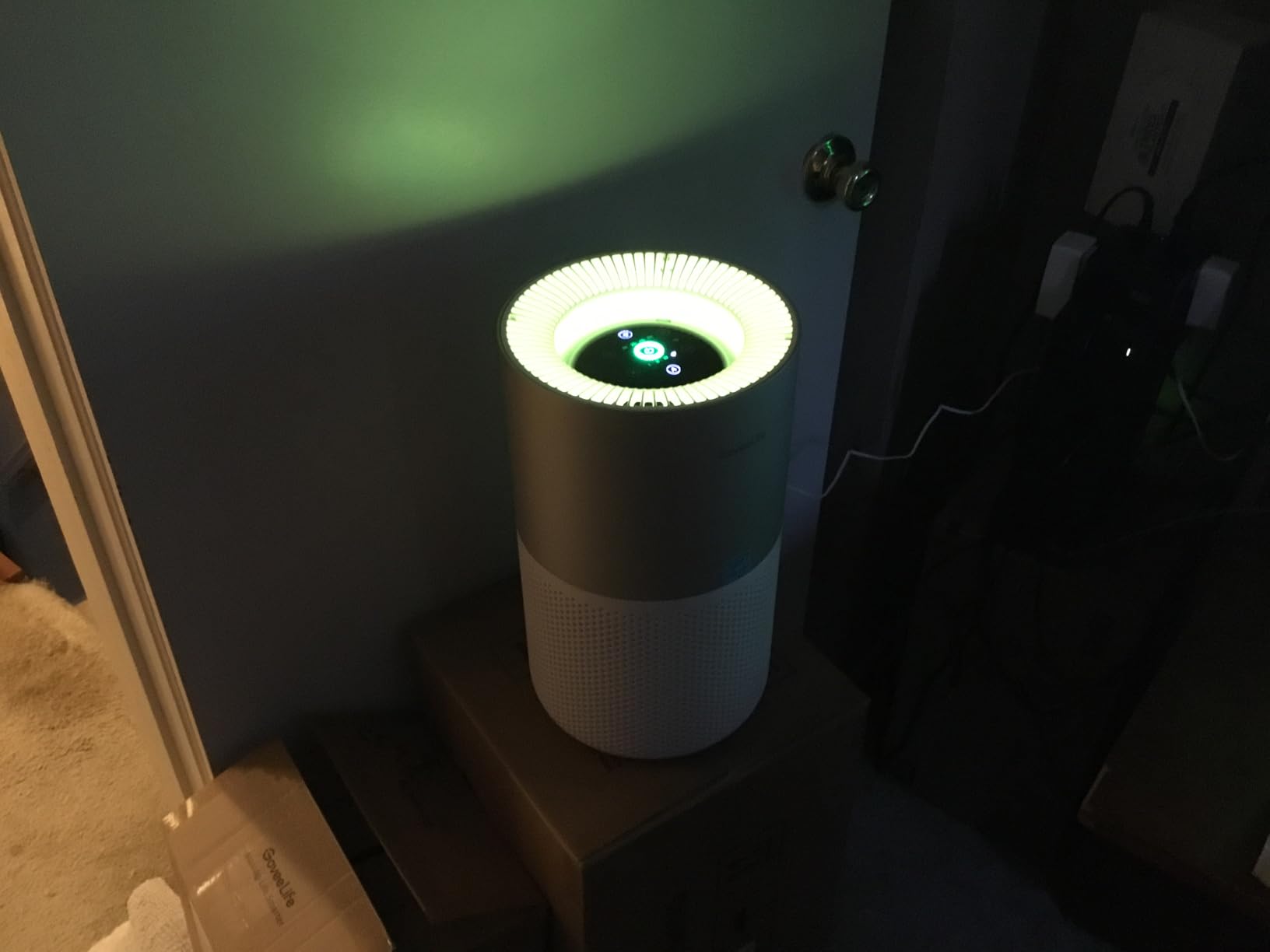
The LED display shows a four-level air quality indicator and can switch between clock and PM2.5 modes, with day and night brightness settings so it is not glowing across a dark room. In the GoveeHome app you get graphs and two years of exportable history, which is more retention than most devices twice the size offer. It also ties into GoveeLife purifiers, humidifiers and fans for basic automation.
What you give up is everything beyond particulates. There is no carbon dioxide, no VOC and no radon sensing, so this is not a ventilation monitor and does not pretend to be one. It is wired with a Type-C cable and has no built-in battery, which is fine for a shelf but rules it out for spot checks around the house. The radio is 2.4GHz only, so if your router has that band split onto a separate network you will have to move it back.
Some owners report the included Type-C cable being absent in the box, and everything depends on the GoveeHome app and cloud for logging, so there is no local access. At 5.44 ounces and 5.31 by 1.57 by 2.47 inches it is small enough to hide on a shelf and forget, which is arguably its best feature.
Who the H5106 suits
It suits first-time buyers, renters, anyone with allergies or asthma who wants a cheap always-on PM2.5 alarm, and households already running GoveeLife appliances. It also makes sense for a single room where you want a glanceable number without opening an app. If your concern is smoke, pollen or dust, this covers it well for the money.
Who should skip it
Skip it if you need to know about CO2, VOCs or radon, because none of those are measured. Anyone without a permanent outlet nearby will find the wired design limiting. Privacy-minded users should note that there is no local control without the app and cloud, so pair it with a local-first device if that matters to you.
6. Temtop Portable CO2 Monitor – Best Budget Carbon Dioxide Meter
Temtop CO2 Monitor Indoor air Quality Monitor Portable CO2 Meter, CO2, Temperature, Humidity Home, Office or School
Swiss NDIR CO2 sensor
400 to 5000 ppm range
Accuracy plus or minus 40 ppm plus 5 percent
70-day battery
USB rechargeable
Pros
- True NDIR CO2 sensing at a low price
- 70-day battery life for portable checks
- Accuracy of plus or minus 40 ppm plus 5 percent
- Alerts can be silenced for sleeping rooms
- 5-second refresh with 1 ppm resolution
Cons
- Standalone device with no app or wireless link
- No data logging or export
- Top of range caps at 5000 ppm
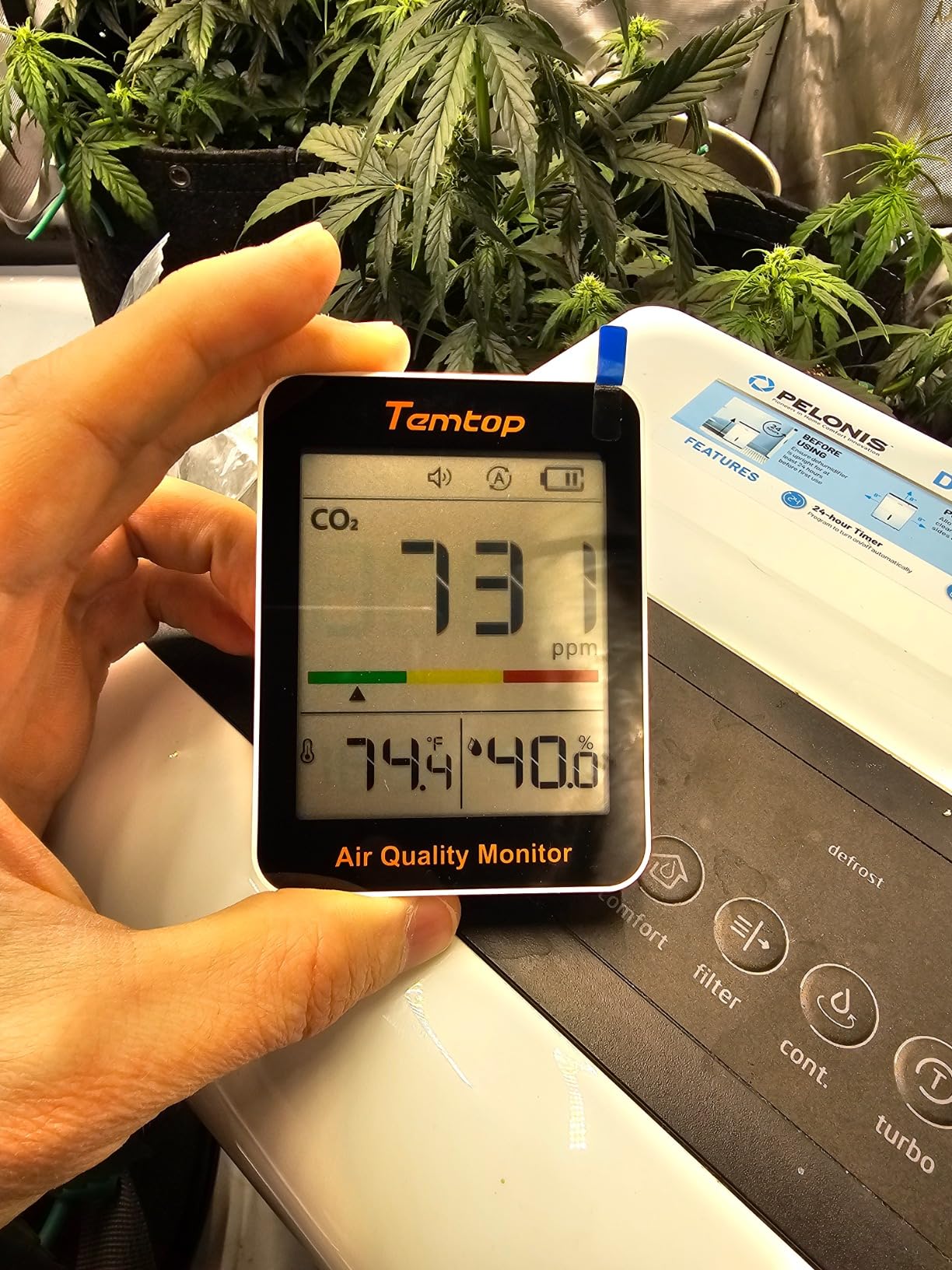
The Temtop C1 is the cheapest way on this list to get a genuine non-dispersive infrared carbon dioxide sensor. That matters more than it sounds: a large share of budget CO2 meters estimate the value from VOC readings instead, and those estimates drift badly in a room with no recent cooking. This one reads CO2 across a 400 to 5000 ppm range with a stated accuracy of plus or minus 40 ppm plus 5 percent of the reading between 400 and 2500 ppm.
It is also genuinely portable. A photoacoustic sensor inside gives roughly 70 days of battery life, and a USB charging cable is included so you can top it up at a desk. Resolution is 1 ppm with a five-second refresh, which is more than enough granularity to watch a room recover after you open a window. Alerts are customisable on both audio and display, so you can silence the buzzer in a bedroom.
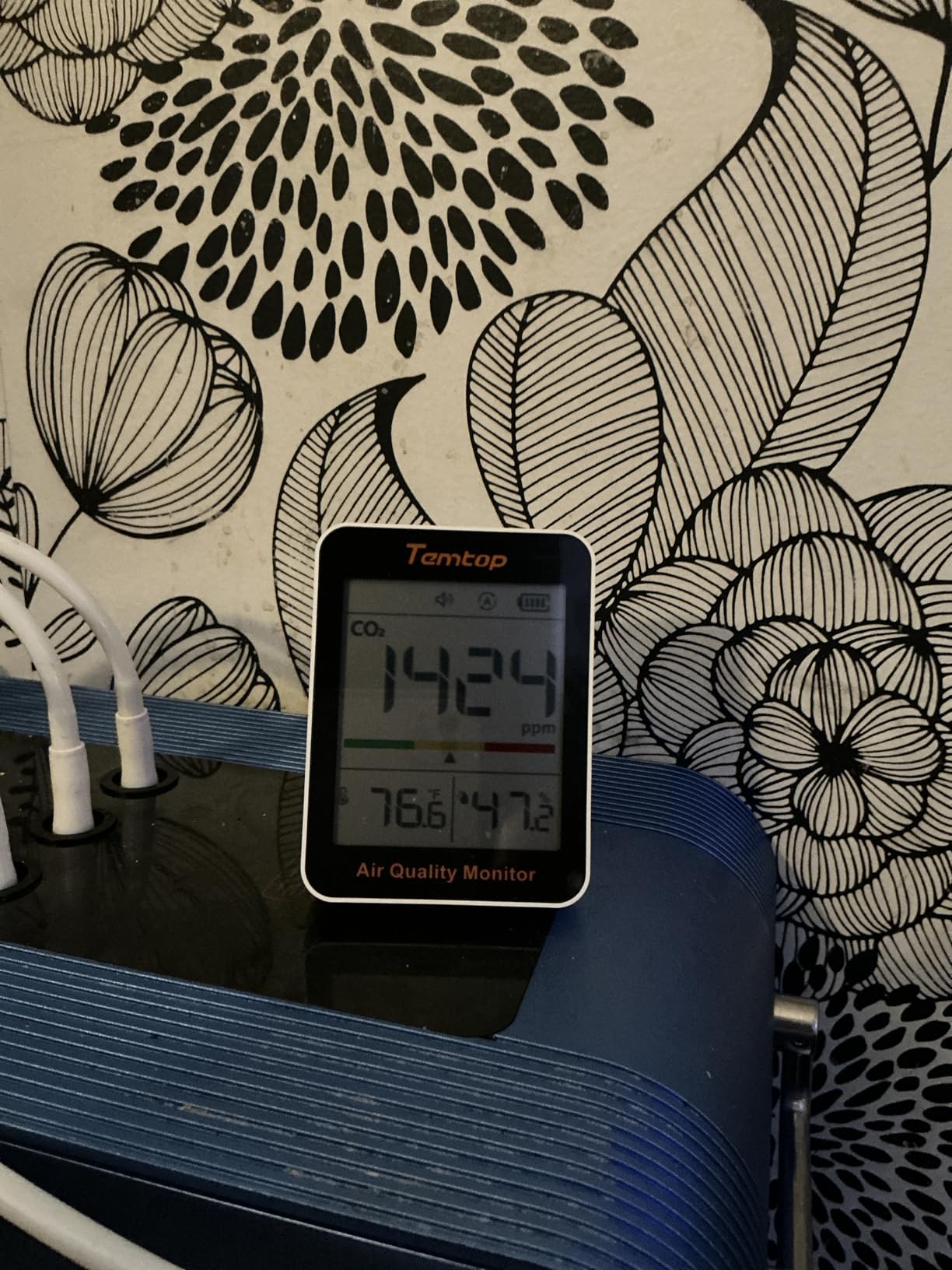
The compromises are about data rather than measurement. There is no Wi-Fi, no Bluetooth and no app, so readings stay on the device unless you write them down, and there is no logging or export at all. The 5000 ppm ceiling is lower than some meters and would saturate in an extreme scenario, though most homes never approach that. The display is small enough that some users find it hard to read from a distance, and the listed sensor type of photoelectric has left some buyers questioning the NDIR claim, though measured readings track reference devices well.
At 4.96 ounces and 5.51 by 1.26 by 4.09 inches it mounts in several orientations, which helps if you want to check a bedroom, then a basement, then a nursery with the same device. Treat it as an instrument you consult rather than a dashboard you watch.
Who the Temtop suits
It suits anyone who wants a real NDIR CO2 reading without spending much, people moving between rooms to test ventilation, and households looking for a simple standalone instrument with no accounts or apps. It is a good fit for renters who cannot install anything permanent and for anyone who dislikes giving their air data to a cloud service.
Who should skip it
Skip it if you want charts, history or automation, because none of that exists here. Anyone tracking a room over weeks needs a logging device. It also tells you nothing about particulates, VOCs or radon, so treat it as one instrument in a set rather than a complete answer to indoor air quality.
7. Safety Siren Pro4 Plug-in Radon Detector – Best for Basement Alarms
Safety Siren Pro4 Series Plug-in Radon Detector for Home Basement & Office
Continuous radon monitoring
Short and long-term averages
Audible and visual alarms with three modes
Plug-in AC power
1.5 inch D x 3.5 W x 4.5 H
Pros
- Readings match professional radon equipment
- Made in the USA since 1993
- No app
- Wi-Fi or subscription to set up
- Audible and visual alarms in three modes
- Backlit display readable in dark basements
Cons
- Plug-in only with no battery backup
- No remote monitoring or data export
- Needs about 48 hours for a first reading
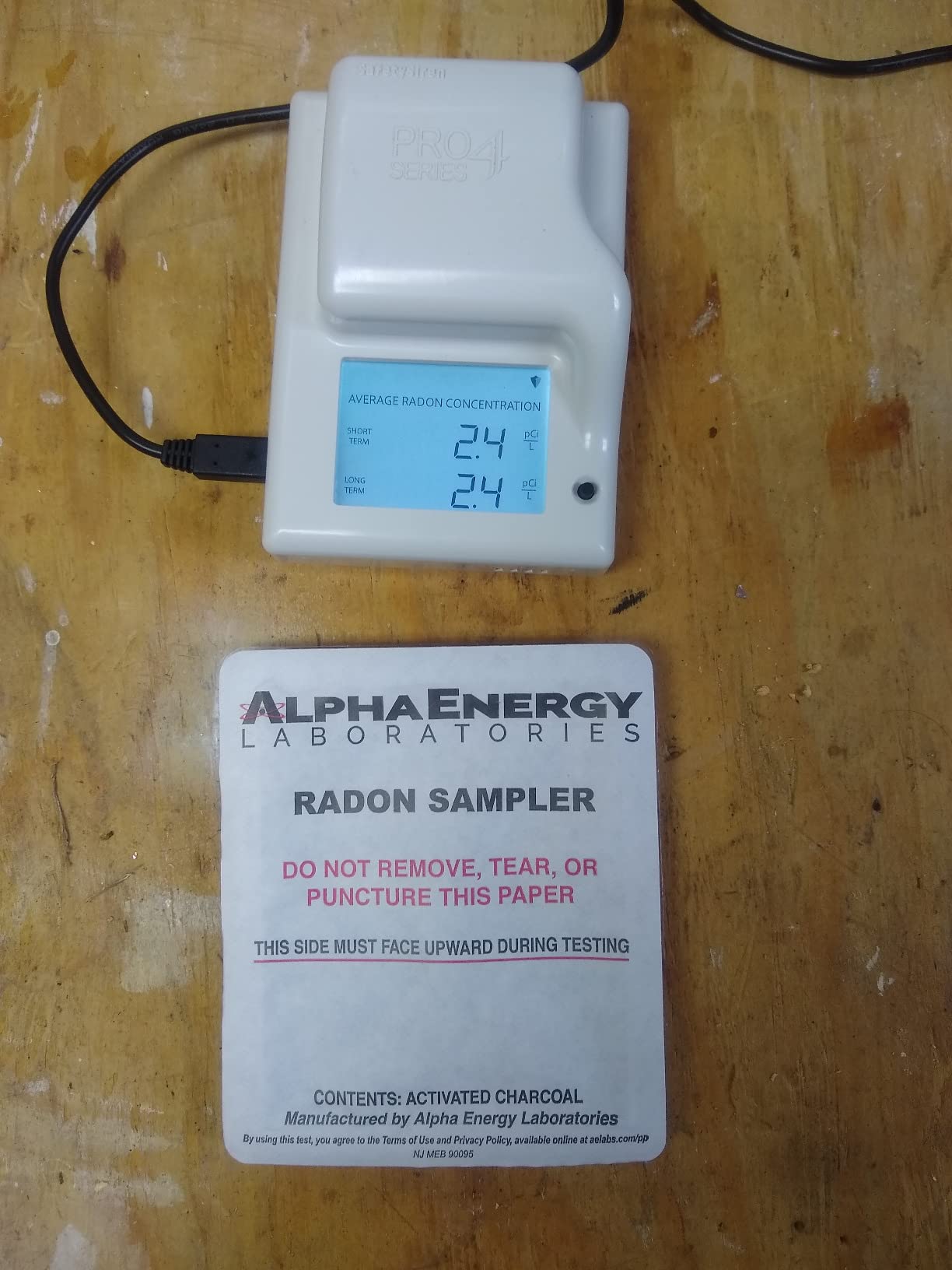
Where the Corentium is the portable choice, the Safety Siren Pro4 is the set-and-forget choice. It plugs into a wall outlet, runs a daily self-test, and displays both short-term and long-term radon averages on a backlit screen you can read in an unlit basement. Three selectable alarm modes cover audible and visual alerts depending on how much noise the household tolerates.
Accuracy is the headline. Owners consistently report the readings lining up with professional radon testing equipment, and Family Safety Products has been making detectors in the United States since 1993, which is a meaningful track record in a category where cheap imports dominate. There is no app, no Wi-Fi and no subscription, so nothing to set up and no monthly cost for as long as you own it.
The plug-in design is the main compromise. If the power goes out there is no battery backup, and unlike battery devices that can be moved around, this one dies in place and may lose accumulated data. There is no remote monitoring, so you only see readings when you walk down to it, and no data export if you want a long record. It measures radon and nothing else, and it should be kept away from humid spaces given the 95 percent operating humidity ceiling.
Expect to wait for the numbers. A first reading takes about 48 hours and roughly seven days for the reading to stabilise into something you can act on. The corded connector has drawn complaints from owners who prefer the sturdier feel of older models, though the enclosure is solid ABS and the daily self-test gives real peace of mind in a space nobody else enters.
Who the Pro4 suits
It suits anyone with a basement, crawlspace or ground-floor bedroom who wants an alarm rather than a chart. It is the right call for households with small children or pets that might trigger a radon alarm and need you to actually respond. Anyone tired of radon apps and accounts will like that it does one job without a subscription.
Who should skip it
Skip it if you want to check radon from your phone or get alerts while away, because neither is possible. People living in humid coastal or tropical climates should consider the humidity limits. If you need a full pollutant picture rather than a single number, the Airthings View Plus covers radon plus six other measurements.
8. BREATHE Airmonitor Plus Gen 2 – Best for Formaldehyde Tracking
BREATHE Airmonitor Plus Indoor Air Quality Monitor w/CO₂, PM & App. Gen 2.
CO2, PM1, PM2.5, PM10, TVOC, HCHO, temperature, humidity
NDIR CO2 and laser particle sensing
6-hour battery or USB-C
90-day history with CSV export
Color display
Pros
- Eight measurements including formaldehyde
- NDIR CO2 paired with laser particle sensing
- 90-day history with CSV export in the app
- Configurable CO2 and PM2.5 alert levels
- 2-year manufacturer warranty
Cons
- 6-hour battery is too short for real portability
- 2.4GHz Wi-Fi only
- Mixed reports on accuracy and reliability
Formaldehyde is the pollutant almost nobody measures and almost everybody is exposed to, coming off new furniture, flooring, upholstery and renovation finishes. The BREATHE Airmonitor Plus Gen 2 is one of only two devices in this roundup with a dedicated formaldehyde sensor, joining the large-display unit further down. Its full list is eight measurements: carbon dioxide, PM1, PM2.5, PM10, TVOC, HCHO, temperature and humidity.
Under the hood it pairs a real NDIR CO2 sensor with laser particle sensing rather than an estimate, and the app keeps 90 days of history with CSV export. CO2 and PM2.5 alert thresholds are configurable, so you can set it to warn you at the level that matters for your household instead of a generic trip point. The colour display and compact 4-ounce body make it easy to place, and a two-year manufacturer warranty covers the parts most likely to give you trouble.
The 6-hour battery is the feature that undermines the marketing. It is described as portable, and it is, for moving between rooms or taking to an office, but it is far too short for genuine portable use and you will end up leaving it plugged into USB-C most of the time, which is fine as long as you accept that. Connectivity is 2.4GHz Wi-Fi only, and the app is required for anything beyond the display.
Owners report mixed results on accuracy and reliability, with some devices experiencing connectivity problems. The 4.0 average reflects a device that does an unusual amount for its tier but does not always do it consistently, so cross-check it against a known good reference if you are making a health decision. Setup and app features also draw mild criticism as thin compared with the sensor list.
Who the Airmonitor Plus suits
It suits anyone in a newly renovated home, a recent furniture delivery, or a house with new carpets and cabinetry, where formaldehyde off-gassing is the concern. It also makes sense as a single device for someone who wants CO2, fine particles and VOCs together without buying two monitors. Buyers who want data they can analyse themselves will appreciate the CSV export.
Who should skip it
Skip it if you need true off-grid portability, because six hours is not enough. Anyone on a 5GHz-only network will have trouble pairing it. If radon is your priority, nothing here measures it, and if you only need a glanceable PM2.5 number the GoveeLife is simpler and cheaper.
9. Kidde Smart Carbon Monoxide Detector and Air Quality Monitor – Best for CO Safety
Kidde Smart Carbon Monoxide Detector & Indoor Air Quality Monitor, Plug-in, WiFi, Alexa Compatible Device, Voice & App Alerts
CO detector plus TVOC and humidity
Voice alarm naming the hazard type
Plug-in with battery backup
WiFi, Alexa and Google Home
10-year limited warranty
Pros
- Carbon monoxide and VOC sensing in one device
- Voice alarm names the type of hazard
- Plug-in power with battery backup
- Works with Alexa and Google Home
- QR code makes app setup quick
Cons
- Reported temperature errors of 5-15 degrees and humidity off by 10-20 percent
- TVOC values swing widely between readings
- Some devices stopped working after about five months
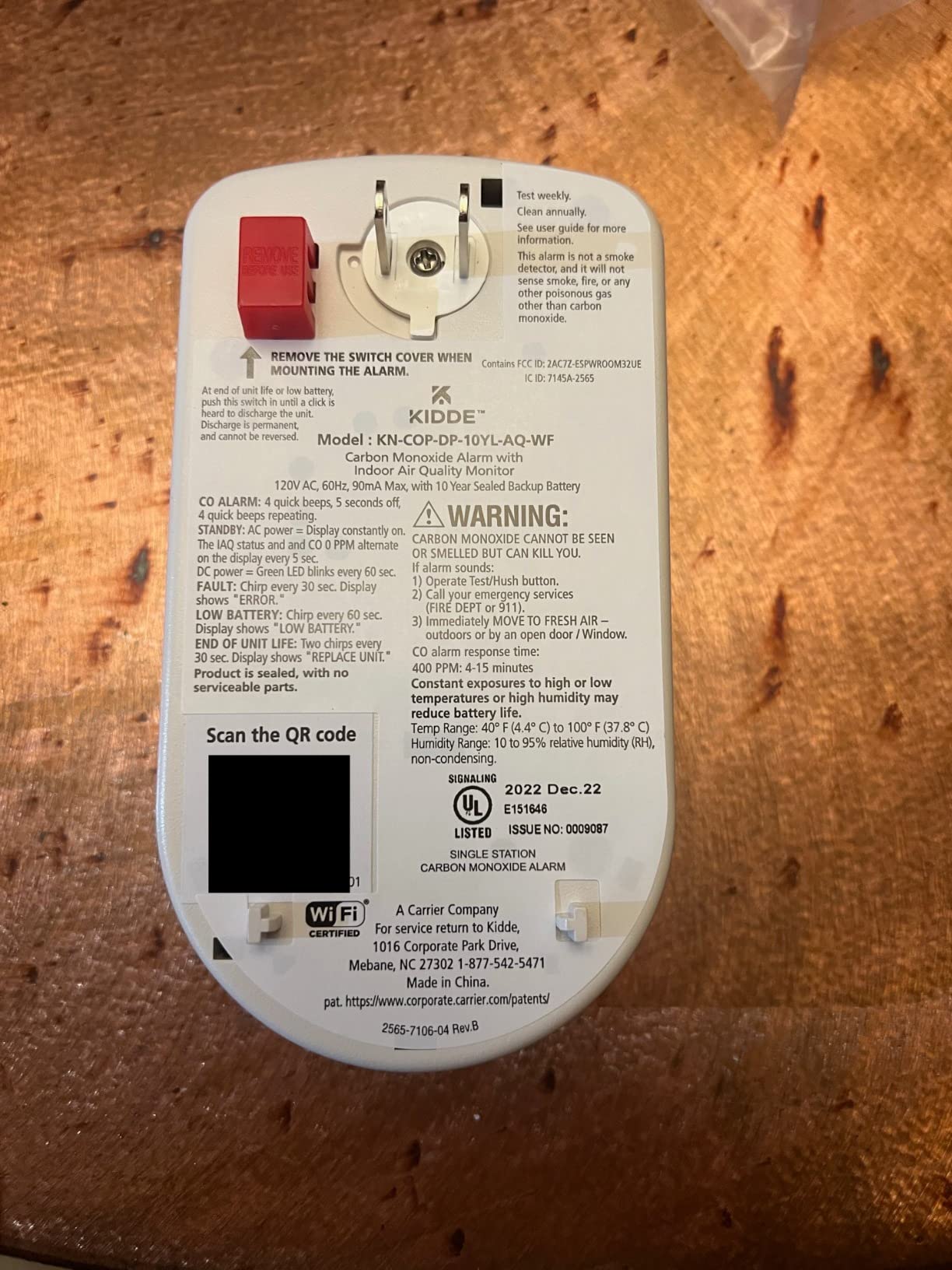
Carbon monoxide is the one pollutant where a wrong answer gets someone hurt, and this is the only all-in-one air quality monitor here with a genuine electrochemical CO sensor backed by a ten-year limited warranty from a long-established detector manufacturer. It plugs into a wall outlet with battery backup, connects over Wi-Fi, and works with Alexa and Google Home. The voice alarm announces which hazard triggered, which is genuinely useful when you are trying to find the problem at night.
The air quality side tracks volatile organic compounds from cleaning products and paint, plus humidity, and sends alerts when they spike. That combination makes it a decent second sensor in a nursery or a home office where a garage or combustion appliance might leak. Setup is quick with the QR code and the Kidde app, and it alerts you if the Wi-Fi connection drops so you do not lose the safety function silently.
The accuracy complaints are the serious part and I would not gloss over them. Owners report temperature readings off by 5 to 15 degrees and humidity off by 10 to 20 percent, TVOC values that swing wildly between readings, and devices on the same network that appear to share or sync data incorrectly. Several devices stopped responding after roughly five months, Wi-Fi reset procedures proved unreliable, and app connections broke after router changes.
The knock-on effect is trust: when the temperature and humidity sensors are visibly wrong, it is hard to believe the CO and VOC figures from the same box. Treat this as a supplementary VOC and humidity monitor and keep a dedicated CO alarm as your primary safety device, which is good practice regardless. Kidde support is praised by owners who have contacted it.
Who the Kidde suits
It suits households with an attached garage, a gas fireplace, a gas furnace or any combustion appliance, where CO plus VOC coverage in one box is convenient. Anyone already using Alexa or Google Home will find the alerts easy to receive. It also works well as a second opinion on humidity in a bathroom-adjacent space.
Who should skip it
Skip it if you want a lab-grade CO2 or PM2.5 number, since it measures neither. Buyers who have had reliability problems with connected safety devices should weigh the reported five-month failures carefully. It is not a radon monitor and does not replace a dedicated CO alarm in a bedroom or hallway.
10. Ecosense RD200 Radon Detector – Best for Fast Radon Readings
Ecosense Continuous Home Radon Detector, OLED Display, Bluetooth, RD200
Patented ion chamber radon sensor at 30 cph/pCi/L
First reading in 10 minutes
Updates every 10 minutes
OLED display
Bluetooth app with trend charts
Pros
- First reading arrives in 10 minutes instead of days
- 30 cph/pCi/L counting efficiency
- OLED display with audio alerts
- App charts short and long-term trends
- Accuracy validated by third parties
Cons
- Bluetooth only so the phone must stay in range
- Measures radon and nothing else
- 12-month warranty is shorter than rivals
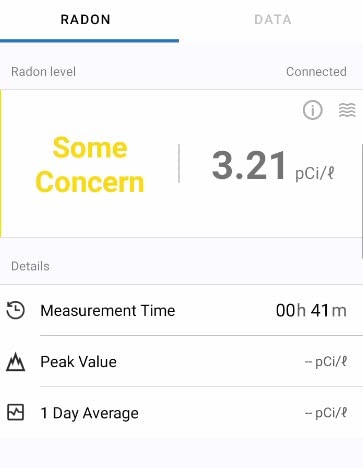
Patience is the worst part of radon testing, and the RD200 attacks that problem directly. It uses a patented ion chamber sensor with a counting efficiency of 30 counts per hour per pCi/L, which delivers its first reading in about ten minutes and then refreshes every ten minutes after that. Owners on Home Assistant forums consistently single it out as the fast, accurate radon-only option, and the OLED screen is bright and easy to read.
Compared with the Airthings Corentium, which can take days to settle into a meaningful number, a ten-minute reading makes it far more practical for moving a detector between rooms and mapping which part of a house is worst. Audio alerts trigger on high readings, and the free Bluetooth app draws short-term and long-term trend charts. Third-party validation has been performed on the sensor, which is unusual at this tier.
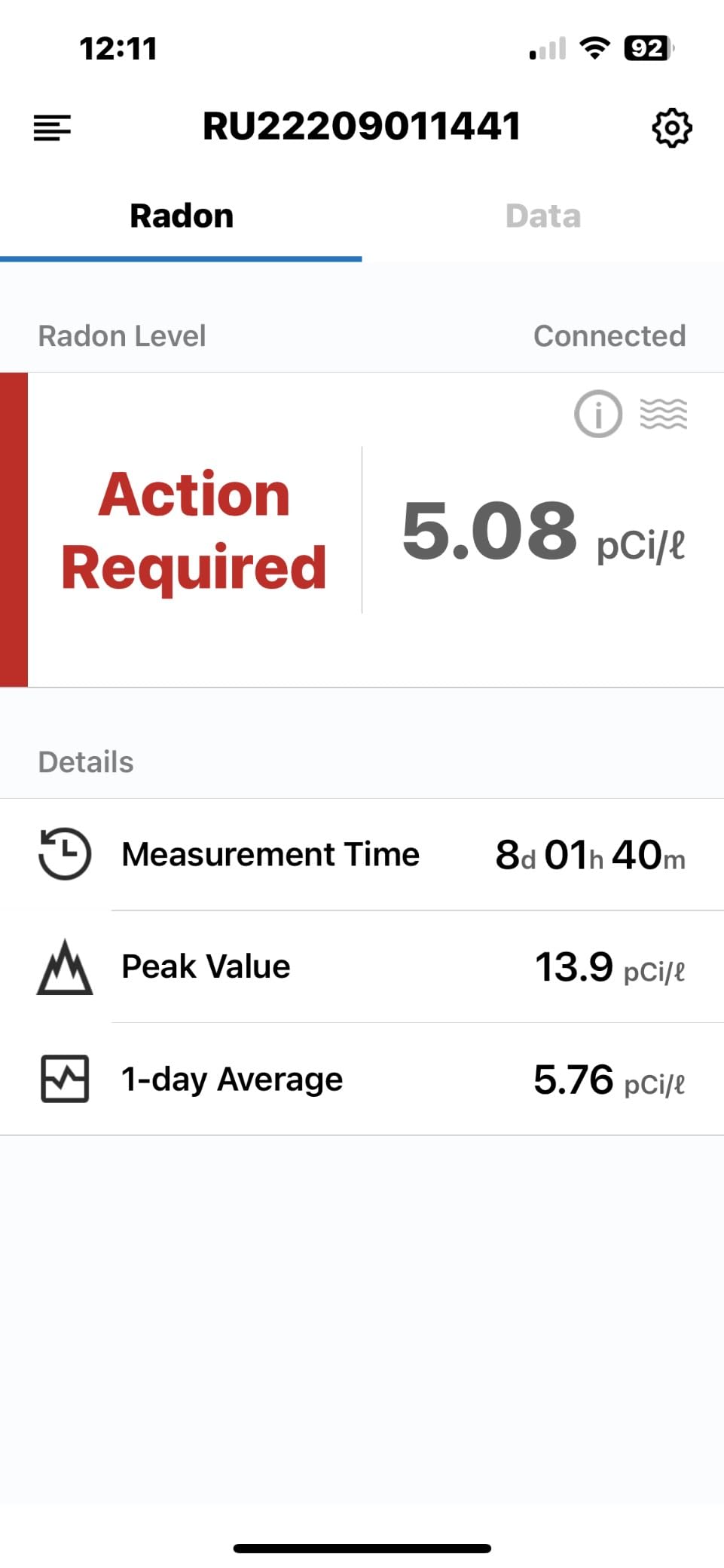
Bluetooth is the only radio, so the phone needs to be within range for app data, and there is no remote access or cloud. It is indoor use only, measures radon and nothing else, and the plastic construction feels lighter in the hand than the metal or ABS enclosures on competing devices. The 12-month limited warranty is the shortest in this roundup, which is a real consideration for a device expected to run continuously.
Users also note the app offers limited features compared with networked devices. That is a fair trade for local-only data, but it does mean the RD200 pairs well with a broader monitor rather than replacing one. At 3.15 by 3.94 by 4.72 inches and 240 grams it is the largest of the radon devices here, sized to house the ion chamber.
Who the RD200 suits
It suits anyone who wants a radon answer quickly, particularly people testing several rooms or floors in one weekend. It suits anyone who wants local data and no cloud account, and it works well alongside a Wi-Fi monitor because it covers the pollutant the Wi-Fi devices miss. If a professional test kit is still months away, this fills the gap usefully.
Who should skip it
Skip it if you need alerts from away from home or multi-pollutant readings. Buyers planning to keep a radon monitor for five years or more should note the 12-month warranty. Anyone needing a compact device will find it bulkier than the battery-powered Corentium.
11. YNAK 16-in-1 Air Quality Monitor – Best for a Large Display
16 in 1 Air Quality Monitor Indoor 7″ High-Precision Real-Time CO2 Monitor
CO2, PM1.0, PM2.5, PM10, HCHO, TVOC, temperature, humidity, AQI
7-inch LED display with 3 brightness levels
USB-C rechargeable with built-in battery
Seven AQI alert buzzers with mute
Model AK22A
Pros
- 9 measured parameters on a single screen
- 7-inch display readable from across a room
- Seven alert tones with a mute button
- Built-in battery with USB-C charging
- Reacts quickly to incense
- ointments and cooking
Cons
- Some devices report CO2 far from the true reading
- PM values often read low against reference monitors
- No app or data export mentioned
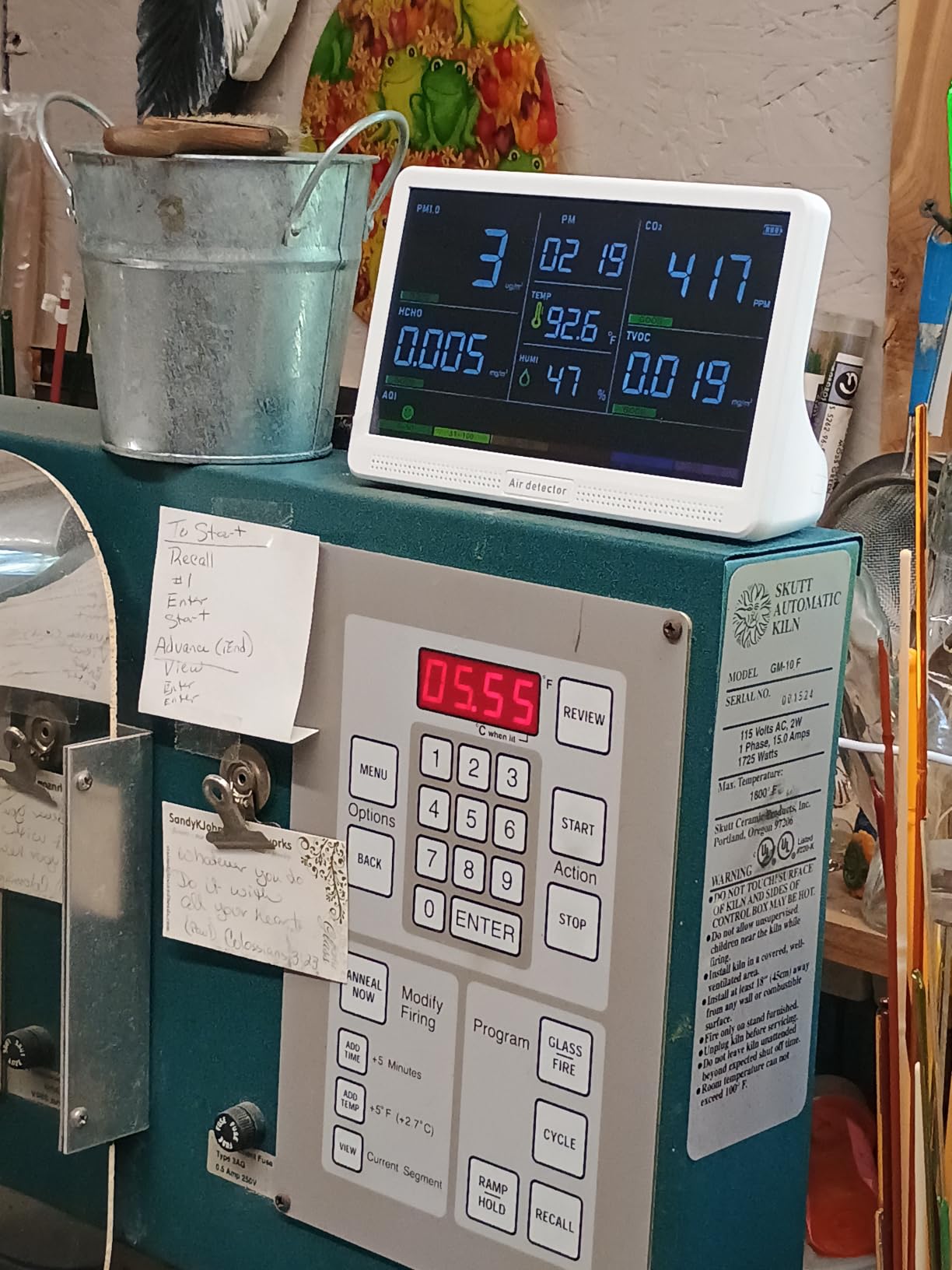
Most air quality monitors are designed to be glanced at from close range, which defeats the purpose if you want to know the state of your living room from the kitchen. The YNAK solves that with a 7-inch LED display and three brightness settings. It measures nine parameters, covering CO2, PM1.0, PM2.5, PM10, formaldehyde, TVOC, temperature and humidity, plus an AQI summary, and it includes seven distinct alert buzzers with a mute button.
Sensitivity is the genuine strength here. Owners report it picking up scented ointments, incense and cooking fumes almost instantly, which makes it a good kitchen and hobby-room monitor. The external high-precision sensors are rated at 0.001 accuracy, the built-in battery charges over USB-C, and colour-coded emoji indicators mean you can read the room status from a distance without decoding digits.
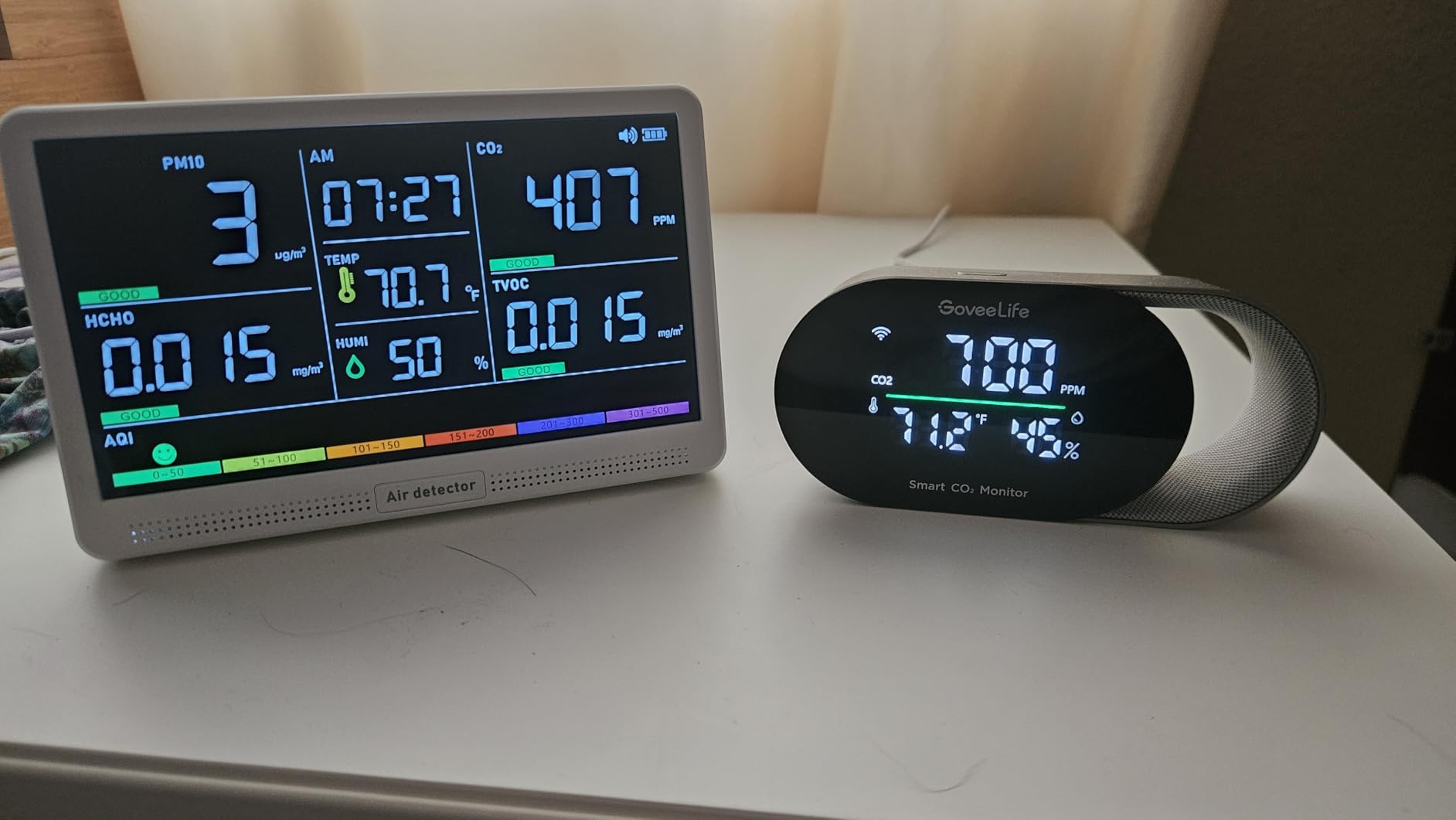
Accuracy is the problem, and it is not a small one. Multiple reviews describe devices reporting carbon dioxide at 400 ppm in rooms where other instruments showed well over 3000, and particulate readings that sit consistently low against reference monitors. Quality control appears inconsistent across devices, which is the usual signal on products with this many sensors in a body this size. If your decisions depend on precise numbers, cross-check it against another device before you act.
Temperature is Fahrenheit only with no Celsius option, there is undocumented Wi-Fi and mirror icons on the boot screen, the sleep timeout kicks in when unplugged, and no app or data export is mentioned. It is also the only device here that claims a 16-in-1 sensor count where most of the extra figure is alert categories rather than measurements.
Who the YNAK suits
It suits anyone who wants one glanceable screen in a busy kitchen, living room or craft space, and people who find small displays unreadable. It suits households that want formaldehyde and fine particle tracking together without extra hardware. It also works as a portable spot-check device thanks to the USB-C rechargeable battery.
Who should skip it
Skip it if accuracy matters more than screen size, because the reported CO2 and PM deviations are too wide to build a ventilation routine on. Anyone who needs data over time should note there is no app or export. It measures no radon either, so pair it with a dedicated radon detector.
12. AEGTEST HOUND-1011S Portable Radon Detector – Best for Long-Term Radon Records
AEGTEST HOUND-1011S Portable Radon Detector, High-Accuracy Sensor for Home, Lightweight, Audible & Visual Alarms, Long-Term Monitoring, Easy-to-Use Radon Tester in pCi/L or Bq/m³ for Basement
Semiconductor radon sensor from 0.09 to 1000 pCi/L
First results within 12 hours
Timeframes from 12 hours to 504 days
Switchable pCi/L and Bq/m3
Type-C continuous power
Pros
- Low cost way to screen a home for radon
- Results align with charcoal canister tests
- Shows timeframes from 12 hours to 504 days
- Switchable between pCi/L and Bq/m3
- Audible and visual alarms included
Cons
- Semiconductor sensor rather than an ion chamber
- All data is lost if the battery dies
- Readings can swing by several pCi/L within days
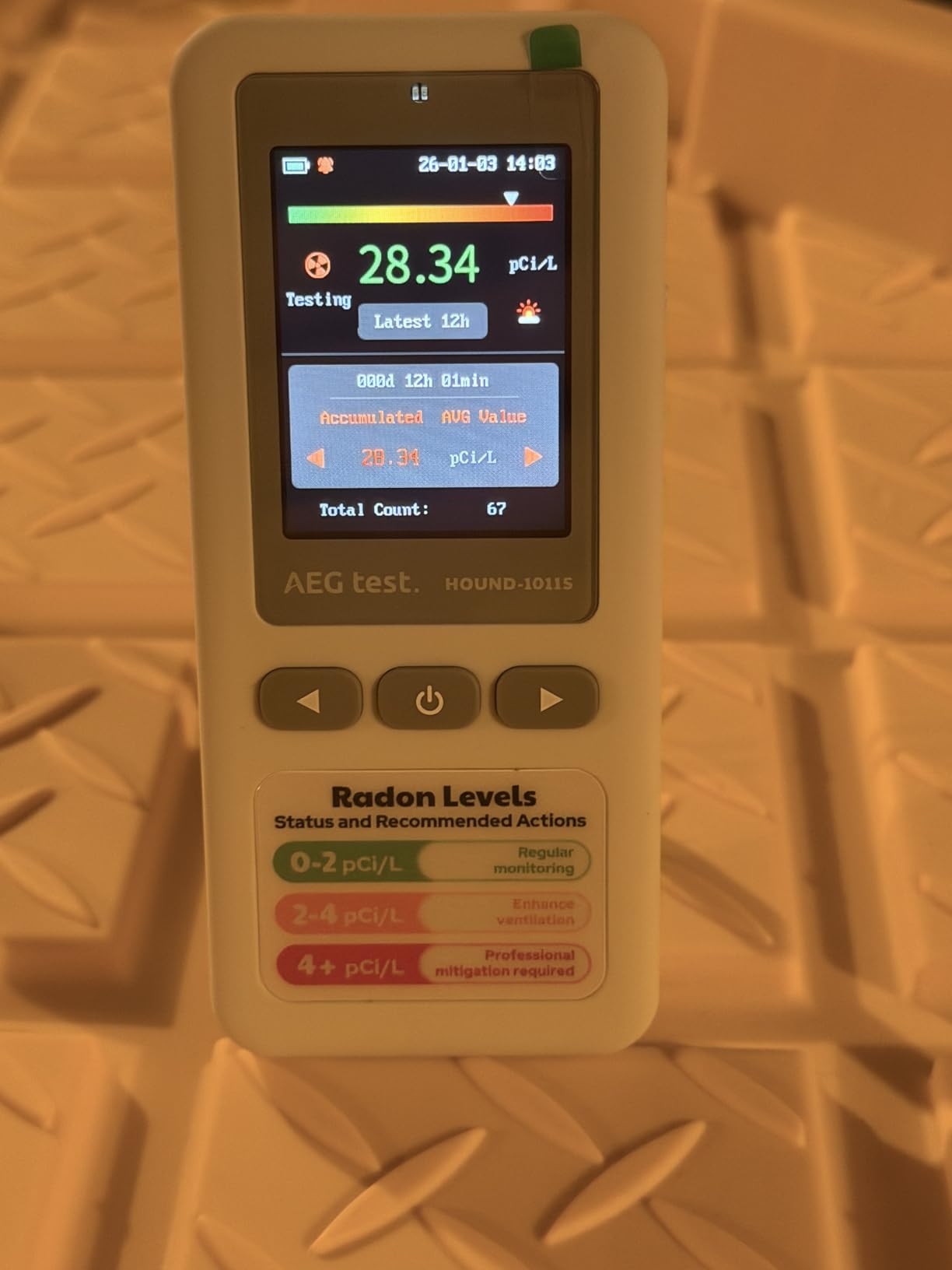
The HOUND-1011S covers a range no other device here touches. Its LCD shows 12-hour, 24-hour, 48-hour, 72-hour and 96-hour views, and it stores long-term monitoring up to 504 days, which makes it the best option on this list for building a proper record of how radon behaves across seasons in your home. Readings switch between pCi/L and Bq/m3, so it matches whichever standard your mitigation contractor uses.
It is also the most approachable radon detector here. First results appear within 12 hours with hourly updates thereafter, it weighs 0.28 kg, and the box includes a stand and lanyard. Type-C continuous power lets you keep monitoring indefinitely, and the built-in battery runs up to 45 days in sleep mode for short trips. Audible and visual alarms give you both notification styles.
The semiconductor sensor is the honest caveat. Professional-grade devices use ion chambers, and this one trades some stability for the lower cost, with some devices showing swings of three to four pCi/L across a few days. Owners frequently report results that match charcoal canister tests, so it is a legitimate screening tool, but it is not a substitute for a professional continuous monitor. Air the device out before first use to establish a clean baseline.
Data is lost entirely if the battery dies, which makes the 45-day sleep-mode limit a real risk for anyone planning a long unattended deployment. There is no Bluetooth, Wi-Fi or app connectivity at all, and the menu system makes stored data awkward to access. For those wanting remote monitoring or a trend graph, the Ecosense RD200 app is a better route.
Who the HOUND suits
It suits homeowners who want to screen several rooms cheaply, compare readings against charcoal canister tests, and keep a long record without paying for a subscription service. Anyone on a tight budget who suspects radon will find it the most affordable entry point. Buyers who need switchable measurement scales will appreciate the Bq/m3 option.
Who should skip it
Skip it if you need rock-steady readings for a health decision or a mitigation plan, because semiconductor sensors drift. Anyone leaving it unattended for months should be warned about total data loss when the battery goes. It also has no connectivity, so it is a poor fit for smart home users expecting alerts.
What You Need to Know Before Buying an Air Quality Monitor
Most buying mistakes come down to expecting one device to measure everything well. Here is what each measurement actually involves, and where the compromises hide.
PM2.5, PM10 and PM1 are the fraction of airborne particles below a given diameter, and PM2.5 is the one tied most directly to asthma and cardiovascular risk. Laser scattering counters are the standard and are what you want; budget devices that use a fan-free optical estimate are less trustworthy. If wildfire smoke or a sensitive family member is the concern, PM2.5 is the number to watch.
Carbon dioxide is not a pollutant at indoor levels but a proxy for ventilation. Outdoor air sits near 400 ppm; readings above 1000 ppm suggest a room needs fresh air. The key question is whether the sensor is a true NDIR unit reading the gas directly or a device estimating CO2 from VOC levels, which is why the Temtop and Aranet4 measure NDIR and several cheaper monitors do not.
VOCs and TVOCs come from paint, adhesives, cleaning sprays, furniture and candles. Most VOC sensors report a relative index rather than specific compounds, so treat the trend as more meaningful than the number. Formaldehyde is tracked separately by only the BREATHE Airmonitor Plus and the YNAK on this list, and it is worth the trouble if you have done recent renovation or bought new furniture.
Radon is the one nobody thinks about and the one with the biggest health consequences. It is a radioactive gas that seeps from soil through cracks and joints, it is the leading cause of lung cancer among non-smokers, and it is invisible and unscented. Continuous electronic monitors like the four here are far more practical than charcoal canister kits for long-term tracking. If you want to go deeper on the whole-home approach, our guide to air filtration systems covers the mechanical side of clean air.
Carbon monoxide belongs in a category of its own. It is lethal, it has no smell, and an air quality monitor should never be your only defence. The Kidde unit here is useful as a secondary indicator, but every bedroom and level needs a certified standalone CO alarm. If anyone in the home is hard of hearing, our roundup of smoke and CO detectors for hearing impaired homes covers the alerting side properly.
Connectivity splits the field in two. Cloud-connected devices such as the Amazon monitor, the Airthings View Plus and the GoveeLife are convenient and automate well, but your readings leave the house. Bluetooth-only devices such as the Aranet4 and the Ecosense RD200 keep data on your phone, and standalone devices such as the Temtop and Safety Siren Pro4 keep no data at all. Home Assistant users should note that cloud polling is the norm on most integrations, which is why local-first devices earn their place.
Calibration and lifespan are the parts buyers ignore. CO2 meters need periodic fresh-air calibration against an outdoor baseline, and laser particle sensors drift after a few years. Radon detectors that need no calibration over a decade, like the Airthings devices, have a real advantage over sensors that do. Budget accordingly for replacement sensors rather than whole devices where a replaceable module exists.
Choose the Monitor That Matches Your Home
Choose the Airthings Corentium Home if radon is unknown in your home and you want the simplest, most trusted answer. It is the pick for first-time buyers and for anyone in a region with documented radon potential.
Choose the Aranet4 if you care about ventilation and want an accurate, long-running CO2 number with your data staying on your phone. It also travels well for testing other spaces.
Choose the GoveeLife H5106 if allergies, asthma, dust or wildfire smoke are your concern and you want a cheap always-on PM2.5 reading with a glanceable display.
Choose the Airthings View Plus if you want radon plus six other measurements in one networked unit and will keep it plugged in. It is the answer when one box has to do everything.
Choose the Temtop CO2 monitor if you want a genuine NDIR carbon dioxide reading at a low cost with no accounts, no apps and no cloud.
Choose the Safety Siren Pro4 if you want a radon alarm in a basement or utility space that anyone can hear and nobody has to manage.
Choose the BREATHE Airmonitor Plus Gen 2 if you have new furniture, new flooring or a recent renovation and want formaldehyde alongside CO2 and particles.
Choose the Kidde Smart CO detector if you have a garage, gas fireplace or gas appliance and want CO and VOC coverage in a networked unit, while keeping a dedicated CO alarm as well.
Choose the Ecosense RD200 if you want radon results in minutes so you can move the device between rooms and map the house quickly.
Choose the YNAK 16-in-1 if you want a large screen you can read from across a kitchen, and you will treat the numbers as directional rather than precise.
Choose the AEGTEST HOUND-1011S if you want a low-cost radon screen, room-to-room comparisons and a long record up to 504 days, with a semiconductor sensor’s stability as an accepted trade.
Most households end up with two devices rather than one. A radon detector plus an NDIR carbon dioxide meter, or a PM2.5 monitor plus a radon detector, covers the two pollutants that matter most without overpaying for a device that measures twelve things badly.
Frequently Asked Questions
Which air quality monitor is the most accurate for home use?
Accuracy depends entirely on which pollutant you care about. For carbon dioxide, a true NDIR sensor such as the Aranet4 or Temtop is the standard, because it measures the gas directly instead of estimating it. For radon, the Corentium Home and the Safety Siren Pro4 are the most trusted options, with owner reports of readings matching professional equipment. For particulate matter, a laser-based counter like the GoveeLife H5106 is adequate for home use. Verify any new monitor against a known good reference in the same room for a week before you trust its numbers.
Do home air quality monitors actually work?
They measure what they say they measure, with two big caveats. First, a cheap monitor may estimate carbon dioxide from VOC readings instead of using an NDIR sensor, and those estimates drift badly in a room with no recent activity. Second, a monitor only helps if you act on the data, which means opening a window, running a purifier or fixing a ventilation problem. Reviews on r/AirQuality include owners who traced persistent symptoms to a specific room and only recovered once they moved or ventilated it.
What is a good CO2 level indoors?
Outdoor air is roughly 400 ppm, so anything below 600 ppm indoors indicates strong ventilation. Between 800 and 1000 ppm is acceptable for most homes. Sustained readings above 1000 ppm usually mean a room needs fresh air, and above 1500 ppm occupants commonly report sluggishness and poor concentration. Sleeping rooms are the worst offenders because a closed door overnight lets CO2 climb steadily. Bring the number down with a window, a fan, or an exhaust route rather than an air purifier, which does not remove CO2.
Do I need a radon monitor if I don’t have a basement?
Yes. Radon seeps up through concrete slabs, cracks in foundations and joints around pipes and wiring, so ground-floor apartments and first-floor bedrooms are just as exposed as basements. EPA zone maps show the highest levels in areas with granite and certain shale geology, but testing is the only reliable way to know. The standard threshold to act on is a long-term average of 4 pCi/L or higher. Many people find it, mitigate with a sub-slab fan, and then use a monitor to confirm the fix worked.
How often should I calibrate air quality monitor sensors?
Calibrate carbon dioxide sensors against outdoor air a few times a year, or whenever readings look stuck at 400 ppm in a clearly occupied room. Many devices also ship with a quick calibration button for a manual pass. Particulate laser sensors drift slowly and are usually good for two to three years before readings drift enough to matter, and several devices on this list need the whole unit replaced rather than a sensor module. Radon detectors need far less attention, and the Airthings devices are rated as needing no calibration across a lifespan of more than a decade.
Do I need Wi-Fi for an air quality monitor to work?
No. Every measurement on this list works without a network, and several devices are fully standalone. Wi-Fi or Bluetooth only adds history, charts, remote alerts and automation. That matters most if you want your purifier or ventilation fan to switch on automatically when a reading crosses a threshold, or if you want alerts while you are away from home. If you prefer to keep your air data private, the Aranet4 and Ecosense RD200 keep everything on your phone over Bluetooth instead.
Final Verdict: Where to Start in 2026
Start with the Airthings Corentium Home if radon is the one thing you have never measured, because it is the most trusted radon device here, it runs for years on batteries, and it never asks you to log into anything. Follow it with an Aranet4 if you want to know when a room needs air, or a GoveeLife H5106 if particulates are your concern. For a single device that covers the widest ground, the Airthings View Plus does it with radon included, provided you are comfortable with cloud polling and mains power.
Whatever you choose, give it two or three weeks in one room before you draw conclusions, because humidity, occupancy and weather all move the numbers. Then use that data to do something: open a window, run a purifier, or call a radon professional. The monitor is the easy part. Acting on what it tells you is the part that changes how your home feels.