
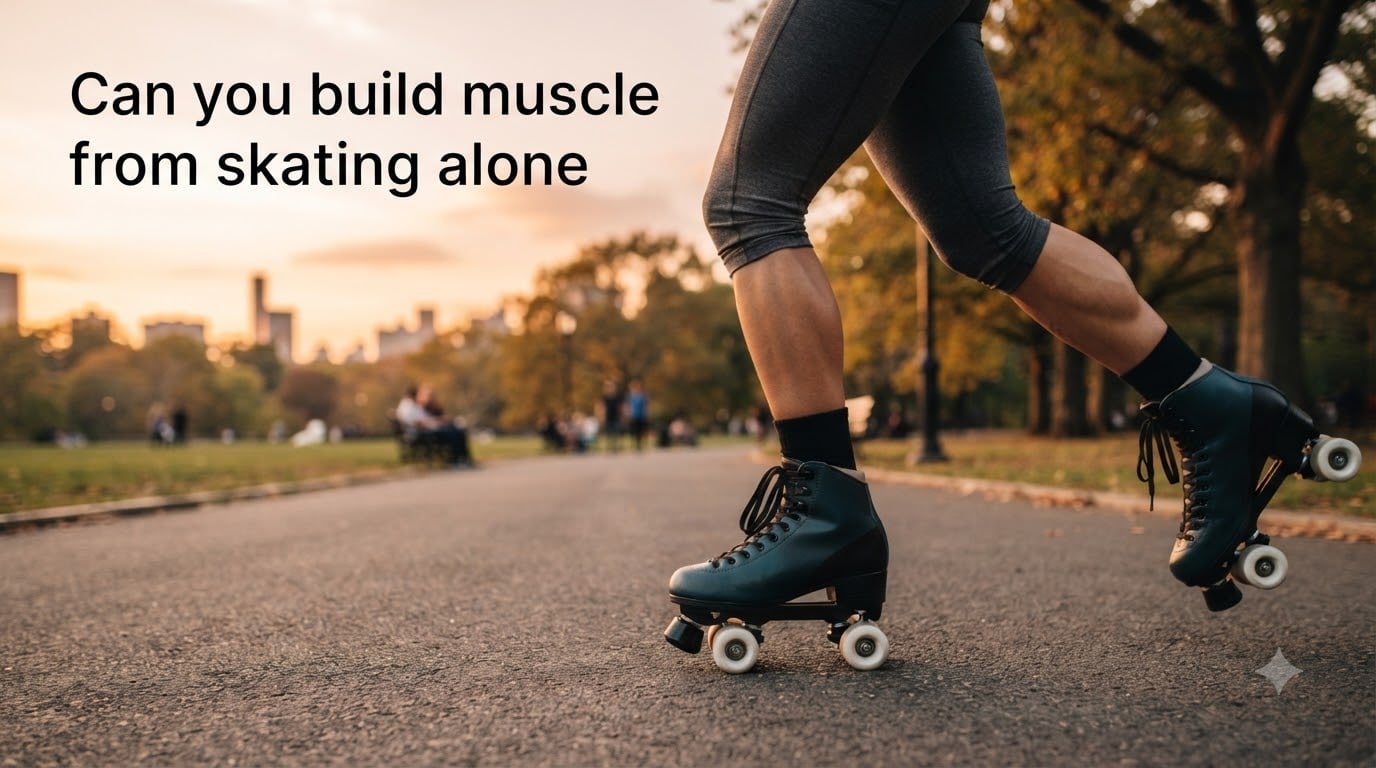
I skated four times a week for eight months before I noticed my quads had reshaped. My jeans fit differently. Carrying groceries up three flights felt easier. But I also plateaued, and the arms I had been neglecting stayed flat. So when people ask whether you can build muscle from skating alone, my answer is honest: yes, partially, and only if you push the right way.
This guide covers what skating actually does to your body, where it falls short, and how to build a muscle-building plan around skating or beside it. I’ll pull from real skater experiences on Reddit, the science of muscle growth, and what I learned the hard way.
Table of Contents
Can You Build Muscle From Skating Alone? The Short Answer
Yes, skating can build muscle, especially in your legs, glutes, and core, but it won’t build the kind of balanced, full-body muscle a structured strength program does. Skating works your lower body hard through repeated pushing, carving, and braking, while your core and stabilizing muscles fire constantly to keep you upright.
The honest part: skating alone is great for lean, functional muscle and endurance. It is not enough if you want maximum hypertrophy in your upper body, chest, or back. To put on serious muscle from skating alone, you need intentional progressive overload, varied terrain, and higher-intensity sessions.
What Muscles Does Skating Actually Work?
Skating is sneaky. It feels like a smooth glide, but underneath, dozens of muscles are firing every second. Here is what gets worked, broken down by region.
Lower Body Powerhouse: Quads, Hamstrings, Glutes, Calves
Every push on a skateboard, every stride on roller skates, every glide on ice engages your quadriceps to extend the knee and your glutes to drive the hip forward. Your hamstrings work eccentrically to slow each push and stabilise your stride. Your calves fire on every toe-off and every landing.
On a typical roller skating session, one Reddit user in r/Rollerskating said they noticed their “calves, quads, and butt” growing visibly within three months of consistent four-times-a-week sessions. I had a similar experience. My calves grew enough that old boots stopped fitting.
Core Engagement Throughout Every Push
Your core is the unsung hero of skating. Without strong abs, obliques, and lower back muscles, you cannot stay balanced, transfer weight between feet, or carve cleanly. Every rotational movement, every crossovers, every sharp turn recruits the deep core stabilisers.
That is why skating builds functional core strength you can feel in everyday life. I noticed my balance improved, my posture straightened, and I stopped twisting awkwardly when reaching for things overhead. The core engagement is constant, not occasional, like in many gym exercises.
Stabilizing Muscles and Balance Control
Skating challenges hundreds of small stabilising muscles most workouts never touch. Your ankles, hip abductors, adductors, and the deep muscles along your spine all work to keep you upright on a moving platform. This is the kind of strength that prevents falls as you age and improves athletic performance in other sports.
One skater on r/NewSkaters mentioned that skating alone drastically improved their lateral step-downs and arabesques in dance class. That is functional, real-world strength.
How Skating Builds Muscle: The Science Behind the Movement
Muscle growth happens when you create mechanical tension, muscle damage, and metabolic stress. Skating hits all three, just differently than lifting weights.
Each push is a concentric contraction of your quads and glutes. Each landing is an eccentric contraction that creates small tears in muscle fibres, which then repair thicker. Each balance check is an isometric hold firing stabilisers for sustained periods.
When you skate for 30 to 60 minutes, the repeated contractions add up to thousands of reps across many angles. That is enough mechanical tension to drive growth, especially in muscles that are not used to this kind of work. Beginners see the fastest gains because their muscles are unaccustomed to the stimulus.
Skating also raises your heart rate into a moderate-to-high zone. The metabolic stress of sustained activity, combined with mild oxygen debt, drives hormonal and cellular adaptations that support muscle growth, especially when paired with adequate protein.
Cardio and Calorie Burn: Why Skaters Stay Lean
A 150-pound person can burn 250 to 600 calories per hour skating, depending on intensity. Roller skating outdoors, aggressive street skating, and ice skating all burn more than casual rink skating. This high calorie burn, combined with muscle preservation, is why experienced skaters tend to look lean rather than bulky.
If your goal is visible muscle definition without bulk, skating is unmatched. But if you want maximum hypertrophy, the calorie burn works against you. Building muscle requires a slight calorie surplus, and a high-burn activity like skating makes that harder. Many skaters I have trained with struggle to eat enough to fuel both their skating and their muscle gains.
Limitations of Skating Alone for Maximum Muscle Growth
I will be straight here. Skating alone has real limits if your goal is significant muscle mass. Here is what you cannot get from skating.
First, upper body. Push-ups, planks, and presses do not happen naturally on skates. Your chest, shoulders, lats, and triceps stay relatively under-stimulated. Skating might give your shoulders some light stabilisation work, but it will not build pressing strength or back width.
Second, max load. Skating is bodyweight and mild resistance. You cannot squat 200 pounds on skates. Progressive overload has a ceiling. You can extend sessions, increase tempo, add hills, or wear resistance bands, but you will eventually hit a cap your legs cannot break through without external load.
Third, single-leg movements. Skating does train one leg at a time, which is good. But you cannot isolate muscle groups with the precision a dumbbell or cable machine allows. If you want to hammer your glutes while sparing your quads, or vice versa, you need lifts.
Fourth, muscle imbalances. New skaters often notice one leg becomes dominant. Without bilateral exercises like squats and deadlifts, imbalances can worsen over time.
Fifth, age-related hormonal decline. After 40, building muscle naturally requires heavier resistance signalling. Skating helps preserve muscle but typically does not reverse sarcopenia on its own.
Skating vs Weight Training: A Real Comparison
People often ask whether skating can replace weight training. The answer depends on your goal. For pure muscle mass, weight training wins. For functional strength, balance, and cardio fitness, skating holds its own.
Weight training lets you progressively overload any muscle group with precise control. You can isolate the biceps, target the upper chest, or push the glutes to failure in eight minutes. Skating cannot do that.
Skating simultaneously trains strength, endurance, balance, coordination, and cardiovascular fitness. Weight training typically trains one or two of those at a time. For older adults, beginners, or anyone who finds the gym boring, skating offers a more engaging full-body workout.
What works best for our team: combine both. Skate three to four times a week for cardio and lower-body functional strength, then add two short weight sessions per week focused on upper body and any lagging muscle groups. That pairing covers the gaps skating leaves behind.
How Long Until You See Muscle Gains From Skating?
Beginners often see noticeable changes in four to six weeks: firmer legs, better endurance, visible calf shape. Visible muscle growth in the quads and glutes typically shows up around the three-month mark with consistent four-times-a-week skating.
Skating Reddit users consistently report their first clear results in 8 to 12 weeks. One r/Fitness user who switched from pure weight training to mostly skateboarding said they built more leg muscle in three months of skating than in six months of standard leg day. Of course, individual results depend on genetics, diet, sleep, and intensity.
For real hypertrophy of the upper body, you should not expect skating alone to deliver. Plan for six months of consistent combined training before judging results.
Progressive Overload Through Skating: How to Keep Growing
Progressive overload means making your muscles do more work over time. On skates, you can do this without ever touching a weight.
Increase session duration. Go from 30 minutes to 60. Then to 90.
Add intensity. Skate hills. Try sprint intervals. Push harder on each stride.
Add resistance. Wear a weighted vest during sessions. Attach small ankle weights for short intervals. Use a sled-push on a flat surface.
Add variety. Try different skating styles: aggressive street, speed skating, dance skating, ice skating. Each one challenges muscles differently.
Track heart rate. Aim for 70 to 85 percent of max during harder intervals. Active recovery at 60 percent. This creates the kind of metabolic stress that drives muscle adaptation.
Rotate terrain. Smooth trails, rough pavement, ramps, and bowls all fire different stabilisers. Variety is the key to avoiding plateaus.
Best Exercises to Combine With Skating for Full Muscle Development
Add these to your weekly routine to fill the gaps skating leaves. Most skaters on Reddit recommend three to four sessions per week of these lifts to complement their skating.
Squats and lunges for additional quad and glute growth once you plateau on skates.
Deadlifts for posterior chain development, hamstrings, and back.
Push-ups, dips, and overhead presses for chest, shoulders, and triceps.
Pull-ups and rows for back and biceps.
Planks and dead bugs for deep core stability beyond what skating provides.
Band-resisted lateral walks for hip abductors, which skating under-trains.
Keep these sessions short, 20 to 30 minutes each, and skate on separate days so your legs recover properly.
Frequently Asked Questions
Is skating good for building muscle?
Yes, skating is good for building muscle in the legs, glutes, calves, and core. The repeated pushing, carving, and balancing motions create enough mechanical tension and metabolic stress to drive hypertrophy in those areas. For upper body muscle, skating alone is not enough.
Why are skaters so lean?
Skaters tend to be lean because skating burns 250 to 600 calories per hour while preserving muscle through repeated low-impact contractions. The combination of high calorie expenditure and functional muscle development produces a lean, athletic build rather than bulk.
What age is hardest to gain muscle?
Muscle gain becomes hardest after age 40, when testosterone and growth hormone levels decline and sarcopenia accelerates. Skating helps preserve muscle mass in this age range, but combining it with progressive resistance training maximises results.
How long to see muscle gains from skating?
Most beginners see noticeable muscle tone and firmness in four to six weeks of consistent skating four times per week. Visible quad and glute growth typically appears around the three-month mark. Upper body gains require added resistance training.
Can skating replace weight training?
Skating can replace weight training for general fitness, balance, and lower body functional strength, but it cannot fully replace weight training if your goal is maximum muscle hypertrophy. For balanced muscle development, combine both.
The Bottom Line on Building Muscle From Skating Alone
Skating alone can build muscle, especially in your legs, glutes, and core, and it will absolutely make you stronger, more balanced, and leaner. I have lived that. But it has limits, and pretending otherwise would set you up for frustration.
For real, balanced muscle growth, skate for the cardio and lower body work you love, and add two short weight sessions per week to cover your upper body and break through plateaus. Track your sessions, push intensity progressively, eat enough protein, and give it at least three months before judging results.
If you want to build muscle from skating alone, you can do it. Just be honest about what you are chasing and pick the right tools for the job. That is how skaters and lifters both win.