
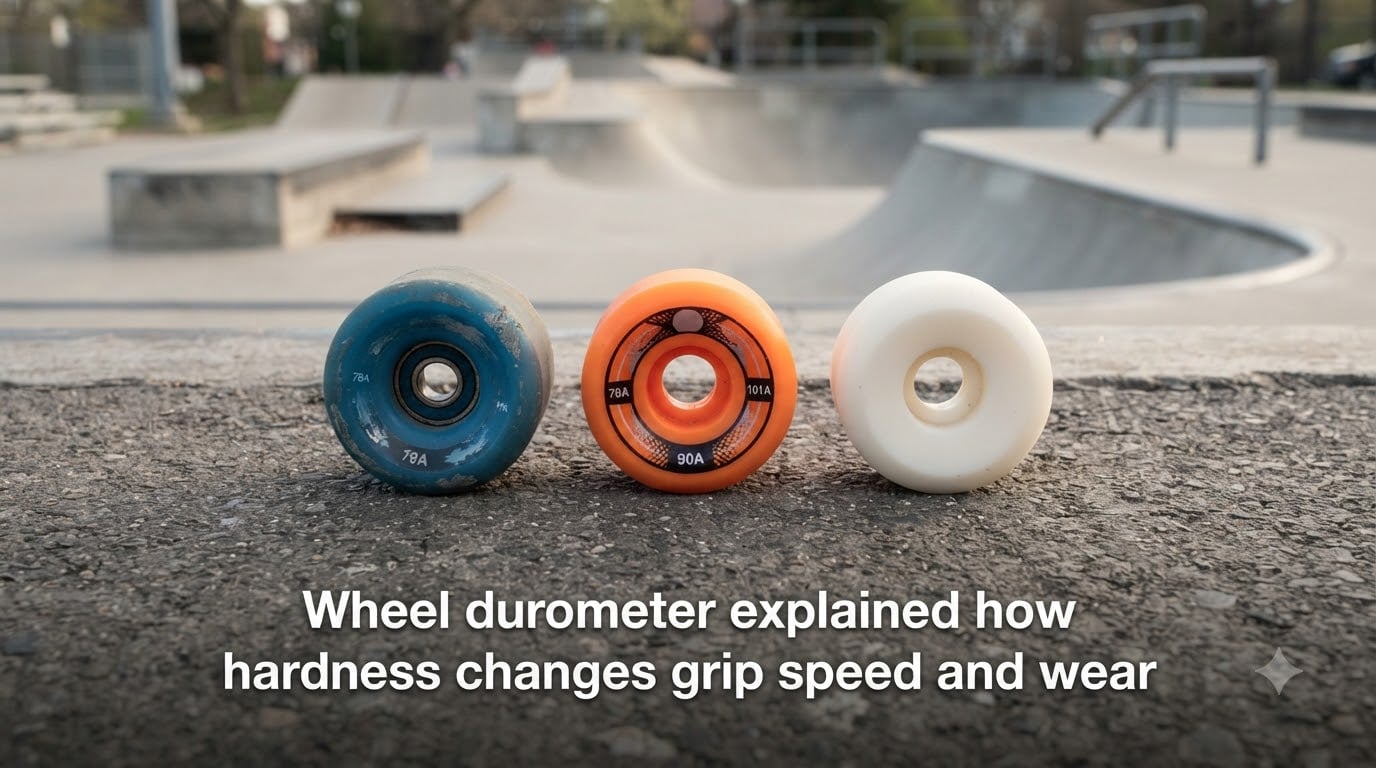
I remember the first time I picked a set of wheels based purely on color. They were 101A, bright orange, and lasted about three sessions before I realized I had no idea what the number meant. After that, I started measuring durometer for every setup I rode, and the difference became obvious within a week.
Wheel durometer is the measurement of how hard your urethane wheels are, and it controls almost everything about how your board or skates feel. The number on the wheel directly changes your grip on the ground, how fast you roll, and how quickly your wheels wear down. Get the durometer wrong, and you’ll fight your setup every session. Get it right, and your wheels disappear under you, doing exactly what you want.
In this guide, I’ll walk you through how the A-scale works, what each hardness range actually does on real pavement, and how to pick the right durometer for your skating style. By the end, you’ll understand why a 78A cruiser wheel and a 101A street wheel feel like completely different products, even though they’re made from the same urethane.
Table of Contents
What Is Wheel Durometer and How Does It Work?
Wheel durometer is a measurement of how resistant a urethane wheel is to being pressed into by a sharp point. The higher the number, the harder the wheel, and the less it deforms under pressure. The standard scale used for skateboard, longboard, and roller skate wheels is the Shore A-scale, sometimes written simply as “A”.
To measure durometer, a calibrated indenter pushes into a flat urethane sample with a specific force, and the depth of the indentation gives the hardness reading. A wheel that lets the indenter sink in deep measures low on the scale. A wheel that barely compresses measures high. For skating wheels, almost everything you’ll see falls between 78A and 101A+, which is the range that balances grip, speed, and durability for real riding.
Here’s what the scale roughly looks like in practice:
78A to 87A: soft, gummy wheels that grip and absorb vibration
88A to 95A: medium wheels that balance grip and speed
96A to 101A+: hard wheels that roll fast and slide predictably
Every step up the scale means the urethane resists deformation more, which is the single concept that explains grip, speed, and wear differences. Once you understand deformation, the rest of the puzzle falls into place.
The A-Scale Explained: From 78A to 101A+
The A-scale runs from 0 to about 100, but in skating we only use the upper portion because softer compounds below 78A wear out too quickly for most riding. Most manufacturers print the durometer right on the wheel, often alongside the diameter in millimeters.
A quick reference of the common tiers:
78A: very soft, longboard cruiser, rough city streets
82A to 85A: soft cruiser and commuter wheels
87A to 90A: crossover wheels, filming setups, beginner-friendly street
93A to 95A: medium street and park, balance of grip and slide
99A to 101A: standard hard street and park wheels
101A and up (sometimes called “B-scale” for extra-hard): technical street, smooth park floors
Within a brand’s lineup, jumping two or three points can change the feel noticeably. Jumping from 99A to 101A sounds small, but on a smooth ledge it can be the difference between a wheel that hooks and one that lets you powerslide out cleanly.
How Hardness Changes Grip
Wheel grip is mostly a story of contact patch and deformation. A soft wheel flattens slightly under your weight and conforms to the texture of the pavement. That larger, textured contact patch grips harder, sticks to cracks, and resists sliding sideways. A hard wheel stays round and small at the contact point, so it has less to grab onto and slides more easily when you push it sideways.
When I run my thumb across a 78A wheel and a 101A wheel, the difference is obvious. The 78A feels like a pencil eraser. The 101A feels like a hard plastic puck. That tactile difference translates directly into how each wheel behaves under your feet.
The trade-off is control versus forgiveness. Soft wheels give you more grip and more vibration absorption, but they also feel vague when you try to break them loose for a slide. Hard wheels give you less grip, but when you commit to a slide, the wheel releases cleanly instead of hooking and throwing you off.
How Hardness Changes Speed
Speed is mostly about rolling resistance, which is the energy lost each time the wheel deforms under your weight. A softer wheel deforms more with every rotation, so it loses a tiny bit of energy to internal friction in the urethane. A harder wheel deforms less, so more of your pushing effort goes into forward motion.
On a perfectly smooth surface like a skate park floor or a freshly resurfaced road, hard wheels roll noticeably faster and coast longer. That’s why downhill longboard racers and park skaters run hard wheels almost every time.
On rough pavement, the rule flips. A hard wheel bounces over every crack and pebble, losing speed to vibration. A soft wheel rolls right over the same cracks because it deforms around them. On badly textured city streets, I’ve actually found that 78A wheels coast farther than 99A wheels, even though the harder wheel is theoretically faster.
So speed depends on both hardness and surface. Match the durometer to the ground, and you’ll go faster than someone running the wrong durometer for the terrain.
How Hardness Changes Wear and Durability
Wear is where the durometer choice starts to hit your wallet. Hard wheels are denser and resist abrasion better, so they last longer in terms of total miles. Soft wheels shed urethane faster, especially during slides and aggressive carving, so the same set of 78A wheels might last you a season while a 99A set lasts two or three.
The catch is how each hardness fails. Hard wheels tend to chip and develop flat spots when you lock into a slide. A flat spot is a worn-down section of the wheel that thuds every rotation, and it’s hard to fix without replacing the wheel. Soft wheels rarely flat-spot because the urethane is forgiving, but they cone and chunk if you slide aggressively, especially on rough surfaces.
New wheels also need a break-in period. The outer skin of a fresh wheel is slightly smoother and harder than the inside, and the first few sessions shape the contact patch to your riding style. I usually give new wheels three to five hours of riding before judging their feel.
Soft Wheels (78A to 87A): Best Uses and Trade-Offs
Soft wheels are your friend when the pavement is rough, your commute involves cracked sidewalks, or you want a smooth carving cruiser. The 78A to 87A range absorbs vibration, grips tenaciously, and rolls over debris that would stop a hard wheel dead. Longboarders cruising city streets, commuters, and beginners on rough terrain get the most out of this range.
The trade-offs are real. Soft wheels wear faster, especially if you push them into powerslides. They also feel slower on smooth ground because of higher rolling resistance. And on hot days, soft urethane gets even softer, which can make the wheels feel unpredictable under heavy load.
If you’re wondering whether 78A wheels are hard or soft, the answer is firmly soft. They’re at the gummy end of the scale and meant for cruising, carving, and rough surfaces, not for technical street tricks.
Medium Wheels (88A to 95A): The Balanced Choice
Medium wheels sit in the sweet spot for many skaters. They grip enough for most surfaces, roll fast enough for commuting, and slide predictably enough for beginner-level tricks. The 88A to 95A range is popular for filmed street skating, all-around park riding, and skaters who split their time between smooth and rough spots.
If you only want one set of wheels for mixed terrain, a 90A or 93A wheel is often the right call. I’ve run 90A wheels for commuting and weekend street sessions, and they handled brick sidewalks, smooth asphalt, and the occasional park ramp without complaint.
Medium wheels won’t give you the absolute grip of an 80A or the absolute speed of a 101A, but they rarely feel out of place anywhere. They’re the diplomatic choice for skaters who don’t want to think too hard about their setup.
Hard Wheels (96A to 101A+): Speed and Slide Control
Hard wheels are built for smooth surfaces, technical tricks, and skaters who want fast, predictable slides. The 96A to 101A range is the standard for street skating, ledge work, and most modern skate park riding. Above 101A, you get into specialty compounds used for very smooth park floors and pro setups.
The advantage is speed and responsiveness. A 99A or 101A wheel accelerates faster, holds speed longer on smooth ground, and breaks loose cleanly when you commit to a powerslide. That’s why most pro street skaters run something in this range.
The disadvantage is unforgiveness on rough ground. A 99A wheel on chunky pavement will rattle your ankles and feel slow because it’s bouncing instead of rolling. If you skate mostly smooth parks and well-maintained ledges, hard wheels are perfect. If your local terrain is rough, you’ll want something softer.
For the question of whether 99A is too hard for street skating, the honest answer is that 99A is actually a standard street hardness. It’s not too hard at all if you skate smooth ground. If your local spots are rough, you might want to drop to 95A or 93A, but 99A is the wheel most street skaters start with.
Matching Wheel Durometer to Surface and Style
Picking the right durometer comes down to two questions: what surface do you ride most, and what do you want the wheel to do for you. Here’s a quick guide I use when helping friends dial in their setup:
Cracked sidewalks, rough asphalt, brick: 78A to 87A for grip and vibration absorption
Mix of smooth and rough: 88A to 95A for balance
Smooth asphalt, skate park, ledges: 96A to 101A for speed and slide
Very smooth park floors, technical street: 101A+ for maximum slide control
Your skating style matters just as much as the surface. Cruisers and commuters want the soft end. Filmed street skaters often run 93A to 95A for a bit of forgiveness on rough landing zones. Park skaters who stick to smooth bowls usually prefer 99A to 101A. Downhill racers go hard for top speed.
If you’re just starting out, I’d recommend a medium wheel around 90A to 95A. It handles most surfaces, forgives small mistakes, and lets you figure out what you actually like before committing to a specialty setup. You can always go softer or harder once you’ve put some sessions on the board.
A practical test I use: skate your usual spots for an hour on a borrowed set of different durometers. If the 78A wheels feel right, you’re a cruiser. If the 99A wheels feel right, you’re a street or park skater. If 90A hits the spot, you’re an all-arounder.
Wheel Rebound, Hub Design, and Other Factors
Durometer is the headline number, but a few other variables quietly shape how a wheel feels on real terrain. Understanding them helps you compare two wheels with the same durometer rating and understand why they ride differently.
Wheel rebound measures how much energy the urethane returns after being compressed. High-rebound wheels feel lively and springy under your feet, and they accelerate out of turns with more energy. Low-rebound wheels feel damp and predictable, which some skaters prefer for technical tricks. Rebound is partly tied to the durometer, but urethane formula matters just as much.
Hub design also affects performance. Wheels with a smaller hub have more urethane between the bearing seat and the ground, which gives a softer, more cushioned feel. Wheels with a larger hub have less urethane to deform, so they feel stiffer and more responsive. The hub position also influences how the wheel transitions from grip to slide during a turn.
Wheel size and hardness interact in ways that matter. A large 78A wheel at 65mm will feel different from a small 78A wheel at 53mm, even though they share the same durometer. Larger wheels roll over debris more easily and carry speed better, while smaller wheels accelerate faster and feel lighter. Many skaters find that as they go up in wheel size, they want to drop a few points in durometer to keep the same overall feel.
Wheel profile, the shape of the wheel’s contact surface, also interacts with hardness. A wide, rounded profile gives a larger contact patch and more grip at any durometer. A narrow, square profile gives a smaller contact patch and easier slides. Combined with durometer, profile is how skaters dial in exactly the feel they want.
Frequently Asked Questions
Is 99A too hard for street skating?
No. 99A is actually a standard street skating hardness used by many pro skaters. It works best on smooth surfaces like skate parks, ledges, and well-maintained asphalt. If your local terrain is rough or cracked, you might prefer 93A or 95A for more forgiveness, but 99A is not too hard for street on smooth ground.
Are 78A wheels hard or soft?
78A wheels are firmly soft. They sit at the gummy end of the A-scale and are made for cruising, longboarding, commuting, and rough pavement. They absorb a lot of vibration and grip tenaciously, but they wear faster and feel slower on smooth surfaces than harder wheels.
How does wheel hardness work?
Wheel hardness is measured on the Shore A-scale, which rates how resistant urethane is to indentation. Lower numbers mean softer wheels that deform under weight and grip more. Higher numbers mean harder wheels that resist deformation, roll faster, and slide more easily. The same number on a real wheel tells you how it will behave on pavement.
Are 80A wheels too soft?
80A wheels are not too soft if you are cruising, commuting, or skating very rough pavement. They will, however, feel too soft for technical street tricks or smooth park bowls. For street and park skating on smooth ground, 95A to 101A is more typical. For rough city commuting, 78A to 85A is the right range.
What durometer do professional skaters use?
Most professional street and park skaters use wheels in the 99A to 101A range for smooth surfaces, or 93A to 95A for filming sessions on rougher terrain. Professional longboard downhill racers often use 78A to 85A wheels for grip, while cruiser specialists use the soft end for vibration absorption on city streets.
Do harder wheels last longer?
Yes, harder wheels generally last longer in terms of total mileage because denser urethane resists abrasion better. Soft wheels shed urethane faster during slides and aggressive carving. However, hard wheels can chip or develop flat spots from locked slides, while soft wheels tend to wear evenly. Total lifespan depends on your riding style and surface.
The Bottom Line on Wheel Durometer
Wheel durometer is the single most important number on any skateboard, longboard, or roller skate wheel. The A-scale from 78A to 101A+ covers everything from soft cruiser wheels that absorb rough pavement to hard street wheels that powerslide on ledges.
The three trade-offs to remember are simple. Softer wheels grip better, absorb more shock, and wear faster. Harder wheels roll faster, slide easier, and last longer. Match the durometer to your surface and style, and you’ll spend less time fighting your setup and more time skating.
If you’re unsure where to start, pick a 90A to 95A wheel and ride it for a few sessions. From there, go softer if you want more grip and comfort, or harder if you want more speed and slide. The number on the wheel is the map. Your feet are the compass.