
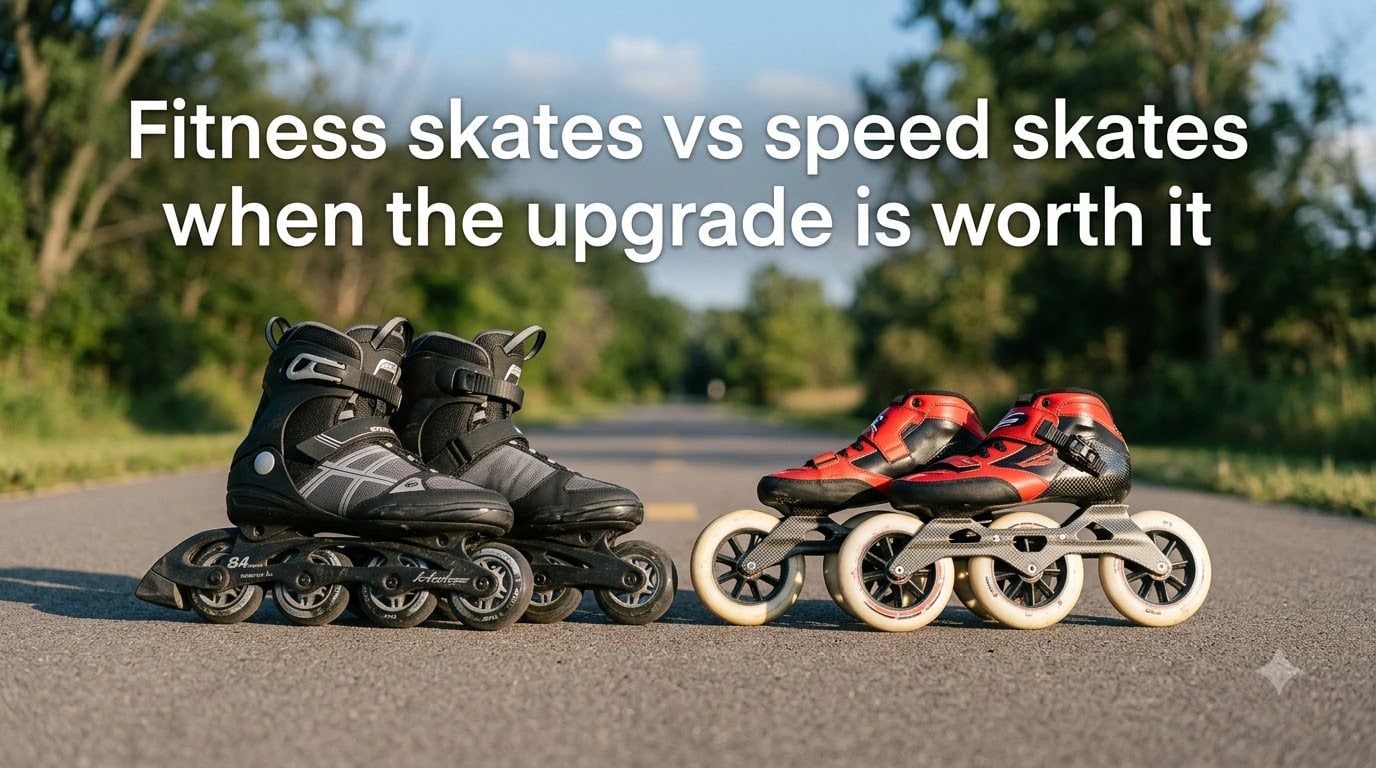
If you have been skating for a while on fitness inline skates, you have probably wondered whether speed skates would make you faster, smoother, or just plain happier on the trail. The fitness skates vs speed skates question is one of the most common debates in the rollerblading community, and the answer is rarely a simple “yes” or “no.”
Our team has spent years skating both types across trails, urban commutes, and long-distance fitness sessions, and we have also sifted through hundreds of Reddit threads from real skaters who made the switch. What we found is that the upgrade is absolutely worth it for some skaters and a frustrating mistake for others, depending almost entirely on skill level, skating goals, and the type of terrain you cover.
This guide breaks down every meaningful difference between fitness skates and speed skates so you can make an informed call. We cover boot design, wheel size and hardness, bearing quality, frame materials, price tiers, and a concrete decision framework for when the upgrade is worth it. By the end, you will know exactly which category fits your skating right now.
One quick note before we dive in: this article is about inline skates, not ice speed skates. If you are shopping for quad or ice setups, the comparison points are very different. Everything below applies to roller inline skates designed for fitness training versus inline speed skating.
Table of Contents
Quick Comparison: Fitness Skates vs Speed Skates
Here is the side-by-side snapshot we wish we had when we first started researching. The table below summarizes the biggest differences at a glance, and each section that follows digs deeper into why these numbers matter.
| Feature | Fitness Inline Skates | Inline Speed Skates |
|---|---|---|
| Boot height | High cuff, above ankle | Low cut, below ankle |
| Boot stiffness | Soft to mid-stiff | Very stiff (carbon shell) |
| Wheel diameter | 72 to 84 mm | 90 to 125 mm |
| Wheel hardness (durometer) | 78A to 84A | 83A to 88A |
| Bearing rating | ABEC 5 to ABEC 7 | ABEC 9 or ILQ 9 and up |
| Frame material | Aluminum or composite | Carbon fiber or aircraft aluminum |
| Typical price range | $100 to $300 | $250 to $900 plus |
| Skill level | Beginner to advanced | Intermediate to expert |
| Best use case | Casual exercise, trails, commuting | Long distance, racing, marathon training |
If you only remember one thing from that table, let it be this: speed skates are not just “faster fitness skates.” They are a fundamentally different tool built for a fundamentally different skating technique, and that technique takes time to learn.
What Are Fitness Skates and Who Are They For?
Fitness inline skates are the most common type of rollerblade you will see on bike paths and in parks. They are designed for exercise, recreation, and moderate-distance skating, with comfort and stability prioritized over raw speed. The boot sits above the ankle bone and is made from softer materials like nylon mesh, foam padding, and plastic cuffs that flex as you skate.
Most fitness skates ship with wheels between 72 mm and 84 mm in diameter. These mid-size wheels accelerate quickly from a standstill and roll smoothly over small cracks and trail imperfections. The bearings are typically ABEC 5 to ABEC 7, which is more than enough for casual fitness skating and commuting speeds of 10 to 15 mph.
Fitness skates are the right starting point for beginners, casual exercisers, and anyone who wants a comfortable skate for trails, bike paths, or urban commuting. If your goal is to get a good cardio workout without obsessing over technique, fitness skates deliver exactly what you need at a price that makes sense.
They are also more forgiving when you make mistakes. The higher cuff and softer boot give you ankle support even when your form is sloppy, and the smaller wheels are easier to control at low speeds. This matters a lot for newer skaters who are still learning how to stop, turn, and balance on one foot.
What Are Speed Skates and Who Are They For?
Inline speed skates are purpose-built machines designed for maximum velocity and efficient power transfer over long distances. They feature low-cut boots that end below the ankle bone, exposing the Achilles tendon and allowing a deeper range of motion in each stride. The boots are made from stiff materials like carbon fiber shells wrapped in thin leather or microfiber, which means almost no flex when you push.
Speed skates roll on large wheels, typically between 90 mm and 125 mm in diameter. Larger wheels maintain momentum better once you are up to speed, which is why marathon skaters can sustain 20 to 25 mph on flat terrain. The frames are usually 4-wheel setups at 100 to 110 mm, or 3-wheel setups with massive 125 mm wheels for maximum top speed.
Bearings on speed skates are rated ABEC 9, ILQ 9, or higher precision Swiss bearings. The difference is measurable but less dramatic than most people think. Good bearings reduce rolling resistance, but the real speed gains come from the wheels, the boot stiffness, and your own technique.
Speed skates are designed for intermediate to advanced skaters who train seriously, race, or skate long distances regularly. They reward proper form and punish bad habits, so they are not a good choice for beginners who are still developing balance, edge control, and braking skills.
Boot Design Differences: Support, Stiffness, and Fit
The boot is the single biggest difference between fitness skates and speed skates, and it affects everything from comfort to performance to safety. Fitness skate boots are tall and soft. Speed skate boots are short and stiff. That contrast shapes the entire skating experience.
Ankle Support and Cuff Height
Fitness skates use a high cuff that rises above the ankle, providing lateral support that keeps your foot stable even when you are tired or off-balance. This is why beginners feel confident on fitness skates, and it is also why ankle injuries are less common with this type.
Speed skates eliminate the high cuff entirely. The boot ends below the ankle bone, which means your own ankle strength does all the stabilizing work. If your ankles are not strong enough, you will feel wobbly, unstable, and at higher risk of rolling an ankle. This is why experienced skaters strongly advise against buying speed skates before you have built up foundational ankle strength.
Boot Stiffness and Power Transfer
Speed skate boots are stiff for a reason. When you push off in a skating stride, any flex in the boot absorbs energy that should go into the ground. A carbon fiber shell transfers nearly all of that energy directly to the frame and wheels, which is what skaters call “power transfer efficiency.” The stiffer the boot, the more of your push becomes forward motion.
Fitness skates sacrifice some of that efficiency for comfort. The softer boot absorbs a portion of your push, which means you work slightly harder to maintain the same speed. For casual exercise, this is a non-issue. For marathon training, it adds up over 26 miles.
Heat-Moldable Boots: The Middle Ground
Many mid-range and premium speed skate boots are heat-moldable, meaning you can bake them in an oven or use a heat gun to soften the shell and shape it to your foot. This gives you a custom fit without paying full custom prices. Bont, in particular, has popularized this feature across their lineup.
Fitness skates are rarely heat-moldable. They rely on foam padding that compresses to your foot over time, which works fine for casual use but never achieves the locked-in fit of a molded speed boot. If blisters or hot spots are a recurring problem, heat-moldable speed boots can solve that issue.
Wheel Size and Hardness: Why Speed Skates Roll Faster
Wheels are where speed skates earn their name. The physics of inline skate wheels are straightforward: larger diameter means higher top speed and better momentum retention, while harder durometer means less rolling resistance on smooth surfaces. Speed skates optimize both, and the difference is immediately noticeable.
Wheel Diameter Explained
Fitness skates typically run 72 mm to 84 mm wheels. These wheels spin up fast from a dead stop and are easy to maneuver at low speeds, which is perfect for stop-and-go urban skating. They also handle rough pavement and trail debris better because there is less wheel to catch on obstacles.
Speed skates use 90 mm to 125 mm wheels. The larger circumference means each revolution covers more ground, so you reach a higher top speed with the same cadence. The trade-off is that larger wheels are harder to accelerate from a standstill and require more ankle strength to control.
Wheel Hardness and Durometer Ratings
Wheel hardness is measured on the durometer scale, written as a number followed by the letter A. Softer wheels (78A to 82A) grip better and absorb vibration, which is why fitness skates use them for rough outdoor surfaces. Harder wheels (84A to 88A) roll faster and last longer on smooth pavement, which is why speed skates favor them.
If you skate on rough roads or trails with debris, harder speed skate wheels will feel harsh and slippery. If you skate on smooth bike paths or indoor tracks, they feel fantastic. Match your wheel hardness to your terrain, not just to the skate type.
Three-Wheel vs Four-Wheel Setups
Modern speed skates come in two main configurations. Four-wheel setups with 100 mm or 110 mm wheels offer stability and are the standard for marathon skating. Three-wheel setups with 125 mm wheels push top speed even higher and weigh less overall, but the longer wheelbase and massive wheel diameter can feel twitchy for skaters who are not used to them.
Reddit users who switched to 125 mm three-wheel setups report a learning curve of several weeks before the skates felt natural. If you are coming from 80 mm fitness wheels, the jump in wheel size is significant and should not be underestimated.
Bearings and Frame Materials: The Hidden Performance Layer
Bearings and frames are the components skaters obsess over the most, but they contribute less to real-world performance than boots and wheels. Still, understanding the differences helps you evaluate whether a speed skate upgrade is justified for your situation.
Bearing Ratings: ABEC and ILQ Scales
The ABEC scale (Annular Bearing Engineering Committee) rates bearing precision from ABEC 1 to ABEC 9. Fitness skates typically use ABEC 5 to ABEC 7 bearings, which are smooth and reliable for everyday skating. Speed skates use ABEC 9, ILQ 9, or Swiss-precision bearings that spin with less friction.
The reality is that the speed difference between ABEC 7 and ABEC 9 is small for most skaters. You will notice the wheels spin longer when you flick them with your finger, but under body weight on pavement, the rolling resistance difference is modest. Good technique matters far more than the last few ABEC points.
Frame Materials: Carbon Fiber vs Aluminum
Speed skate frames are made from either aircraft-grade aluminum or carbon fiber. Aluminum frames are stiff, durable, and relatively affordable. Carbon fiber frames are lighter, stiffer, and more expensive, and they absorb more road vibration than metal. Most entry-level speed skates use aluminum, while premium models move to carbon.
Frame alignment also matters. Speed skate frames allow lateral and longitudinal adjustment so you can position the frame under your foot based on your pronation or supination tendencies. Fitness skates rarely offer this adjustment, which is fine for casual use but limits performance tuning.
Price Comparison and Total Cost of Ownership
Cost is often the deciding factor in the fitness skates vs speed skates debate, and the price gap is significant. Understanding both the upfront cost and the long-term maintenance costs helps you decide whether the upgrade makes financial sense.
Upfront Price Tiers
Entry-level fitness skates cost between $100 and $180. Mid-range fitness skates with better boots and larger wheels run $180 to $300. Premium fitness skates with carbon-composite shells and high-end components can reach $350 to $500, though at that point you are approaching speed skate territory.
Entry-level speed skates start around $250 to $400. Mid-range speed skates with heat-moldable carbon boots and aluminum frames cost $400 to $600. Premium speed skates with full carbon boots, carbon frames, and top-tier wheels run $600 to $900. Full custom speed boots can exceed $1,000.
Long-Term Maintenance Costs
Speed skate wheels are larger and use more urethane, so replacement sets cost more. A full set of four 110 mm speed wheels runs $80 to $160, while four 80 mm fitness wheels cost $30 to $60. Larger wheels do last longer before wearing out, which partially offsets the higher per-wheel cost.
Speed skate boots also require more careful maintenance. Carbon shells can crack if abused, and heat-moldable boots should only be re-baked a limited number of times. Fitness skates are more durable and forgiving overall, which is why many experienced skaters keep a pair for rough conditions even after upgrading to speed skates.
When the Upgrade from Fitness to Speed Skates Is Worth It
This is the question that brought you here, so let us give you a clear decision framework. The upgrade from fitness skates to speed skates is worth it when all of the following conditions are true.
Signs You Are Ready to Upgrade
You are a strong intermediate or advanced skater who can comfortably skate 10 miles or more without stopping. You have solid one-foot balance, can skate on edges with control, and can brake reliably at speed using a T-stop or heel brake. You skate primarily on smooth, paved surfaces like bike paths, closed roads, or skating tracks.
You want to skate faster, cover longer distances, or train for events like marathons and distance races. You are willing to invest time in learning a new skating technique, because speed skates demand a longer stride, deeper edge angle, and more committed weight transfer than fitness skates.
You have a skiing, snowboarding, or ice skating background, which translates well to speed skating. Reddit users with alpine skiing experience consistently report a faster and more confident transition to speed skates because the balance mechanics are similar.
Signs You Should Wait
You are still learning to balance, brake, or turn confidently. Speed skates will not fix technique problems, they will amplify them. If you cannot skate comfortably on one foot for 10 seconds or control your speed on gentle downhill sections, stay on fitness skates and build those fundamentals first.
You skate mostly in urban environments with traffic, pedestrians, stairs, and rough pavement. Speed skates are harder to stop quickly at low speeds, and the low-cut boot offers less protection in a fall. Reddit threads are full of skaters who regretted buying speed skates for city commuting.
Your primary goal is casual exercise or fun. If you are not training for distance or speed specifically, the extra cost and steeper learning curve of speed skates will not pay off. Fitness skates give you an excellent workout and are more enjoyable for recreational skating.
The Decision Checklist
Run through this quick checklist before you buy. If you can answer yes to four or more of these, the upgrade is likely worth it.
You can skate 10-plus miles comfortably on your current fitness skates.
You can balance on one skate for at least 10 seconds at cruising speed.
You can stop reliably using a T-stop or power slide, not just a heel brake.
You skate on smooth, paved surfaces most of the time.
You want to skate faster or longer than your current skates allow.
You have a budget of at least $300 to $400 for a quality entry-level speed skate.
You are willing to spend several weeks relearning your stride technique.
Common Mistakes to Avoid When Choosing Skates
We have seen the same mistakes repeated across dozens of forum threads and customer questions. Here are the ones that cause the most buyer regret.
Mistake number one: buying speed skates too early. This is the most common and most expensive error. Skaters see the sleek boots and big wheels, assume faster is better, and end up with skates they cannot control. If you cannot confidently answer the decision checklist above, wait.
Mistake number two: ignoring wheel hardness for your terrain. Hard speed wheels on rough pavement feel awful and can actually slow you down because they skip and slide instead of gripping. Match your wheels to your surface.
Mistake number three: skipping the break-in period. Speed skate boots, especially carbon ones, feel tight and uncomfortable out of the box. Skaters who give up after one or two sessions never get to experience the boot once it has properly molded to their foot.
Mistake number four: assuming more expensive bearings equal more speed. ABEC 9 bearings will not make a beginner faster. Technique and wheel selection matter far more, and the difference between ABEC 7 and ABEC 9 under load is small.
Mistake number five: choosing a 125 mm three-wheel setup as your first speed skate. The jump from 80 mm fitness wheels to 125 mm speed wheels is massive. Start with 100 mm or 110 mm four-wheel setups, which are more stable and forgiving while you adapt to the low-cut boot.
Break-In Period and Real User Experience
The break-in period for speed skates is real, and it is the number one reason new speed skate owners post panicked questions on Reddit during their first week. Here is what to expect based on real user reports.
Carbon speed boots typically need 5 to 15 hours of skating before they feel comfortable. During that time, you will likely experience pressure points on your ankle bones, arch cramping from the stiffer sole, and general foot fatigue as your muscles adapt to the new boot position. Heat molding can shorten this period by shaping the boot before you skate in it.
Several Reddit users who transitioned from fitness to speed skates reported that the first three sessions felt worse than their old fitness skates. They felt slower, less stable, and questioned whether they had made a mistake. After about two weeks of consistent skating, the muscle memory adapted and the speed advantage became obvious.
One user, a 6-foot-2 skater weighing under 200 pounds, switched to speed skates for transportation and exercise. His biggest surprise was how much harder speed skates are to stop at low speeds compared to fitness skates. The low-cut boot and larger wheels make controlled braking more technical, which is a safety consideration for anyone skating in traffic or crowded areas.
Another common observation: speed skate boots are smaller and lighter than fitness boots, making them easier to carry when you need to walk. Skaters who commute by public transit and skate the last mile appreciate this portability advantage, even though the skating experience itself is less forgiving.
The consensus from real-world experience is that technique development matters more than the equipment itself. Skaters who invested time in improving their form saw bigger gains than those who simply bought more expensive gear. The break-in period is as much about your body adapting as it is about the boot molding to your foot.
Frequently Asked Questions
Are speed skates better than fitness skates?
Speed skates are not universally better, they are designed for a different purpose. They are faster and more efficient for long-distance skating on smooth surfaces, but they require more skill, are harder to stop at low speeds, and are less comfortable for casual use. Fitness skates are better for beginners, urban skating, and recreational exercise.
What is the difference between recreational skates and fitness skates?
Recreational skates are the most basic type, with soft boots and small wheels (70-76mm) meant for short casual sessions. Fitness skates are a step up, with better support, larger wheels (72-84mm), and higher-quality bearings designed for regular exercise and longer distances. Fitness skates cost more but last longer and perform better for workouts.
Why do speed skates look different from fitness skates?
Speed skates have a low-cut boot that ends below the ankle to allow a deeper stride, a stiff carbon shell for maximum power transfer, and very large wheels (90-125mm) for higher top speed. The design prioritizes aerodynamics and efficiency over comfort and ankle support, which is why they look sleeker and more aggressive than fitness skates.
Which type of inline skate is better for beginners?
Fitness skates are the clear choice for beginners. The high cuff provides ankle support while you develop balance, the smaller wheels are easier to control at low speeds, and the softer boot is more comfortable during the learning process. Beginners should master fundamentals on fitness skates before considering a speed skate upgrade.
Can I use fitness skates for marathon skating?
Yes, you can complete a marathon on fitness skates, and many first-time marathon skaters do exactly that. However, fitness skates will slow you down over 26 miles due to less efficient power transfer and smaller wheels. If you plan to skate multiple marathons or race competitively, speed skates will significantly improve your times and reduce fatigue.
How long does it take to break in speed skates?
Most carbon speed skate boots need 5 to 15 hours of skating to break in fully. Heat-moldable boots can shorten this period because you can pre-shape the boot to your foot. Expect the first three to five sessions to feel uncomfortable as both the boot and your feet adapt to the new fit and skating position.
Are speed skates harder to stop than fitness skates?
Yes, speed skates are harder to stop, especially at low speeds. The low-cut boot provides less leverage for braking, and the larger wheels have more momentum. Most speed skaters rely on T-stops and power slides rather than heel brakes, which require practice to master. This is a key reason speed skates are not recommended for urban commuting.
Conclusion: Making the Right Call for Your Skating
The fitness skates vs speed skates decision comes down to honesty about your current skill level and your skating goals. Fitness skates are the right choice for the majority of skaters because they are comfortable, forgiving, and versatile enough for trails, commuting, and exercise. Speed skates are a specialized tool that pays off when you have the technique, terrain, and training goals to use them properly.
If you checked four or more boxes on our decision checklist, start researching entry-level speed skates with 100 mm or 110 mm four-wheel setups. If you are still building fundamentals, stay on fitness skates and focus on improving your balance, braking, and one-foot control. The speed skates will still be there when you are ready.
Our best advice, gathered from years of skating and hundreds of community discussions, is this: invest in technique before equipment. The fastest skater on fitness skates will beat the beginner on speed skates every time. Master your stride on the skates you own, and the upgrade decision will become obvious on its own.