
If you are standing at the crossroads of roller skating vs rollerblading, which should you learn first? It is one of the most common questions beginners ask before lacing up. The short answer: most people find roller skates (quad skates) easier to balance on at first, while rollerblades (inline skates) are easier to keep moving forward once you get going.
Our team has spent years skating both styles and reading thousands of forum threads from adult beginners. The decision really comes down to what you want to do on wheels, where you plan to skate, and how much patience you have for the learning curve. By the end of this guide, you will have a clear recommendation based on your specific situation.
We will cover wheel configurations, balance differences, stopping mechanisms, speed, skill transfer, safety, and age-specific advice that most other guides skip entirely.
Table of Contents
What Are Roller Skates and Rollerblades?
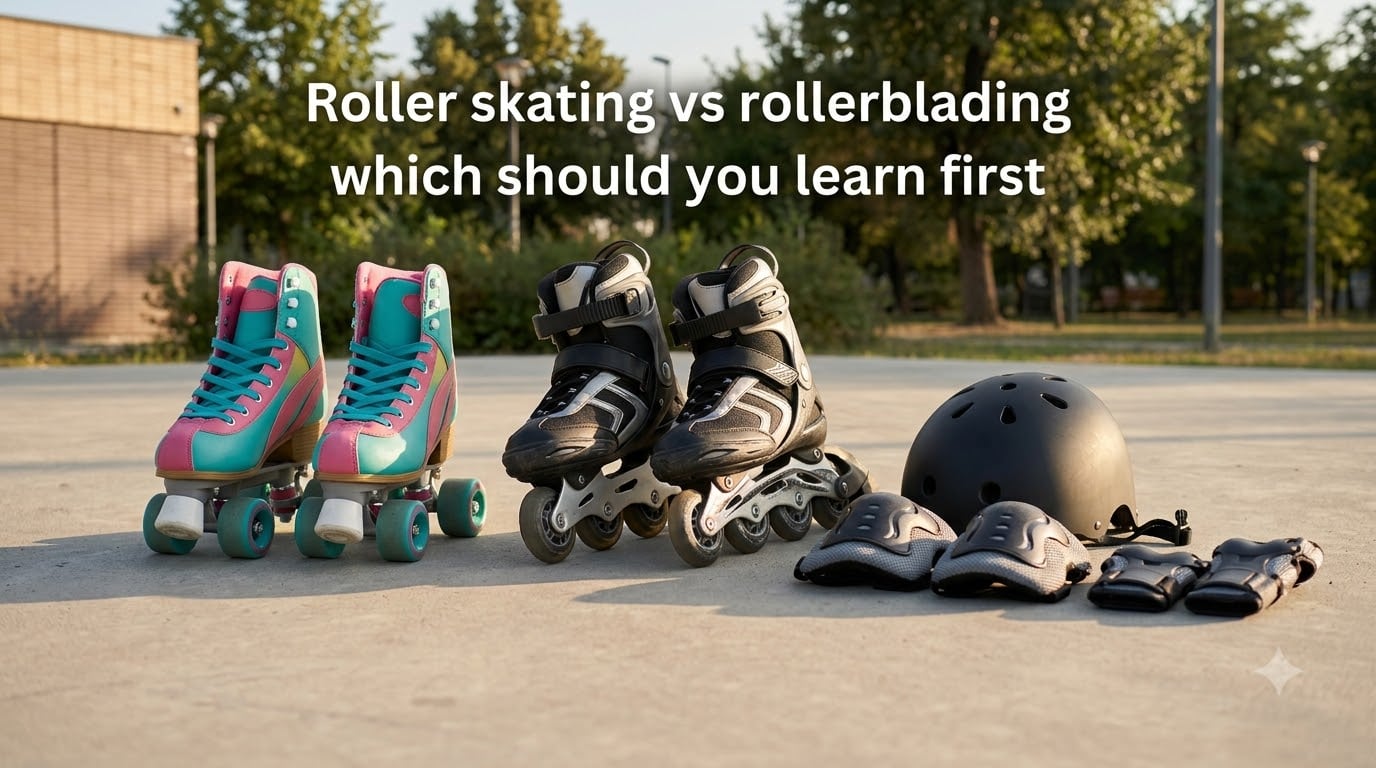
Roller skates (also called quad skates) have four wheels arranged in a two-by-two pattern, like the corners of a rectangle. This wide base mimics the stance of standing on your own two feet. A rubber toe stop sits at the front of each skate for braking.
Rollerblades is actually a brand name that became the common term for inline skates. These have three to five wheels arranged in a single straight line down the center of the boot, similar to an ice skate blade. Most recreational inline skates include a heel brake on one skate.
Understanding this terminology clears up a lot of confusion. When people say “quad skates vs inline skates,” they are having the exact same conversation as “roller skates vs rollerblades.”
Wheel Configuration Differences
The wheel setup is the single biggest factor that separates these two skate types, and it affects everything else on this list.
Quad roller skates place wheels at the four corners of a wide wheelbase. This creates a large contact patch with the ground and a stable platform that resists tipping. Think of it like a table with four legs. It does not want to fall over on its own.
Inline skates arrange wheels in a narrow line, creating a much smaller contact area. Think of this like a tightrope. The longer front-to-back wheelbase helps with forward stability, but there is very little side-to-side support. Your ankles do most of the balancing work.
This is why roller skates feel planted and secure when you stand still, while inline skates feel wobbly until you start moving forward. Once in motion, the longer inline frame tracks straighter and resists turning on its own.
Balance and Stability Differences
Balance is where beginners notice the biggest gap between the two styles. The answer to “are rollerblades harder than roller skates” depends on what kind of balance you struggle with.
Roller skates win on static balance, meaning standing still or moving slowly. The four-wheel base keeps you upright without much effort. This is why rink rentals are almost always quad skates, and why kids learn on them first.
Inline skates win on dynamic balance, meaning balance while moving at speed. The aligned wheels and longer frame make it easier to glide in a straight line once you have forward momentum. Many skaters report that inline skates actually feel more stable above a certain speed.
The tradeoff is that inline skates are more unstable sideways. New bladers are more likely to have a sideways fall, where their foot rolls outward or inward. Roller skaters are more likely to fall forward or backward when they lose balance.
Which Should Beginners Choose: Roller Skating or Rollerblading?
Here is the direct answer most of you came here for. If you have never skated before, start with roller skates. The wider base gives you immediate confidence, lets you stand still without wobbling, and makes the first hour far less frustrating.
That said, there are exceptions where inline skates are the better first choice:
You plan to skate outdoors on trails, bike paths, or rough pavement (inline wheels handle debris better).
Your goal is fitness skating, commuting, or covering long distances.
You have prior ice skating or skiing experience (the inline stance will feel familiar).
You are willing to spend a little more time on the learning curve for a smoother ride later.
One experienced skater on Reddit put it well: “Rollerblading is easier right at first for moving forward. Roller skating is more rewarding and versatile long-term.” That matches what most instructors recommend.
For a deeper look at beginner-friendly skate options, our team recommends checking a dedicated guide to beginner roller skate setups once you have decided on a style.
Stopping Mechanisms Comparison
Stopping is the skill beginners fear most, and the two skate types handle it very differently. This is a recurring pain point in skating forums.
Roller skates use a toe stop, a rubber plug that screws into the front plate. To stop, you drag the toe stop behind you while keeping your weight on the other foot. It takes practice because you must lift your heel and point your toe down, which feels unnatural at first.
Inline skates use a heel brake, a rubber pad that extends from the back of one skate (usually the right). To stop, you slide the braking foot forward and lift your toe, pressing the brake into the ground. Many beginners find this motion more intuitive because it keeps your weight centered.
Both methods require real practice. Neither is a “stomp and stop” solution. However, forum posts consistently show that adult beginners pick up the inline heel brake faster than the quad toe stop. One skater shared that they learned to stop on inline skates in a single session but still struggled with toe stops after weeks.
Advanced skaters on both styles eventually learn the T-stop (dragging one skate perpendicular behind you) and other brake-free techniques, so the built-in brake matters less as you progress.
Speed and Maneuverability
Inline skates are faster than quad skates, full stop. The longer wheelbase, larger wheels, and aligned frame create less rolling resistance. Speed skaters and marathon skaters all use inline setups for this reason.
Quad skates are more maneuverable in tight spaces. The shorter wheelbase and wider stance let you pivot, spin, and change direction quickly. This is why artistic skating, roller dance, and roller derby all use quad skates.
For casual cruising, the speed difference is minor. But if you want to skate 10 miles on a trail, inline skates will get you there with less effort. If you want to dance at the rink or weave through a derby pack, quad skates are the clear winner.
Skill Transfer Between Skate Types
This is a question almost no competitor answers, and it comes up constantly in forums. Can you switch from one skate type to the other? Yes, but with a learning adjustment.
The core skills (weight shifting, edge control, stopping, falling safely) transfer well. The specific balance reflexes do not. A quad skater trying inline skates for the first time will feel tippy and unstable sideways. An inline skater trying quads will feel like the skates want to roll out from under them.
One Reddit skater summed it up: “If you skated on inlines as a kid, you will find inlines easier as an adult, and vice versa for quad roller skates.” Muscle memory from your first style tends to stick.
Most people can become comfortable on the second style after two to four sessions of focused practice. You are not starting from zero, you are just recalibrating your balance.
Age-Specific Recommendations
Age changes the calculus, and most guides ignore this entirely. Here is what our team recommends based on real beginner feedback.
Kids under 10: Start with roller skates. The wide base builds confidence fast, and toe stops are easier for small feet to manage. Most rink learn-to-skate programs use quads for children.
Teens and young adults: Either works well. Pick based on your goals. Inline skates for outdoor and fitness, quad skates for rink sessions and social skating.
Adults in their 40s and 50s: This is where forum questions cluster heavily. A 40-year-old woman asking “roller blades or roller skates?” should consider her priorities. Roller skates offer more immediate stability and lower fall risk in the first session. Inline skates offer a better outdoor experience if she is willing to invest in protective gear and a few lessons.
Adults 60 and older: We recommend roller skates with full safety gear, ideally starting in a rink with a barrier or rail. One forum user, a 62-year-old woman, asked where to start. The community consensus: begin indoors, use knee pads and wrist guards, and consider a skate trainer walker for the first session.
Safety Comparison
Neither skate type is inherently safer than the other, but they produce different types of falls. Understanding this helps you prepare.
Roller skate falls tend to be forward or backward as the skates shoot out. This leads to scraped knees, wrist impacts, and tailbone bruises. Wrist guards and knee pads are essential.
Inline skate falls tend to be sideways as the ankle rolls. This leads to ankle twists, hip impacts, and shoulder catches. Ankle support in the boot helps, but knee pads and wrist guards still matter most.
The single biggest safety factor is not the skate type, it is protective gear. A helmet, wrist guards, knee pads, and elbow pads dramatically reduce injury risk regardless of which style you choose. Skating on smooth, clean surfaces away from traffic also matters more than your wheel configuration.
Why Is Rollerblading Less Popular Now?
This question pops up in search results, so let us address it directly. Rollerblading had a massive boom in the 1990s, then faded from mainstream visibility. Inline skate sales dropped sharply in the 2000s.
The reasons are a mix of trends and practicality. The 90s fitness craze moved on to other activities. Aggressive inline skating (the X Games version) lost television coverage. Some cities restricted inline skating on sidewalks and trails. Meanwhile, roller skating had a cultural revival in 2020 driven by social media, with quad skates becoming a viral trend on TikTok and Instagram.
That said, inline skating is far from dead. Fitness inline skating, inline marathons, and urban commuting on inline skates all remain popular in Europe and are growing again in the US. The decline was cultural, not a sign that inline skates are worse.
Frequently Asked Questions
Which is harder to learn, roller skating or rollerblading?
Neither is universally harder. Roller skates are easier to balance on while standing still or moving slowly, thanks to the four-wheel base. Inline skates are easier to balance on once you are moving at speed. Most beginners find roller skates easier in the first session, but inline skates become comfortable after a few hours of practice.
Are rollerblades harder than roller skates?
Rollerblades (inline skates) are harder to balance on sideways because the wheels sit in a single narrow line. They are easier to keep moving straight once you have momentum. If you struggle with ankle stability, roller skates will feel easier at first.
Is rollerblading safer than roller skating?
Neither is clearly safer. Roller skate falls tend to be forward or backward, while inline skate falls tend to be sideways. The biggest safety factor is wearing a helmet, wrist guards, and knee pads regardless of which style you choose.
Why is rollerblading not popular anymore?
Rollerblading peaked in the 1990s and declined as the fitness trend faded, aggressive skating lost TV coverage, and some cities restricted inline skating on public paths. Roller skating then surged again around 2020 thanks to social media. Inline skating remains popular for fitness and commuting in many regions.
Can you transfer skills from roller skates to rollerblades?
Yes. Core skills like weight shifting, edge control, and safe falling transfer well between styles. The balance reflexes take two to four sessions to recalibrate. Most skaters find their first style easier due to muscle memory, but switching is very doable.
Conclusion
So when it comes to roller skating vs rollerblading, which should you learn first? For most absolute beginners, roller skates are the gentler on-ramp because the four-wheel base gives you instant stability and confidence. But if your goal is outdoor trails, fitness, or commuting, inline skates are worth the steeper first-day learning curve.
Your next steps are simple. Pick the style that matches where and how you want to skate. Buy a helmet, wrist guards, and knee pads before your first session. Find a smooth, flat, traffic-free surface like a rink, an empty tennis court, or a quiet parking lot. And give yourself at least three sessions before judging whether skating is for you.
The best skate is the one that gets you rolling. Both styles lead to the same reward: the freedom of gliding on wheels.