
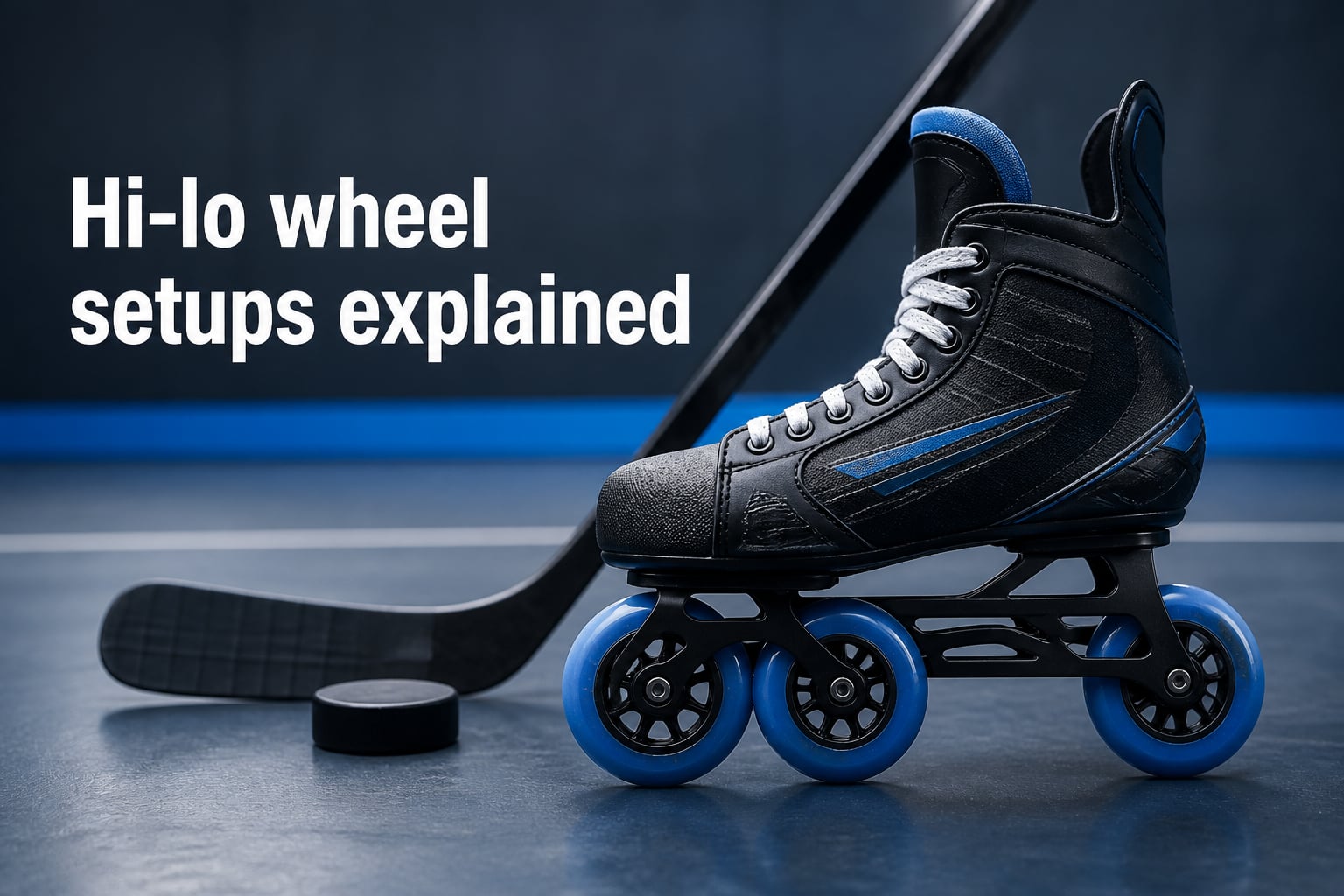
Our team has spent years testing inline skate configurations, and the question we hear most from newer players is always the same: what exactly is a hi-lo wheel setup, and why does everyone in hockey keep talking about it? Whether you are switching from a flat frame or just trying to understand the buzz around Bauer and Mission skates, this guide breaks down everything you need to know about hi-lo wheel setups in plain language.
We will cover the mechanics behind the design, the specific wheel sizes involved, how hi-lo compares to other configurations like flat and rockered, and when you should choose one over the others. By the end, you will understand exactly why this setup dominates inline hockey.
Table of Contents
What Is a Hi-Lo Wheel Setup?
A hi-lo wheel setup is an inline skate configuration where the rear wheels are larger in diameter than the front wheels, with all four wheels maintaining contact with the ground at the same time. On a standard four-wheel frame, the two back wheels typically measure 80mm while the two front wheels measure 76mm, creating a slight downward slope from heel to toe.
The frame itself is specifically designed to accommodate this size difference. You cannot simply slap smaller wheels on a flat chassis and call it hi-lo, because the axle positions on a flat frame are all at the same height. A true hi-lo chassis positions the front axles closer to the ground so those smaller wheels still roll flush with the larger rear ones.
This setup is the default configuration on most inline hockey skates from brands like Bauer, Mission, and CCM. It exists for one reason: to give hockey players a combination of speed and agility that no single wheel size can deliver on its own.
How a Hi-Lo Wheel Setup Works
The magic of the hi-lo setup comes down to physics and body positioning. When the rear of the skate sits higher than the front, your weight naturally shifts forward onto the balls of your feet. This forward lean puts you in what hockey players call a perpetual sprint position, where your center of gravity sits directly over the smaller, more responsive front wheels.
Those smaller front wheels (76mm or 72mm) have less rotational mass, which means they spin up faster when you push off. Translation: quicker acceleration and sharper turns. The larger rear wheels (80mm) carry more momentum once you are up to speed, helping you maintain velocity on straightaways and during long shifts on the rink.
Think of it like the gearing on a bicycle. Small wheels in front give you snap and responsiveness, while big wheels in back keep you rolling. The result is a setup that feels fast and twitchy at the same time, which is exactly what a hockey player needs when cutting, stopping, and changing direction every few seconds.
We have tested this extensively, and the difference is noticeable the first time you skate on a hi-lo frame after using a flat setup. The forward lean takes about one session to get used to, but after that, most skaters do not want to go back.
Common Hi-Lo Wheel Size Configurations
Hi-lo setups are not one-size-fits-all. The wheel combination you choose changes how the skate feels underfoot. Here are the most common configurations we see in the wild:
80-76-76-80: The classic hi-lo setup found on most stock hockey skates. The 4mm difference between front and rear creates a moderate forward lean that works for the majority of players.
80-72-72-80: A more aggressive slope for players who want maximum maneuverability. The smaller 72mm front wheels sharpen turning even further, though you lose a bit of top-end speed.
76-72-72-76: A scaled-down hi-lo for younger players or lighter skaters. Smaller overall wheel sizes reduce weight and make the skate feel lighter on the foot.
80-76-80-76 (diagonal hi-lo): An alternate pattern where large and small wheels alternate diagonally. This is less common but offers a unique feel for specific skating styles.
The standard 80-76-76-80 is where most players should start. It delivers the core hi-lo benefits without being too extreme. From there, you can experiment with steeper slopes if you want more agility or flatter setups if you want more speed.
Hi-Lo vs Flat vs Rockered vs Anti-Rocker
To really understand hi-lo, it helps to see it next to the other common inline skate setups. Each configuration trades different performance characteristics, and the right choice depends entirely on what you do on skates.
| Setup Type | Wheel Pattern | Best For | Key Trait |
|---|---|---|---|
| Hi-Lo | Larger rear, smaller front (all wheels down) | Inline and roller hockey | Forward lean plus speed and agility combo |
| Flat | All wheels same size (all down) | Speed skating, fitness, beginners | Maximum stability and top speed |
| Rockered | Middle wheels lower than outer (banana shape) | Slalom, freestyle, artistic | Pivots on two wheels for tight spins |
| Anti-Rocker | Small hard middle wheels, large soft outer | Aggressive street skating, grinds | Stable on rails, rolls over gaps |
Flat setups give you the most predictable, stable ride because all four wheels match in size and sit at the same height. They are what most recreational and speed skaters use. Rockered setups lift the front and back wheels slightly so only the two middle wheels touch the ground, which makes the skate pivot easily for spins and tight turns but feels unstable at speed.
Anti-rocker setups flip the concept, using small hard wheels in the middle for grinding on rails and ledges, with larger wheels on the outside for rolling between spots. Hi-lo is the only configuration that gives you both speed and quick acceleration in one package, which is why it owns the hockey market.
Best Use Cases for Hi-Lo Setups
Hi-lo setups shine brightest in situations where you need to alternate between sprinting and changing direction quickly. Here is where this configuration makes the most sense:
Inline hockey: The primary use case. The forward lean keeps you in an athletic stance, and the small front wheels let you cut and stop on a dime.
Roller hockey: Same benefits as inline hockey. The larger rear wheels help you cover ground on bigger rinks without sacrificing agility in tight spaces.
Recregressive and fitness skating: Some fitness skaters prefer hi-lo because the forward lean feels more energetic and the acceleration is snappy. It is not as fast as a flat setup, but it is more fun for stop-and-go skating.
Beginner hockey players: Hi-lo is the default for a reason. It is forgiving, keeps you balanced, and teaches good forward posture from day one.
If you are a pure speed skater logging long distance miles, a flat setup with large 90mm or 100mm wheels will serve you better. But for anything that involves stops, starts, cuts, and quick direction changes, hi-lo is hard to beat.
Diagonal Hi-Lo Setups Explained
One configuration that almost no competitor covers is the diagonal hi-lo. Instead of having both rear wheels large and both front wheels small, the diagonal pattern alternates the sizes across the frame. For example, a 80-76-80-76 arrangement places large and small wheels diagonally opposite each other.
This creates an interesting effect: the skate no longer tilts forward in a uniform way. Instead, each foot maintains a flatter profile while still benefiting from the rotational differences between large and small wheels. Some players report that the diagonal setup feels more balanced on turns because weight distributes more evenly across the frame.
Diagonal hi-lo is not a mainstream configuration, and you will not find many stock skates built for it. However, some advanced players with adjustable frames experiment with it to fine-tune their feel. If you have a frame that accepts multiple wheel sizes and you are curious, it is worth trying to see if the alternate weight distribution suits your skating style.
Wheel Rotation Tips for Hi-Lo Setups
One downside of hi-lo setups is that wheel wear is uneven. Because your weight shifts forward onto the smaller front wheels, those wheels bear more pressure and tend to wear down faster than the larger rear ones. This means your wheel rotation strategy matters more than it does on a flat setup.
Here is the rotation pattern we recommend for hi-lo frames: swap the front two wheels with each other (left front to right front, flipped), then swap the rear two wheels with each other the same way. Do not mix front and rear positions, because the size difference means they are not interchangeable. Rotate every 4 to 6 sessions, or sooner if you skate on rough surfaces.
Keep an eye on wheel diameter as they wear. Once your 76mm front wheels shrink to around 74mm, the slope becomes steeper and the forward lean increases. At that point, you may want to replace just the front pair to restore the original feel. Replacing wheels in pairs rather than all four at once is a cost-effective way to maintain consistent performance.
How to Choose the Right Hi-Lo Setup?
Picking the right hi-lo configuration comes down to three factors: your body weight, your skating style, and your experience level. Here is how we recommend thinking through each one.
For body weight, heavier skaters (over 190 pounds) should stick with the standard 80-76-76-80 setup. The larger rear wheels handle the extra load better and maintain momentum more effectively. Lighter skaters can experiment with 80-72-72-80 for a more aggressive, maneuverable feel without losing too much speed.
For skating style, ask yourself what you do most on the rink. If you are a forward who sprints and cuts constantly, a steeper hi-lo with smaller front wheels gives you the agility you need. If you are a defenseman covering lots of ice, a milder slope or even a flatter setup might serve you better for sustained speed.
For beginners, we always recommend starting with the stock configuration on whatever hi-lo skate you buy. Most entry and mid-level hockey skates come with 80-76-76-80 right out of the box. Skate on that for a full season before making changes, so you have a baseline to compare against. Once you understand how the setup feels, you can start tweaking wheel sizes to match your preferences.
Frequently Asked Questions
What is the hi-lo setup in roller hockey?
The hi-lo setup in roller hockey is a wheel configuration where the two rear wheels are larger (typically 80mm) than the two front wheels (typically 76mm). All four wheels touch the ground simultaneously. This creates a forward lean that keeps players in a sprint position, combining the speed of larger rear wheels with the quick acceleration and maneuverability of smaller front wheels.
What size wheels are on a Hi-Lo chassis?
A standard hi-lo chassis uses 80mm wheels in the rear two positions and 76mm wheels in the front two positions. Some setups use 76mm rear with 72mm front for lighter players, or 80mm rear with 72mm front for a more aggressive forward lean. The exact sizes depend on the frame design and the player’s preference.
Are 99A wheels too hard?
99A wheels are on the harder end of the durometer scale and work well on smooth indoor surfaces like sport court or polished concrete. They roll fast and grip well on clean floors. However, on rougher outdoor surfaces, 99A wheels will feel slippery and wear down quickly. For outdoor skating, softer wheels in the 82A to 86A range are a better choice.
Can I put smaller wheels on a flat chassis to get a hi-lo effect?
No, you cannot create a true hi-lo setup by putting smaller wheels on a flat chassis. A flat frame positions all axles at the same height, so smaller front wheels would sit above the ground and not make contact. A genuine hi-lo effect requires a chassis specifically designed with lower front axle positions so all four wheels roll flat regardless of size differences.
Wrapping Up Hi-Lo Wheel Setups
Understanding hi-lo wheel setups explained comes down to one core idea: combining different wheel sizes on a purpose-built frame gives you the best of speed and agility in one skate. The larger rear wheels carry momentum while the smaller front wheels deliver quick acceleration and sharp turning, and the built-in forward lean keeps you in an athletic position.
If you play inline or roller hockey, hi-lo is the standard for good reason. Start with the stock 80-76-76-80 configuration, learn how it feels, and then experiment from there. The right setup is the one that matches your body, your style, and the way you move on the rink.