
Most skaters obsess over wheel size and hardness, then ignore the one spec that actually decides how a wheel feels underfoot: the wheel profile. The inline skating wheel profile round vs flat debate shapes everything from your top speed to how confidently you can land a jump.
I learned this the hard way. I spent months blaming my frame geometry for a “muddy” feel on my freeskates, then swapped a set of flat profile wheels for round profile wheels and the whole skate came alive. Same bearings, same hardness, same diameter. The only thing that changed was the shape of the urethane touching the ground.
In this guide, I will walk you through exactly what wheel profile means, how flat, round, and bullet profiles differ, and how to pick the right one for your skating style, surface, and skill level. By the end you will know which profile belongs on your skates and why.
Table of Contents
What Is Wheel Profile on Inline Skates?
Wheel profile is the cross-sectional shape of the urethane where it meets the ground. The easiest way to picture it is the “paint dip test” that Inline Warehouse popularized: imagine dipping your wheel into a tray of paint and rolling it across a flat surface. The mark it leaves is the contact patch, and the shape of that mark is your profile.
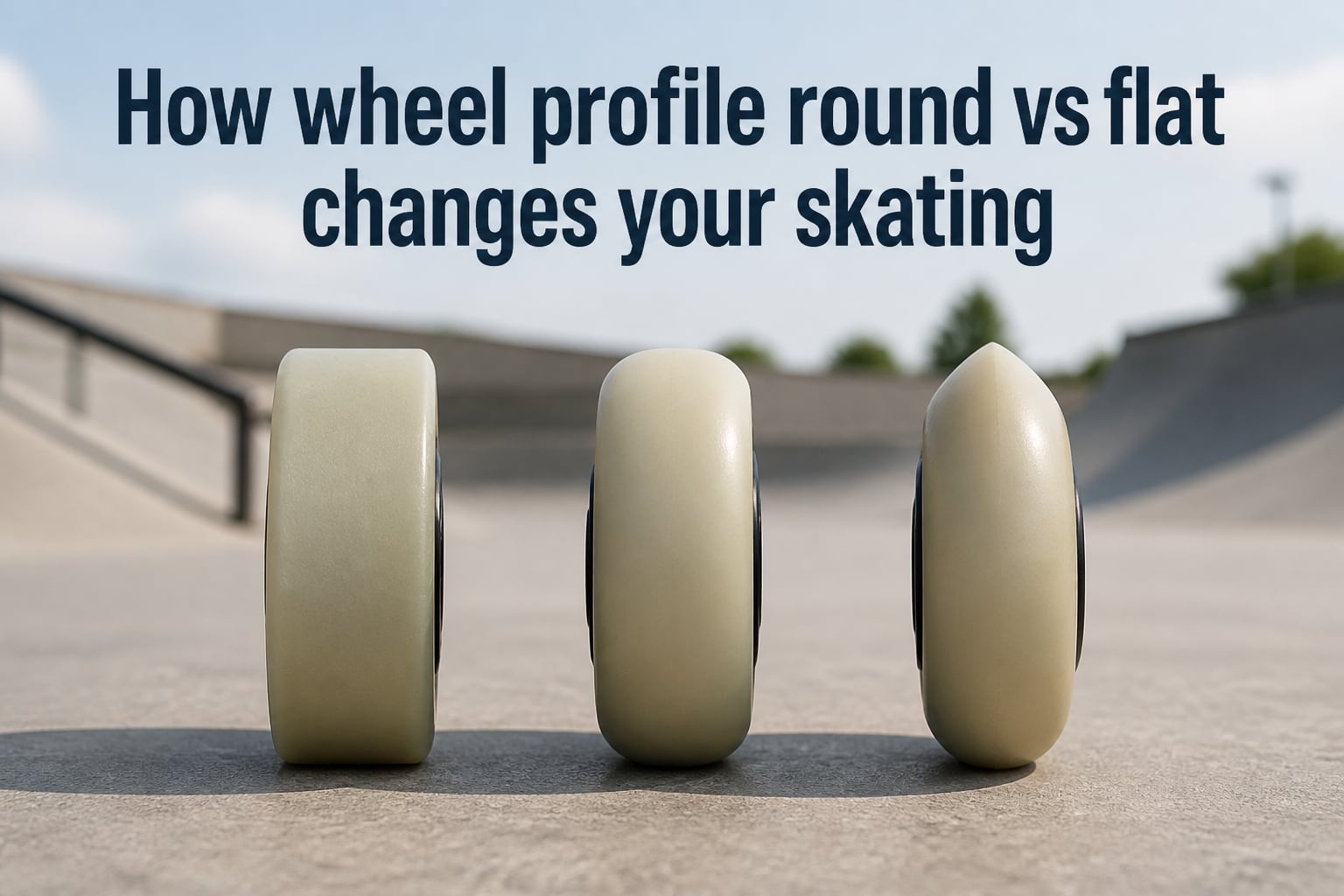
A flat profile leaves a wide, rectangular smear. A round profile leaves a softer oval. A bullet or pointy profile leaves a thin, almost pencil-like line. That single difference in footprint changes how your wheel grips, rolls, slides, and carves.
Three things matter when you read about profile: the contact patch (how much urethane touches the ground at once), the shape of the shoulder (the transition from tread to sidewall), and how those two interact with your weight and angle. Get those three right and the rest of the spec sheet almost writes itself.
Why does this matter for your skating? Because the contact patch controls rolling resistance, grip, and slide predictability. A bigger patch means more grip and more drag. A smaller patch means less drag and more slide. The shape of the shoulder controls how aggressive you can lean before the wheel “lets go” and starts carving.
The Three Main Inline Skate Wheel Profiles
Inline skate wheels come in three dominant profile shapes, and almost every wheel you can buy falls into one of these buckets:
Flat profile: The tread surface is essentially straight across from edge to edge. Maximum contact patch, maximum stability, minimum speed.
Round profile: The tread has a gentle arc from edge to edge. A balanced contact patch that splits the difference between grip and speed.
Bullet or pointy profile: The tread has a pronounced crown in the middle that tapers sharply to the edges. Minimum contact patch, maximum speed, minimum grip.
You will also see terms like “speed profile,” “aggressive profile,” and “hybrid profile” in marketing copy. Those are usually round or bullet profiles with a slight tweak to the shoulder or radius. The three categories above cover roughly 95% of what you will actually encounter.
Flat Profile Wheels: Stability and Maximum Grip
Flat profile wheels have a wide, rectangular tread that places the maximum amount of urethane in contact with the ground at all times. The shoulder rises almost vertically from the tread to the sidewall, which gives the wheel a stable, “planted” feel when you lean into it.
Because the contact patch is so large, flat profile wheels deliver the highest grip of any profile. They resist sliding sideways, which is exactly what you want when you are learning to stop, learning to T-stop, or learning to skate on rough pavement where every crack wants to throw you off balance.
The trade-off is rolling resistance. A bigger contact patch means more urethane is fighting the ground with every rotation. Flat profile wheels feel slower to accelerate, slower to coast, and slightly heavier through transitions. If you have ever described a wheel as “muddy,” there is a good chance it was a flat profile on a smooth surface.
Flat profile wheels shine in aggressive skating, where grinds, slides, and landings demand maximum stability. They also work well for beginners on rough outdoor surfaces, because the wide contact patch forgives small balance corrections and stays stable over cracks and pebbles.
Best use cases for flat profile wheels:
Aggressive inline skating and street grinds
Beginners learning balance and stopping
Rough outdoor pavement
Skatepark transitions and bowls
Anti-rocker setups where small wheels sit between larger wheels
Round Profile Wheels: The All-Around Performer
Round profile wheels have a gentle arc across the tread, like a fat tire on a bicycle. The contact patch is smaller than a flat profile but the shape of the shoulder lets you lean further before the wheel breaks traction. This is the most versatile profile, and it is what most freeskates and urban skates ship with from the factory.
The round profile splits the difference between grip and speed. You get enough contact patch to feel stable on most surfaces, but not so much that you feel like you are dragging through molasses. When you lean into a carve, the shoulder rolls smoothly into the contact patch, giving you a predictable, progressive transition from grip to slide.
Round profile wheels are the workhorses of urban skating, fitness skating, and freestyle slalom. They handle cracked sidewalks, smooth bike paths, and indoor rinks with equal confidence. Most skaters who describe a wheel as “fun” or “predictable” are talking about a round profile.
The trade-off is that round profile wheels do not specialize in anything. They are not the fastest, not the grippiest, not the most slide-friendly. For most skaters, that is a feature, not a bug. You can carve a hard turn, slide a soul grind, bomb a hill, and cruise a boardwalk on the same set of wheels without feeling out of place.
Best use cases for round profile wheels:
Urban skating and street cruising
Freeskating and big-wheel setups
Fitness and recreational skating
Freestyle slalom
Intermediate to advanced skaters who want one setup for everything
Bullet and Pointy Profile Wheels: Speed and Agility
Bullet profile wheels have a pronounced crown in the middle that tapers sharply toward the edges. Some manufacturers call them “pointy” or “speed” profiles. The contact patch is small, almost a line, which means very little urethane is touching the ground at any given moment.
A small contact patch means low rolling resistance. Bullet profile wheels accelerate faster, hold top speed longer, and feel snappy and quick through the legs. They are also the easiest profile to slide, because the small contact patch has less grip to fight in the first place.
The trade-off is stability. Bullet profile wheels feel twitchy at slow speeds and unforgiving on rough surfaces. They also demand better technique, because the small contact patch offers less margin for error when you lean into a turn. If you have ever felt a wheel “skip” or “judder” under your weight, that was almost certainly a pointy profile on a slightly imperfect surface.
Bullet profile wheels are the choice of speed skaters, experienced slalom skaters, and advanced freeskating purists who want maximum response. They also work well for skaters who log long distances on smooth pavement, where the reduced rolling resistance adds up over hours of skating.
Best use cases for bullet profile wheels:
Speed skating and distance skating on smooth surfaces
Advanced freestyle slalom
Aggressive park skating for advanced skaters who want quicker rotations
Smooth indoor rinks and polished concrete
Skaters who prioritize responsiveness over stability
How Wheel Profile Affects Speed, Stability, and Control?
Wheel profile directly shapes three performance characteristics: top speed, lateral stability, and edge-to-edge control. Understanding the relationship between profile and performance is the key to dialing in your setup.
Speed comes from a small contact patch. The less urethane touching the ground, the less friction your wheel has to fight. A bullet profile wheel will roll faster at the same effort than a round profile wheel, which will roll faster than a flat profile wheel. The difference is noticeable on a long straightaway and almost invisible on a short sprint.
Stability comes from a wide contact patch and a tall shoulder. Flat profile wheels support your weight across more surface area, which means small bumps and balance corrections do not upset the wheel. This is why aggressive skaters and beginners gravitate toward flat profiles.
Control comes from the shoulder shape. A round profile gives you a smooth, progressive transition from grip to slide. A flat profile holds grip longer and then breaks loose suddenly. A bullet profile lets go almost immediately. The “feel” you get when carving hard is almost entirely a function of the shoulder geometry.
Here is how the three profiles compare on the most common performance metrics:
Top speed: Bullet profile wins, round profile close behind, flat profile slowest.
Acceleration: Bullet profile snappiest, round profile moderate, flat profile slowest.
Stability at low speed: Flat profile most stable, round profile good, bullet profile twitchy.
Landing stability from jumps: Flat profile absorbs best, round profile solid, bullet profile least forgiving.
Slide predictability: Bullet profile easiest to initiate, round profile progressive, flat profile holds grip longest.
Edge-to-edge response: Bullet profile fastest, round profile balanced, flat profile slowest.
Choosing a Profile by Skating Style
Different skating disciplines demand different things from a wheel, and matching your profile to your style is the fastest way to feel more confident on your skates. Here is the breakdown I recommend based on how the pros and serious hobbyists set up their gear.
Aggressive inline skating: Flat profile is the standard, especially for street and skatepark setups. The wide contact patch keeps you stable on grinds, supports hard landings, and gives you the confidence to commit to tricks. Round profile works for park-focused skaters who want a bit more slide on transitions.
Urban skating: Round profile is the sweet spot. You need enough grip to handle unexpected road hazards, enough speed to keep up with traffic on bike paths, and enough slide to throw a soul grind or a powerslide when you need to stop. Flat profile feels too slow, bullet profile feels too nervous.
Freeskating and big-wheel setups: Round profile is the most common choice for setups with 100mm to 110mm wheels. The balanced contact patch keeps the wheel feeling predictable even at higher speeds, and the shoulder shape lets you carve tight turns without losing the wheel.
Speed skating: Bullet profile is mandatory for serious speed work. The reduced rolling resistance is the entire point, and on a smooth oval track the small contact patch never feels unstable.
Freestyle slalom: Round profile is the standard for most slalom skaters, because the shoulder shape lets you link tight cones smoothly. Bullet profile works for advanced slalom skaters who want maximum response on each cone.
Fitness and recreational skating: Round profile is the safest recommendation. It handles rough sidewalks, smooth paths, and the occasional trail without drama. Flat profile is also fine if you stay on rougher outdoor surfaces.
Choosing a Profile by Surface Type
Surface matters as much as skating style. The rougher the surface, the more you want a profile that forgives small imperfections. Forum regulars almost universally agree that rounded profiles are better for outdoor skating because they roll more smoothly over cracks and gravel.
For rough outdoor pavement, a round profile is the best starting point. It has enough contact patch to feel stable over uneven ground but enough shoulder to keep your speed up. Flat profile also works, especially for beginners who want maximum grip. Bullet profile on rough outdoor surfaces will feel nervous and will punish every crack in the sidewalk.
For smooth indoor rinks, bullet profile comes into its own. The polished surface is consistent enough that the small contact patch feels stable, and the reduced rolling resistance helps you skate longer with less effort. Skatepark concrete falls in the same category.
For mixed-use skaters who move between indoor and outdoor surfaces, round profile is the most versatile choice. You give up a little speed on smooth surfaces and a little stability on rough ones, but you never feel out of place.
Choosing a Profile by Skill Level
Beginners benefit from flat or round profiles. Flat profile gives you maximum stability and the most forgiving feel as you learn to balance, stop, and turn. Round profile gives you a bit more versatility once you have the basics down. Avoid bullet profile as a beginner. The twitchy feel and reduced grip will make your first months of skating harder than they need to be.
Intermediate skaters can comfortably run round profiles for almost any discipline. This is the stage where you start dialing in your preferences, and round profile gives you the headroom to experiment with different styles without committing to a specialist setup.
Advanced skaters have the technique to take advantage of bullet profile wheels. By the time you can confidently control a slide, manage a hard landing, and adjust your stance on the fly, you have the skills to make a pointy profile work for you rather than against you.
Wheel Bite, Profile Wear, and the Magic Rocker Setup
Wheel bite happens when a wheel contacts the boot, frame, or another wheel during a sharp turn, causing the skate to stop suddenly. Flat profile wheels are the most prone to wheel bite because of their wide contact patch and tall shoulder. Bullet profile wheels are the least prone because the small contact patch keeps the wheel away from the frame.
Wheels wear over time, and the profile changes with them. Flat profile wheels develop a slight roundness at the edges as they wear down, which gradually increases slide and reduces grip. Bullet profile wheels flatten out as they wear, gaining grip and losing speed. Round profile wheels stay roughly the same through most of their life, which is part of why they feel so consistent.
The Magic Rocker is a setup where your wheels are not all the same size. The two middle wheels sit slightly smaller than the two outer wheels, which creates a rocker shape that mimics the natural curvature of a flat-skating foot. This setup improves maneuverability and makes turns feel more natural, at the cost of some top speed. Round profile wheels work best in a Magic Rocker setup because their balanced shoulder shape keeps the transition between wheel sizes smooth.
Reshaping a wheel profile is possible with a lathe or a profile reshaping tool, but it is a specialized skill. Most skaters rotate their wheels regularly to even out wear and replace them when they get too small. If you want a different profile, swap the wheel rather than try to modify it.
Frequently Asked Questions
What is the difference between round and bullet profile wheels?
Round profile wheels have a gentle arc across the tread, giving a balanced contact patch that splits the difference between grip and speed. Bullet profile wheels have a pronounced crown that tapers sharply to the edges, creating a small contact patch that prioritizes speed and slide over stability. Round profile is more versatile and forgiving, while bullet profile is faster and more responsive for skilled skaters.
What wheel profile is best for beginners?
Flat or round profile wheels are best for beginners. Flat profile gives maximum stability and grip, which is helpful when learning to balance and stop. Round profile is the next step up, offering more versatility once the basics are solid. Bullet profile wheels are too twitchy and unforgiving for most beginners to control comfortably.
How does wheel profile affect speed and stability?
Wheel profile affects speed and stability primarily through the size of the contact patch. A larger contact patch means more grip and more stability but more rolling resistance and slower speeds. A smaller contact patch means less rolling resistance and faster speeds but less grip and less stability. The shoulder shape also controls how progressively the wheel transitions from grip to slide during turns.
What wheel profile do aggressive skaters use?
Most aggressive skaters use flat profile wheels for street and park skating. The wide contact patch provides the stability needed for grinds, hard landings, and technical tricks. Round profile wheels are also common for park-focused skaters who want a bit more slide on transitions. Bullet profile is less common in aggressive skating because the small contact patch feels unstable during heavy landings.
Can you change the profile of your wheels?
Yes, you can change the profile of your wheels using a lathe or a profile reshaping tool, but this is a specialized process most skaters do not attempt at home. The easier and more common approach is to swap one set of wheels for a different profile. Rotating your wheels regularly helps them wear evenly and slows down changes to the profile over time.
Final Thoughts on Wheel Profile Choice
The inline skating wheel profile round vs flat question does not have a single right answer, but it does have a right answer for you. Match your profile to your skating style, your surface, and your skill level, and you will feel the difference immediately under your feet.
If you only remember one thing from this guide, remember this: round profile is the most versatile choice for most skaters. Flat profile is best for aggressive skating and beginners on rough surfaces. Bullet profile is best for speed and advanced skaters on smooth surfaces. Start with the profile that matches your current setup, and adjust as your skating evolves.