
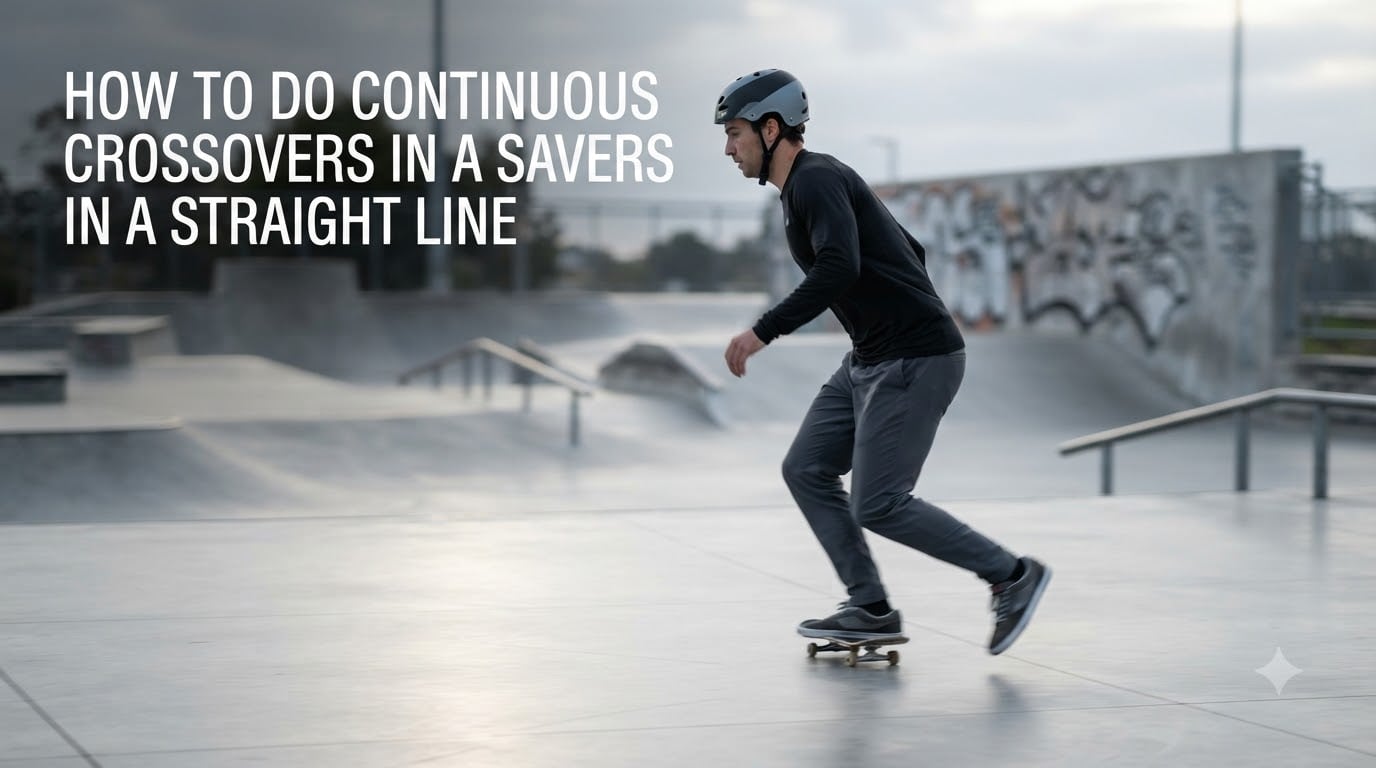
Continuous crossovers in a straight line are a skating technique where you repeatedly cross one foot over the other while counter-rotating your upper body to prevent the natural curving motion that crossovers create. The key is balancing the inward push of each crossover with deliberate shoulder and hip rotation that keeps you traveling forward instead of turning in circles. This skill matters because it lets you generate serious speed on straightaways — something regular crossovers simply cannot do without pulling you off course.
Whether you are into inline skating, roller skating, ice hockey, or speed skating, mastering continuous crossovers in a straight line transforms your ability to accelerate quickly and maintain momentum. I have spent years working with skaters at every level, and the single biggest breakthrough always comes down to understanding why crossovers curve in the first place — and then learning the counter-movements that cancel that curve out.
In this guide, I will walk you through everything: the prerequisites you need, a detailed step-by-step breakdown of the technique, the most common mistakes (and how I help skaters fix them), practice drills that actually work, and a comparison between forward and backward continuous crossovers. By the end, you will have a clear roadmap for how to do continuous crossovers in a straight line with confidence.
Table of Contents
What Are Continuous Crossovers in a Straight Line?
Continuous crossovers in a straight line involve repeating the crossover motion — stepping one foot over the other — without the usual circular turning pattern that crossovers naturally produce. Instead of traveling in an arc or circle, you keep your path straight by using upper body counter-rotation and strategic weight distribution. Think of it as tricking the turn into cancelling itself out with each stride.
A standard crossover turns you because the crossing foot lands inside your line of travel, creating rotational force. When you do one crossover, you curve slightly. Do several in a row without correction, and you end up skating in a circle. This is why most skaters only use crossovers on curves, corners, or circles.
Continuous crossovers solve this by pairing each crossover with a counter-rotation of the shoulders and hips. Every time your legs cross and create turning force, your upper body rotates in the opposite direction to neutralize it. The result is a powerful, speed-building stride that carries you straight ahead.
This technique is used by speed skaters on straightaways, hockey players accelerating from a standstill, and roller derby skaters who need rapid bursts of speed. Once you understand the mechanics, you can apply it to both forward and backward skating.
Prerequisites Before You Start
Before attempting continuous crossovers in a straight line, you need a solid foundation. I have seen too many skaters skip the basics and frustrate themselves for weeks. Here is what you should be comfortable with first.
You should already be able to do single crossovers in both directions on a circle or curve. If you can only crossover turning one way, work on that asymmetry before moving to continuous crossovers. Being able to cross both left-over-right and right-over-left is non-negotiable.
Strong one-foot balance is essential. You will spend brief moments balancing on one skate during each crossover cycle, and instability there kills the whole technique. Practice gliding on each foot for at least 10 seconds without wobbling before you move on.
Proper knee bend and forward lean should be second nature. If you skate with straight legs, you will not generate the power needed for continuous crossovers, and your balance will suffer. Get comfortable in an athletic stance — knees bent, weight slightly forward, core engaged.
Finally, you should be able to skate backward with confidence if you want to learn backward continuous crossovers. Forward crossovers come first, but many skaters eventually want both directions.
How to Do Continuous Crossovers in a Straight Line: Step by Step
Here is the detailed technique breakdown I teach skaters who want to learn how to do continuous crossovers in a straight line. Work through each step slowly before trying to chain them together at speed.
Step 1: Set Your Stance and Body Position
Start in an athletic skating stance with your knees bent deeply — more than you think you need. Your weight should be distributed evenly across both feet, centered over the middle of your skates. Keep your chest up and shoulders relaxed, not hunched.
Look straight ahead at where you want to go, not down at your feet. This sounds simple, but I see skaters stare at their skates constantly. Your body follows your eyes, and looking down throws off your balance and rotation control.
Step 2: Initiate the First Crossover
Begin by shifting your weight to your outside foot — the foot that will stay on the ground while the other crosses over. Push slightly with that outside foot to generate initial momentum. Then lift your inside foot and cross it over the outside foot, placing it down on the other side.
The crossover should feel like a confident step, not a tentative placement. Commit to the weight transfer. As your crossing foot lands, transfer your weight onto it fully. Hesitation here is what causes most beginners to stumble.
Step 3: Execute the Cross-Under Push
This is where the power comes from. After your crossing foot lands, the foot that is now underneath (your former outside foot) pushes outward and sideways against the skating surface. This push — called the cross-under or under-push — is what generates speed.
Think of it as carving a push into the ice or pavement with the inside edge of the underneath foot. Many skaters skip this push entirely and just step over. Without the under-push, you are just walking sideways on skates, not generating real speed.
Step 4: Counter-Rotate to Stay Straight
This is the make-or-break step for continuous crossovers in a straight line. As your legs complete the crossover and create turning force, rotate your shoulders and hips in the opposite direction. If you crossed right-over-left (which would turn you left), rotate your upper body to the right.
The amount of counter-rotation needed depends on your speed and how aggressively you are crossing. Start with exaggerated counter-rotation to get the feel, then dial it back as you find the sweet spot. Your arms can help — swing them slightly in the direction of counter-rotation.
This opposing rotation is what cancels out the curve. Without it, you will arc in circles no matter how good your footwork is.
Step 5: Recover and Repeat the Rhythm
After the under-push, bring your underneath foot back to a neutral position beside your other foot. Immediately prepare for the next crossover in the same direction. The rhythm is: cross, push under, recover, cross again.
Keep the cadence consistent. A smooth, rhythmic pattern generates more speed than fast, jerky movements. I tell skaters to think of it like a metronome — steady and controlled.
Step 6: Maintain Speed Through Continuous Motion
To keep your speed building, focus on maximizing each under-push rather than rushing through more crossovers. Quality beats quantity. Each push should extend fully before you recover the foot.
As you gain speed, your crossovers will naturally become quicker. Let the speed dictate the rhythm rather than forcing a faster pace. Lean slightly into the direction of travel and keep your core tight to maintain stability at higher speeds.
Common Mistakes and How to Fix Them
Even experienced skaters struggle with continuous crossovers at first. Here are the most common mistakes I see and how to correct them.
Mistake 1: Still curving despite trying to go straight. This means your counter-rotation is not strong enough or is happening at the wrong time. Exaggerate the shoulder rotation even more than feels natural. Also check that you are rotating at the hips, not just the shoulders — both need to counter the turn.
Mistake 2: Not bending knees enough. Stiff legs kill your power and balance. If your crossovers feel weak or unstable, drop your hips lower. A deeper knee bend gives you a longer push and a more stable base. I tell skaters to bend until it feels almost uncomfortable, then hold that position.
Mistake 3: Upper body is stiff and locked. Continuous crossovers require fluid rotation through the torso. If your shoulders and hips are rigid, the counter-rotation will not work. Loosen up, engage your core for stability, and let your upper body move naturally with each stride.
Mistake 4: Looking down at your feet. Your body follows your gaze, and looking down shifts your weight backward, killing your momentum and balance. Pick a point 20 to 30 feet ahead and keep your eyes on it. This alone fixes a surprising number of crossover problems.
Mistake 5: Being strong in only one direction. Many skaters can only crossover comfortably turning left (or right), often due to handedness or always practicing the same direction. Force yourself to practice both directions equally from the start. Unilateral practice creates bad habits that are hard to unlearn.
Mistake 6: Skipping the under-push. Without the cross-under push, you are just stepping over your feet with no power generation. Focus on feeling the underneath foot push against the surface each time. This push is the engine of continuous crossovers.
Drills to Master Continuous Crossovers
These are the drills I have seen produce the fastest results. Practice them in order, and do not move to the next one until the previous one feels comfortable.
Drill 1: Circle Crossovers First. Before trying straight-line continuous crossovers, practice regular crossovers on a large circle. This builds the muscle memory for the crossing and under-push motion. Do 10 laps in each direction, focusing on smooth, powerful pushes. Once you can maintain speed on a circle without thinking, you are ready for straight-line work.
Drill 2: One-Foot Balance Holds. Glide on one foot for 10 to 15 seconds, then switch. Do this in both directions and on each foot. This drill builds the balance and ankle stability you need during the crossover phase when all your weight is on one skate. Forum skaters consistently report this as the single most helpful exercise.
Drill 3: Alternating Crossover Straight-Line Drill. Do two crossovers to the right, then two to the left, trying to stay on a straight line. The alternating directions naturally cancel out the curving tendency and teach your body the counter-rotation pattern. Start slow and build speed as the movement becomes more natural.
Drill 4: The Metronome Drill. Set a consistent rhythm and do continuous crossovers in one direction while focusing entirely on counter-rotation. Use a slow tempo at first. Count out loud — “cross, push, rotate, recover” — to keep the pattern steady. Gradually increase the tempo as your body adapts.
Drill 5: Speed Maintenance Drill. Start from a standstill and use continuous crossovers to build speed over 30 meters. Focus on making each push count rather than doing more crossovers. Time yourself and try to improve. This drill teaches you to generate real speed, not just go through the motions.
Forward vs Backward Continuous Crossovers
Both forward and backward continuous crossovers follow the same core principle — counter-rotation cancels the curve. But the execution differs in important ways.
Forward continuous crossovers are easier to learn first. Your weight naturally falls in the right direction, and you can see where you are going. Most skaters should master forward continuous crossovers before attempting backward ones.
Backward continuous crossovers require more confidence in your backward skating ability. The counter-rotation is trickier because your body is already facing away from your travel direction. The under-push is the same concept, but the angle of the push changes. Many skaters find they need to lean slightly differently backward compared to forward.
For backward continuous crossovers, look over your shoulder in the direction of travel rather than straight behind. This helps with both balance and rotation control. Start on a circle backward before attempting straight lines, just as you did with forward crossovers.
Both directions are valuable. Hockey players and roller derby skaters use backward continuous crossovers regularly, while speed skaters and fitness skaters focus primarily on the forward version. Learn whichever matches your skating goals.
Frequently Asked Questions
What common crossover mistakes should I avoid?
The most common crossover mistakes are not bending your knees enough, skipping the under-push, looking down at your feet, having a stiff upper body that cannot counter-rotate, and only practicing one direction. Fix these by dropping into a deeper knee bend, focusing on pushing with the underneath foot on every crossover, picking a point ahead to look at, loosening your torso for fluid rotation, and forcing yourself to practice both left and right crossovers equally.
How to properly do a crossover?
To do a crossover properly, start in an athletic stance with knees bent and weight centered. Shift your weight to your outside foot, then lift your inside foot and cross it over the outside foot, placing it firmly on the other side. As the crossing foot lands, push outward with the underneath foot using its inside edge — this under-push generates your speed. Transfer your weight fully to the crossing foot, then recover the underneath foot back to neutral. Look ahead, keep your core engaged, and maintain a smooth rhythm throughout.
How long does it take to learn crossovers?
Most skaters can learn basic crossovers in 4 to 8 weeks with consistent practice of 2 to 3 sessions per week. Mastering continuous crossovers in a straight line typically takes 3 to 6 months after you are comfortable with basic crossovers on circles. Your timeline depends on how often you practice, your starting balance and fitness level, and whether you practice both directions from the beginning.
Why do my crossovers curve instead of going straight?
Crossovers curve because the crossing foot lands inside your line of travel, creating rotational force that turns your body. To prevent curving during continuous crossovers, rotate your shoulders and hips in the opposite direction of each crossover. This counter-rotation cancels out the turning force and keeps you moving straight. Exaggerate the rotation at first, then refine it as you find the right amount.
Wrapping Up: Your Path to Continuous Crossover Mastery
Learning how to do continuous crossovers in a straight line comes down to understanding one core principle: counter-rotation cancels the curve. Every crossover creates turning force, and your upper body rotation in the opposite direction neutralizes it. Master that counter-movement, and the rest falls into place.
Start with the prerequisites — solid one-foot balance, deep knee bend, and basic crossovers on circles in both directions. Then work through the step-by-step technique, paying special attention to the under-push for power and the counter-rotation for straight-line control. Use the drills in order, and be patient with yourself.
Most skaters see meaningful progress within a few weeks of focused practice and reach comfortable mastery in 3 to 6 months. The key is consistency — short, regular practice sessions beat long, infrequent ones every time. Get out there, bend those knees, and start crossing over.