
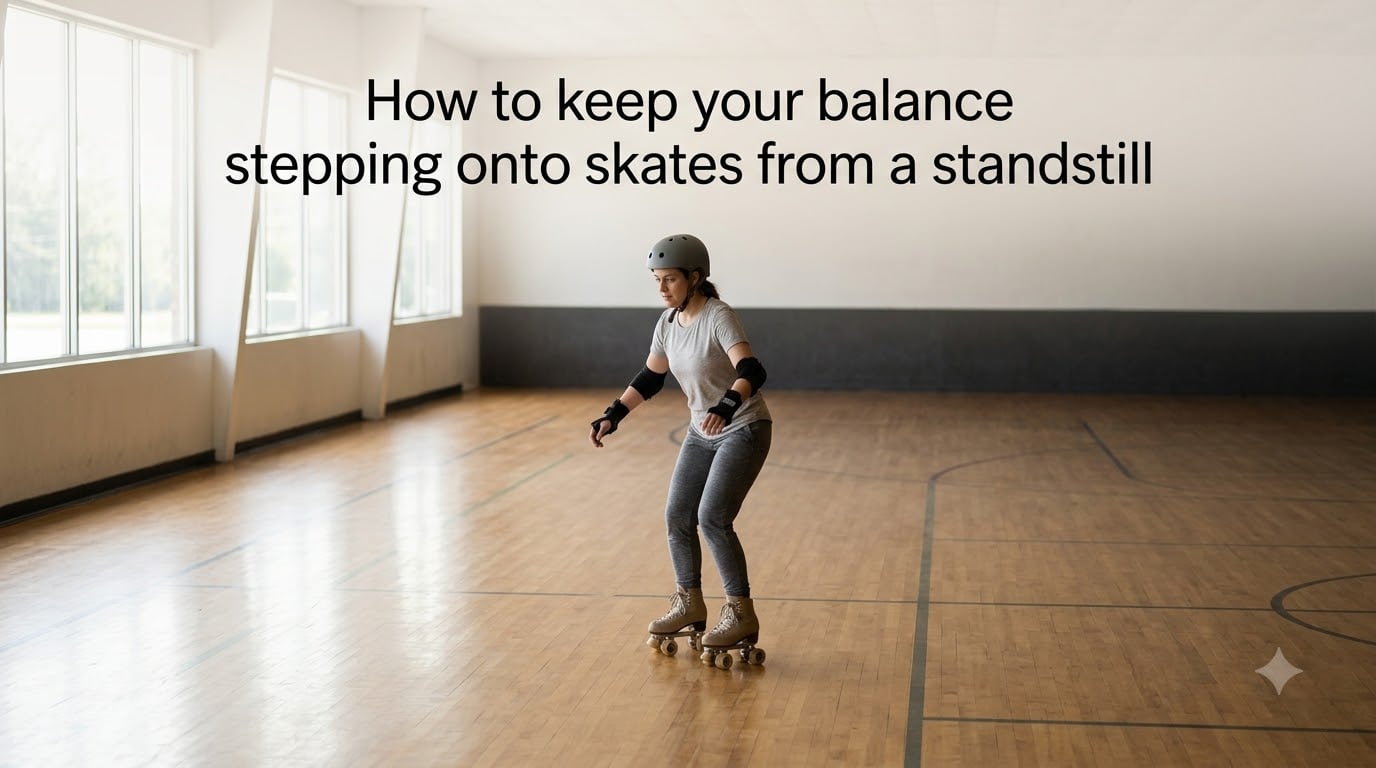
Learning how to keep your balance stepping onto skates from a standstill is the one thing almost every beginner guide skips. Most articles jump straight to pushing, gliding, and turning, but if you cannot stand still on your skates without grabbing a wall, none of those tips help you yet.
After watching dozens of beginners struggle at our local rink and reading the same frustration on Reddit threads, our team put together this guide to fill that exact gap. We will walk through stance, weight distribution, the actual moment of stepping onto your skates, and the off-skate drills that build the balance you need before your first push.
Table of Contents
Why Balance on Skates Starts Before You Move?
Most skating content teaches the moving phase. It covers stride, glide, and stop. The standing phase, where you stand still in your skates, gather your composure, and find your center, gets almost no attention.
That standing moment is where falls actually happen. It is also where your brain learns the new feel of four wheels under your feet. If you skip this step, your first push comes with zero muscle memory, and you are guaranteed to lurch.
Forum users describe the feeling over and over: “I can move, but I cannot stand still.” That single sentence tells you why the standstill phase deserves its own guide. It is the foundation for everything that comes after.
What Is the Correct Stance on Roller Skates?
The correct stance on roller skates is a low, stable, slightly forward position with knees bent and weight centered. Think of an athletic ready position, similar to a shortstop in baseball or a goalie before a save.
Here are the four posture rules that lock it in:
Feet shoulder-width apart. Too narrow makes you wobble. Too wide locks your hips.
Knees bent over the toes. Not crushed to the chest, just soft, as if you are sitting on an invisible chair.
Back straight with chest slightly forward. Shoulders stacked over hips, head up.
Hips over the heels. Not pitched forward onto the toe stops, not dropped back onto the heels.
When I tested this in my living room before my first rink visit, the difference was instant. Standing tall felt unstable. Standing in this athletic stance felt planted.
How Weight Distribution Keeps You Upright?
Weight distribution on skates is about keeping your center of gravity directly above the middle of your skates. For most quad skates, that means above the arch between the front and rear wheels.
If your weight drifts forward, you feel like you are tipping over the toe stops. That usually leads to grabbing the rail or falling forward. If your weight drifts backward, your heels dig in and you feel like the skates are about to shoot out from under you.
The fix is constant small adjustments. Shift your hips slightly forward, then back, until you find the spot where the skates feel glued to the floor. That spot is your balance point. Stay there.
Our team has found that beginners who spend two full minutes finding this point before moving have a far easier time with their first stride than those who just start pushing.
Step-by-Step: Stepping Onto Skates From a Standstill
This is the transition every beginner needs but no guide actually breaks down. Follow these six steps the first time you put on skates, and the standing phase will feel manageable instead of terrifying.
Step 1: Sit down and fasten your skates while seated. Do not try to balance on one foot while lacing the other. Sit on a bench, a chair, or even the floor. Lace both skates fully before standing.
Step 2: Position yourself next to a stable support. A wall, a railing, or the back of a sturdy chair all work. The support should be at hip height so you can grip it without twisting.
Step 3: Rise slowly while holding the support. Do not jump up. Push through your heels, keep your knees bent, and stand up the same way you would from a low couch. The skates will roll slightly. Let them.
Step 4: Find your balance point. With both hands on the support, gently shift your weight forward and back until the skates stop wanting to move. That stillness is your center of gravity.
Step 5: Release the support one hand at a time. Let go with your dominant hand first, hold for five seconds, then release the second hand. Stay still. Let your body wobble. The wobble is normal and it is how your ankles learn.
Step 6: Stand still and breathe. Count to thirty. Do nothing else. You are training your nervous system to recognize “stable on skates” as a safe state. This step is the one most beginners skip, and it is the one that builds real confidence.
Balance Exercises to Practice Off-Skates First
You do not need skates to start training balance. These three off-skate drills build the proprioception, your body’s sense of where it is in space, that makes on-skate balance easier.
Single-leg stand with eyes closed. Stand barefoot on a flat floor, feet together, then lift one foot an inch off the ground. Close your eyes. Aim for thirty seconds. Switch feet. This drill, recommended by Reddit users and physical therapists alike, wakes up the small stabilizer muscles around your ankles.
Feet-together sway drill. Stand with feet touching, arms out. Slowly sway forward and back without letting your feet separate. The motion mimics the micro-adjustments your ankles will make on skates.
Knee-bend squats on a cushion. Stand on a folded towel or soft cushion. Bend your knees to a quarter squat and hold for ten seconds. The unstable surface forces your ankles to work, exactly as they will when the wheels start to roll.
Doing these three drills for five minutes a day, three days a week, gives most beginners noticeable improvement within two weeks.
Arm Position and Head Placement for Stability
Your arms and eyes are secret balance tools. Most beginners ignore them, then wonder why they feel wobbly.
Hold your arms slightly out from your sides, elbows soft, hands open. This gives your body a wider base of support and lets you make instant counterbalancing moves. Tucking your arms in makes you wobble twice as much.
Keep your eyes forward, not down at your feet. Looking down shifts your weight forward and locks your knees, two things that destroy balance. Pick a spot on the wall across from you and look at it while you stand still.
Shoulders stay relaxed. Hunched shoulders tighten your core and push your weight off-center. Drop them, breathe out, and your balance usually returns.
Common Mistakes When Stepping Onto Skates
These four mistakes account for most of the wobbling, lurching, and falling beginners experience in the first five minutes on skates.
Locking the knees. Straight legs cannot absorb the small wheel movements. Always keep a soft bend.
Looking down at the feet. This pulls your weight forward and removes your visual horizon. Look forward.
Leaning too far forward. Beginners instinctively lean toward the toe stops for safety. This is the most common cause of forward falls. Stay over the arch.
Standing on tiptoes. Rising onto the front wheels removes half your base of support. Keep your whole foot on the floor.
If you catch yourself doing any of these, pause, reset to the stance in the section above, and try again.
Building Confidence in the Standing Phase
Wobbling is not failure. It is information. Every micro-adjustment your ankles make is teaching your brain what stable feels like on skates. The wobble fades faster than you think.
Practice near a support you trust the first few times. Stand still for short bursts of thirty to sixty seconds rather than trying to stand for five straight minutes. Short, frequent sessions build skill faster than long, exhausting ones.
If you still feel discouraged, you are not alone. The Reddit thread titled “What to do if you cannot even stand in skates” has hundreds of replies from skaters who struggled at the standstill phase and went on to skate confidently. The standing moment is temporary. Your persistence is what makes you a skater.
FAQ
How do I keep my balance on skates?
Keep your knees bent, feet shoulder-width apart, and weight centered over the arch of your skates. Hold your arms slightly out and look forward, not down. Practice standing still for thirty seconds at a time before attempting to move.
Why can’t I balance on roller skates?
Most balance problems come from locked knees, looking down at the feet, or leaning too far forward onto the toe stops. Loosen your knees, lift your eyes, and shift your hips back over your heels until the skates feel still.
How do you distribute weight on skates?
Distribute your weight evenly between both feet and center it above the middle of the skate, between the front and rear wheels. Avoid pitching forward onto the toe stops or back onto the heels.
Why do I feel like I’m going to fall backwards on skates?
Falling backward usually means your weight is too far forward, which causes the skates to drift out from under you. Bend your knees more, drop your hips back over your heels, and look forward to shift your center of gravity into a stable position.
Final Thoughts on Stepping Onto Skates With Confidence
Learning how to keep your balance stepping onto skates from a standstill comes down to three pillars: a low athletic stance, weight centered over the arch, and eyes forward. Master those, and the moving phase becomes a thousand times easier.
Before your next session, spend a few minutes on the off-skate drills, then follow the six-step transition from seated to standing still. The standing phase is short. Your patience in it pays off for every skate session that follows.