
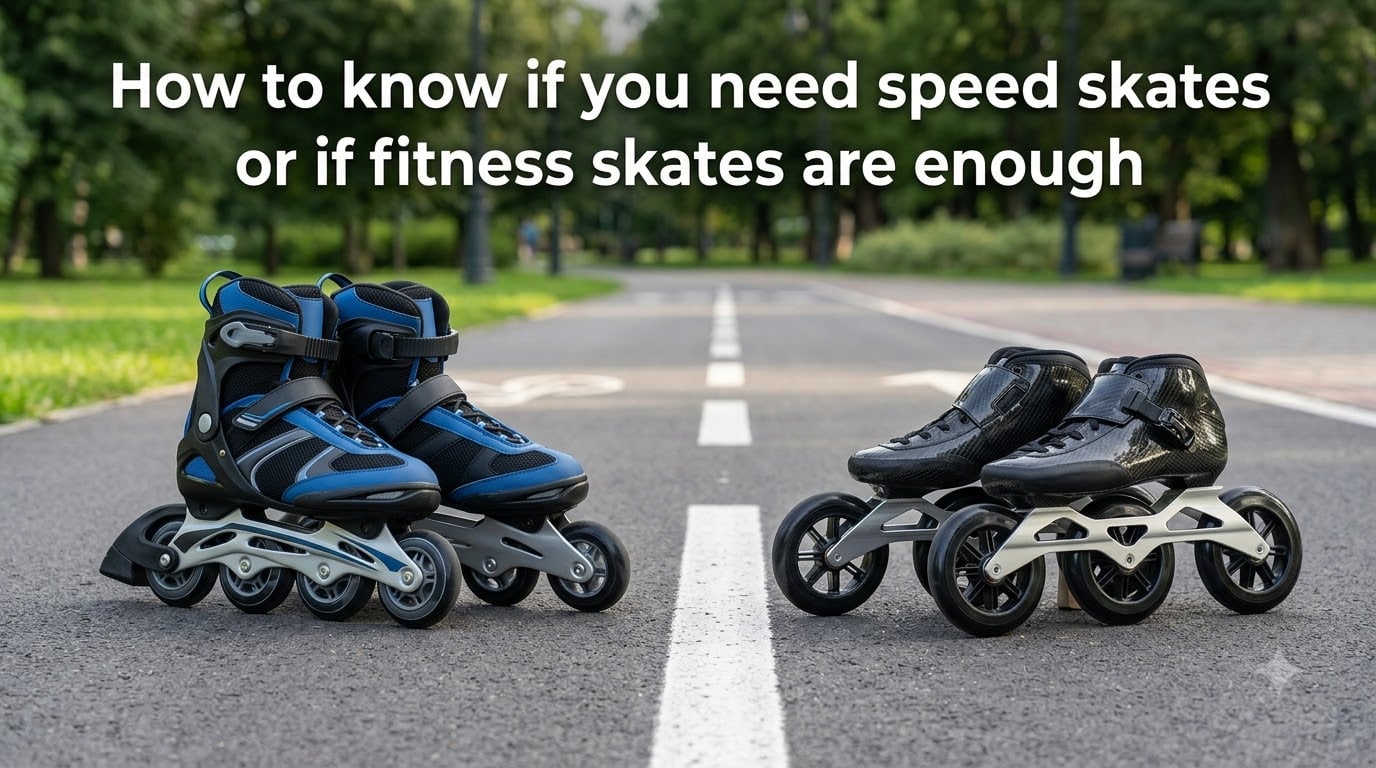
Choosing between speed skates vs fitness skates comes down to one question: do you want maximum control or maximum speed? If you skate for exercise, leisure, or urban commuting, fitness skates are almost always enough. If you race, train for marathons, or routinely chase higher speeds on long, straight paths, speed skates earn their place. Anyone in between is usually better served by a quality fitness skate with a Triskate setup.
I’ve been skating for over a decade, and I have made both the right and wrong choices on this exact question. This guide is what I wish someone had handed me before I bought my first pair of 110mm wheels. I will walk you through the real differences, give you a self-assessment checklist, and show you how to decide without second-guessing your wallet.
Table of Contents
Speed Skates vs Fitness Skates – Quick Comparison
Here is the short answer in table form, so you can tell at a glance which category matches your skating style.
| Feature | Fitness Skates | Speed Skates |
|---|---|---|
| Typical wheel size | 80 to 90 mm (4-wheel) or 100 to 110 mm (Triskate) | 90 to 125 mm |
| Frame length | Short to medium | Long (often 12.8 inch or more) |
| Boot type | Soft boot with cuff | Hard shell or carbon boot |
| Maneuverability | High | Low |
| Top speed potential | Moderate | High |
| Brake | Heel brake included on most models | No brake, must use T-stop or power slide |
| Best for | Exercise, urban, commuting, beginners | Distance, marathons, racing |
| Price range | Budget to mid-range friendly | Mid-range to premium |
Keep this table in mind as you read the rest of the article. Every detail below is just a deeper explanation of one of these rows.
What Are Fitness Skates?
Fitness skates are inline skates built for aerobic exercise, technique practice, and casual distance skating. They are the most common category you will see at a rink or on a bike path, and for good reason: they balance comfort, control, and speed well enough for almost any non-competitive skater.
Most fitness skates share three defining traits. They run on 80 to 90 mm wheels in a classic four-wheel setup, though the popular Triskate configuration uses three 100 to 110 mm wheels for a faster feel. The boot is a soft shell with a supportive cuff, which feels closer to a sneaker than a ski boot. And almost every fitness skate ships with a heel brake, which is the single biggest reason beginners stay safe on them.
Honestly, fitness skates are the default for a reason. They are forgiving, comfortable for long sessions, easy to control, and they slow down predictably. If you have never bought a pair of inline skates before, this is where you start.
What Are Speed Skates?
Speed skates are inline skates engineered for one job: going fast on a straight line. They look noticeably different from fitness skates. The frame is long, the wheels are large, and the boot is short and stiff. The whole setup is built to give you more wheels on the ground, more power transfer per stroke, and less weight swinging around your ankle.
Most speed skates run a 4x100mm, 3x110mm, or 4x110mm setup, and serious racers push toward 120 or 125 mm wheels. The boot is either a hard carbon shell or a hard plastic composite with very little padding. The frame is usually aluminum or carbon and is mounted to 195mm or longer spacing. There is no heel brake, because in a race you would never use one.
Speed skates are specialized. They reward good technique and punish bad habits. If you try to use them on a crowded path, you will find yourself wishing for the turning radius of a car.
Key Differences Between Speed Skates and Fitness Skates
Now that the basic definitions are out of the way, here is a deeper look at the differences that actually matter when you are skating. The marketing copy on a box tells you less than you might think.
Wheel Size and Speed
Larger wheels roll faster and hold speed better over rough ground. Fitness skates typically run 80 to 90 mm, which is plenty for a 10 to 15 km/h cruise. Speed skates start at 90 mm and go up to 125 mm. Each step up in wheel size is roughly a 10 to 15 percent gain in theoretical top speed on flat ground, but only if your technique can handle the longer wheelbase.
Boot Type and Support
Fitness skates use soft boots with a breathable liner and a cuff that wraps the ankle. They feel comfortable within minutes and forgive sloppy ankle alignment. Speed skates use hard carbon or composite boots that lock your ankle in place. That stiffness is what transfers energy from your legs directly into the wheels instead of into foam padding. It also takes weeks to break in and is unforgiving on weak ankles.
Frame Length and Stability
Longer frames feel more stable at high speed and let you stride out. Shorter frames are twitchier but turn on a dime. A 4x80mm fitness frame is great for weaving around pedestrians. A 4x110mm speed frame is great for striding down a closed road. Choose the frame length that matches your environment more than your aspirations.
Maneuverability vs Speed Trade-Off
This is the trade-off the forums keep talking about, and it is real. Speed skates do not turn as well as fitness skates. The longer wheelbase resists carving, and the hard boot does not let your ankle roll the way a soft cuff does. If your skating involves tight corners, crowded paths, or unpredictable obstacles, fitness skates are the safer pick. If your skating involves long, open stretches where you want to push your pace, speed skates win every time.
Brake and Stopping
Fitness skates come with a heel brake. Speed skates do not. That single fact is the biggest reason beginners should not start on speed skates. You need to already know how to T-stop, power slide, or use a heel brake on a fitness skate before you can safely ride a speed setup.
Fit and Sizing
Speed skates fit more snugly because the rigid shell is designed to transfer power, not comfort. Most skaters size up, especially in EU sizing. From what I have seen, a half size up from your normal shoe is a safe starting point for fitness skates, and a full size up for speed skates is closer to typical. Trying skates on in person is still the gold standard.
Signs You Need Speed Skates
You probably need speed skates if you can check at least three of the boxes below. If only one or two apply, give yourself another six months on fitness skates first.
You skate three or more times a week and want to push your pace.
You regularly train on closed courses, bike paths, or dedicated skating tracks.
You have signed up for a marathon, half-marathon, or competitive race.
Your fitness skates regularly feel too slow or too unstable at your top speed.
You have already learned the T-stop and power slide and feel confident without a heel brake.
You are willing to invest in a stiffer boot and accept a longer break-in period.
If that list sounds like you, you are ready for speed skates. Just pick a frame and wheel setup that matches your most common terrain, not the dream race you want to do two years from now.
Signs Fitness Skates Are Enough for You
Most skaters fall into this category, and there is no shame in it. Fitness skates are excellent tools. You are fine staying on them if any of the following is true.
You skate for general exercise, fresh air, or to clear your head.
Your routes include bike paths, urban streets, parks, or mixed terrain.
You are still working on balance, stopping, or general technique.
You have never used a heel brake and have not yet learned a T-stop.
You want one pair of skates that can handle hills, crowds, and casual outings.
Speed is not a goal. Enjoyment and consistency are.
Honestly, a quality pair of fitness skates with good wheels will follow most recreational skaters for years. There is no expiration date on them.
How to Transition from Fitness Skates to Speed Skates?
The transition is a real thing, and it is the step most guides skip. Treat it like picking up a new sport, even if you can already skate. Here is the order I would recommend.
Step 1: Master the T-Stop and Power Slide
Before you ever strap into speed skates, you should be able to stop without a heel brake, on a slight downhill, on demand. The T-stop is the easiest to learn. The power slide is faster and more reliable but takes longer to dial in. Practicing both on fitness skates first means you can trust your feet when you switch.
Step 2: Skate Your Fitness Skates Harder
Before you buy speed skates, push your fitness skates to the pace you actually want to skate at for sustained periods. You will quickly find out whether speed is a real goal or a fun idea. If you rarely push past 18 km/h, fitness skates are still enough.
Step 3: Pick a Triskate Fitness Setup First
If you are hovering between the two categories, a 3x110mm fitness Triskate is the perfect bridge. It gives you bigger wheels and faster rolling without the hard boot and knife-edge turning. Many skaters never leave this setup, and that is fine.
Step 4: Size Up and Try in Person
Speed skates fit tighter than fitness skates. A full size up from your normal shoe is a reasonable starting point. If you can, try them on. The fit is the single biggest factor in whether you will enjoy the transition.
Step 5: Give Your Ankles Two Weeks
The hard boot will feel strange for the first two weeks. Your ankles and calves will be sore as they adjust to the rigid support. Skate shorter sessions, stretch after, and back off if you feel sharp pain. The comfort comes in waves, not all at once.
Common Mistakes to Avoid When Choosing Skate Type
You will save yourself money and frustration if you avoid the traps most beginners fall into.
Buying speed skates for urban commuting. The lack of a brake and tight turning radius is a real safety issue.
Buying fitness skates for a marathon. You will finish, but you will leave speed on the table.
Skipping the heel brake because it looks uncool. Learn to stop first, then decide.
Choosing wheel size purely for speed. Bigger wheels are less forgiving and worse on rough pavement.
Trusting the box label instead of your feet. Sizing varies wildly between brands.
These are the same mistakes I see in the forums every week. The good news is that none of them are fatal. They just cost you a pair of skates you will not use.
FAQ
Are speed skates better than fitness skates?
Speed skates are better for one specific thing: going fast on a straight line. For everything else, fitness skates are usually the smarter pick. They handle better, stop easier, and cost less. Speed skates only win when speed is the goal.
What is the difference between recreational skates and fitness skates?
Recreational skates are softer, more cushioned, and aimed at short, casual rides. Fitness skates are stiffer, faster, and built for longer sessions at higher effort. Recreational skates favor comfort, fitness skates favor performance.
How do I know if I need speed skates?
You need speed skates if you regularly train for races, skate on closed courses, want to push past 25 km/h, and can already stop without a heel brake. If those do not describe you, fitness skates are enough.
Can I use fitness skates for marathon training?
You can, and many skaters do. A fitness Triskate with 100 to 110 mm wheels will carry you through a marathon comfortably. The gap between fitness and speed skates shrinks at the marathon level, so the upgrade is more about preference than necessity.
When should I switch to speed skates?
Switch when your fitness skates feel slow, you have mastered stopping without a heel brake, and you have a clear reason to go faster. Do not switch on a whim. The transition takes time and the wrong setup can sour you on the sport.
Conclusion
The decision between speed skates and fitness skates is not about which is better. It is about which matches your skating. If you want control, comfort, and a safety net, fitness skates are enough. If you want speed and have the technique to match, speed skates earn their cost. For everyone in between, a fitness Triskate is the sweet spot.
Use the checklists above before you spend anything. Skate your current setup for another month at the pace you want. Then decide. The right pair of skates is the one that matches the skating you actually do, not the one you wish you did.