
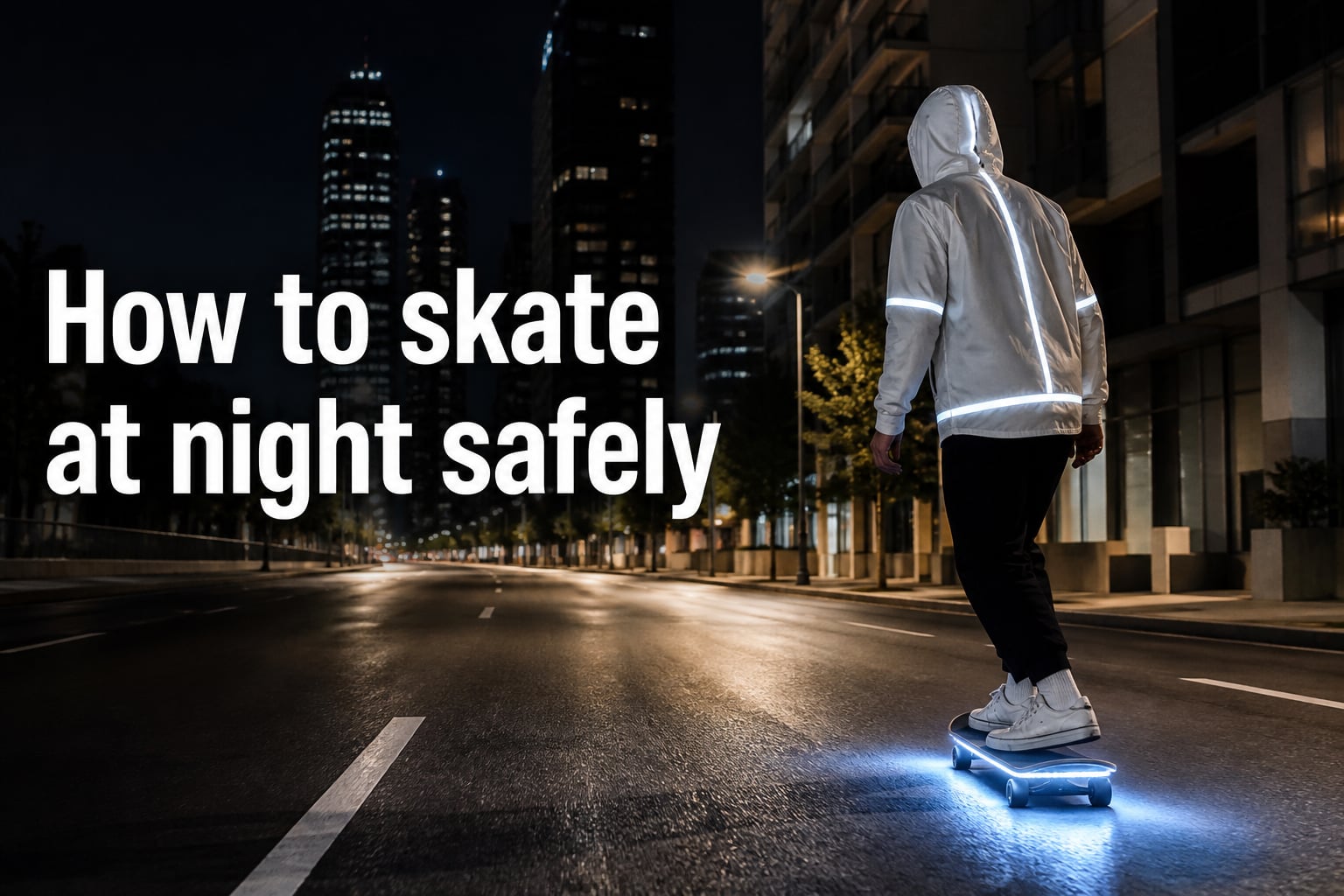
Skating after dark is one of the most peaceful experiences you can have on a board or skates. Empty streets, cooler air, and the silence of a city winding down create a vibe you just can’t find at noon. But if you want to enjoy it without ending up in the ER, you need to know how to skate at night safely.
I have spent years skating in parking garages, empty campus sidewalks, and quiet suburban streets after the sun goes down. Every session taught me something new about visibility, route planning, and the gear that actually keeps you safe versus the stuff that just looks cool. This guide pulls all of that together so you can skate at night with confidence.
Whether you skateboard, roller skate, or inline skate, the core safety principles stay the same. The biggest risks at night are reduced visibility (both yours and others’), unpredictable surfaces, and being harder for drivers to spot. With the right preparation, gear, and mindset, you can manage every one of those risks.
By the end of this guide, you will have a complete checklist for safe night skating, covering visibility gear, protective equipment, route planning, weather conditions, and emergency preparedness.
Table of Contents
How to Skate at Night Safely: A Complete Overview
Skating at night safely comes down to three pillars: see, be seen, and skate within your limits. Every decision you make, from the gear you pack to the route you choose, should support those three goals.
First, make sure you can see the road ahead. A headlamp or board-mounted light helps you spot cracks, potholes, and debris before they send you flying. Second, make yourself visible to drivers, cyclists, and pedestrians using reflective materials, bright colors, and active lighting. Third, dial back your speed and trick attempts, because reaction times drop significantly in low-light conditions.
The sections below break down each pillar into specific, actionable steps you can follow before your next night session.
Why Skate at Night? The Real Benefits
Before getting into safety gear, it helps to understand why so many skaters head out after dark in the first place. Night skating is not just a fallback for busy schedules. For a lot of people, it is the best part of their day.
Skaters on Reddit consistently mention one benefit above all others: solitude. When you skate at night, nobody is watching, nobody is judging, and you have the spot to yourself. That freedom lets you try new tricks, practice fundamentals, or just cruise without feeling self-conscious.
Cooler air is another major plus, especially during summer. Asphalt that felt like a frying pan at 2 PM becomes a smooth, comfortable surface by 9 PM. Less foot and vehicle traffic also means fewer interruptions and a more predictable environment, as long as you pick your route well.
For skaters with ADHD, the calm of night skating can actually help with focus. The reduced sensory input lets you zero in on your board, your balance, and the rhythm of your ride. Many skaters describe it as meditative.
Essential Visibility Gear for Night Skating
Visibility gear is the single most important investment you can make for night skating. Without it, you are essentially invisible to anyone in a car, and you will struggle to read the surface in front of you. Here is what you need.
Reflective Clothing and Materials
Reflective materials bounce light from headlights back toward the source, which makes you glow brightly in a driver’s eyes. A reflective vest, armbands, or ankle bands are cheap, lightweight, and incredibly effective.
Look for garments with retro-reflective strips rather than just bright colors. Neon yellow looks great during the day, but at night it disappears without a light source hitting it. Reflective tape on your helmet, backpack, or even your shoes adds extra visibility points.
LED Lights for Your Skateboard or Roller Skates
LED lights mounted under your board are popular for a reason. Products like Board Blazers and similar underglow kits cast light downward, illuminating the pavement and making your board highly visible from multiple angles.
LED wheels are another option, especially for roller skates and inline skates. Brands like Luminous, Clas Fox, and FomoTeam produce wheels that light up as they spin. Forum skaters consistently report that LED wheels dramatically improve how visible they are, and they look fantastic too.
For the best results, combine underglow lights with LED wheels. The two systems cover different angles and ensure drivers can see you from the front, back, and sides.
Headlamps and External Lighting
A headlamp is non-negotiable if you are skating anywhere without overhead lighting. Aim for at least 200 lumens to light up the path ahead and give yourself enough time to react to obstacles.
Wear the headlamp on your helmet or forehead so the beam follows your line of sight. Some skaters also clip a small tail light to their backpack or belt loop, which acts like a bike tail light and alerts anyone approaching from behind.
Protective Equipment You Should Never Skip
Night skating increases your risk of falls because you cannot see hazards as clearly. Wearing full protective gear is not optional here. It is the difference between brushing yourself off and calling for a ride to the hospital.
A certified skateboard helmet is the most important piece of equipment you own. Look for one that meets ASTM F1492 or CPSC standards. A helmet with reflective stickers or a built-in LED light does double duty by protecting your head and boosting your visibility.
Wrist guards, knee pads, and elbow pads round out your kit. Wrist injuries are the most common skating injury, and they happen fast when you cannot see the ground clearly. Knee pads with hard plastic caps also let you safely bail into a knee slide if something goes wrong.
Do not forget closed-toe shoes with grip. Loose gravel and unseen debris can stop a wheel dead, and your feet take the brunt of any sudden stop.
Best Places to Skate at Night
Where you skate at night matters as much as what you wear. The ideal spot is smooth, well-lit, legal to skate, and free of vehicle traffic. Here are the locations that skaters consistently recommend.
Parking garages are a night skating staple. They offer smooth concrete, overhead lighting, and shelter from dew and light rain. The catch is that corners can be blind spots, so skate slowly on ramps and listen for engines. Some garages have security that will ask you to leave, so be respectful and move on without arguing.
Skate parks are excellent if yours stays open late or has no posted closing time. The surfaces are designed for skating, and the features are predictable. Just remember that obstacles are harder to see at night, so scope the park before dropping in at speed.
Well-lit campus walkways and empty business district sidewalks work well on weeknights. College campuses often have smooth pathways and good lighting, and foot traffic drops to near zero after 10 PM. Always check for posted rules about skating on campus property.
Quiet residential streets can work, but they come with caveats. Driveways, parked cars, and noise from your wheels can bother residents. Keep your speed down and avoid areas with heavy evening traffic or limited street lighting.
Route Planning and Surface Assessment
The best night skaters treat every route like a mission. You scout, you plan, and you adjust. Showing up to a new spot blind at 11 PM is asking for trouble.
Walk or skate your intended route during daylight first. Note potholes, rough patches, storm drains, expansion joints, and any surface that could catch a wheel. Take photos so you remember problem areas. Once you know the route, you can skate it confidently after dark.
Stick to routes you know well, especially when skating alone. Familiarity means you instinctively slow down before that one cracked section or brake early for the steep hill. New terrain at night should always be approached at low speed.
Avoid routes with frequent driveways, intersections, or blind corners where a car could appear suddenly. Even with full lighting gear, drivers are not expecting a skater in the road at midnight.
Speed Management and Skate Control
Speed is your enemy at night. The faster you go, the less time you have to react to something you did not see. That crack, rock, or wet patch becomes a serious hazard at 20 mph when you only spot it two seconds before impact.
Aim for 60 to 70 percent of your normal cruising speed during night sessions. This gives you a comfortable margin to brake, swerve, or step off if something unexpected appears in your path. If you normally cruise at 12 mph, target 8 or 9 mph at night.
Practice your braking techniques in daylight until they are automatic. Foot braking, heel dragging, and controlled slides should all happen without thinking. When you skate at night, you need those skills on instant recall.
Avoid bombing hills in the dark unless you know the run inside out and have spotters or a clear sightline. Even then, dew and temperature changes can alter how your wheels grip, turning a familiar hill into a wildcard.
Skating Alone vs With Others: Safety Trade-offs
The buddy system is one of the oldest safety rules for a reason. Skating with at least one other person means someone is there to call for help if you go down hard. For night skating, this matters even more because fewer people are around to notice an accident.
That said, solo night skating is incredibly common and many skaters love it. If you skate alone, take extra precautions. Share your live location with a friend or family member using your phone’s location-sharing feature. Tell someone your route and when you expect to be back.
Car a fully charged phone and a small power bank. A dead phone at 1 AM defeats the entire purpose of having it for emergencies. Set a check-in time with your contact so they know to worry if they do not hear from you.
If you do skate with a group, agree on hand signals for stops, hazards, and turns before you roll out. Keep the group tight enough that everyone stays in sight, but spaced enough to avoid collisions if someone falls.
Weather and Environmental Conditions at Night
Weather behaves differently at night, and skaters who ignore this end up on the ground. As temperatures drop after sunset, moisture in the air condenses on surfaces, creating a thin layer of dew that makes pavement dangerously slick.
Dew is the silent killer of night skating. It forms on smooth concrete, metal coping, and painted lines, reducing grip before you even realize it is there. If the ground looks slightly glossy or your wheels feel slippery, slow down immediately or call the session.
Temperature drops also affect your wheels and bearings. Urethane gets harder in cold conditions, which means less grip and a harsher ride. Your bearings may feel sluggish until they warm up from rolling. Give yourself a few minutes of easy cruising before pushing hard.
Check the dew point before you head out. If the forecast temperature is close to the dew point, expect slick conditions. Humid nights are riskier than dry ones, and a light fog can reduce your visibility to almost nothing even with a good headlamp.
Wind is another factor that ramps up at night in some areas. Strong gusts can push you off balance, especially on cruisers with large wheels. Pay attention to the wind forecast and avoid open stretches if gusts are over 15 mph.
Emergency Preparedness and Location Sharing
Even with perfect gear and route planning, things can go wrong. A rock stops your wheel, a car pulls out unexpectedly, or you twist an ankle on a curb. Being prepared for the worst is what turns a bad situation into a minor inconvenience.
Carry identification and a small first-aid kit in your backpack. Bandages, antiseptic wipes, and a compression wrap handle most road rash and minor sprains on the spot. Some skaters also carry a whistle to signal for help if they are injured and alone.
Set up an ICE (In Case of Emergency) contact on your phone lock screen. If someone finds you unconscious, they can reach your emergency contact without unlocking your device. Both iOS and Android support this feature natively.
Save the location of the nearest urgent care or hospital before you skate. If you are in an unfamiliar area, knowing where to go saves critical minutes in an emergency. Several location-sharing apps also let friends track your route in real time, which is invaluable for solo skaters.
If security or police approach you while night skating, stay calm and cooperative. Most of the time they just want to know what you are doing and will let you go if you are respectful. Arguing or running escalates the situation and can lead to trespassing charges.
Frequently Asked Questions
How late is too late to skate?
There is no universal cutoff, but most skaters avoid skating past midnight in residential areas due to noise concerns and reduced visibility. In commercial or industrial areas with no nearby homes, you can skate later. Use judgment based on lighting, traffic, and whether your presence will disturb others. Always check local curfews and posted park hours before heading out.
Is night skateboarding considered safe?
Night skateboarding is safe when you wear proper visibility gear, use lighting, skate familiar routes at controlled speeds, and protect yourself with a helmet and pads. The risks increase without preparation, but skaters who follow safety protocols report few issues. The key is reducing speed, improving visibility, and avoiding unfamiliar terrain after dark.
What can a skateboarder do to protect himself from harm?
Wear a certified helmet, wrist guards, knee pads, and elbow pads every session. Use reflective clothing and LED lights so drivers can see you. Skate at 60 to 70 percent of your normal speed, scout routes in daylight, and carry a charged phone with location sharing enabled. Avoid skating alone in isolated areas whenever possible.
What lights do I need for night skating?
You need a headlamp with at least 200 lumens to see the path ahead, plus underglow LED lights or light-up wheels so others can see you. A rear tail light clipped to your backpack or belt adds extra protection from behind. Combining multiple light sources at different angles gives you the best visibility coverage.
Is it safe to skate alone at night?
Skating alone at night is manageable if you take extra precautions. Share your live location with a trusted contact, carry a fully charged phone and power bank, stick to familiar well-lit routes, and wear full protective gear. Avoid isolated areas with no foot traffic, and set a check-in time so someone knows to act if they do not hear from you.
What should I wear for visibility while skateboarding at night?
Wear reflective clothing with retro-reflective strips, bright colors as a base layer, and add reflective tape to your helmet and shoes. LED armbands, ankle bands, and a reflective vest maximize your visibility to drivers. Pair your clothing with board-mounted lights or LED wheels so you are visible from every angle.
Wrapping Up: Skate Smart, Skate Safe
Learning how to skate at night safely is not about avoiding the fun. It is about earning the freedom to skate whenever you want, without paying for it with injuries or close calls. The skaters who get the most out of night sessions are the ones who respect the risks and prepare accordingly.
Build a kit that covers visibility from every angle. Reflective clothing, LED lights, and a solid headlamp are your foundation. Add a certified helmet, full pads, and closed-toe shoes so you walk away from any fall. Then layer in good habits: scout routes in daylight, slow down, watch for dew, and always let someone know where you are.
The beauty of night skating is worth the effort. Once you have your system dialed in, you unlock a calmer, cooler, and quieter way to ride that no daytime session can match. Start with a short, familiar route close to home, test your gear, and build up gradually as your confidence grows.
Grab your board or skates, suit up, and go enjoy the empty streets. Just make sure you can see, be seen, and skate within your limits every single time.