
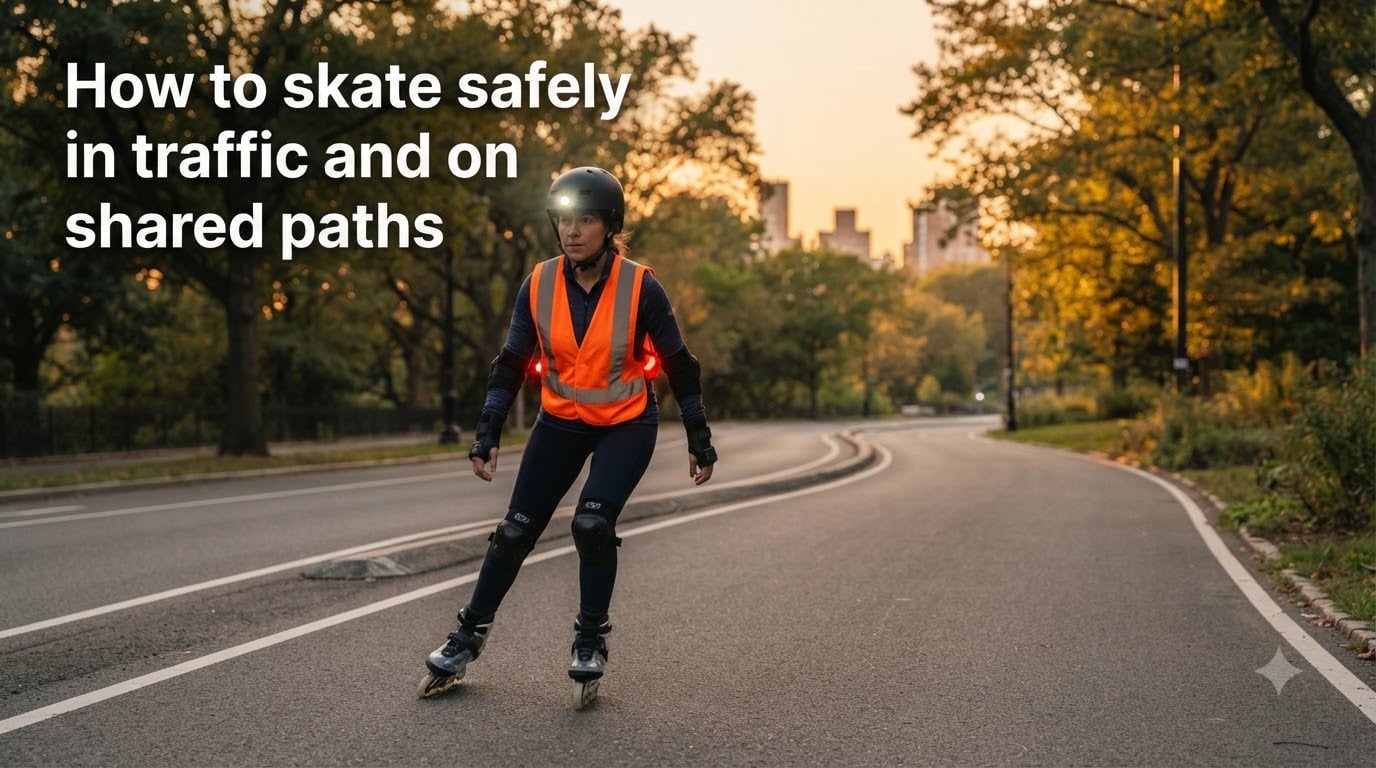
Learning to skate safely in traffic changed everything for me. Three years ago I was bombing down a bike lane in full gear when a sedan drifted into my lane and pinned my ankle against the curb. The helmet and wrist guards kept me out of the ER, but the close call taught me one thing: gear and technique are non-negotiable when cars are around. This guide is everything I wish I’d known on day one.
If you commute on skates, train on shared paths, or just want to feel confident around traffic, you’re in the right place. I’ll cover the gear you’ll actually use, the defensive skating moves that keep you alive, the laws that govern where you can roll, and the etiquette that makes shared paths work for everyone.
Table of Contents
Essential Safety Gear You Need Before You Skate in Traffic
Gear is the foundation of skating safely in traffic. A skater on Reddit once described getting their ankle clipped by a passing car, then wrote “thats the end of that ankle here we go.” They walked away. Full gear did its job.
Here’s what I put on every single time I leave the driveway.
Helmet
A certified helmet is non-negotiable. I use a multi-impact skate helmet because I fall more than I’d like to admit. Look for ASTM F1492 or CPSC certification for skating, not just a bike helmet that won’t sit right on your head.
Wrist Guards
Wrist fractures are the most common roller skating injury according to emergency room data. Wrist guards with rigid splints on both the palm and back of the hand keep your wrists from bending past their limit when you instinctively put your hands out to break a fall.
Knee and Elbow Pads
Hard-shell pads are best for street and path skating. Soft caps pad minor falls but won’t save you from a slide across asphalt. Make sure the straps hold firm even when your knees are bent.
Lights
A white front light and red rear light are required by law in most places once the sun goes down, and they’re smart practice in daylight too. Drivers spot a flashing light far sooner than they spot a skater. I run a 200-lumen rechargeable front light clipped to my helmet and a USB-rechargeable red blinker on my right skate.
Reflective Clothing
A reflective vest or vest-style straps turn you into a glowing target from the side. Reflective ankle bands are underrated because they move as you skate, which catches peripheral vision in a way static gear cannot.
Mouthguard (Optional but Smart)
Dental work is expensive. A simple boil-and-bite mouthguard costs almost nothing and has saved countless skaters from chipped teeth in falls I would not have predicted.
Safety check before you leave: Helmet strapped, pads tight, lights on, reflective gear visible, phone charged. This two-minute routine has saved me more than once.
Road Skating Fundamentals: Positioning, Direction, and Awareness
Knowing how to skate safely in traffic on public roads comes down to three habits: position yourself predictably, make yourself visible, and communicate clearly.
Ride on the Right Side of the Road
Like cyclists, skaters travel in the same direction as car traffic. On a two-way street, stay on the right half. Hug the right edge when cars are present and pull out a bit when you need room to maneuver around potholes or debris.
Stay as Far Right as Practicable
The phrase “as far right as practicable” appears in most cycling statutes and applies to skaters too. It means you don’t have to ride in the gutter if it’s full of drain grates or gravel. Move left to avoid hazards, then return.
Single File When Cars Approach
Two skaters side by side force drivers to swerve into the oncoming lane. Skate single file the moment you hear or see a car approaching. Pull back into a tight line until the car passes, then spread out again.
Shoulder Checks Before Turning
Before any lateral move or turn, glance over your shoulder in the direction you’re moving. Do this at least three seconds before you actually turn. Drivers closing the gap at 35 mph will close a lot of distance in two seconds.
Hand Signals
Use clear arm signals to indicate turns and stops. Left arm straight out for a left turn, left arm bent up for a right turn, left arm bent down for a stop. Make your signals obvious, hold them long enough to register, and return your hand to a ready position before the move.
How to Handle Car Encounters Without Getting Hurt
Defensive skating is a frame of mind. You assume every driver is distracted and act accordingly. Cars passing too close is the most common pain point I hear about in online skating forums, and it usually happens because the driver misjudged speed or drifted across the lane.
Here are six techniques that have kept me upright through thousands of miles of traffic skating.
- Stay predictable. Hold a straight line, constant speed, and clear hand signals. Predictable skaters are easy drivers.
- Make eye contact with drivers at intersections. A confirmed glance means the driver sees you. If they don’t look, assume they don’t see you.
- Avoid the door zone. Stay at least four feet out from parked cars to avoid being doored.
- Don’t hug the curb too tightly. Leaves you nowhere to swerve when a car drifts or a pedestrian steps out.
- Wave a small thanks when a driver yields properly. It builds goodwill and keeps drivers alert to skaters in the future.
- If a car passes too close, control your reaction. Don’t swerve into traffic. Slow down, hold your line, and note the vehicle. Report aggressive drivers when needed.
What to Do If a Car Actually Hits You
This is the scenario every skater dreads, but it has a clear procedure. Move out of traffic as soon as you safely can. Check yourself for serious injury before trying to stand. Call emergency services if anything hurts beyond normal road rash. Stay calm, exchange information, and photograph the scene, the car, the road, and your injuries. If you cannot stand, stay still and wait for help.
A near-miss is a warning. Take it seriously, review what happened, and adjust your route or behavior. One forum user wrote, “I notice a car behind me so I don’t take big strides.” That kind of awareness is the entire game.
How to Skate on Bumpy Roads and Rough Surfaces
Bumpy roads are where new skaters lose confidence. The technique is simple: relax, look ahead, and let your knees absorb the impact. Most importantly, get enough speed. Going over cracks isn’t a big deal if you have enough speed, as one experienced commuter put it.
- Scan the surface 20 to 30 feet ahead. Look for cracks, seams, pebbles, wet leaves, and storm drains.
- Bend your knees more. Lower center of gravity and softer joints turn every bump into a small shock rather than a balance disaster.
- Keep your weight centered. Don’t lean back, don’t lean forward, stay over the wheels.
- Maintain a smooth rolling speed. Too slow and you get bounced. Too fast and reaction time shrinks.
- Choose smooth routes when possible. Bike paths, park loops, and fresh asphalt make learning much easier than broken side streets.
Sharing Paths With Pedestrians: Etiquette That Keeps Everyone Safe
Pedestrians should never be expected to step off a shared-use path or sidewalk to make way for another user. That line from a cycling etiquette guide applies to skaters exactly the same way.
Keep Right, Pass on the Left
The right side of any path is the slow lane. Walkers, joggers, and dog owners take the right. You skate on the right too and pass on the left, just like passing on a road.
Yield to Pedestrians
Pedestrians always have the right of way on a shared path. When in doubt, slow down, ring a small bell, or call out “passing on your left.” A friendly voice prevents a lot of startled jumps.
Slow Near Blind Corners
Path corners hide oncoming users. Slow to a speed you can stop at, peek around the curve, then accelerate through.
Watch for Dogs
Dogs on retractable leashes are a real hazard. The leash can wrap ankles or yank the dog into your path. Slow down, ask the owner to shorten the leash, and pass with care.
Avoid Crowded Sections
When sidewalks or paths are packed, skating becomes a stop-and-go nuisance for everyone. Switch to a quieter route or skate at off-peak times. Early weekend mornings are perfect because foot traffic is light.
Passing Etiquette
Single file riding is for narrow sections. Pass a pedestrian only when you have clear space ahead and on the left. Slow down, call out, then glide past at a calm speed. Never zip past a child, an elderly walker, or a stroller without giving warning.
Sharing Paths With Cyclists and Other Wheeled Users
Cyclists moving at 15 mph can close a block in seconds. A cyclist passing without warning at high speed is one of the most common complaints on shared path forums. The fix is communication and predictability.
Listen Behind You
Skating quietly under bright leaves masks approaching cyclists. Wear a small bell or call out before passing, and listen for the soft whir of bike tires behind you.
Hold a Steady Line
Cyclists aim for your line, not your body. Hold a straight line and they’ll flow around you. Weaving makes you a moving obstacle and forces sudden braking.
Take the Whole Path When Needed
Narrow paths do not allow passing room. Slow down, signal, and use the full width of the path to make eye contact with the cyclist before merging back to single file.
Avoid Sudden Direction Changes
Cyclists cannot stop as fast as skaters can. Anticipate turns and obstacles well in advance so your path is clear and obvious.
Heads Up at Junctions
Where paths cross roads, both cyclists and skaters are vulnerable. Slow down, look both ways, and make eye contact with any driver waiting at the crossing.
Legal Considerations: Where You Can (and Can’t) Skate
Is it illegal to skate on roads? It depends entirely on where you live. Most states treat roller skates somewhere between a pedestrian and a bicycle, and the rules shift by jurisdiction.
Sidewalks
Skaters are usually allowed on sidewalks unless posted otherwise. Local ordinances may restrict skating in business districts or downtown cores, so always check signage. Yield to pedestrians at all times.
Bike Lanes and Roads
Many states explicitly allow skaters in bike lanes when a bike lane is present. California amended its vehicle code to allow skaters in bike lanes, and other states like New York generally permit skaters on most public roads but prohibit them on limited-access highways. Always verify the rule where you skate.
State-by-State Snapshots
- California: Skaters are considered pedestrians by default and may use bike lanes and roads where pedestrians are allowed.
- New York: Skating on sidewalks and roads is generally allowed, but not on interstates or highways.
- Florida: Local municipalities govern most skating laws. Many cities require lights at night and ban skating on certain roads.
- Texas: No statewide ban on road skating, but local rules vary widely. Always check your city code.
Your Responsibilities
Wherever you skate, you owe the same duty of care as a cyclist. Obey traffic signals, signal your turns, yield when required, and ride sober. Insurance-wise, some homeowner’s or renter’s policies cover skating injuries, but liability coverage for hitting a pedestrian is rare. A low-cost cycling umbrella policy can close that gap.
Always verify your local rules before heading out. A quick call to your city’s transportation department or a search of municipal code clears up most questions in minutes.
Night Skating and Low-Light Visibility
Night skating magnifies every risk. Drivers’ eyes adjust for distance, not for a six-foot shape rolling along the right side. Visibility gear is your lifeline.
Lighting Checklist
- White front light visible from 500 feet
- Red rear light visible from 300 feet
- Reflective vest or harness
- Reflective ankle bands for motion visibility
- Optional helmet light for turns and intersections
Route Selection
Choose familiar, well-lit routes after dark. Quiet neighborhood streets with streetlights are safer than fast arterial roads with poor lighting. Avoid unlit paths unless you run a powerful front light.
Buddy System
Night skating with at least one other person is the simplest safety upgrade you can make. Another skater is another set of eyes and another set of lights.
Overcoming Fear and Building Confidence on Busy Streets
Fear of traffic is the single biggest reason new skaters stay on quiet paths. I’ve talked to dozens of skaters who say the same thing: it’s the cars, not the skating, that scares them. That’s a real feeling and it deserves a real plan.
Start Off-Road
Begin in empty parking lots, smooth park loops, or protected bike paths. Build balance, stopping, and turning at low speed before you ever face a moving car.
Pick Off-Peak Times
Saturday and Sunday early mornings have light traffic and alert drivers. Use those windows to push into busier neighborhoods.
Practice Emergency Stops
An emergency stop you trust makes every other move less scary. Practice the toe stop drag, the T-stop, and a controlled slide-stop until one of them feels automatic. When you trust your brakes, the road feels smaller.
Skate With a Buddy
Two skaters are easier for drivers to see and easier for anxious skaters to manage. Local skate meetups are a great way to find training partners.
Incrementally Raise the Challenge
Add one new stressor per week. A slightly busier street. A new intersection. A short night skate. The cumulative effect of small wins builds real confidence.
Reframe the Risk
You’re not helpless on skates. You’re faster than a walker, more agile than a cyclist, and far better at spotting hazards than a driver. Defensive skating is the skill of using those advantages.
Emergency Procedures: What to Do When Something Goes Wrong
Even great skaters fall. Knowing what to do in the moment turns a bad day into a manageable one.
If You Fall
Try to relax on impact. Tucking and rolling distributes force across your body rather than your wrists or head. Pads absorb the slide. Once stopped, get out of any active path before checking for injuries.
If You’re Hit by a Car
Stay calm and still until you know your injuries. Call 911 if there is any doubt. Photograph the car, the road, your gear, and your injuries. Get the driver’s name, contact, plate number, and insurance details. Avoid signing anything at the scene.
If You Witness a Crash
Stop, check on the skater, and call emergency services if needed. Stay as a witness until help arrives. Your testimony matters when fault is disputed.
Insurance and Liability
Check your homeowner’s or renter’s insurance for personal liability coverage. If you skate to work or commute often, a low-cost cycling or recreational sports policy gives you injury protection and liability coverage that standard policies exclude.
Reporting Aggressive Drivers
If a driver intentionally endangers you, pull over safely and call the non-emergency police line. License plate numbers and dashcam footage make reports actionable.
Frequently Asked Questions
Is it illegal to skate on roads?
In most U.S. states, roller skating on public roads is legal, but local ordinances may restrict where you can skate. Many states treat skaters like cyclists or pedestrians and require you to follow the same rules of the road. Always check your city’s municipal code before skating on busy streets.
How do I skate on bumpy roads safely?
Scan 20 to 30 feet ahead for cracks and debris, bend your knees to absorb shocks, keep your weight centered over the wheels, and maintain a smooth rolling speed. Smooth asphalt bike paths and park loops are great training grounds before tackling rougher streets.
What are the most important roller skating safety tips?
Always wear a helmet, wrist guards, knee pads, and elbow pads. Use lights and reflective gear for visibility. Skate on the right side of the road, signal all turns, keep a predictable line, and yield to pedestrians on shared paths. Practice emergency stops in a quiet area before taking on traffic.
What is the most common injury in roller skating?
Wrist fractures are the most common roller skating injury, often caused by instinctively putting out a hand to break a fall. Wrist guards with rigid splints significantly reduce the risk. Knee, elbow, and head injuries are also frequent, which is why full protective gear is strongly recommended.
Should skating be done on the roads or sidewalks?
Both can work depending on your local laws and the conditions of each surface. Roads with bike lanes are often the smoothest and most direct option for experienced skaters, while sidewalks and shared paths are better for beginners or in low-traffic areas. Always yield to pedestrians when using a sidewalk.
Final Thoughts: Skate Smart, Skate Often
Learning to skate safely in traffic is a skill you build one session at a time. Start with full gear, then layer in positioning, signaling, and emergency braking. Master shared-path etiquette so pedestrians and cyclists welcome skaters in their space. Respect the local laws so the rest of us don’t lose access to the roads we depend on.
The reward is worth the work. A confident, defensive skater can move through a city faster than a car in many situations, free of fuel costs and parking stress. Gear up, start small, and get a little braver every weekend. The pavement is out there waiting.