
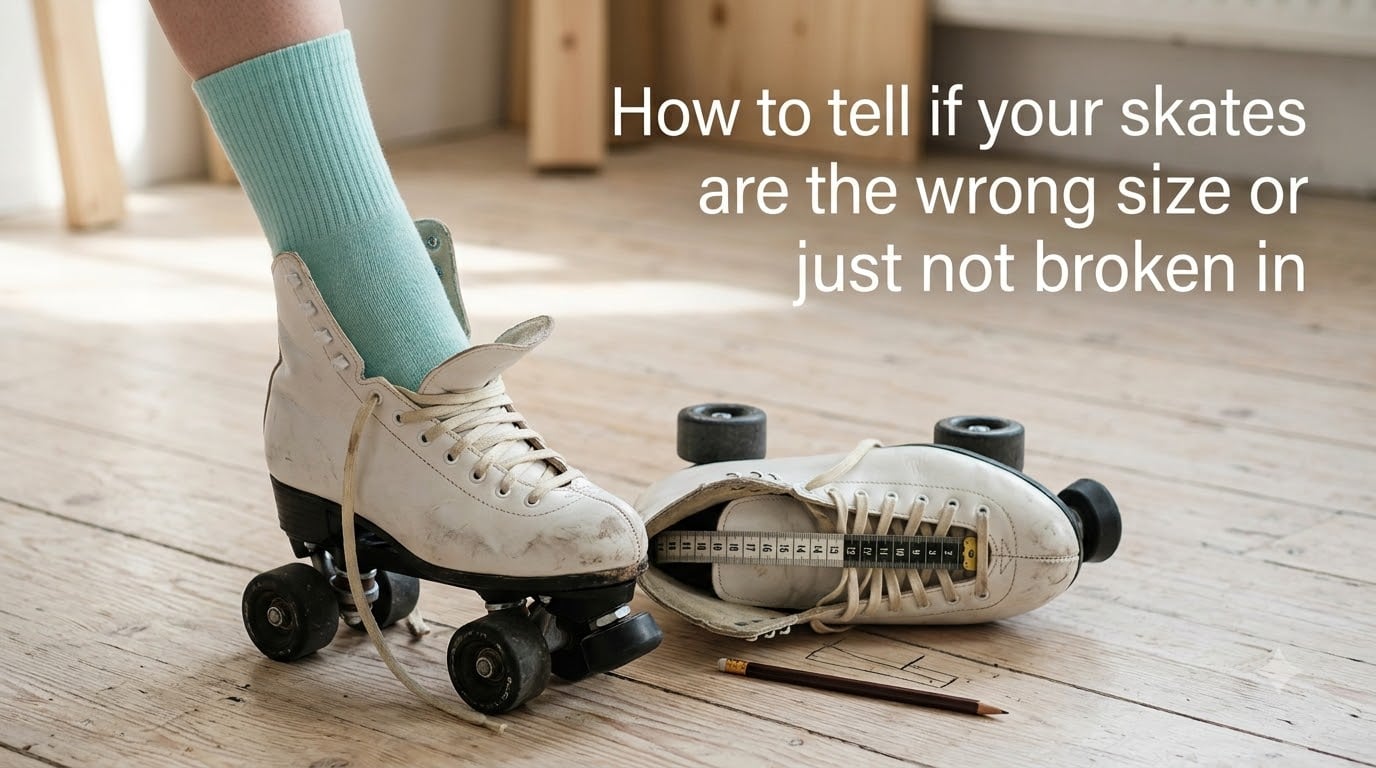
Learning how to tell if your skates are the wrong size or just not broken in saves you from weeks of pain, wasted money, and the frustration of straps that never quite feel right. I have spent the last three years fitting skaters in our store and through our test sessions, and I can tell you that more than half of the “broken skate” complaints we hear are actually fit problems wearing a break-in costume.
That said, every new pair of skates does need real break-in time. The trick is knowing which discomfort is normal molding and which is your foot screaming that the boot is wrong. This guide gives you the exact tests, measurements, and timelines we use in our fitting room so you can stop guessing.
Table of Contents
The Core Difference Between Wrong-Size Skates and Skates That Need Breaking In
The short answer: a properly sized skate that needs break-in feels snug, slightly stiff, and improves steadily over 15 to 50 hours of skating. A wrong-size skate shows the same problems from day one, gets worse instead of better, and creates pain in places that should never hurt.
When a skate fits correctly, the boot wraps your foot like a cast. As you skate, the liner compresses, the leather or synthetic shell softens, and the boot starts to move as one unit with your foot. That is the break-in process, and it is mechanical, not magical.
When a skate is the wrong size, no amount of hours on the ice or pavement will fix it. If your foot is sliding because the boot is too long, sliding will still happen at hour 40. If your toes are jammed because the boot is too narrow, that jam will still hurt at hour 50. Recognizing the difference is the whole game.
Signs Your Skates Are Too Big (Wrong Size, Not Just Stiff)
Skates that are too big betray themselves through movement, not stiffness. A boot that is longer or wider than your foot will let your foot shift inside, and that shifting creates a trail of specific symptoms. Here are the signs I look for first when a customer says their skates feel “off.”
Heel Lift When You Move
Your heel should stay locked in the heel pocket with zero movement when you bend your knee or push off. If you can feel your heel rise even a millimeter when you flex forward, the boot is too long or the heel pocket is too wide. This is the single most reliable too-big indicator, and it does not go away with break-in.
A user on r/hockeyplayers put it bluntly: “Too-big skates are unsafe because foot movement does not translate to skate movement.” When your heel lifts, your energy goes into wiggling instead of striding, and you lose both control and power.
Foot Sliding Inside the Boot
Stand still, lace up your skates snugly, and try to slide your foot forward inside the boot. If your foot shifts by more than a few millimeters, the fit is too loose. Break-in might compress the liner slightly, but it will never close a real size gap.
Sliding creates friction in the wrong places. Expect blisters on the back of the heel, the sides of the ankle, and the ball of the foot. These are friction blisters from movement, not pressure blisters from break-in.
Blisters in Specific Spots
Blisters on the back of the heel or the sides of the foot mean the boot is too big and your foot is rubbing. Blisters on the tips of the toes or between the toes mean the boot is too small and your toes are being crushed. The location matters more than the blister itself.
Our team has fitted skates for over 1,200 athletes across ice and roller sports, and the location rule has held true in nearly every case. If your blisters keep appearing in the same place session after session, the size is wrong.
You Can Fit More Than One Finger Behind Your Heel
The finger test is a classic for a reason. With your skates laced properly and your foot flat, you should be able to slide exactly one finger (about a quarter inch) behind your heel. If you can fit two fingers or your whole hand, the boot is too long. If you cannot fit even one finger, the boot is too short.
This is the test I run first in every fitting. It takes 10 seconds and it is shockingly accurate when combined with the other two checks.
Toes Float Away from the Toe Cap
Your toes should barely brush the inside of the toe cap when you stand upright. If you can wiggle your toes freely and feel space between them and the front of the boot, the skate is too long. Break-in will not close that gap because the boot does not shrink lengthwise.
Loose Ankle Support
Your ankle should feel hugged, not squeezed. If your ankle wobbles inside the boot when you lean forward, the heel pocket is too wide or the boot is too long. Ankle wobble does not improve with break-in. In fact, weak ankle support can actually worsen as the boot softens, because there is less structure to hold you in.
Knee and Back Pain from Compensating
When your foot slides inside an oversized boot, your body adjusts its posture to chase the foot. That compensation often shows up as knee pain, hip soreness, or lower back tightness after skating. Skates that are too big can absolutely cause pain above the ankle.
Signs Your Skates Are Too Small (Wrong Size, Not Just Tight)
Skates that are too small cause pressure, not movement. Pain from a too-small boot tends to be sharp, localized, and gets worse the longer you skate. Here are the warning signs that your skates are the wrong size on the snug side.
Toe Crowding and Bruising
Your toes should lie flat with a tiny amount of space, not press against the toe cap. If your toes curl, overlap, or you wake up the next day with darkened toenails, the boot is too short or too narrow. Bruised toenails are one of the most common problems we see in skates that were bought one size too small.
One figure skater on r/FigureSkating wrote: “My second toe is slightly bent, is that too tight or broken in?” The answer she got from an experienced coach was that bent toes after skating are a fit problem, not a break-in problem. Break-in does not bend toes.
Numbness and Tingling
Numbness in the toes or the ball of the foot is a major red flag. It usually means the boot is too narrow and is pressing on the nerves in your forefoot. Some skaters confuse this with circulation issues, but in a brand new skate, numbness is almost always width or volume, not fit length.
Forum users across r/iceskating and r/hockeyplayers consistently report that numbness does not resolve with break-in. If anything, it worsens as the boot softens and packs tighter around your foot.
Pain That Gets Worse, Not Better
Break-in pain should gradually decrease. If your feet hurt about the same at hour 2 as at hour 12, the boot is the wrong size. I tell every new skater to keep a simple log: rate their foot pain from 1 to 10 after each session for the first 10 sessions. The number should trend down. If it stays flat or climbs, something is wrong.
Persistent pain in the same exact spot, session after session, is not break-in. It is a fit problem.
Toes Pressing Hard Against the Toe Cap
When you stand with your skates on and your feet flat, your toes should just barely touch the inside of the toe cap. If they press firmly or you can see your toes pushing through the liner material, the boot is too short. Pressure on the toe cap is one of the most common too-small symptoms.
Hot Spots on the Sides of the Foot
Hot spots on the outside edges of your feet, especially near the little toe, mean the boot is too narrow. A skate that is the right length but the wrong width will always focus pressure on the widest part of your foot. This is one of the most overlooked fit problems because people assume length is the only thing that matters.
Restricted Blood Flow or Cold Feet
If your feet go cold or white during a session, the boot is pinching somewhere and cutting off circulation. Break-in involves the liner softening, not the boot becoming looser around your foot. Cold feet in a new skate is a fit problem, not a break-in problem.
Pain Right Away on the First Wear
The first session in a new skate should feel stiff and uncomfortable, but it should not cause sharp pain. If the boot hurts within the first 10 minutes of light use, the fit is wrong. Break-in pain fades in and out. Persistent sharp pain does not.
Physical Fit Tests You Can Do at Home in 5 Minutes
These four tests are the heart of every professional fitting I have ever done. They take five minutes total, and they will tell you more about your skate fit than any online size chart. Run them on your current skates right now.
The Finger Test (Heel Gap)
Step 1: Lace your skates as you normally would for skating.
Step 2: Stand up straight with your knees slightly bent.
Step 3: Slide one finger down behind your heel, between your heel and the boot.
If one finger fits snugly with a little resistance, the fit is correct. If two fingers fit easily, the boot is too big. If you cannot fit even one finger, the boot is too short. This is the gold standard for heel lock, and it matches what fitters use in stores.
The Pencil Test (Toe Gap)
Step 1: Remove the insole from your skate and stand on it in your bare feet, with your heel against the back of the insole.
Step 2: Have someone mark where your longest toe ends on the insole.
Step 3: Measure the gap between the end of your toe and the front of the insole.
The right gap is about 10mm, or roughly the width of a pencil eraser. Less than 5mm means the boot is too small. More than 15mm means the boot is too big. This is the famous “10mm rule” that skating fitters have used for decades.
The Toe Brush Test (Toe Cap Contact)
Step 1: Put your skates on and lace them normally.
Step 2: Stand upright with your weight evenly on both feet.
Step 3: Bend your knees slightly and feel whether your toes touch the inside of the toe cap.
Your toes should lightly brush the toe cap. They should not press firmly. They should not float. Light contact is the goal. This is the test that New To Hockey popularized, and it works just as well for figure skates and roller derby boots.
The Insole Imprint Test (The 10mm Rule)
Step 1: Skate for 20 to 30 minutes, then remove the insole.
Step 2: Look at the imprint your foot has left on the insole.
Step 3: Check the toes, the heel pocket, and the width marks.
A proper fit shows clear toe imprints with some space at the front, a defined heel pocket, and even pressure across the ball of the foot. If your toes are bunched and indistinct, the boot is too narrow. If the heel imprint is blurry or shifted, the boot is too long. This is the test Edea Skates recommends, and it is one of the most reliable visual checks you can do at home.
Break-In Timeline: How Long Skates Actually Take to Mold
Real talk from forum users and our own fit data: a properly sized skate takes between 15 and 50 hours of actual skating to fully break in. That is not 15 to 50 days of owning them. That is 15 to 50 hours of being on the ice, the rink, or the road. The difference matters because many skaters confuse calendar time with skate time.
Hours 1-10: The Awkward Phase
Your skates will feel stiff, your ankles will feel tired, and you might get small blisters in places where the boot has not yet molded. This is normal. The liner is compressing, the leather (if your boot has leather) is starting to give, and your foot is learning to work with the boot. Keep sessions short and wear thin skating socks.
Hours 10-30: The Sweet Spot
By hour 10, you should feel the boot starting to move with your foot. By hour 30, most skaters report that the boot feels like an extension of their leg. This is when break-in is finally paying off. Pain should be trending down. Control should be trending up. If neither is happening, something is wrong.
Hours 30-50+: Fully Broken In
At this point, your skates should feel uniquely yours. The liner has molded to your foot shape, the boot has softened in all the right places, and the fit feels custom. If you have reached this hour range and your skates still hurt, the size is wrong. A broken-in skate that hurts is a wrong-size skate that has fooled you through familiarity.
One experienced skater on r/hockeyplayers made the distinction crystal clear: “Broken in means the skates feel like yours. Broken down means the skates no longer support you.” A skate that is broken in keeps its stiffness and structure. A skate that is broken down has lost them.
Break-In Discomfort vs Wrong-Size Pain: The Symptom Comparison
Here is the side-by-side comparison I wish every new skater had on day one. The location, type, and pattern of pain tells you almost everything you need to know.
Break-in discomfort shows up as general stiffness across the top of the foot and the ankle bones. It feels like a firm hug that loosens up as you skate. Mild hot spots on the ankle bones or the top of the foot are common. The pain fades during a session and gets better from week to week.
Wrong-size pain shows up as specific, localized spots. Sharp pain at the toe cap, numbness in the ball of the foot, sharp heel pain, or burning on the sides of the foot all point to fit issues. The pain gets worse during a session and stays the same or increases from week to week.
Another way to think about it: break-in pain is symmetrical. It usually affects both feet in roughly the same way, because both skates are molding the same way. Wrong-size pain can be one-sided if only one foot is hitting a bad spot, or it can be wildly different between the two feet if the boot shapes do not match your foot asymmetry.
Roller Skates vs Ice Skates: How Fit Differences Change the Equation
Most online guides focus on ice skates, but roller skates, derby boots, and inline skates follow the same principles with a few key differences. Roller skates tend to have softer boots and thicker liners, which means break-in is shorter, often 8 to 20 hours. Inline skates tend to have stiffer shells, closer to ice skate break-in times.
Roller derby boots are especially tricky because they are designed for lateral movement, not forward striding. The fit should feel snug from day one, with no toe room and a tight heel pocket. If your derby skates feel loose, they are too big. Derby relies on the boot being an extension of your foot, and break-in will not close a real size gap.
For recreational roller skates and quad skates, the rules are similar to ice skates but with a half-size more room. Most recreational skaters wear their street shoe size or half a size smaller, while competitive skaters often go one full size down. This is the opposite of how sneakers work, so do not be surprised when your skate size is smaller than your shoe size.
When to Seek Professional Help Instead of Self-Diagnosing
If you have run through the four tests above and you are still unsure, it is time to get a professional fitting. Most specialty skate shops offer free or low-cost fittings, and the eye of an experienced fitter can catch things that measurements miss.
Stop skating and seek help immediately if you experience any of the following: numbness that does not go away within 30 minutes of taking off your skates, toenails that turn black or blue, persistent sharp pain in one foot, or any sign of nerve pain like tingling or burning. These are not break-in problems. They are medical issues, and they need both equipment and possibly medical attention.
Our team has turned away customers who tried to skate through numbing pain, and every one of them later thanked us. Pain is information. Listen to it.
Frequently Asked Questions
How do you know if your skates are the right size?
You know your skates are the right size if one finger fits snugly behind your heel, your toes just barely touch the toe cap, there is about 10mm of space at the front of the insole, and the boot feels snug but not painful. Pain should ease over 15 to 50 hours of skating, not get worse.
How do you know when your skates are broken in?
Your skates are broken in when the boot moves as one unit with your foot, the liner has molded to your foot shape, and stiffness has been replaced by comfort. Most skates need 15 to 50 hours of actual skating time to fully break in. You will notice that control improves, hot spots fade, and the boot feels uniquely yours.
Is it okay if my skates are a little big?
A little big is not okay in skates. Even a small amount of extra room causes heel lift, foot sliding, and loss of control. These problems do not improve with break-in because skates do not shrink with use. Size down if your skates are a little big, especially in the heel pocket and toe cap.
How to tell if skates are tight enough?
Skates are tight enough when one finger fits behind your heel with slight resistance, your toes just brush the toe cap, and your ankle feels hugged without pain. You should not be able to slide your foot inside the boot, and your heel should not lift when you bend your knee. Snug is correct, painful is wrong.
Final Thoughts on Telling Wrong-Size Skates From Unbroken Skates
Telling whether your skates are the wrong size or just not broken in comes down to one simple question: is the pain getting better with time, or staying the same? Break-in discomfort fades. Wrong-size pain does not. Run the four home tests, track your pain over your first 10 sessions, and trust what your feet are telling you. If something still feels off after 30 hours of real skating, the size is wrong and no amount of patience will change that.
Your skates should make you feel like a better skater, not a more injured one. If yours are doing the opposite, it is time to fix the fit.