
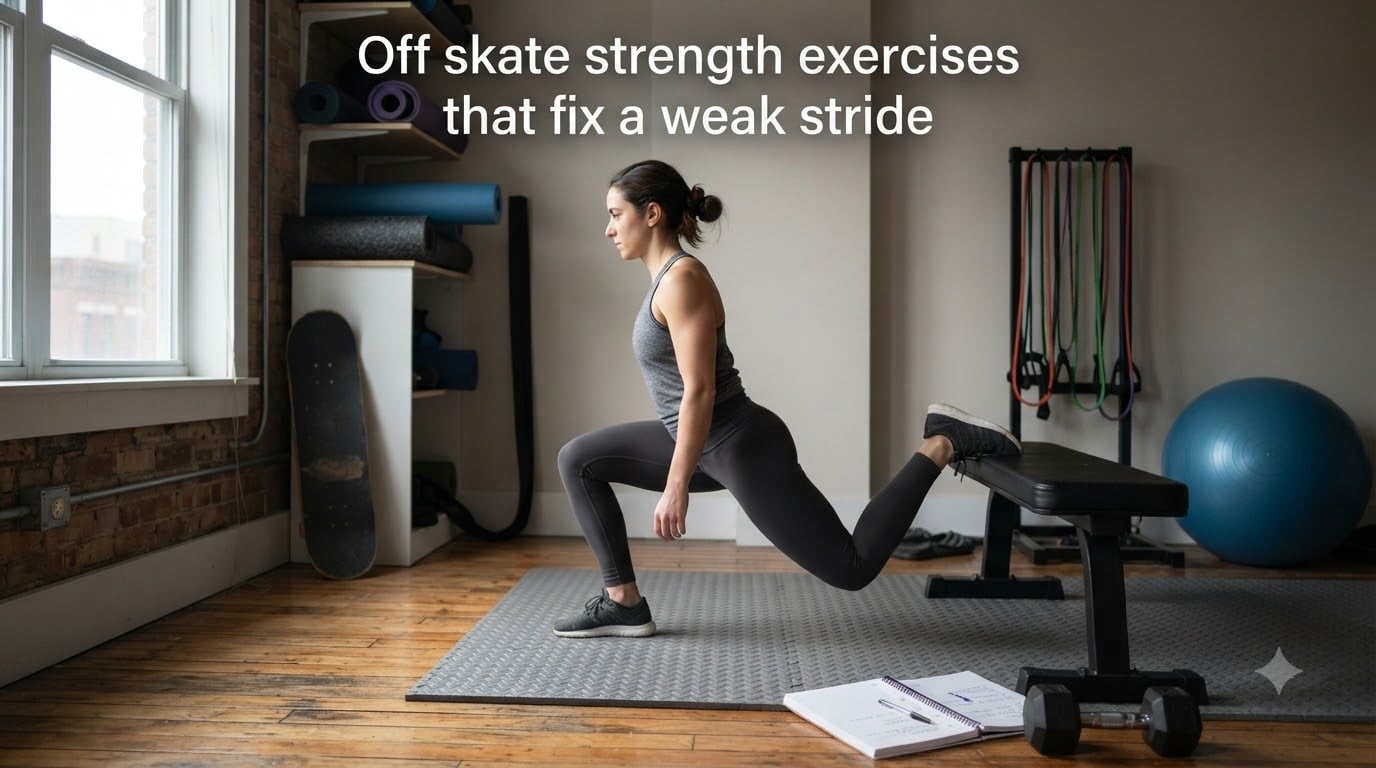
If your skating stride feels flat, choppy, or just plain weak, the fix almost never lives on your skates. After coaching recreational and competitive skaters for years, I’ve watched hundreds of athletes transform a soggy stride into something powerful by spending 30 to 45 minutes a week on off-skate strength exercises. This guide gives you the exact training blueprint I share with my own team, organized by muscle group, with progressions from beginner to advanced.
I’ll walk you through diagnosis first, then prescribe the drills your body actually needs. By the end, you’ll have a structured program you can run from your living room, a hotel room, or any small home gym. No excuses.
Table of Contents
Why a Weak Stride Happens and How Off-Skate Training Fixes It?
A weak skating stride isn’t a willpower problem. It’s a physics problem. Your body can only push as hard as the muscles generating force, controlled by the stabilizers keeping you upright. When any link in that chain fails, your stride shortens, your speed drops, and your technique falls apart at speed.
Here’s the diagnostic framework I run every skater through before we touch a single exercise.
Five Common Signs of a Weak Skating Stride
You can’t hold a deep edge for more than a few seconds
Your crossover feels like dragging the trailing foot rather than pushing off it
Speed drops sharply after two to three laps
You lean forward at the waist instead of driving from the hips
You compensate by swinging the upper body side to side
Five Muscle Imbalances That Drag Your Stride Down
Weak glutes limit hip extension, killing your push-off power
Tight hip flexors prevent full leg recovery, shortening your stride
Inactive core lets the pelvis tilt, leaking energy with every push
Underdeveloped hip abductors cause the knee to collapse inward, robbing lateral power from crossovers
Poor ankle stability forces compensations up the chain, slowing reaction time
How Off-Skate Training Rebuilds What On-Skates Practice Can’t Reach
Practicing on skates reinforces patterns, but it cannot load a single muscle group with enough intensity to grow. Off-skate work lets you isolate weak links, push them to fatigue, and rebuild the foundation. I have seen derby jammers add visible speed after six weeks of focused hip and glute work alone. One skater in our community shaved a full second off her lap time after rebuilding her single-leg balance.
Core Stability Exercises for Skating Control
Your core is the engine cradle. If it wobbles, every push leaks energy. These four core stability exercises for skaters form the spine of every program I write.
Plank Variations
Hold a forearm plank for 30 to 60 seconds, three sets. Progress to side planks and plank reaches once you can hold the front plank steady for a full minute without sagging at the hips. Planks train anti-extension, the exact quality you need to stay tall under acceleration.
Dead Bugs
Lie on your back with arms reaching toward the ceiling and knees stacked over hips. Slowly extend opposite arm and leg without letting your lower back arch. Three sets of 10 reps per side. Dead bugs teach the deep core to stabilize while the limbs move, exactly what happens in every skating stride.
Bird Dogs
From hands and knees, extend opposite arm and leg while keeping your spine neutral. Three sets of 10 per side. Bird dogs add an anti-rotation demand that translates directly to one-foot glides and edge work.
Pallof Press
Anchor a resistance band at chest height. Press the band straight out from your chest and hold for two seconds. Three sets of 10 per side. The Pallof press builds anti-rotation strength, the muscle group that keeps you from twisting off line when you push hard on one side.
Lower Body Strength Exercises Targeting Stride Power
This is where stride power lives. Pick three exercises from this section per session and rotate them across the week.
Squats and Split Squats
Bodyweight squats warm up the pattern. Progress to goblet squats holding a kettlebell or dumbbell at chest height. Three sets of 8 to 12 reps. Then move to reverse lunges, three sets of 8 per leg, to load each side independently.
Bulgarian Split Squats
Place one foot behind you on a bench or chair. Lower until the front thigh is parallel to the floor. Three sets of 8 to 10 per leg. This single exercise lights up the glutes, quads, and stabilizers more than any other leg movement, and it shows up in nearly every roller derby training program on Reddit for good reason.
Glute Bridges and Hip Thrusts
Drive your hips up by squeezing the glutes, not by arching the lower back. Three sets of 12 to 15 reps. For hip thrusts, rest your upper back on a bench and load up with a barbell or dumbbell. Glute activation is the single biggest predictor of stride power I see in testing.
Single-Leg Romanian Deadlifts
Stand on one leg, hinge at the hip, and reach toward the floor with the opposite hand. Three sets of 8 per leg. This builds hamstring strength, hip stability, and balance all at once.
Wall Sits
Back against the wall, knees at 90 degrees, hold for 30 to 60 seconds, three sets. Wall sits build isometric quad endurance, which is what keeps your stride tall when fatigue sets in during long sessions.
Muscles Worked vs. Skating Movement (Mapping Table)
| Exercise | Primary Muscles | Skating Movement It Improves |
|---|---|---|
| Bulgarian split squat | Quads, glutes, adductors | Push-off power |
| Glute bridge | Glutes, hamstrings | Hip extension in stride |
| Single-leg RDL | Hamstrings, glutes, core | Balance + recovery phase |
| Wall sit | Quadriceps | Edge hold endurance |
| Reverse lunge | Quads, glutes | Asymmetric stride drive |
Hip Strengthening for Better Skating Posture
Hip stability for skating is non-negotiable. Without strong hip abductors, your knees cave inward and your stride loses lateral power.
Clamshells
Side-lying with knees bent, open the top knee like a clamshell while keeping feet together. Three sets of 15 per side. Add a resistance band above the knees for progression.
Side-Lying Leg Lifts
Same position, but lift the whole straight leg. Three sets of 12 per side. This isolates the gluteus medius more than clamshells, perfect for skaters who feel their hips drop during crossovers.
Banded Lateral Walks
Place a band around your ankles or just above your knees. Step sideways for 10 steps one way, then back. Three sets per direction. The lateral walk is the closest land drill to a crossover you’ll find.
Fire Hydrants
On hands and knees, lift one leg out to the side without tilting the pelvis. Three sets of 12 per side. Great warm-up before any skating session.
Plyometric Drills for Explosive Skating Power
Once you’ve built a base of strength (usually 4 to 6 weeks in), plyometric exercises for skating convert that strength into speed.
Box Jumps
Start with a low box, 12 to 18 inches. Jump and land softly with knees tracking over toes. Three sets of 5 to 8 reps. Box jumps train the stretch-shortening cycle, the elastic energy release that makes a powerful stride feel effortless.
Broad Jumps
Jump forward as far as you can, landing in an athletic position. Three sets of 5 reps. Broad jumps build horizontal power, exactly what you need for explosive starts.
Lateral Bounds
Bound side to side over a line or low object. Three sets of 6 per side. This is the closest land drill to a crossover push, and it lights up the glute medius under load.
Squat Jumps
Squat down, explode up, land softly. Three sets of 8 reps. Reset between reps to avoid grinding. Use squat jumps as a finisher once per week.
Balance and Proprioception Training
Every powerful push happens on a single wheelbase. If your ankles wobble, your brain plays it safe and your stride shortens. These drills sharpen proprioception for skaters.
Single-Leg Stands
Stand on one foot for 30 seconds, three sets per side. Progress by closing your eyes for 10-second intervals.
Single-Leg Romanian Deadlifts (Reprise)
Already covered in the lower body section, but worth repeating as a balance drill. Touch the floor with one hand while standing on the opposite leg.
Bosu Ball Work
Stand on a Bosu ball (dome side up or down) for 30 to 60 seconds. Add knee drives or light squats for more challenge. If you don’t own a Bosu, a folded towel on a hard floor creates similar instability.
Eyes-Closed Progressions
Close your eyes during single-leg stands to force the ankle stabilizers to work harder. Only progress to this once you can stand on one leg for 30 seconds with eyes open on a stable surface.
Agility and Footwork Drills Off Skates
Quick feet on land translate to quick feet on skates. Spend 10 minutes per session on these drills.
Agility Ladder Drills for Skating
Run through these patterns twice each:
Icky shuffle: lateral movement through the ladder
In-in-out-out: quick lateral foot placement
Lateral crossover steps: mimics on-skate crossover footwork
High knees through the ladder: builds knee drive and turnover
Cone Drills
Set up five cones in a line, 18 inches apart. Shuffle laterally touching each cone with your hand. Three sets per direction. Great for crossover power.
Lateral Shuffle Work
Shuffle between two cones 15 feet apart, keeping a low athletic stance. Three sets of 6 to 8 reps per direction. Train the muscles you’ll use in transitions.
Flexibility and Mobility for Longer Strides
Tight muscles limit stride length more than most skaters realize. A 10-minute mobility routine three times per week pays off in noticeable reach on every push.
Hip Flexor Stretches
Half-kneeling hip flexor stretch, 60 seconds per side. Drive the hips forward while keeping the core braced.
Hamstring Mobility
Standing or supine hamstring stretch, 60 seconds per side. Don’t lock the knee. Add a strap for deeper work.
Ankle Dorsiflexion Drills
Kneel with one foot ahead, knee tracking over toes. Drive the knee forward without lifting the heel. 10 reps per side. Ankle dorsiflexion is the unsung hero of deep edges.
Thoracic Spine Rotation
Quadruped thread-the-needle stretch, 8 reps per side. A mobile upper back keeps your shoulders square when you push hard, which keeps your stride efficient.
Progressive Training Programs From Beginner to Advanced
Here are three ready-to-run programs. Pick the one that matches your current fitness level. Each program assumes 4 to 6 weeks of consistent work before moving up a level.
Beginner Program (3 Days per Week)
Day A – Strength: Goblet squat 3×10, glute bridge 3×12, plank 3x30s, bird dog 3×10/side
Day B – Stability: Clamshell 3×15/side, banded lateral walk 3×10/side, single-leg stand 3x30s/side, dead bug 3×10/side
Day C – Mobility: 10-minute mobility flow covering hip flexors, hamstrings, ankles, thoracic spine
Intermediate Program (4 Days per Week)
Day A – Lower Body Strength: Bulgarian split squat 3×8/side, single-leg RDL 3×8/side, reverse lunge 3×10/side, wall sit 3x45s
Day B – Core + Hip: Pallof press 3×10/side, side plank 3x30s/side, banded lateral walk 3×12/side, side-lying leg lift 3×12/side
Day C – Plyometrics + Agility: Box jump 3×5, lateral bound 3×6/side, agility ladder 4 patterns x 2, cone drill 3 sets
Day D – Mobility + Balance: Bosu balance work 5 minutes, single-leg stand with eyes closed 3x20s/side, 10-minute mobility flow
Advanced Program (5 Days per Week)
Day A – Heavy Lower: Barbell back squat 4×6, barbell hip thrust 4×8, walking lunge 3×12/side, single-leg RDL 3×8/side
Day B – Plyometrics: Broad jump 4×5, squat jump 4×8, lateral bound 4×6/side, box jump 4×5
Day C – Core + Hip Stability: Pallof press 4×10/side, plank reach 3×10/side, banded lateral walk 4×12/side, fire hydrant 3×15/side
Day D – Agility + Balance: Agility ladder 5 patterns x 2, cone shuffle 4 sets, single-leg stand eyes closed 4x30s/side, Bosu squats 3×10
Day E – Mobility + Recovery: 15-minute full-body mobility flow, foam rolling, light movement
Skating communities on Reddit consistently report that consistency matters more than intensity. Showing up three days per week for eight weeks beats sporadic hero workouts every time.
Common Mistakes to Avoid When Training Off-Skates
I’ve watched smart skaters stall their progress with the same handful of errors. Avoid these and you’ll move forward faster.
Skipping the warm-up. Cold muscles and joints do not respond well to plyometric or balance work. Always spend 5 minutes mobilizing first.
Training through fatigue with bad form. If your knees cave or your back rounds, stop the set. Quality reps build strength. Sloppy reps build patterns you’ll carry onto the skating floor.
Only training the strong side. Every skater has a dominant side. Train both sides in every session, even if it feels redundant.
Ignoring mobility work. Strength without mobility is just stiffness waiting to cause injury.
Doing too much too soon. Plyometrics are powerful but high-impact. Build at least four weeks of base strength before adding them.
Not connecting training to skating. After every session, visualize the exercises translating to your stride. The mind-body link accelerates skill transfer.
One roller derby skater I worked with spent her first month only doing heavy squats, no balance or hip work. Her stride got stronger but her crossovers actually got worse because she never trained lateral stability. Don’t make that mistake.
Frequently Asked Questions
What is the 3-3-3 rule for workouts?
The 3-3-3 rule is a simple workout structure: three exercises, three sets each, three days a week. It is ideal for beginners starting off-skate strength training because it builds consistency without overwhelming the body. Pick one lower body exercise, one core exercise, and one hip stability exercise per session.
How do you correct a weak skating stride?
To correct a weak skating stride, focus on rebuilding hip extension strength with glute bridges and Bulgarian split squats, improving single-leg balance, and activating the glute medius through banded lateral walks. Combine these off-skate exercises with deliberate on-skate technique drills for 6 to 8 weeks. Most skaters see measurable improvements within that window.
What exercises help with unsteady gait?
Exercises that help with unsteady gait include single-leg stands, single-leg Romanian deadlifts, Bosu ball balance work, and dead bugs. These drills improve proprioception, ankle stability, and core control, the three systems that keep your gait steady on and off skates. Practice them barefoot on a hard floor for the best transfer.
What is an alternative to the skaters exercise?
Great alternatives to the skaters exercise include lateral banded walks, side-lying leg lifts, lateral bounds, and curtsy lunges. Each targets the same hip abductors and adductors the skater exercise works, but with a different loading pattern that may better suit your goals or equipment access. Choose based on whether you want strength, endurance, or power.
How long does it take to see stride improvements from off-skate training?
Most skaters notice small stride improvements within 4 to 6 weeks of consistent off-skate training, with more dramatic gains appearing around the 8 to 12 week mark. Strength adaptations happen fastest in the first month, while balance and motor pattern improvements take longer. Stick with the program for at least 8 weeks before judging results.
Conclusion
A weak stride isn’t a permanent sentence. It’s a solvable problem with the right off-skate strength exercises and consistent work. Start with the diagnostic checklist, pick a program that matches your current fitness level, and commit to eight full weeks before you evaluate your progress. Combine glute strength, hip stability, balance, and mobility, and you’ll rebuild a stride that pushes harder, holds longer, and feels effortless on the skating floor.
Pick one exercise from each section of this guide, add it to your week, and reassess after a month. Your stride will tell you everything you need to know about whether the program is working. Now lace up off the skates and get to work.