
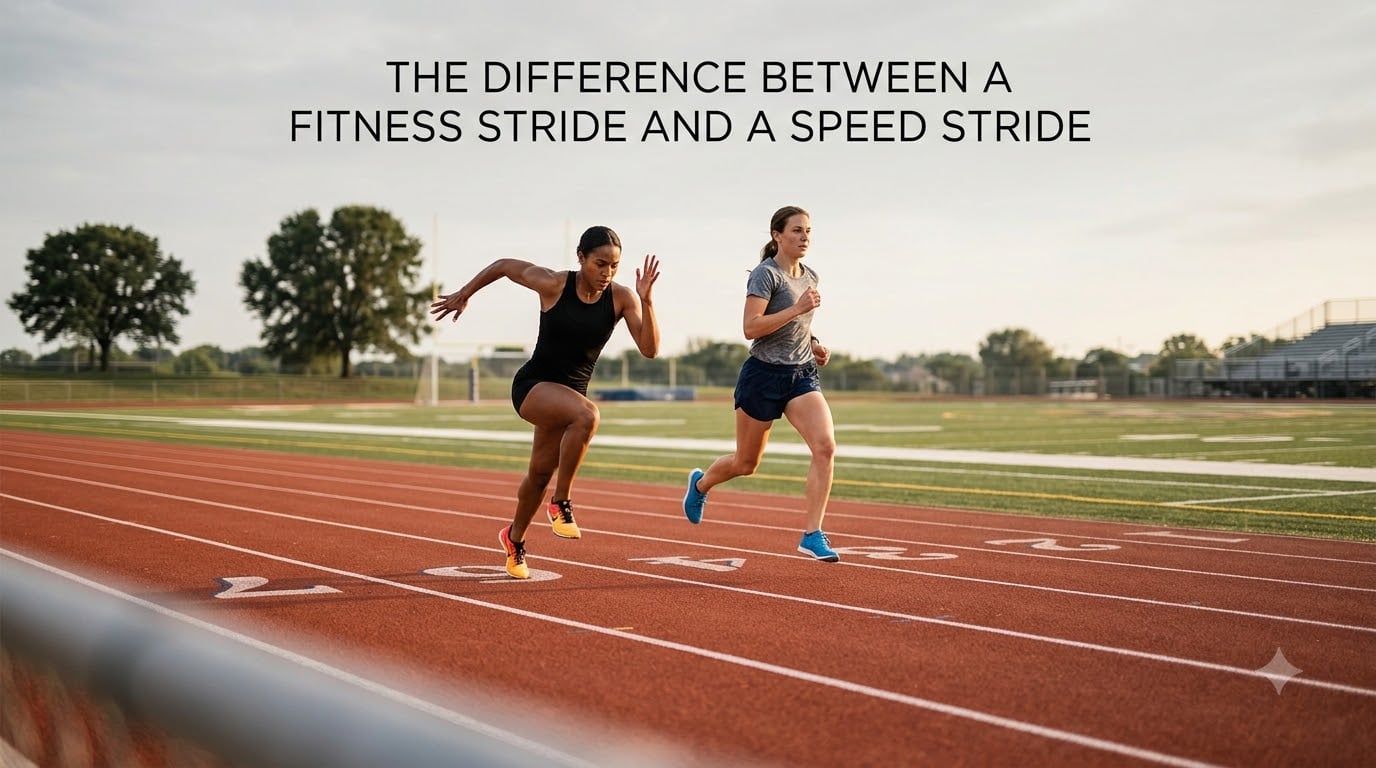
Every runner I coach eventually asks me the same question: what is the difference between a fitness stride and a speed stride? It is one of the most confused topics in running, partly because most resources treat all “strides” as the same thing. They are not.
A fitness stride is a controlled, technique-focused running effort done at a moderate pace to improve form and neuromuscular coordination, while a speed stride is performed at near-maximal intensity to develop explosive power, maximum velocity, and fast-twitch muscle fiber recruitment. Both are short efforts, but their intent, intensity, and training outcomes are fundamentally different.
That distinction matters more than you might think. I have seen recreational runners burn out doing speed strides when they needed fitness strides for form work. I have also watched competitive runners plateau because they only did relaxed strides and never trained their top-end speed. Getting this right can change your entire training approach.
In this guide, I will break down exactly what separates a fitness stride from a speed stride. You will learn how to execute each one, when to use them, and how to avoid the mistakes that lead to injury or wasted effort. Whether you are a beginner building running economy or a seasoned racer chasing a PR, understanding fitness stride vs speed stride will make your training sharper.
Table of Contents
What Is a Fitness Stride?
A fitness stride is a short, controlled running effort focused on form, relaxation, and smooth mechanics rather than raw speed. You typically run these at roughly your 5K to mile race pace, covering 50 to 100 meters in about 20 to 30 seconds. The goal is not to go fast for its own sake. The goal is to practice good running technique at a moderately brisk pace.
Think of a fitness stride as a form drill with forward motion. You accelerate gradually to a controlled pace, hold that effort briefly, and decelerate smoothly. Throughout the effort, your attention stays on posture, arm carriage, foot strike, and breathing. It is neuromuscular training, meaning you are teaching your nervous system to fire muscle fibers in an efficient, coordinated pattern.
Most coaches I have worked with recommend fitness strides at the end of an easy run or as part of a warm-up before harder workouts. They help you transition from the sluggish feeling of slow distance running into a snappier, more athletic movement pattern. I personally do four to six of them after my easy days, and I notice a real difference in how my legs feel the next morning.
The key word here is controlled. You should finish a fitness stride feeling smooth and relaxed, not gasping for air. If your form starts breaking down, you are running too hard. Back off and focus on the quality of your movement.
What Is a Speed Stride?
A speed stride is a short, high-intensity running effort designed to develop maximum velocity and explosive power. You perform these at 90 to 95 percent of your maximum effort, covering similar distances of 50 to 150 meters. But unlike a fitness stride, a speed stride pushes you toward your top-end speed to recruit fast-twitch muscle fibers and train your body to produce force rapidly.
Speed strides are where you work the force-velocity curve. Research from Peter Weyand at Southern Methodist University showed that the fastest runners apply more force into the ground in shorter contact times. Speed strides train exactly that mechanism: teaching your legs to hit the ground harder and get off it faster.
When I coach speed strides, I tell runners to think about acceleration and power. You drive your knees forward, pump your arms aggressively, and push off the ground with intent. This is not a relaxed roll through 100 meters. It is a focused, powerful effort that should leave you breathing hard and needing full recovery before the next one.
That recovery piece is critical. Speed strides demand full rest between repetitions, typically 60 to 90 seconds or even longer. If you shortchange the recovery, the effort becomes an endurance workout rather than a speed workout. You lose the training stimulus you are after.
Fitness Stride vs Speed Stride: Key Differences
The fitness stride vs speed stride distinction comes down to intent, intensity, and adaptation. A fitness stride trains your nervous system to move well at a sustainable pace. A speed stride trains your muscles to produce maximum force at top velocity. Both are short efforts, but everything about how you execute them changes based on that core difference.
Intensity is the most obvious separator. Fitness strides sit at roughly 70 to 85 percent effort, or about 5K to mile race pace. Speed strides sit at 90 to 95 percent effort, approaching your maximum sprint velocity. If you can hold a conversation after a stride, it was a fitness stride. If you need a full minute to catch your breath, it was a speed stride.
Recovery between reps tells you which one you are doing. Fitness strides need only 30 to 45 seconds of easy walking or jogging. Speed strides need 60 to 120 seconds of complete or near-complete rest. I see runners ruin their speed work by treating it like fitness work, taking short recoveries and wondering why their times do not improve.
The training adaptations also diverge sharply. Fitness strides improve running economy, coordination, and form consistency. They make your easy running feel smoother and more efficient over time. Speed strides develop raw power, ground reaction force, and top-end velocity. They make you faster in a way that fitness strides simply cannot.
Here is a quick breakdown I share with my runners:
Fitness stride: 70-85% effort, 5K-mile pace, 20-30 seconds, short recovery, focus on form and relaxation, improves running economy.
Speed stride: 90-95% effort, near-maximal velocity, 15-25 seconds, full recovery, focus on power and force, develops top-end speed.
Neither is better than the other. They serve different purposes, and most runners benefit from using both at different points in their training cycle.
How to Execute Each Stride Type Properly?
Executing strides correctly is what separates runners who improve from runners who just go through the motions. The technique for fitness strides and speed strides shares some foundations, but the execution feels noticeably different.
Fitness Stride Technique
Step 1: Start with 10 to 15 meters of relaxed, gradual acceleration. Do not sprint from a standstill. Build into the effort smoothly.
Step 2: Settle into your target pace, around 5K to mile race effort. Focus on tall posture, a slight forward lean from the ankles, and a quick but relaxed arm swing.
Step 3: Hold this effort for 15 to 20 meters. Think about landing midfoot under your center of gravity, keeping your foot contact time short but not forced.
Step 4: Gradually decelerate over the final 10 meters. Walk back to your starting point, take 30 to 45 seconds of easy walking, and repeat.
Throughout the effort, I cue myself with three words: tall, quick, relaxed. If I feel tension creeping into my shoulders or my stride getting choppy, I know I am pushing too hard.
Speed Stride Technique
Step 1: Accelerate aggressively over the first 15 to 20 meters. Drive your knees forward, pump your arms hard, and build speed rapidly.
Step 2: Reach near-maximal velocity and hold it for 10 to 20 meters. Focus on applying maximum force into the ground with each footstrike.
Step 3: Maintain aggressive arm drive and full hip extension. Your foot should strike the ground forcefully beneath your body, not out in front.
Step 4: Decelerate gradually and take a full 60 to 120 seconds of rest. Do not start the next rep until you feel recovered. Quality over quantity is the entire point.
With speed strides, I always err on the side of doing fewer repetitions with better form. Six high-quality speed strides beat ten sloppy ones every time.
Common Mistakes to Avoid
In all my years of coaching and training, I see the same stride mistakes over and over. Most of these come from runners not understanding whether they are doing a fitness stride or a speed stride, and then executing something that serves neither purpose well.
Overstriding is the number one issue I see on forums like r/running and r/AdvancedRunning. Runners reach forward with their lead foot, landing heel-first well ahead of their center of gravity. This creates a braking force with every step, slows you down, and sends shock through your knees and hips. Overstriding is a leading cause of knee injuries in recreational runners. The fix is simple: land with your foot under your body, not in front of it.
Running fitness strides too hard is another common error. Many runners treat every stride like a sprint, pushing to 95 percent effort when they should be at 75 percent. This turns a form-focused drill into an unstructured speed session. You end up tired without getting the neuromuscular benefits, and you add unnecessary fatigue to your training week.
Taking insufficient recovery on speed strides undermines the entire workout. If you start your next speed rep before you have fully recovered, you are training endurance, not power. I have watched runners do 8 x 100m “speed strides” with 30 seconds rest and wonder why their sprint speed never improves. You need full recovery for speed work. There are no shortcuts here.
Letting form collapse when fatigued is the silent stride killer. As you get tired, your core stability drops, your arm swing gets sloppy, and your foot strike drifts forward. If your form is falling apart, stop. Doing more repetitions with bad form just reinforces bad movement patterns.
One runner on r/AdvancedRunning put it well: strides should be the highest-quality running you do all week. If you are treating them as an afterthought, you are leaving improvement on the table.
Training Drills to Improve Both Stride Types
Specific drills can sharpen the mechanics that underpin both fitness and speed strides. I rotate through these with the runners I coach, and they consistently produce results within a few weeks.
High knees build knee lift and dorsiflexion, which matter for both stride types. Do 2 sets of 20 meters, focusing on quick ground contact and active foot recovery. This drill trains the hip flexor strength and coordination that every good stride relies on.
Butt kicks develop hamstring flexibility and heel recovery. Run 2 sets of 20 meters, bringing your heels up toward your glutes with each step. This improves the backside mechanics that make your stride cycle more efficient.
B-skips are a more advanced drill that combines knee drive with an active paw-back motion. They are particularly useful for speed stride development because they train the force application phase of ground contact. Start with 2 sets of 20 meters and focus on rhythm before speed.
Acceleration sprints from a standing start build the first 20 meters of your speed stride. Start relaxed, build speed over 30 meters, and walk back. Do 4 to 6 repetitions with full recovery. These directly transfer to the drive phase of your speed strides.
Flying sprints train the max-velocity portion of your speed stride. Build speed over 20 to 30 meters, hold near-maximal velocity for 10 to 15 meters, and decelerate gradually. These are demanding, so do only 3 to 5 reps with 2 to 3 minutes of rest between each.
For fitness strides specifically, I recommend doing relaxed 100-meter pickups at the end of your easy runs. Focus entirely on smooth form and quick turnover without forcing the pace. Four to six of these, twice a week, will noticeably improve your running economy within a month.
When to Use Each Stride Type in Your Training?
Placement matters as much as execution. Fitness strides and speed strides belong at different points in your training schedule, and using them at the wrong time can blunt their effectiveness or add unnecessary fatigue.
Fitness strides work best at the end of easy runs or as part of a warm-up before a harder session. They are low-stress enough that you can do them frequently. I recommend 4 to 6 fitness strides, 2 to 3 times per week, for most runners. They add minimal fatigue but reinforce good movement patterns consistently.
Speed strides belong in dedicated speed sessions or on days when you are fresh. Do not tack them onto the end of a long run. They demand full energy and focus. I program them as a standalone session, typically 4 to 8 repetitions with full recovery, once or twice per week during a speed-focused training block.
Recreational runners who just want to stay healthy and run efficiently should lean heavily on fitness strides. Do them after easy runs a few times a week. They will make your running feel smoother without adding injury risk.
Competitive runners training for races from the 800m to the marathon need both types. Fitness strides maintain coordination year-round. Speed strides build the top-end power that translates to faster race paces across all distances. I have my marathoners do speed strides in the 6 to 8 weeks before goal races because sustained speed at race pace requires a velocity ceiling above that pace.
If you are new to strides, start with fitness strides exclusively for 4 to 6 weeks. Once your form is solid and your body has adapted to the faster running, add speed strides gradually. One session per week is plenty to start.
Frequently Asked Questions
What is a fitness stride?
A fitness stride is a short, controlled running effort of 50 to 100 meters done at roughly 5K to mile race pace. The focus is on running form, relaxation, and neuromuscular coordination rather than maximum speed. Most runners do 4 to 6 fitness strides after easy runs to reinforce efficient movement patterns.
What is a speed stride?
A speed stride is a high-intensity running effort of 50 to 150 meters performed at 90 to 95 percent of maximum effort. The goal is to develop explosive power, top-end velocity, and fast-twitch muscle fiber recruitment. Speed strides require full recovery of 60 to 120 seconds between repetitions.
How long should strides be?
Most strides are 50 to 150 meters long, lasting 15 to 30 seconds each. Fitness strides tend to be on the shorter end at 50 to 100 meters. Speed strides can extend to 150 meters to allow for a proper acceleration phase followed by a max-velocity hold. The key is quality, not distance.
Are strides the same as sprints?
No, strides and sprints are not the same. Sprints are all-out efforts at 100 percent maximum speed, typically in a competitive or timed setting. Fitness strides are done at 70 to 85 percent effort with a form focus. Speed strides approach 95 percent effort but still emphasize technique and controlled execution rather than all-out racing.
How often should you do strides?
Fitness strides can be done 2 to 3 times per week, typically 4 to 6 reps after easy runs. Speed strides should be done 1 to 2 times per week as a dedicated session with full recovery between reps. Beginners should start with fitness strides only for 4 to 6 weeks before adding speed strides.
What pace should running strides be?
Fitness strides should be run at approximately 5K to mile race pace, or 70 to 85 percent of maximum effort. Speed strides should be run at 90 to 95 percent of maximum effort, approaching your top sprint velocity. The pace difference is what creates the different training adaptations between the two stride types.
Conclusion
Understanding the difference between a fitness stride and a speed stride gives you two distinct training tools instead of one blurry concept. Fitness strides build form, coordination, and running economy at controlled speeds. Speed strides develop raw power, force production, and top-end velocity at near-maximal intensity. Both are short efforts, but their intent, execution, and payoffs are fundamentally different.
My recommendation is to start where you are. If you are new to strides or focused on staying healthy and efficient, prioritize fitness strides after your easy runs. They are low-risk, high-reward, and they make everything else in your training feel better. Once you have built solid mechanics over 4 to 6 weeks, layer in speed strides during a focused training block to raise your velocity ceiling.
The runners who improve the fastest are the ones who match their stride type to their training goal. Do not do speed strides when you need form work. Do not do relaxed fitness strides when you are trying to get faster. Get specific about what each stride type does, and use it accordingly.
The fitness stride vs speed stride question has a simple answer once you understand it: they are two different tools for two different jobs. Use both wisely, and your running will be smoother, faster, and more durable for it.