
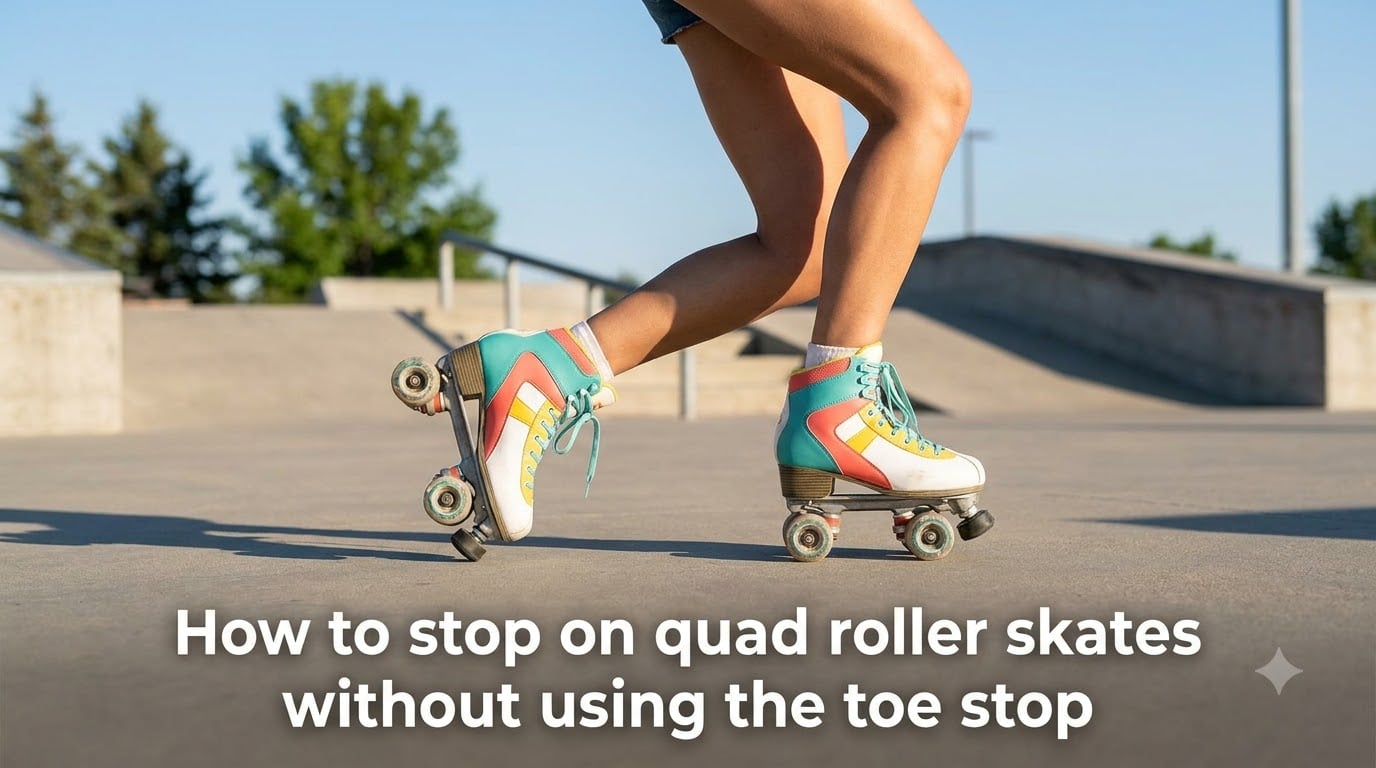
Learning how to stop on quad roller skates without using the toe stop is one of the most valuable skills any skater can develop. I remember running into walls to stop during my first few months at the rink, convinced that real stopping was something only pros could pull off. The truth is that four reliable techniques (the T-stop, plow stop, power slide, and hockey stop) work on any quad skate, and each one teaches you something different about balance and control.
This guide walks you through every technique I teach in my own skating lessons. You will get clear step-by-step instructions, common mistakes to avoid, and a practice plan that takes you from your first hesitant stops to confident control at speed. By the end, you will know exactly how to stop on quad roller skates without using the toe stop in any situation.
Table of Contents
Why Some Skaters Stop Using Toe Stops?
Many skaters deliberately remove or avoid their toe stops because toe stops get in the way of dance moves, footwork, and tricks. Roller dance, jam skating, rhythm skating, and park skating all rely on clean toe-to-heel movements where a chunky rubber toe stop can trip you up or limit your range of motion.
I started skating without toe stops when I got into rhythm skating. The first thing I noticed was how much smoother my footwork felt without that rubber bumper sticking out front. The trade-off is that I had to learn to stop using only my wheels, which made me a much more confident skater overall.
Toe stops also wear out quickly, especially if you skate outdoors on rough pavement. Some skaters swap them out for low-profile jam plugs or skate plugs (small round stoppers that sit flush with the plate) so they keep a built-in brake but lose the bulk. Others go completely stopless and rely entirely on their technique. Either way, mastering wheel-only stopping is essential.
The T-Stop Is the Easiest Way to Stop on Quad Skates Without a Toe Stop
The T-stop is the simplest and most beginner-friendly stopping technique on quad skates. You drag one skate behind you in a T-shape while keeping your weight on your front foot. The friction of the dragging wheel slows you down smoothly, and you stay in full control the entire time.
Step-by-Step T-Stop Instructions
Start at a comfortable roll. Begin practicing at a slow, controlled pace on a flat, smooth surface. Your front foot should be pointing straight ahead.
Shift your weight forward. Place roughly 70 percent of your body weight on your front foot. Your front knee should be slightly bent for stability and shock absorption.
Lift your back foot slightly and angle it sideways. Turn your back skate 90 degrees so it forms a T with your front skate. Only the wheels of your back skate should touch the ground.
Lower the back skate gently. Touch the wheels down lightly first, then apply gradual pressure. Pushing down too hard at the start is the most common mistake and can throw you off balance.
Increase pressure as you slow down. As your speed drops, apply more pressure on the dragging wheels to bring yourself to a complete stop.
Lift the back foot and roll away. Once stopped, lift your back foot back into normal skating position and continue rolling.
The T-stop works on quad skates because you have four wheels in contact with the ground at all times. The wider wheelbase gives you more stability than inline skates, and the urethane wheels create consistent friction against the skating surface.
Common T-Stop Mistakes to Avoid
Many beginners lean too far back when they first try the T-stop, which puts them off balance. I made this exact mistake my first week and ended up on my backside more times than I want to admit. Keep your weight forward and let the back foot do the braking work.
Another common error is locking the back ankle rigid. Keep a soft bend in your back knee so it can absorb bumps and slight weight shifts. A stiff leg will catch on rough surfaces and can send you tumbling.
The Plow Stop Gives You Maximum Control When Slowing Down
The plow stop is another excellent beginner technique. Instead of dragging one foot behind you, you point both skates outward in a wedge or pizza-slice shape. The inner edges of both sets of wheels create friction, and the wider your stance, the more you slow down.
How to Do a Plow Stop on Quad Skates
Roll forward at a slow to moderate pace. Start on flat ground until you are comfortable with the motion.
Bend your knees deeply. Lower your center of gravity so you stay stable throughout the stop. Think about sitting back into a chair.
Push both heels outward. Keep your toes pointing slightly inward and your heels pushing out. Your skates should form a V or pizza wedge shape.
Maintain even pressure on both feet. Both skates share the braking work equally, which makes the plow stop feel very stable.
Increase the wedge angle to stop faster. The wider you push your heels out, the more friction you generate and the faster you decelerate.
Bring your feet back together. Once stopped, return both skates to parallel position.
I love teaching the plow stop first because it keeps both skates on the ground and feels secure. Beginners often feel safer keeping all eight wheels down rather than dragging one foot. It is also a great warm-up drill because it strengthens your inner thigh muscles and improves your balance.
One thing to watch out for: do not let your toes turn inward too sharply, or you risk catching an inner wheel and tripping. Keep the wedge angle gradual, especially when you are just starting out.
Power Slide and Parallel Slide for Intermediate Skaters
The power slide is the dramatic sideways slide you see park skaters and derby players doing. Both skates turn perpendicular to your direction of travel and slide across the floor together. It is faster and more stylish than a T-stop, but it requires more balance and confidence.
Power Slide Steps for Quad Skates
Build up a moderate amount of speed. You need enough momentum to carry you through the slide, but not so much that you lose control.
Bend your knees deeply and lower your hips. Get low. The lower your center of gravity, the more stable your slide will be.
Shift your weight to your dominant foot. About 70 percent of your weight should sit on your front skate.
Turn your back skate 90 degrees. Push your back foot out so both wheels are sliding sideways. Keep your front skate pointing forward for stability.
Engage your core and let the wheels slide. Do not fight the slide. Relax into it and let the wheels do the work.
Bring the back skate back to parallel. Once you have slowed enough, return your back skate to forward-facing position.
The parallel slide is similar, except both skates turn sideways at the same time. It is more advanced because you have no forward-facing skate to stabilize you. I recommend getting comfortable with the power slide first before attempting the parallel slide.
For the parallel slide, the trick is engaging your thigh muscles hard to hold both skates sideways against the slide. It is a great workout and an impressive-looking stop once you master it.
The Hockey Stop Works on Quad Skates Too
The hockey stop is the classic ice-skating move where you rotate both skates sideways and dig into the surface. With practice, you can absolutely pull this off on quad skates. The motion is the same: rotate, dig in, and slide.
Hockey Stop Technique on Quads
Approach at moderate speed with knees bent. Stay loose and athletic.
Rotate your hips and shoulders in the direction you want to stop. Lead with your upper body.
Turn both skates perpendicular to your direction of travel. Both sets of wheels should be facing sideways at the same time.
Press down and lean back slightly. This engages the wheels against the floor and creates the slide.
Hold the position until you stop. Your wheels will leave skid marks on the floor if you do it right.
The hockey stop is harder on quad skates than on ice because the wheels grip more than a skate blade. You will not slide as far, but you will still stop effectively. Some skaters prefer to start with a one-foot hockey stop (turning just the back skate) and progress to both feet as they build confidence.
Weight Distribution and Knee Bend Are the Foundation of Every Stop
Every stopping technique on quad skates depends on the same two fundamentals: weight distribution and knee bend. Get these right, and the techniques fall into place much faster.
Bend your knees. Lowering your center of gravity keeps you stable when friction tries to push you around. A straight-legged stance will get knocked out from under you the moment any sideways force kicks in.
Keep your weight forward. Most beginners shift their weight backward when they try to stop, which is the opposite of what you want. Your weight should sit over your front foot so the braking foot or feet can do their job without yanking you off balance.
Engage your core. A tight core keeps your upper body stable while your lower body handles the friction. Think of your torso as a steady platform that your legs work beneath.
Stay loose in your ankles. Stiff ankles catch on every little bump in the floor. Soft ankles absorb shocks and keep you rolling smoothly through the stop.
How to Slow Down on Roller Skates Going Downhill?
Stopping on a downhill is the most common scary moment for new skaters. Without a toe stop, you have to rely on technique alone, so pick your method based on the steepness of the slope.
For gentle downhills, the T-stop is your best friend. Apply steady pressure to your back foot and let it gradually scrub off speed. Avoid jamming down hard, because sudden pressure on a downhill can throw you forward.
For steeper hills, switch to carving. Make wide S-shaped turns across the slope instead of going straight down. Each carve eats up momentum and keeps your speed manageable without ever needing a hard stop.
For very steep slopes, come to a complete stop at the top, walk down on foot, or find a flatter route. No technique is worth a bad fall. Always scout your downhill path before committing to it.
Common Mistakes That Keep Beginners From Stopping Properly
After watching dozens of beginners try to learn these techniques, I have noticed the same handful of mistakes over and over. Avoid these and your learning curve will be much shorter.
Looking down at your feet. Your head should stay up and looking where you want to go. Watching your feet throws off your balance and slows your reaction time.
Tensing up. Fear makes you stiff, and stiffness makes you fall. Stay relaxed, breathe, and trust the technique.
Trying techniques at full speed too soon. Start slow. There is no shame in practicing at walking pace until the motion feels natural.
Skipping protective gear. Wrist guards, knee pads, and a helmet are non-negotiable when you are learning. Falling is part of the process, and gear keeps those falls from becoming injuries.
Giving up after one bad fall. Every skater falls. I still take the occasional tumble when I try a new trick. Get back up, dust off, and try again.
Safety Gear and Practice Tips for Learning to Stop
Wrist guards are the single most important piece of safety gear for new skaters. Wrists take the brunt of most beginner falls because the natural instinct is to put your hands out. A good pair of wrist guards will save you from a lot of pain.
Knee pads, elbow pads, and a helmet round out the basic kit. Helmet use is especially important if you are learning to stop on a downhill or at the skate park. I never step into skates without my helmet, even for casual practice.
For practice scheduling, I recommend three to four short sessions per week instead of one long one. Twenty to thirty minutes per session is plenty. Your muscles need time to recover and adapt, and shorter sessions keep you fresh and focused.
Practice on smooth, flat surfaces first. Empty parking lots, smooth sidewalks, and indoor rinks are ideal. Avoid rough asphalt, gravel, or wet surfaces until your stopping techniques are second nature.
Frequently Asked Questions About Stopping Without Toe Stops
How do you stop on quad skates?
To stop on quad skates, use a friction-based technique like the T-stop, plow stop, power slide, or hockey stop. Each one works by turning your wheels sideways or pressing them against the floor to create friction that slows you down. The T-stop is the easiest for beginners, while the power slide offers the fastest deceleration.
How do you brake on quad roller skates?
Braking on quad roller skates without a toe stop involves shifting your weight to one foot and dragging the other foot sideways to create friction. The T-stop is the most common method, where the back skate turns perpendicular to the front skate and gradually slows you down as you apply pressure.
How do you stop on roller skates without brakes?
You can stop on roller skates without brakes using the T-stop, plow stop, power slide, or hockey stop. All of these techniques use wheel friction against the floor instead of a dedicated braking device. Each technique works by turning one or both skates sideways to create drag.
Do I need toe stops on roller skates?
You do not need toe stops on roller skates if you have learned a friction-based stopping technique. Many skaters remove their toe stops for dance, jam skating, or park skating because the rubber bumper interferes with footwork. Jam plugs or skate plugs offer a low-profile alternative if you want some braking power.
What is the best way to stop on roller skates?
The best way to stop on roller skates depends on your skill level. Beginners should start with the T-stop because it is the easiest to learn. Intermediate skaters can move on to the plow stop and power slide for faster, more controlled stops. Advanced skaters often use the hockey stop or parallel slide for dramatic, fast stops.
What is the T-stop in roller skating?
The T-stop is a roller skating braking technique where you drag one skate behind you perpendicular to the other, forming a T-shape. The friction between the dragging wheels and the floor gradually slows you down. It is the most beginner-friendly stopping technique on quad skates.
Build Your Stopping Skills and Skate With Confidence
Learning how to stop on quad roller skates without using the toe stop opens up a whole new world of skating. You will move smoother, dance cleaner, and feel more in control of every stride. Start with the T-stop, build up to the plow stop, and progress to the power slide and hockey stop as your confidence grows.
Practice a little each day, wear your protective gear, and be patient with yourself. Before long, stopping without toe stops will feel just as natural as skating itself. Get out there, roll strong, and enjoy every moment on your wheels.