
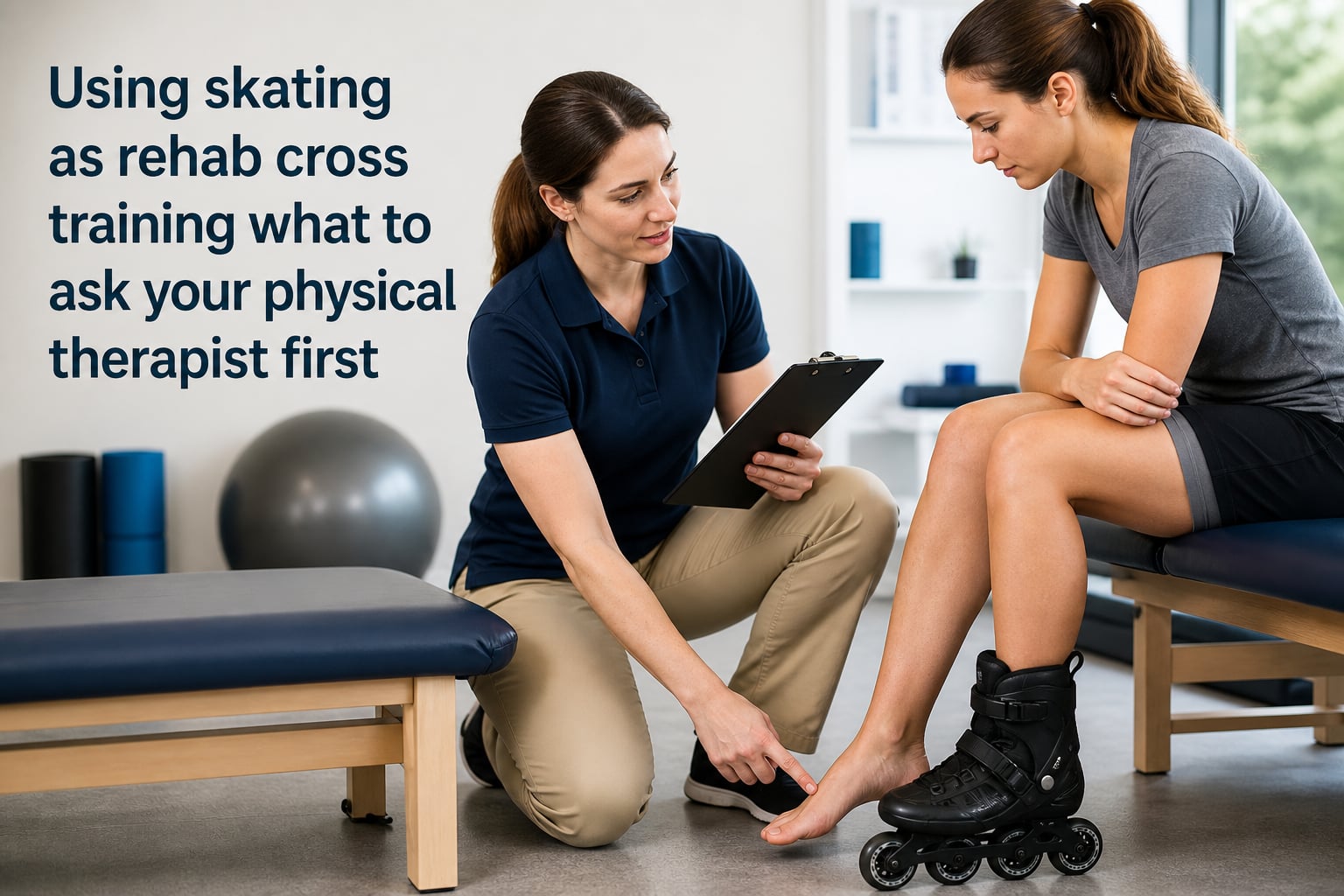
Skating pulls double duty for athletes recovering from injury. It builds balance, strengthens the lower body, and offers cardio without the high-impact pounding of running. Before you lace up your skates for rehab cross training, though, your physical therapist needs to weigh in.
Skating involves lateral motion, single-leg balance, and rotational forces that can either help your recovery or set it back. The difference comes down to when, how, and what type of skating you do. This guide covers the key questions to ask your physical therapist first, the specific skating movements to discuss, and the warning signs that mean you should stop and call your PT.
Important: This article is for educational purposes only. It does not replace medical advice from a licensed physical therapist or physician. Always consult a qualified healthcare provider before starting any new exercise program during injury recovery.
Table of Contents
Why Skating Can Work as Cross-Training (And When It Cannot)
Skating is a low-impact cardiovascular activity that loads the joints differently than running or jumping. Each push engages your glutes, quads, hamstrings, and calves in a controlled range of motion. The balance component also activates smaller stabilizer muscles around your ankles, knees, and hips that often weaken after time off from training.
I have seen athletes use skating as a bridge between formal rehab and full return to sport. The lateral movement pattern is similar to sports like tennis and soccer, while the single-leg stance mirrors many agility drills. For runners, skaters, and team sport athletes, skating can fill the cardio gap while protecting healing tissue.
Skating is not appropriate as rehab cross training in every situation. If you have an acute fracture, severe ligament tear, or post-surgical restrictions, your PT will likely rule out skating until you reach later phases of recovery. Conditions involving high fall risk, balance deficits, or significant weight-bearing restrictions also make skating a poor choice early in the rehab timeline.
What makes skating uniquely useful for cross-training
Three biomechanical features stand out. First, skating is non-weight-bearing in the vertical sense during the glide phase, which reduces impact on healing joints. Second, the push-off motion builds hip abductor strength, a known weak link in runners and athletes recovering from knee injuries. Third, the constant micro-adjustments for balance train proprioception in ways that stationary exercises cannot match.
Safety First: Before You Step on Skates, Talk to Your PT
Even if you have skated your entire life, rehabilitation changes the equation. Your body is not the same as it was pre-injury, and the demands of cross-training during recovery are specific. Skating without PT clearance can lead to re-injury, compensation patterns, or chronic issues that derail your return to your main sport.
The American Physical Therapy Association recommends that athletes in rehab consult their PT before adding any new activity to their program. This is especially true for skating, which carries both cardiovascular intensity and fall risk.
Signs you should see a PT before skating during rehab
Schedule a PT evaluation before skating if you have any of the following: lingering pain at rest, swelling that returns after activity, numbness or tingling in your lower extremities, a recent surgery within the past 12 weeks, or a history of repeated ankle sprains. A PT who works with athletes or skaters specifically will understand the demands and risks involved.
Essential Questions to Ask Your Physical Therapist About Skating
Walking into your PT appointment prepared makes the conversation more productive. Here are the 10 questions I tell athletes to bring to their first consultation about using skating as rehab cross training. Each one targets a specific decision point your therapist will help you navigate.
Is skating safe for my specific injury and recovery stage?
What type of skating do you recommend (ice, inline, quad) given my condition?
How often per week can I skate during this phase of rehab?
What intensity or duration should I start with?
Are there specific skating movements I should avoid right now?
What symptoms should prompt me to stop skating immediately?
Do I need any protective gear or modifications to my skates?
How does skating fit with the rest of my rehab exercises this week?
When should I follow up with you to reassess my progress?
What signs will tell us I am ready to return to full skating or my main sport?
Each of these questions opens the door to a richer conversation. For example, asking about type of skating matters because ice, inline, and quad skates each create different ankle angles and stability demands. A PT treating an Achilles tendon issue might prefer inline skates with a softer boot, while a knee injury patient might do better on quad skates for the added lateral stability.
Bring a notebook or use your phone to record the answers. PTs cover a lot of ground in a session, and details about frequency, intensity, and red flags are easy to forget by the time you reach the skate park or rink.
Skating Movements Your PT Needs to Know About
Not all skating is created equal when it comes to rehab risk. Your therapist should understand which movements you plan to do because each one loads the body differently. Here are the main categories to discuss.
Forward striding and gentle gliding
This is the lowest-risk option and often the first skating activity cleared during rehab. The motion is mostly sagittal plane, with mild hip and knee flexion. It is similar to walking but with a longer stride and more single-leg balance demand. Most PTs will clear this movement well before more complex drills.
Crossovers and lateral pushes
Crossovers introduce strong lateral forces and hip abduction. These are excellent for building hip stability but place high demand on the knee’s MCL and the ankle’s lateral ligaments. If you are rehabbing a knee ligament injury or chronic ankle instability, your PT may hold off on crossovers until you pass specific strength tests.
Stopping techniques
The way you stop matters more than most skaters realize. T-stop and plow stop both generate shear force through the lower leg. A sudden hard stop multiplies that force. Your PT should know which stopping method you use because it affects joint loading patterns during the cooldown of every lap.
Jumps, spins, and aggressive transitions
Figure skaters and aggressive inline skaters need to discuss jumps and rotational elements specifically. These involve pre-rotation, takeoff forces, and landing impacts that can be contraindicated during many rehab phases. If your sport includes these elements, your PT will likely require a return-to-jump protocol before clearing you.
How Skating Affects Ankles, Knees, Hips, and Lower Back
Forum threads on r/iceskating, r/rollerderby, and r/FigureSkating consistently highlight the same pain points. Knowing how skating stresses each area helps you ask better questions and interpret your PT’s guidance.
Ankle stability
Ankles absorb every push-off and every wobble. Skaters recovering from ankle sprains often report persistent instability even months after the initial injury. Your PT can test single-leg balance and peroneal strength to determine if your ankle is ready for skating. Strengthening exercises like single-leg calf raises and banded ankle inversions are common pre-skating prescriptions.
Knee alignment and patellofemoral stress
Knee pain tops the list of skating complaints on forums. Glute and hip strengthening reduces knee pain risk significantly, according to multiple PT-recommended protocols. If you have a history of patellofemoral pain or IT band syndrome, ask your PT to assess hip strength before clearing skating.
Hip mobility and glute activation
Hips drive every skating stride. Tight hip flexors or weak glutes change your stride mechanics and can cause cascading issues in the knees and lower back. Mat Pilates and targeted hip strengthening are popular cross-training recommendations in skating communities for this reason.
Lower back posture
Many skaters report low back pain from the forward-leaning posture required during skating. Cycling is frequently mentioned on r/iceskating as a complementary activity that helps offset this. Your PT may prescribe core stability work and hip flexor stretches to address this pattern before clearing longer skating sessions.
Warning Signs: When to Stop Skating and Call Your PT
Red flags during rehab cross-training are symptoms that suggest you are overloading healing tissue or moving too fast. Stop skating and contact your PT if you experience any of the following.
Sharp or acute pain during or after skating that does not resolve within 24 hours.
New swelling around a previously injured joint after a skating session.
Instability or giving way in the ankle or knee during skating.
Numbness, tingling, or color changes in the feet or toes.
Pain that disrupts your sleep the night after skating.
Compensation patterns such as limping, hitching, or guarding that persist after your session.
Your PT may use these signs to dial back your skating volume, change the type of skating you are doing, or refer you back to your physician for further evaluation. Never push through these symptoms hoping they will go away.
Building a Return-to-Skating Plan With Your Therapist
A solid return-to-skating plan follows the same principles as any return-to-sport protocol. Start below the threshold of symptoms, build gradually, and reassess often. Most PTs will structure your plan in phases.
Phase 1: Capacity building
Begin with light gliding on flat surfaces for 10 to 15 minutes, two to three times per week. Focus on stride mechanics and balance. Avoid hills, stops that generate high shear, and crowded sessions. Track any symptoms in a training log.
Phase 2: Movement progression
Add crossovers, controlled stops, and gentle transitions once your PT clears you. Sessions can extend to 20 to 30 minutes. Introduce mild interval work to build cardiovascular tolerance. Continue strength work in the gym three times per week.
Phase 3: Sport-specific reintroduction
Resume the full range of skating movements including jumps, spins, or aggressive maneuvers as appropriate for your sport. Sessions can match pre-injury duration. Add sport-specific drills and begin return-to-competition planning with your PT and coach.
Throughout each phase, your PT will likely reassess strength, range of motion, and functional movement at regular intervals. Use these check-ins to adjust your plan based on real data, not guesswork.
Frequently Asked Questions
Is skating good cross-training for running?
Skating can complement running well because it builds hip abductor strength, improves balance, and provides cardio with less vertical impact. Many runners use skating as an easy-day cross-training option, but consult your PT if you are returning from injury.
How long after an injury can I start skating for rehab?
There is no universal timeline. Clearance depends on your injury type, healing stage, strength benchmarks, and PT assessment. Some athletes return to gentle skating within weeks of minor injuries, while post-surgical cases may require months before skating is safe.
What are good questions to ask a physical therapist before starting a new activity?
Ask whether the activity is safe for your condition, what intensity and frequency to start with, which movements to avoid, what symptoms should stop you, what gear or modifications you need, and how the activity fits with your current rehab plan.
What is a red flag for a physical therapist during rehab cross-training?
Red flags include sharp pain, new swelling, instability, numbness or tingling, pain that disrupts sleep, and compensation patterns that persist after activity. Report any of these to your PT immediately rather than pushing through.
Do figure skaters cross train?
Yes. Figure skaters commonly cross train with cycling, Pilates, strength work, and off-ice mobility drills. These activities build the aerobic base, hip stability, and core control that support on-ice performance and reduce injury risk.
What should I expect at my first PT visit about skating?
Your PT will review your injury history, assess strength and range of motion, test balance and functional movement, and discuss your skating goals. Bring your skates if possible, a list of movements you want to do, and questions about type, frequency, and intensity.
The Bottom Line on Skating and Physical Therapy
Skating is a legitimate cross-training option that can support rehab when introduced at the right time and in the right way. The key word is consultation. Your physical therapist understands your specific injury, healing stage, and goals in a way that no general article can replace.
Use the questions in this guide to start the conversation. Bring them to your next PT appointment along with notes about your skating history and goals. If your therapist is not familiar with skating as an activity, ask for a referral to a sports-focused PT who works with skaters or athletes in similar sports.
When you and your PT build the plan together, skating can become a powerful tool for rebuilding strength, balance, and confidence after injury. The work you put in during rehab cross training pays off when you return to your main sport stronger and more resilient than before.
Skating is a sport, a workout, and for many of us, a way of life. Treating rehab with the same respect you give your training will keep you on skates for years to come.