
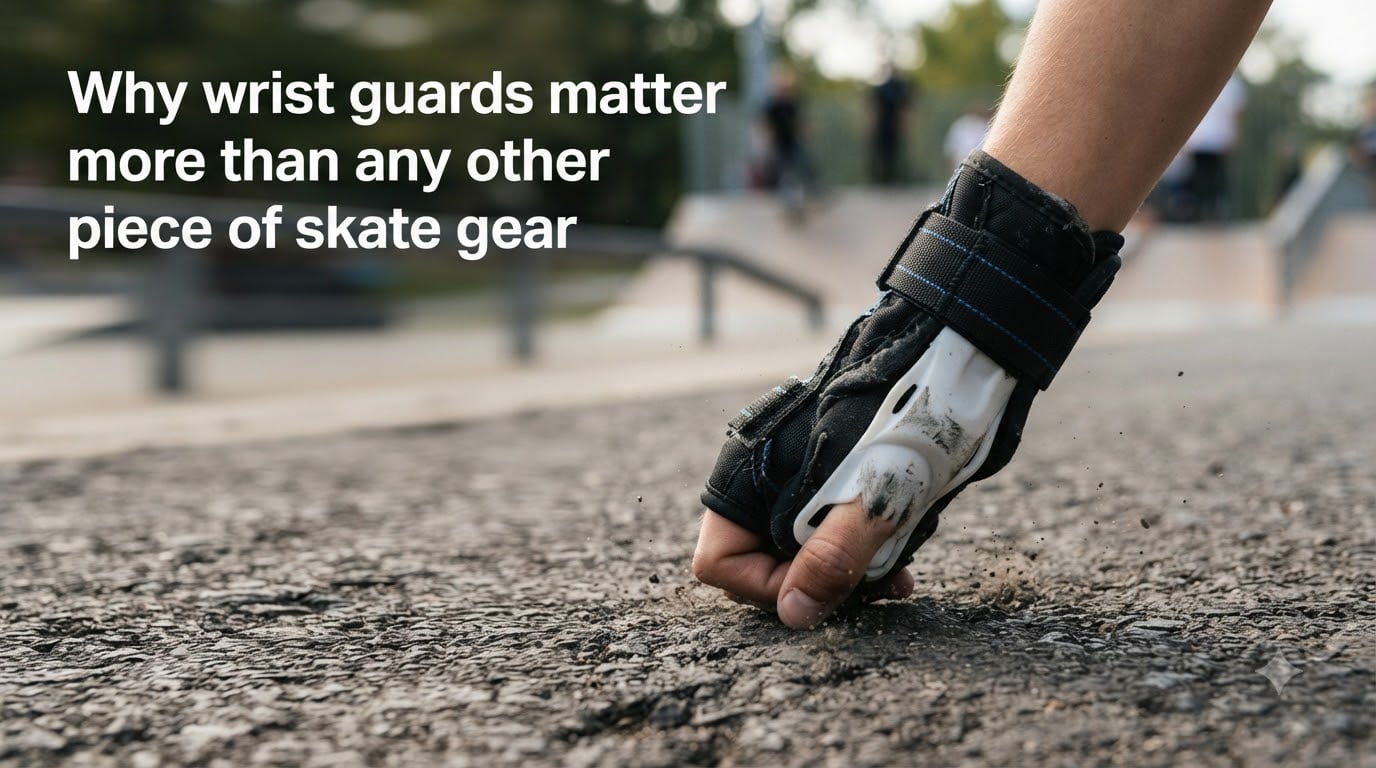
Falling onto an outstretched hand is the most instinctive reaction your body has when you lose balance on skates. That’s exactly why wrist guards matter more than any other piece of skate gear. Research from the American Journal of Sports Medicine shows wrist guards reduce wrist injury risk by up to 87%, and case-control studies confirm that not wearing wrist guards increases injury risk by over 10x compared to skaters who wear them properly.
Our team has spent years coaching beginners, talking to orthopedic surgeons, and reviewing injury databases. The pattern is consistent: when protective gear fails or is skipped, the wrist pays the price more often than the head, knees, or elbows. In this guide, I’ll explain the science, the statistics, and the practical reasons wrist guards belong at the top of every skater’s gear list.
Table of Contents
The Science: How Wrist Injuries Happen When You Skate?
Wrist injuries happen because of an involuntary reflex that’s nearly impossible to override. When you feel yourself falling forward, your arms shoot out automatically and your palms hit the ground first.
That reflex evolved to protect your head and face from impact. But on wheels or blades, that same protective instinct transfers a destructive amount of force straight into your wrists. Your hands absorb the entire momentum of your falling body multiplied by the speed of your roll.
The most common skating wrist injury is a distal radius fracture, where the larger forearm bone breaks near the wrist joint. Scaphoid fractures are the second most frequent, and they are notoriously slow to heal because the scaphoid bone has poor blood supply.
Beyond fractures, skaters also suffer sprains, ligament tears, and hyperextension injuries. Hyperextension occurs when your wrist bends backward beyond its normal range, stretching or tearing ligaments on the palm side of the joint. A single bad fall can produce any combination of these injuries, and most happen within the first six months of someone’s skating life.
Your wrist anatomy is uniquely vulnerable because the joint relies on a complex network of small bones, ligaments, and tendons working together. There is no muscle “padding” protecting the joint from direct impact. Bone meets pavement through a thin layer of skin and almost nothing else.
The Statistics: What the Research Shows About Wrist Guards
The case for wrist guards rests on more than anecdotal experience. Multiple peer-reviewed studies point to the same conclusion: wrist guards work, and they work dramatically.
Here are the numbers that matter most:
87% reduction in wrist injuries when properly fitted wrist guards are worn, according to studies cited by the American Journal of Sports Medicine.
10x increase in wrist injury risk for skaters who do not wear wrist guards, based on case-control studies analyzed by RollerSkateNation.
50% reduction in wrist injuries documented in a study of more than 7,000 snowboarders, a population with similar falling mechanics to skaters.
Highest injury frequency in beginners, who fall roughly 10 times more often than experienced skaters during their first three months.
Beginners are not just more likely to fall. The type of falls beginners experience is also worse for wrists. New skaters tend to fall forward with locked arms, sending maximum force through the wrist joint. Experienced skaters develop protective reflexes and falling techniques that distribute impact across the forearms, knees, and hips, but the learning curve takes months.
Even experienced skaters can have a bad fall. Distractions, wet pavement, unexpected cracks, and one-in-a-thousand trick attempts all produce wrist-loading falls. The 87% reduction statistic applies to every skill level, which is why coaches and physical therapists consistently rate wrist guards as the single most valuable piece of protective gear.
Why Wrist Guards Outrank Every Other Piece of Protective Gear
Every piece of protective gear serves a purpose, but the injury data tells a clear story about which pieces matter most. Wrist guards top the list because wrist injuries are the most common, the most expensive to treat, and the most likely to produce long-term consequences.
Helmets protect against the most catastrophic injuries: skull fractures and traumatic brain injuries. These injuries are less frequent than wrist injuries, but when they happen, the consequences can be life-altering. Still, head injuries remain statistically rarer than wrist injuries in recreational skating.
Knee pads and elbow pads prevent road rash, patella fractures, and elbow contusions. These injuries are painful and inconvenient, but most heal fully within weeks and rarely require surgery. A distal radius fracture, by contrast, often requires a cast for six to eight weeks, sometimes surgery, and months of physical therapy.
Here’s how the protective pieces stack up against each other based on injury frequency and severity:
Wrist guards: Highest injury rate, fractures common, months of recovery, surgery sometimes required.
Helmets: Lower injury rate, but the most severe potential outcome among protective gear.
Knee pads: Moderate injury rate, mostly soft-tissue damage, usually heals without surgery.
Elbow pads: Similar profile to knee pads, slightly less frequent injuries.
The reason wrist guards outrank all others comes down to a single factor: how often your hands hit the ground. Until you master falling techniques that redirect impact away from your wrists, every single fall is a wrist-loading event. Helmets and pads sit idle for many sessions; wrist guards work on nearly every fall.
Anatomy of a Wrist Guard: What Makes Them Actually Work
Wrist guards look simple, but each component is engineered to address a specific failure mode. Understanding the anatomy helps you choose the right pair and wear them correctly.
The palm-side splint is the most important feature. This rigid plate, usually made of high-density plastic or composite, sits between your palm and the ground during a forward fall. Its job is to transfer force from the small bones of your wrist across a wider area, so no single bone bears the entire load. The splint also prevents hyperextension by physically blocking your wrist from bending past its safe range.
Around the splint, dual-density foam absorbs initial impact. The harder layer spreads the load, while the softer layer cushions the shock against your skin. Premium wrist guards add a third component: a palm slider that lets your hand slide slightly forward on impact, dissipating energy through friction rather than absorbing all of it at once.
Velcro closures keep the guard snug against your wrist and forearm. A loose wrist guard shifts during a fall and fails to transfer force correctly. Most quality guards have two or three adjustment points: one near the palm, one across the wrist, and one on the forearm strap.
Modern guards also include moisture-wicking liners to keep your skin dry during long sessions. This isn’t a comfort luxury. Damp skin allows the guard to slip on impact, which reduces protection precisely when you need it most.
Common Misconceptions About Wrist Guards
Several myths persist in skating communities, and some of them discourage people from wearing the gear that could save them months of recovery. Let me address each one directly.
Myth 1: Wrist guards encourage bad falling technique.
This is the most common critique, especially from experienced skaters. The concern is that beginners will rely on the guards instead of learning to fall properly. The reality is more nuanced. Yes, guards can compensate for poor technique temporarily, but that compensation is the entire point. Learning to fall correctly takes months, and guards bridge that gap. Most instructors recommend teaching both together, not choosing one over the other.
Myth 2: Wrist guards prevent all injuries.
No protective gear prevents every injury. Wrist guards work for forward falls, where your palm hits the ground. Backward falls where you land on the back of your hand or twist sideways can still produce injuries, particularly scaphoid and ligament damage. The 87% reduction figure accounts for these limitations; it’s not 100%.
Myth 3: Only beginners need wrist guards.
Adults face higher stakes than children when it comes to wrist injuries. A child’s distal radius fracture typically heals in six weeks with minimal long-term impact. The same fracture in a 40-year-old often requires surgery and can produce lasting stiffness. Skaters returning after a break also have rusty reflexes, putting them at higher risk than they were before.
Myth 4: Wrist guards restrict movement too much.
Modern designs balance protection with mobility. Many skaters report that after a short adjustment period, they barely notice the guards. Trying a few different models is the best way to find a pair that fits your style and skating discipline.
The Right Way to Wear Wrist Guards and Fall Safely
Proper fit matters more than brand or price. A wrist guard that shifts during a fall provides roughly half the protection of a properly fitted one. Here are the key fit points to check.
The palm splint should sit centered along the length of your palm and extend just past your wrist crease toward your forearm. If it ends in the middle of your palm, it won’t prevent hyperextension. If it ends too far up your forearm, it will restrict your grip.
Straps should be snug, not tight. You should be able to slide one finger under each strap. Blood should flow normally to your fingers; if they tingle or turn pale, the guard is too tight.
Even with perfect-fitting guards, learning to fall reduces injury risk further. The recommended sequence is: drop to one knee, tuck your chin, slide on your knee pads, and let your forearms distribute the load instead of catching the fall with locked wrists. This technique pairs naturally with wrist guards and helps skaters transition to gear-free confidence eventually.
The Long-Term Cost of Skipping Wrist Guards
The short-term price of wrist guards is minor: a single piece of gear that lasts years. The cost of skipping them can ripple through the rest of your skating life.
A distal radius fracture often requires six to eight weeks in a cast, sometimes surgery with plates and screws, and physical therapy that stretches into months. Full grip strength can take a year to return. Adults over 40 sometimes never recover complete range of motion in the injured wrist.
Beyond medical bills and lost work time, a single wrist injury creates lasting psychological effects. Skaters who break a wrist often skate less afterward, afraid of repeating the experience. Many never return to the trails, rinks, or skate parks they once loved.
Compare that to a wrist guard that costs less than a single physical therapy session and lasts for years of regular skating. The investment case is overwhelming.
FAQ: Wrist Guards and Skating Safety
Are wrist guards worth it for skateboarding?
Yes. Studies cited by the American Journal of Sports Medicine show wrist guards reduce wrist injury risk by up to 87%, making them one of the most effective pieces of protective gear available to skaters of any skill level.
Do wrist pads actually help skating?
Wrist pads and wrist guards work by combining a rigid palm splint with impact-absorbing foam to redistribute force across the forearm and prevent hyperextension. Research consistently shows they reduce fractures and sprains significantly.
How important are wrist guards?
Wrist guards are the single most important piece of skate gear because falling onto an outstretched hand is an instinctive reflex, and case-control studies show not wearing wrist guards increases injury risk by over 10x.
What is the most important protection for skateboarding?
Helmets prevent the most severe injuries, but wrist injuries are far more frequent. Across injury data, wrist guards prevent more total injuries than any other single piece of protective gear.
Should I wear wrist guards when skating?
Every skater should wear wrist guards, but beginners and adults benefit most. Beginners fall more often, and adults face longer recovery times from the same injuries that children recover from quickly.
Why Wrist Guards Deserve the Top Spot in Your Gear Bag
Wrist guards matter more than any other piece of skate gear because they address the most common, most likely, and most life-disrupting injury in the sport. The 87% reduction in wrist injuries, the 10x risk increase without guards, and the instinctive falling reflex all point to the same conclusion.
I’ve broken down the science, the statistics, the anatomy, and the misconceptions. The next step is yours. Pick a pair of well-reviewed wrist guards, fit them properly, and make them the first piece of gear you put on before every session. Your future self, the one who still skates confidently at 60, will thank you.