
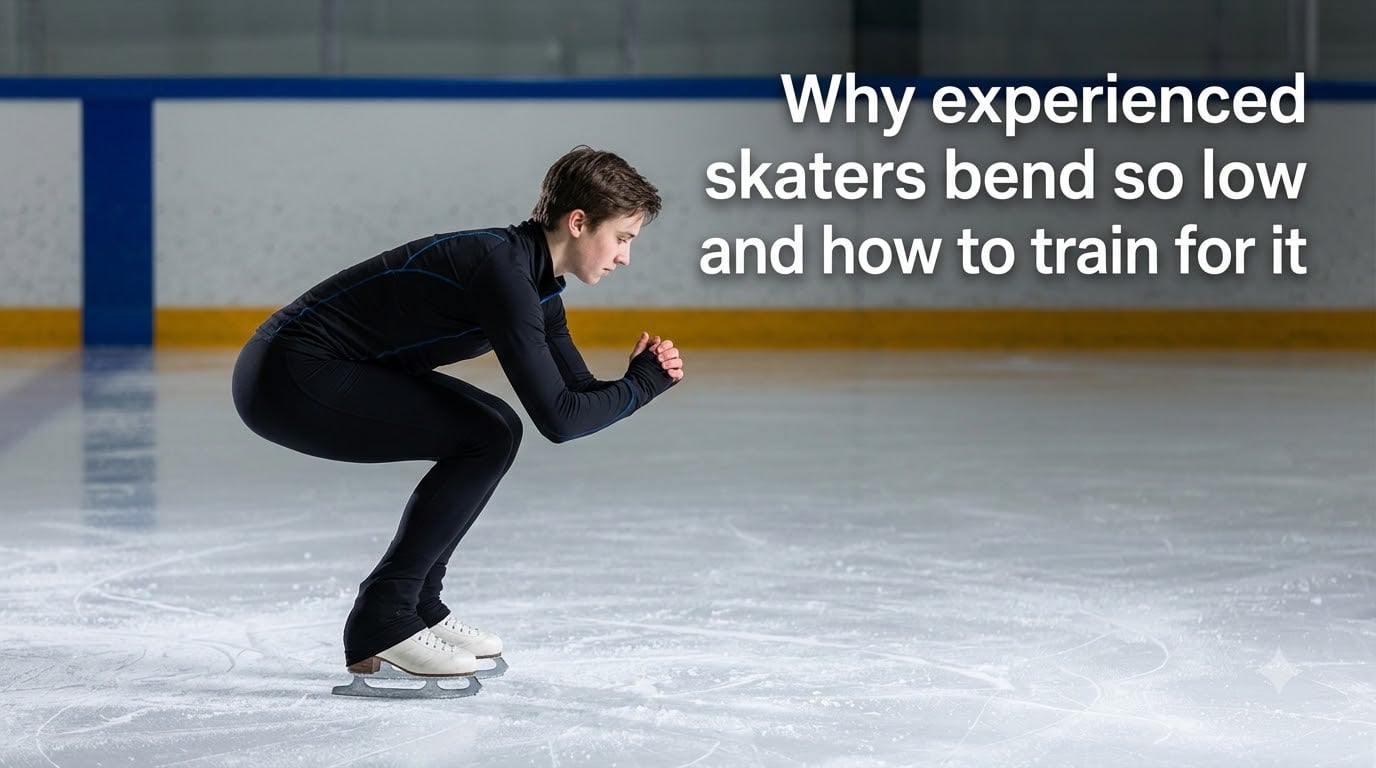
If you have ever watched experienced skaters glide across the ice or rink, you probably noticed something striking. They crouch low, almost sitting into their skates, while beginners stand tall and stiff. That deep, athletic posture is not just for show. It is the single biggest technical difference between a skater who looks confident and one who looks like they might fall at any moment.
Understanding why experienced skaters bend so low comes down to physics, biomechanics, and muscle engagement. When you lower your centre of gravity, you gain stability, power, and control that simply are not available from an upright position. Every push becomes stronger, every turn becomes tighter, and every landing becomes softer.
In this guide, I will break down exactly why knee bend matters, how hip hinge and knee flexion work together, and how to train your body to hold a deeper skating posture. Whether you are into figure skating, speed skating, hockey, or roller skating, the principles here will transform the way you move on blades or wheels.
Table of Contents
Why Experienced Skaters Bend So Low?
Experienced skaters bend so low because bending the knees lowers the body’s centre of gravity, which directly increases balance and stability while reducing aerodynamic drag. A lower centre of gravity means your weight sits closer to your base of support, making it significantly harder to tip over. This is the same reason a sports car corners better than a tall SUV.
Speed skaters take this to the extreme. If you have watched Olympic speed skating, you see athletes practically folded in half, chests nearly parallel to the ice. That hunched position reduces wind resistance dramatically, allowing them to maintain higher speeds with less energy output. At elite speeds, even small reductions in drag translate to meaningful time gains over a race.
But the physics go beyond drag. When your knees are flexed, your legs act as natural shock absorbers. Every bump, edge catch, or landing force travels through bent joints that absorb and distribute the energy. Stand with locked knees and even a small wobble sends you off balance. Bend deeply and that same wobble becomes easy to correct.
There is also a leverage advantage. A bent knee positions your muscles in their strongest range, where quadriceps, glutes, and hamstrings can generate maximum force. This is why coaches constantly repeat the instruction to bend deeper. The lower you sit into your stance, the more power you can produce with each stride.
Benefits of a Deep Knee Bend in Skating
A deep knee bend in skating delivers four major advantages that affect every aspect of performance. Let me walk through each one so you understand exactly what you gain from sitting lower in your stance.
Better Balance and Stability
Lowering your centre of gravity is the fastest way to improve balance on skates. When your weight drops closer to the ground, your body has a wider effective base of support. Small shifts in weight that would topple an upright skater become manageable corrections for someone in a deep knee bend.
Forum skaters describe this well. One Reddit user noted that soft, bent knees balance skaters over their blades better, while another pointed out that bending keeps your centre of gravity low so you feel more stable. These are not just opinions. They reflect solid physics principles about weight distribution and stability.
More Power and Longer Strides
Bent knees let you push through a fuller range of motion, which means each stride covers more distance. Less knee bend makes the push weaker and shorter, covering less ice and generating less speed. This is why power skating coaches in hockey obsess over knee flexion angles.
When your knee is bent to roughly 90 degrees, your leg extensors are in their optimal force-producing position. You can drive off the ice or floor with significantly more power than you could from a nearly straight leg. Over the course of a shift, a race, or a program, that extra power per stride adds up fast.
Greater Muscle Engagement
A deep skating stance engages more muscle groups simultaneously. Your quadriceps work to hold the bend, your glutes stabilise your hips, your hamstrings control the descent, and your calves and ankles manage edge control. Even your core gets involved to keep your torso aligned over your skates.
Standing upright on skates, by contrast, lets most of those muscles go dormant. You rely on your skeleton and a small amount of ankle stability to stay upright. Bending deep turns skating into a full lower-body workout, which is exactly why it feels tiring at first but builds strength quickly.
Shock Absorption and Impact Protection
Bent knees absorb impact. Whether you are landing a jump in figure skating, taking a hit in hockey, or simply rolling over rough pavement on roller skates, flexed joints soak up forces that would otherwise jar through your spine and hips. This is one of the strongest injury prevention arguments for proper knee bend.
Hip Hinge vs Knee Bend: What Beginners Get Wrong
The most common confusion I see among new skaters is the difference between a hip hinge and a knee bend. Coaches say bend your knees, and beginners dutifully flex their knees while keeping their torso upright. The problem is that this alone does not get you low enough or balanced correctly.
What Is a Hip Hinge?
A hip hinge is a forward rotation of your pelvis at the hip joint, which tilts your torso forward from the waist up. Think of how a speed skater folds forward. That fold comes primarily from the hips, not the lower back. The hip hinge moves your chest forward and your hips backward, shifting your weight over the middle of your skates.
Proper hip hinge engages your glutes and hamstrings as powerful stabilisers. It also keeps your back in a safe, neutral position rather than rounded. If you feel strain in your lower back when skating low, you are probably bending from the spine instead of hinging from the hips.
What Is Knee Flexion?
Knee flexion is simply the bending angle at your knee joint. The deeper the flexion, the lower your body drops. Combined with ankle dorsiflexion, which is the forward movement of your shin over your foot, knee flexion determines how low you can sit into your skating stance.
One forum skater described the sensation perfectly. They said that with a really deep knee bend, they could feel their lower leg pushing forward against the tongue of their skate. That forward shin pressure is ankle dorsiflexion working alongside knee flexion. Both are needed for a proper deep stance.
How They Work Together
Here is the key insight that most resources miss. A proper skating posture requires both hip hinge and knee bend working together. The hip hinge gets your torso forward and your weight balanced over your skates. The knee bend drops your centre of gravity low. Skip either one and you either stay too high or tip forward.
If you only bend your knees without hinging, your torso stays vertical and your weight shifts too far back onto your heels. If you only hinge without bending your knees, your chest drops but your centre of gravity stays high. The sweet spot is a simultaneous hip hinge and deep knee flexion that stacks your shoulders over your knees over your toes.
What Proper Knee Bend Should Feel Like
Many forum skaters say they do not know if they are bending enough. Here is what to look for. You should feel pressure through the middle of your blade or wheel, not the heels. Your shins should press gently against the tongues of your skates. Your thighs should be working, and your glutes should feel engaged, not relaxed.
Your lower back should feel neutral, not arched or rounded. If you feel like you are sitting back into an invisible chair with your chest tall but tilted forward slightly, you are in the right position. It will feel awkward and tiring at first. That is normal and means your muscles are adapting.
Sport-Specific Knee Bend Variations
While the basic physics stay the same, different skating disciplines use knee bend in slightly different ways. Understanding your sport’s specific demands helps you train more effectively.
Figure Skating
Figure skaters use deep knee bend for edge control, spirals, spins, and jump take-offs. The knee bend on a spin entry helps lower the centre of gravity before pulling up tight. On jumps, a deep knee on the take-off edge loads the leg like a spring, storing energy that launches the skater into the air.
Figure skaters also use knee bend for artistic expression. A deep, soft knee over a long edge creates that flowing, effortless look judges reward. Shallow knees make skating look choppy and stiff.
Speed Skating
Speed skaters push knee bend to the extreme, holding chest-low positions for the entirety of a race. Their hip hinge is dramatically deeper than in other disciplines because aerodynamic drag is the primary enemy at racing speeds. The combination of extreme hip flexion and deep knee flexion lets them maintain maximum velocity with minimum air resistance.
This position demands exceptional quad and glute endurance. Speed skaters train off-ice with holding exercises and single-leg work specifically to sustain that low posture for minutes at a time.
Hockey Skating
Hockey players need a versatile stance that balances agility, power, and readiness. Their knee bend is deep but not as extreme as speed skating, because they need to explode into sprints, stop suddenly, and change direction on a dime. The hockey stance sits somewhere between a speed skater’s fold and a figure skater’s upright edge work.
Hockey coaches talk about the 90-degree knee bend as a baseline. That angle gives players enough flexion for powerful strides while keeping their chest high enough to see the ice and react quickly.
Roller Skating and Derby
Roller skaters and derby athletes follow the same principles on wheels. Derby players in particular rely on a low, wide stance for stability during contact and quick directional changes. The lower centre of gravity helps absorb pushes and maintain balance in chaotic pack situations.
Signs Your Knee Bend Is Wrong (And How to Fix It)
Identifying incorrect knee bend is the first step toward fixing it. Here are the most common signs I see, along with their corrections.
You Feel Unstable or Wobbly
If you feel like you might fall at any moment, your knees are probably too straight. The fix is simple but uncomfortable. Bend deeper. Drop your hips another few inches and feel your weight settle over the middle of your blades. The wobble should reduce almost immediately.
Your Lower Back Hurts After Skating
Lower back pain after skating usually means you are bending from the spine instead of hinging from the hips. Focus on pushing your hips back and keeping your back flat. Stretch your hip flexors off-ice, since tight hips force your lower back to compensate.
You Cannot Maintain the Bend While Gliding
Many skaters bend into a push but straighten up during the glide. This usually stems from weak quads and glutes that fatigue quickly. Off-ice strength training, particularly wall sits and single-leg squats, builds the endurance to hold a deep bend continuously.
Your Knees Hurt During or After Skating
Knee pain can come from several sources, but in the context of knee bend it often relates to poor tracking or inadequate muscle support. Make sure your knees track over your toes, not collapsing inward. Strengthen your glutes and hamstrings so they share the load with your quads. If pain persists, see a physiotherapist before pushing harder.
How to Train for a Deeper Knee Bend
Training for a deeper knee bend requires both off-ice strength work and on-ice drills. I recommend a progressive approach, starting with exercises that build the foundation and advancing to skating-specific movements. Here is a step-by-step system you can follow.
Step 1: Wall Sits for Quad Endurance
Wall sits build the isometric quad strength you need to hold a deep skating stance. Start with your back against a wall, knees bent to 90 degrees, and hold for 30 seconds. Work up to 60 seconds over a few weeks, then add three sets. This single exercise does more for your skating posture than almost anything else.
One GoldenSkate forum user credited single-leg work, including wall sit variations, with helping them feel comfortable bending deeply while skating. The carryover from off-ice holds to on-ice stance is direct and measurable.
Step 2: Bodyweight Squats for Full Range
Bodyweight squats train your knees to flex deeply with control. Lower until your thighs are parallel to the floor or deeper, keeping your weight in your heels and your chest tall. Do three sets of 15 reps, focusing on a slow, controlled descent. This builds the strength and mobility for a deeper on-ice bend.
Step 3: Single-Leg Squats for Skating-Specific Strength
Single-leg squats, even partial range using a bench for support, build the unilateral strength that skating demands. Since you push off one leg at a time, single-leg training directly transfers to stride power and balance. Start with bench-assisted single-leg squats and progress to free-standing as your strength improves.
Step 4: Hip Hinge Drills with a Stick
Hold a broomstick along your spine, touching your head, upper back, and tailbone. Hinge forward at the hips while keeping all three contact points. This drill teaches proper hip hinge mechanics and prevents the lower-back rounding that plagues so many skaters. Do three sets of 10 hinges.
Step 5: Ankle Dorsiflexion Stretches
Limited ankle flexibility prevents deep knee bend because your shin cannot travel far enough forward. Stretch your calves regularly and practice knee-to-wall drills, where you keep your foot flat and drive your knee toward a wall. Improved dorsiflexion translates directly to a deeper, more comfortable skating stance.
Step 6: On-Ice Two-Foot Deep Bend Glides
On the ice or rink, push off and glide on two feet while sinking into the deepest knee bend you can hold. Stay low for the full length of your glide. This drill trains your body to maintain the position while moving, which feels different from holding it statically off-ice.
Step 7: On-Ice One-Foot Deep Bend Glides
Progress to gliding on one foot with a deep knee bend. This is significantly harder because your supporting leg must stabilise your entire body weight in a flexed position. Start with short glides and extend the distance as your balance and strength improve. This drill closely mimics the balance demands of real skating.
Step 8: Marching While Low
From a deep two-foot bend, march in place, lifting one foot at a time while maintaining your depth. This trains the dynamic stability you need for stride transitions. Keep your head level, meaning no bouncing up and down as you lift each foot.
Safety and Injury Prevention
Training for a deeper knee bend places new demands on your joints and muscles. Take a few precautions to stay healthy as you progress.
Always warm up before deep bend work. Five minutes of light skating, leg swings, and bodyweight squats prepares your muscles and joints for the load. Cold muscles are far more prone to strain, especially when you are asking them to hold unfamiliar positions.
Progress gradually. If you jump from shallow knees to very deep bending overnight, your quads, hip flexors, and lower back will rebel. Add depth in small increments week by week, giving your body time to adapt. Soreness is normal. Sharp pain is not.
Stretch your hip flexors, quads, and calves after every skating session. These muscles work overtime during deep knee bend and tighten quickly if not addressed. Tight hip flexors in particular pull your pelvis forward, which undermines your hip hinge and strains your lower back.
Frequently Asked Questions
Why do skaters bend their knees?
Skaters bend their knees to lower their centre of gravity, which improves balance, stability, and power. A deep knee bend also engages more muscles, absorbs impact, and allows for longer, stronger strides.
Why are speed skaters hunched over?
Speed skaters hunch over to reduce aerodynamic drag. At racing speeds, air resistance is the primary force slowing them down, and a low, folded position minimises their frontal area. The hunched posture comes from a deep hip hinge combined with extreme knee flexion.
How do I bend my knees more when skating?
To bend your knees more when skating, combine a hip hinge with deep knee flexion, keeping your weight over the middle of your blades. Train off-ice with wall sits, squats, and hip hinge drills to build the strength and mobility needed for a deeper stance.
How to strengthen knees for skating?
Strengthen your knees for skating with wall sits, bodyweight squats, single-leg squats, and hip hinge drills. Also stretch your calves and hip flexors to improve ankle dorsiflexion, which allows for a deeper and safer knee bend.
Why can’t I maintain knee bend while gliding?
Most skaters struggle to hold knee bend while gliding because their quads and glutes lack endurance. Off-ice isometric holds like wall sits build the stamina needed to stay low continuously. Start with short glides in a deep bend and gradually extend the distance.
Is a deep knee bend hard on your knees?
A proper deep knee bend is not harmful when your muscles are strong enough to support it. Problems arise when weak glutes and hamstrings force the quads and knee joints to take all the load. Build balanced leg strength and ensure your knees track over your toes to protect the joint.
Conclusion
Understanding why experienced skaters bend so low changes everything about how you approach the sport. The deep knee bend is not a stylistic choice. It is the foundation of balance, power, control, and injury prevention on skates. Combined with a proper hip hinge, it transforms an unstable beginner into a confident, efficient skater.
Start with the off-ice exercises in this guide, progress to the on-ice drills, and be patient with your body as it adapts. The deeper you sit into your skates, the more the entire sport opens up to you. Your edges sharpen, your speed builds, and your confidence grows with every session.