
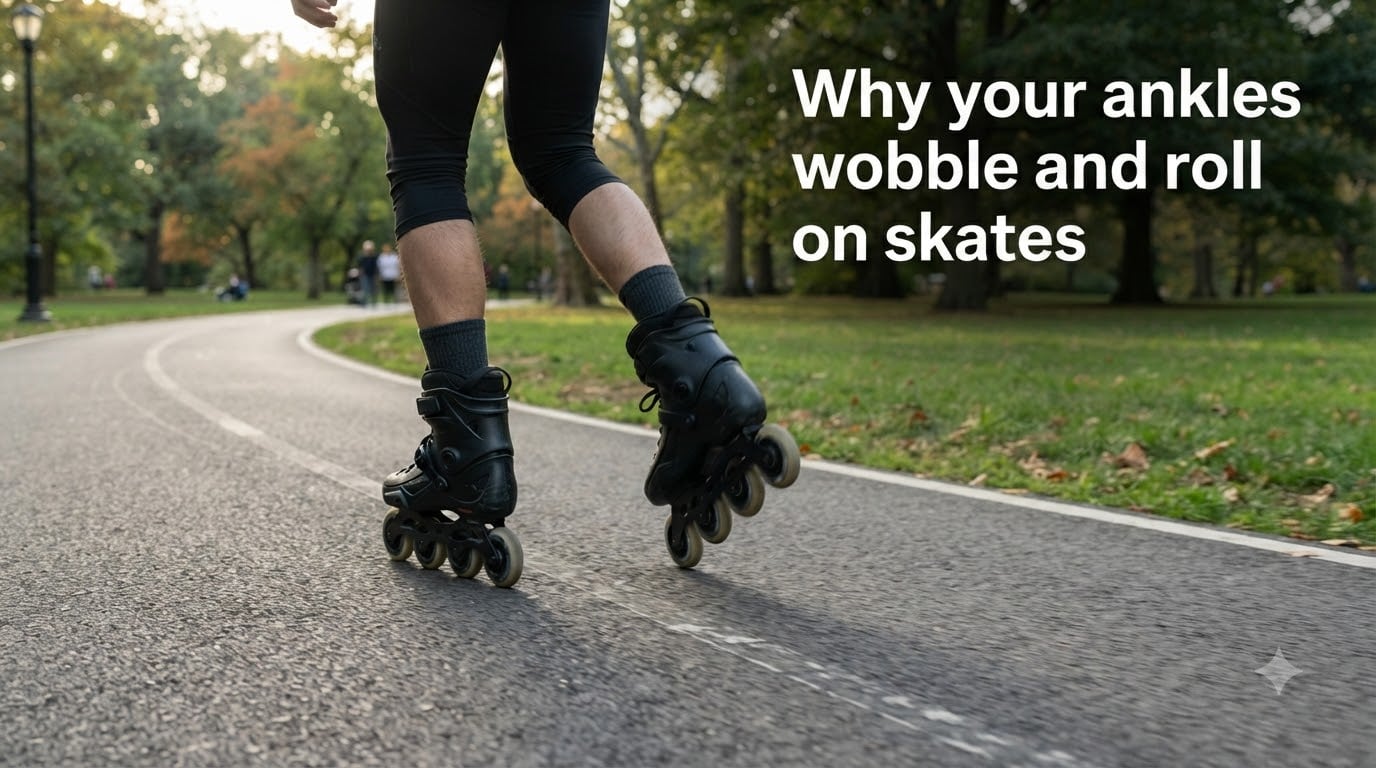
If you have ever laced up a pair of skates and felt your ankles buckle sideways within the first few minutes, you are not alone. Ankle wobble and roll is one of the most common frustrations skaters face, especially beginners. Whether you are rolling on inline four roller skates or traditional quad skates, that unsettling sideways movement can shake your confidence and even lead to injury.
The good news is that ankle wobble is almost always fixable. It comes down to a combination of skate fit, boot support, muscle strength, and technique. Once you understand what is happening inside your boots, you can take targeted steps to lock your ankles in place and skate with control.
In this guide, we break down exactly why your ankles wobble and roll on skates, what causes it, and how to fix it for good. We cover strength exercises, fit adjustments, boot stiffness basics, and practical drills you can start today.
Table of Contents
Why Do Your Ankles Wobble and Roll on Skates?
Ankle wobble on skates happens when your ankle joint is unable to stay centered over the skate’s wheelbase. Instead of tracking straight, your foot tilts inward or outward, creating that frightening rolling sensation.
Your ankle joint is a hinge that moves in multiple directions. When you stand on skates, you are balancing on a narrow surface with wheels underneath. If the muscles, tendons, and ligaments around the ankle are not strong enough to hold the joint stable, the ankle drifts. The skate boot can only do so much if your body is not providing active support from the inside.
On inline four roller skates, the wheelbase is longer and narrower than on quad skates. This gives you better forward-backward stability but less natural side-to-side support. That is why new inline skaters often feel their ankles rolling laterally even when they feel fine walking in regular shoes.
The sensation of ankle roll is your body’s warning system. It means something in your setup, strength, or technique needs attention before you skate harder or faster.
Common Causes of Ankle Wobble
Several factors contribute to ankle wobble on skates. Most skaters deal with more than one at the same time, which is why the problem can feel overwhelming.
Weak Ankle Stabilizer Muscles
The most common cause is simply weak stabilizer muscles. These are the small muscles around your ankle and lower leg that keep the joint aligned. If you have never spent time strengthening them, they fatigue quickly on skates and the ankle starts to drift.
People who sit for long hours or have not done balance-based sports often have underdeveloped ankle stabilizers. Even strong runners and cyclists can struggle here because those sports do not challenge lateral ankle control.
Skates That Are Too Big
Oversized skates are a massive contributor to ankle roll. If there is extra space inside the boot, your foot slides around instead of locking in. Even a half-size too large can leave enough room for your heel to lift and your ankle to tilt.
Many beginners buy skates a size up thinking they need room to grow or that tighter skates will be uncomfortable. In reality, a loose skate is far more uncomfortable and dangerous than a snug one.
Soft or Worn-Out Boot Cuffs
The cuff is the upper portion of the skate boot that wraps around your ankle. Over time, plastic and composite cuffs soften and lose their rigidity. A skate that gave great support two years ago may now flex sideways under pressure.
Soft-boot recreational skates are particularly prone to this. The breathable mesh material feels comfortable but offers less lateral resistance than a hard-shell boot.
Improper Lacing and Buckle Tension
Even the best skate will wobble if it is not fastened correctly. If your laces are loose around the ankle or your top buckle is not cinched down, the boot cannot do its job of holding your ankle centered.
A common mistake is tightening the toe area but leaving the ankle section loose. The ankle junction is where you need the most tension to prevent lateral movement.
Standing Too Upright
Posture matters enormously on skates. When you stand tall with straight legs, all your weight stacks vertically over a tiny wheel contact patch. This makes balancing difficult and exaggerates any ankle movement.
Bending your knees lowers your center of gravity and engages your thigh and calf muscles, which take pressure off your ankles. Skaters who wobble often discover that simply dropping into a deeper knee bend immediately reduces the rolling sensation.
How to Build Ankle Strength for Skating?
Building ankle strength is the single most effective long-term fix for wobble. These exercises require no equipment and can be done at home in under fifteen minutes a day.
Calf Raises
Stand on the edge of a step with your heels hanging off. Rise onto your toes slowly, hold for two seconds, and lower back down. Do three sets of fifteen repetitions. This strengthens your calves and the stabilizing tendons around your ankle.
Once single-leg calf raises feel easy, switch to doing them one foot at a time to challenge your balance further.
Single-Leg Balancing
Stand on one foot with your eyes open for thirty seconds, then switch sides. Once that is easy, close your eyes or stand on an unstable surface like a folded towel or balance pad. This trains the proprioceptors in your ankle that tell your brain where your foot is in space.
Aim for three sets per leg. Consistent practice over two to three weeks produces noticeable improvements on skates.
Resistance Band Inversions and Eversions
Loop a light resistance band around your foot and press the foot outward against the band, then inward. These movements directly target the muscles on each side of your ankle that prevent rolling. Do three sets of twelve reps in each direction.
This exercise is especially helpful for skaters who have previously sprained an ankle, since old injuries leave the joint less stable.
Towel Scrunches
Place a small towel on the floor and use your toes to scrunch it toward you. This strengthens the muscles in the arch of your foot, which contributes to overall ankle stability. Two sets of twenty scrunches per foot is a good starting point.
Proper Skate Fit to Prevent Ankle Roll
Getting the right fit eliminates a huge portion of ankle wobble problems. Here is what to look for when fitting skates.
Snug but Not Painful
Your skate should feel like a firm handshake around your entire foot. There should be no pressure points or pinching, but also no empty space. When you stand in the skates, your toes should lightly touch the front without being crushed.
If your heel lifts when you lean forward in the skate, the fit is too loose. Heel lift is a direct cause of ankle roll because it lets your foot pivot inside the boot.
Sizing Down from Shoe Size
Most inline skate brands run differently than street shoes. Rollerblade and Powerslide models often require sizing down by half to a full size. Always check the brand’s specific sizing chart and measure your foot length in centimeters for the most accurate match.
Mondopoint sizing, used by brands like Seba and FR Skates, measures foot length in millimeters and is the most precise way to get a performance fit.
Tightening the Ankle Junction
When lacing your skates, pull firmly at the point where the eyelets cross over your ankle bone. This is the lateral lock. If your skate has a ratchet buckle at the top of the cuff, crank it down until you feel solid pressure on your ankle without cutting off circulation.
A powerstrap or Velcro strap across the upper instep adds another layer of lockdown. Use it to pull your heel into the back of the boot.
Boot Stiffness and Ankle Support Explained
Boot stiffness directly affects how much lateral support your ankles receive. Understanding the trade-offs helps you choose the right skate for your skill level and goals.
Soft-Boot Skates
Soft-boot recreational skates use mesh and fabric uppers mounted on a plastic or composite base. They are lightweight, breathable, and comfortable for casual skating. However, they flex more under lateral pressure, which means less ankle support.
These are fine for light recreational use but can contribute to wobble for heavier skaters or those with weaker ankles. If you wobble in a soft boot, upgrading to a stiffer model often resolves the issue immediately.
Hard-Boot Skates
Hard-shell boots use a rigid plastic or carbon fiber exoskeleton that wraps the foot and ankle. They provide excellent lateral support and energy transfer. Urban, freeride, and slalom skaters rely on hard boots for precise control.
The trade-off is that hard boots are less breathable and can feel stiff until broken in. Many models feature heat-moldable liners that conform to your foot shape over time for a custom fit.
Carbon Fiber Boots
Carbon boots are the stiffest and lightest option, used primarily for speed and marathon skating. They offer maximum power transfer but minimal padding. These are overkill for most beginners but are worth knowing about if you plan to progress into speed skating.
Drills to Improve Ankle Stability on Skates
Once you have addressed fit and begun strength training, these on-skate drills will sharpen your balance and lock in your ankle control.
Stationary Balance Holds
Stand on a flat surface in your skates with feet shoulder-width apart. Bend your knees and hold a static position for thirty seconds. Focus on keeping your ankles straight and your weight centered over the middle of each foot.
Repeat three times. As you improve, narrow your stance until your skates are nearly touching.
Single-Skate Balance
While moving slowly, lift one skate off the ground and balance on the other for five seconds. Switch sides. This drill forces your ankle stabilizers to work under dynamic conditions.
Start at a slow rolling speed and gradually increase as your confidence grows. Aim for ten holds per leg per session.
Weight Shifts
From a standing position with knees bent, slowly shift your weight from one skate to the other. Feel your ankle stay centered as your body moves over each foot. This teaches you to control lateral pressure instead of letting it control you.
Deep Knee Bend Glides
Build speed and then drop into a deep squat with both skates on the ground. Glide for as long as you can hold the position. This drill builds leg and ankle strength simultaneously while reinforcing the bent-knee posture that prevents wobble.
When to Replace Skates for Better Support
Sometimes the problem is not your body but your equipment. If your skates are several years old and the cuffs have softened, no amount of tightening will bring back the original support.
Signs it is time to replace your skates include visible sideways flex when you press the cuff, a liner that has compressed and no longer holds your heel, and cracks in the frame or shell. Worn-out frames can also cause uneven wheel contact that feels like ankle instability.
Upgrading from a soft-boot recreational skate to a hard-shell urban or freeride model is one of the most effective changes a wobbling skater can make. The added lateral stiffness provides instant support that no exercise or lacing trick can replicate.
Frequently Asked Questions
Why do my ankles wobble when I skate?
Ankle wobble on skates is caused by a combination of weak stabilizer muscles, improperly fitted boots, loose lacing or buckle tension, worn-out boot cuffs, and standing too upright. Addressing fit and strength together resolves the issue for most skaters.
Will stiffer skates stop my ankles from rolling?
Yes, stiffer boots provide more lateral ankle support. Hard-shell and carbon boots resist sideways flex much better than soft recreational boots, which reduces ankle roll significantly. However, stiffer boots do not replace the need for ankle strength training.
How tight should inline skates be around the ankle?
Skates should feel snug around the ankle with no heel lift when you lean forward. Tighten the laces firmly at the ankle junction and crank the top buckle until you feel solid pressure. The fit should be secure but not painful or numb-inducing.
Can ankle exercises really fix skating wobble?
Yes. Strengthening the stabilizer muscles around your ankle with calf raises, single-leg balancing, and resistance band work dramatically improves stability on skates. Most skaters see noticeable improvement within two to three weeks of consistent daily exercise.
Should beginners use inline four roller skates or quad skates?
Inline four roller skates offer a longer wheelbase that provides better forward stability, while quad skates offer more natural lateral stability. Many beginners find inline skates easier for forward motion after a brief adjustment period. The best choice depends on where and how you plan to skate.
Conclusion
Ankle wobble and roll on skates is a solvable problem. By understanding why your ankles wobble and roll on skates, you can pinpoint whether the cause is muscle weakness, poor fit, soft boots, or technique.
Start with a proper fit check, tighten the ankle junction of your skates, and commit to a few minutes of ankle strengthening each day. Add on-skate balance drills to accelerate your progress. If your boots are worn or too soft, consider upgrading to a stiffer model for immediate lateral support.
Stick with it. Most skaters see a dramatic reduction in wobble within a few weeks of focused effort. Once your ankles feel locked in, you can focus on what skating is really about: enjoying the ride.